

A co-pilot who already has several thousand flight hours inquires about the next captain upgrade course and discovers that the missing column is not the total hours: it’s the column for command functions, exercised or held under supervision. The title everyone calls « frozen » doesn’t thaw with time. It thaws on experience, part of which doesn’t build itself in the air, and another part can expire while you’re looking elsewhere. Here’s what the restriction actually prevents, where it gets stuck, and what’s being prepared years before the request.
« Frozen » is not a regulatory term
No European regulation recognizes a « frozen » license. What a newly hired co-pilot carries in their wallet is a professional pilot license, supplemented by an instrument rating, a crew resource management certificate, and a type rating for the operated aircraft. In addition, there’s something that isn’t a license and isn’t on the back: the benefit of passed airline transport pilot theoretical exams, completed before joining the airline. It’s this credit that’s frozen, not the title.
The distinction governs everything that follows: no authority thaws anything. On the day in question, you don’t modify an existing license, you request the issuance of an airline transport pilot license that replaces the previous one and retains its qualifications. As long as this request isn’t processed, the theoretical credit lives its own life—and it has an expiration date.
Two clocks run in parallel, and they don’t start at the same time. The first limits the use of exams to issue a license or rating: thirty-six months. It’s almost always consumed upon hiring. The second, the only one that counts once in service, limits the issuance of the airline transport pilot license itself: seven years from the last validity date of an instrument rating recorded on the license. As long as the IR is renewed without interruption, this date recedes and the clock never really starts.
Le titre “gelé” n’est pas un vrai titre, mais un crédit théorique qui expire. Deux délais comptent: 36 mois pour utiliser les examens, et 7 ans à partir de la dernière validité de l’IR. Si l’IR expire, le compte à rebours commence.
The trap: a long interruption starts the countdown in silence. Parental leave, medical suspension, mass layoff: during all this time, the instrument rating isn’t renewed, and the last recorded date becomes the zero point. The pilot who returns years later renews their IR without difficulty, finds a right seat, and discovers upon submitting their file that the theoretical credit has expired. The full set of exams must be retaken, without exemptions, in parallel with a line check.
What the restriction prohibits, and what it doesn’t
On the line, it prohibits nothing. The privileges that authorize occupying the right seat of a multi-pilot aircraft in commercial air transport come from the professional license, the instrument rating, the crew resource management training, and the type rating. The co-pilot’s license level doesn’t appear anywhere in the task distribution or line check criteria. A co-pilot with a frozen title lands by minima, manages a failure as the acting pilot, and takes command of the flight if the captain is incapacitated: the order of succession comes from the operations manual, not the wallet.
The restriction primarily affects three areas. The first is command: exercising captain functions in commercial air transport on a multi-pilot aircraft requires an airline transport pilot license, and captain upgrade courses are practically only open to pilots who can present this title upon completion. The second is access to certain ancillary functions—instructor on type, flight check, supervision—whose admission conditions refer to a threshold of experience or a license level. The third is mobility: transferring a license from one authority to another puts the recognition of theoretical credit and the acceptance of logged hours back into play.
| Situation | Commercial licence with ATPL theory credit | Airline transport pilot licence |
|---|---|---|
| Co-pilot in commercial air transport, multi-pilot aeroplane | Permitted, with no restriction linked to licence level | Permitted |
| Pilot-in-command in commercial air transport, multi-pilot aeroplane | Exclu | Permitted |
| Pilot-in-command in commercial air transport, single-pilot aeroplane | Available under commercial privileges, depending on ratings | Ouvert |
| Status of the theoretical credit | Live, therefore perishable, tied to IR validity | Used up on issue, irrelevant thereafter |
| What moves you from one state to the other | Full experience, check at the required level, application processed | Nothing: the state has been reached |
| What makes you lose the prospect | Lapse of IR validity beyond the window | No equivalent expiry mechanism |
Hence a career consequence that recruitment plans rarely state: the restriction isn’t an operational handicap, it’s an administrative deadline. It’s not worked on by flying better, but by monitoring two dates and six columns.
Six columns, and one that decides the date
Issuance requires a set of minimum experience on aircraft, expressed not as a single number but as six simultaneous requirements. One thousand five hundred total flight hours. Five hundred hours in multi-pilot operations. Two hundred fifty hours as captain, or one hundred hours as captain plus one hundred fifty hours of captain functions under supervision, or two hundred fifty hours of those same functions under supervision. Two hundred hours of navigation, with one hundred as captain or under supervision. Seventy-five hours of instrument time, with no more than thirty acquired in a simulator. One hundred hours of night flying, as captain or co-pilot.
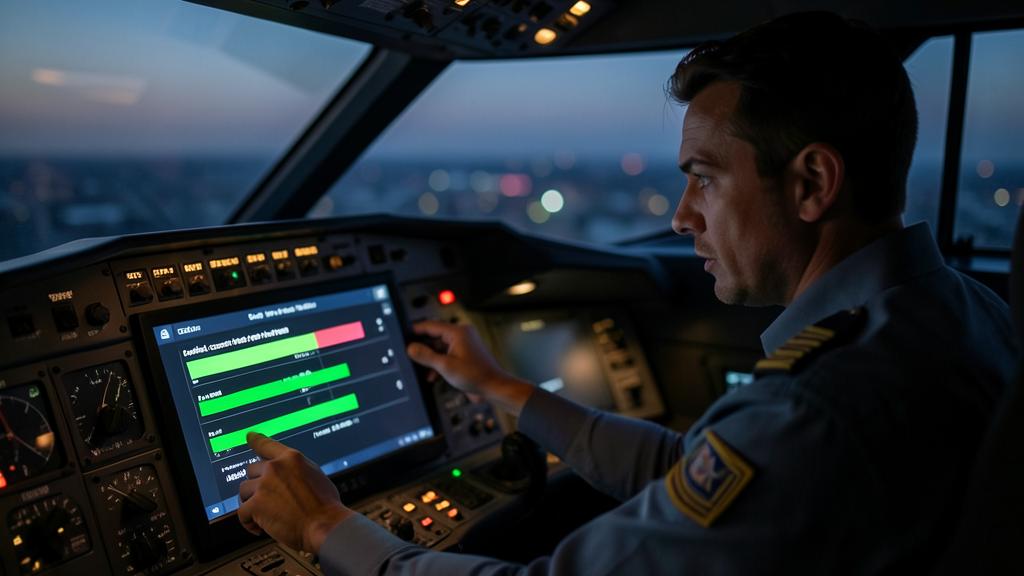
Un copilote sur un réseau court-courrier accumule 1 500 heures totales, 500 heures en équipage multiple, 200 heures de navigation, et 75 heures aux instruments. Mais il n’a que 50 heures de vol de nuit et 100 heures de fonctions de commandant sous supervision. Sa demande sera bloquée par ces deux colonnes.
Listed this way, these conditions seem redundant: a co-pilot who reaches one thousand five hundred hours with an airline has certainly done five hundred hours in multi-crew and two hundred hours of navigation. That’s true, and that’s exactly what’s misleading. Four columns fill up just by flying, a fifth depends on the network, and the sixth doesn’t fill up at all if no one organizes it.
| Colonne | What the requirement asks | What fills it on the line | What holds it back |
|---|---|---|---|
| Heures totales | One thousand five hundred hours on aeroplanes | Every logged flight, whatever the seat | Extended part-time work, long inactivity |
| Exploitation multipilote | Five hundred hours in multi-pilot operations | Every commercial sector on the programme | Long-term secondment to a single-pilot aeroplane |
| Pilot-in-command or under supervision | Two hundred and fifty hours, under three possible combinations | Only an organised scheme, or command outside the airline | No scheme: the column stays at zero indefinitely |
| Navigation | Two hundred hours cross-country, of which one hundred as pilot-in-command or under supervision | Virtually all commercial sectors | The one-hundred-hour sub-requirement, which falls back on the previous column |
| Instrument time | Seventy-five hours, of which no more than thirty acquired on the ground | Routine instrument operations, plus simulator sessions | The cap on ground time, and the definition adopted by the authority |
| Night flying | One hundred hours, as pilot-in-command or co-pilot | Night schedules, late sectors, long-haul flights | An exclusively daytime network, an entire summer season |
The instrument time column deserves a mention, because it’s the only one where ground time counts. Time acquired in a simulator is included within the limit and is the easiest to document since the organization issues a dated certificate; beyond the ceiling, only real flight counts. Above all, the very definition of instrument time—time actually flown using only instrument references, or the entirety of a flight conducted under instrument flight rules—isn’t unanimous from one authority to another. It’s one of the few areas where you log your book in good faith and may be subject to reprocessing.
Supervised flying, the only truly controllable lever
The blocking column has a common name in all license management services: PICUS, for captain functions exercised under supervision. The mechanism is more subtle than it appears, and it’s from this subtlety that dossier rejections are born. During a flight logged this way, the authority and responsibility remain entirely with the designated captain: nothing is delegated in a legal sense. What changes is that the co-pilot actually performs the captain’s tasks and functions—decision-making, flight management, communication with services—under the supervision of someone who can take back control at any moment and who later certifies the flight.
Not all operators have this. Those that do almost always limit it: eligible sectors, excluded airports, weather minima, exclusion of low-visibility approaches, co-pilot seniority, supervisor qualification. These limits condition the acceptance of the arrangement. A flight effectively conducted by the co-pilot but carried out outside the described framework doesn’t feed the column, no matter how sincere the logging.
The second trap: logging supervised time based on internal practice, without the procedure appearing in the operations manual or being accepted by the authority. The cross-check of the logbook with the operator’s documents then collapses the column. The pilot has nothing to reproach themselves for, but they’re left with several hundred hours that no longer count, and no retroactive catch-up procedure exists.
The other path is old and often neglected: command outside the airline. One hundred hours as captain on a light aircraft—aero club, towing, ferry, instruction—are enough to unlock the intermediate combination. They’re done on days off, at a cost incomparable to the wait. Pilots who accumulate them from their first year in service have a complete file when the total arrives; others wait for the column to fill another way, which usually takes years.
The right reflex: from the first month in service, open a separate log of only the rare columns—night, captain functions, command outside the airline—with for each flight the date, registration, stage, and name of the supervising captain. What blocks files isn’t the absence of hours but the a posteriori reconstruction: three years later, the schedules are no longer accessible and the captains have changed airlines. An annual check-in on your own log costs little and saves months.
The same flight hour doesn’t fill the same boxes
Two co-pilots hired on the same day, one on a dense short-haul network, the other on long-haul, don’t reach the full title at the same time, and it’s not a matter of pace. Long-haul accumulates total hours much faster per rotation, and night flying follows mechanically since a significant portion of the block takes place at night. But sectors are rare, captain functions under supervision are rarely organized, and cruise time as a reserve is logged according to the role actually held: it feeds the total and multi-pilot operations, not command.
Short-haul does the opposite. Sectors follow one another, navigation and multi-pilot operations fill up quickly, and supervision arrangements are more frequent because short, familiar stages lend themselves to it. But two seasons of day program back-to-back reach the total without approaching one hundred night hours. The blocking column therefore isn’t the same depending on the network, and a career plan that ignores this misses the mark.
The release: a check, a file, and advance to take
Gathering the experience doesn’t grant anything. The request requires a minimum age of twenty-one, a current class 1 medical certificate, the required language proficiency level, possession of a type rating for multi-pilot aircraft, and demonstration of the competencies expected of an airline pilot. In practice, this demonstration is coordinated with already scheduled periodic checks rather than added to them, but its exact form depends on the issuing authority and what the operator has had approved. This is the first point to verify, not the last.
The file itself is an exercise in proof, not declaration. The authority reads the logbook line by line and cross-checks: reported totals, nature of hours, operator certificates for supervised time, organization certificates for simulator-acquired instrument time, qualification records. Files that drag aren’t almost never files of insufficient experience: they’re those where the nature of an hour can no longer be established. Hence the interest in submitting well in advance, with time to get signatures while signatories are still reachable.
What a recruiter reads behind « frozen ATPL »
On a resume, the mention only indicates one thing: the theoretical exams were passed on a given date. An experienced recruitment service looks for three other, more discriminating elements. The date of the last instrument rating renewal, which indicates whether there’s still margin or if the clock is ticking. The breakdown of hours by type: a co-pilot with significantly fewer total hours, but whose supervised time is logged and certified, is closer to the title than one with none. And the existence of command hours outside the airline, which indicates how the candidate manages their own career.
Two gray areas remain and deserve to be addressed before they cost. The first is the change of issuing authority: the recognition of theoretical credit and the acceptance of supervised hours logged under another regime aren’t guaranteed by default, and are verified before the move, not after. The second is the transition through a multi-crew pilot license, whose own restriction doesn’t lift according to the same mechanism and requires its own additional experience. Both are addressed by writing to the concerned authority, with a logbook attachment: hallway answers and peer discussions guide, but they don’t commit anyone.
For those preparing a type rating or changing operators, the question to ask in an interview isn’t « how long until one becomes a captain, » but: is there a supervised flying arrangement described in the manual, which sectors are eligible, from what seniority, and in what form does the operator certify the hours. These four answers are worth several years of trajectory.
The thresholds, combinations of experience, and form of competency demonstration evolve with successive amendments and with each national authority’s doctrine. In case of discrepancy, the applicable text in force, the issuing authority’s publications, and the operator’s approved documentation prevail over what is written here.


Leave a Reply
You must be logged in to post a comment.