
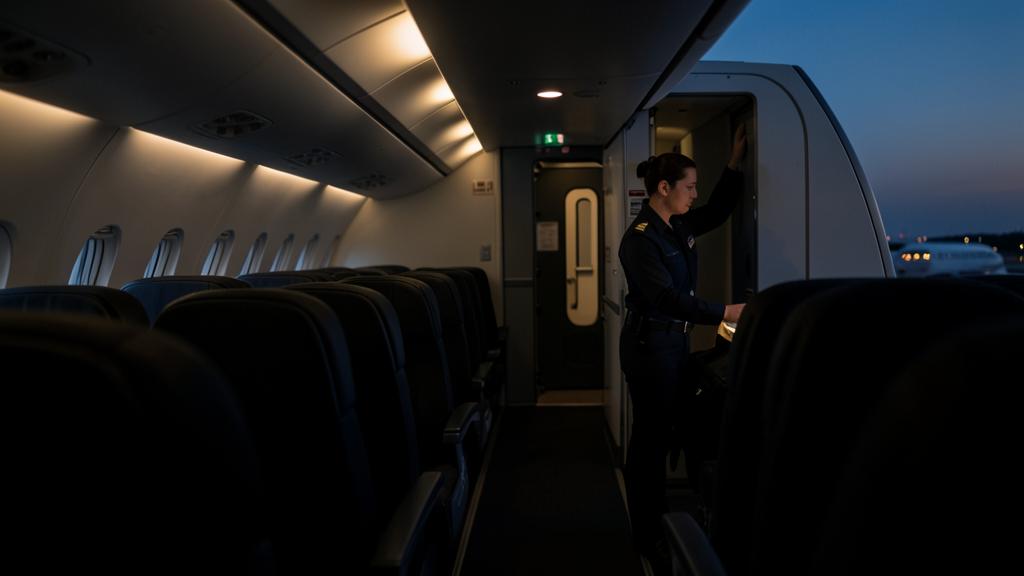
Forty passengers booked on an aircraft with one hundred and eighty seats, and a cabin crew member who fails to show up for the briefing. Someone suggests blocking off the rear rows and departing with three: fewer people to evacuate, fewer people to evacuate them. The arithmetic looks airtight, and it does not apply. The number written into the operations manual describes neither a service nor a workload: it is a leftover of the type certification, obtained in a hangar, in ninety seconds, with half the exits blocked — and it is counted in installed seats, not in boarded passengers.
Three calculations, and the most demanding one prevails
The obligation to carry cabin personnel is triggered by a characteristic of the aircraft, not by how full it is: beyond a maximum approved configuration of nineteen passenger seats, as soon as at least one passenger is on board. A single passenger on a single-aisle aircraft with one hundred and eighty seats is therefore enough to trigger it, and to trigger it in full.
The number itself does not come from a single formula. Three paths each lead to a result, and the operator retains the most demanding one.
The first is direct: the complement established during type certification for the cabin configuration the operator actually uses. When this value exists, it prevails over any other reasoning.
The second applies when no demonstration has been conducted for that specific configuration. It starts from the complement established for the type’s maximum certified capacity, and removes one member for each whole multiple of fifty seats by which the operated configuration falls below that maximum. It is a deduction, not a calculation: it recognises that a thinned-out cabin evacuates faster, without requiring a new demonstration.
The third is the only one everyone quotes: one cabin crew member per block of fifty installed passenger seats, or fraction thereof, on the same deck. It is a universal floor, not the general rule. Two words do all the work here: “installed” and “fraction”.
The cabin crew number is based on the aircraft’s design, not how many passengers are on board. It’s set during testing where half the exits are blocked. Even with few passengers, you can’t reduce the crew count unless you remove seats permanently.
An Airbus A320 with 180 seats requires 4 crew members (1 per 50 seats). If you remove 30 seats, you still need 4 members – the count only drops when you cross a 50-seat threshold (to 3 members at 150 seats).
The fraction produces a threshold effect that intuition does not predict: one hundred and fifty-one seats require the same complement as two hundred. The configuration office that gains a row by densifying buys a crew position for the aircraft’s entire life, and the reverse is also true. This arithmetic is decided years before a cabin manager ever has to live with it.
The word “installed” is the second trap. It does not mean “occupied”, nor “offered for sale”: a seat fixed to the rail and belonging to the approved configuration counts, whether or not anyone sits in it. As for “on the same deck”, the wording becomes significant on wide-bodies with two passenger decks: the calculation is made deck by deck, and the complements are added together.
What the evacuation demonstration actually measured
The whole construction rests on a test that few people have seen and that everyone quotes. The large aeroplane certification specifications require demonstrating that all occupants can leave the aircraft within ninety seconds, under conditions that are anything but favourable: cabin at maximum capacity, emergency lighting only, aisles cluttered with baggage and blankets, a participant population representative in age and sex, no prior rehearsal. And above all, only the exits on one side are usable. It is this last condition that turns the test into something more than an exercise: it simulates the obstacle that puts half the fuselage out of action.
The cabin crew is not a backdrop in this affair. The number of members present during the demonstration is an input, and it is that number for which approval is sought. So the test does not measure how many members would be needed: it verifies that the proposed number is sufficient. Going below it requires either a new demonstration, or an analysis accepted by the certifying authority and supported by partial tests.
Full-scale tests are rare, costly, and not without risk for the participants; analysis combined with partial demonstrations — opening an exit, deploying a slide, measuring flow through an aisle — has become the ordinary route for derivatives. The result remains of the same nature: a maximum seating capacity and a crew complement that cannot be separated.
From exits to the seating ceiling
Even before the demonstration, another ceiling applies: the one set by the number and type of exits. The specifications classify emergency exits by size and mode of access — floor-level door, hatch above the wing — and attach to each pair a number of admitted passengers. The maximum capacity the manufacturer can request follows from the sum of these allowances, and the demonstration must then be conducted at that capacity.
This scale explains design choices that are often assumed to be commercial ones.
| Exit type | Location and access | Passengers admitted per pair |
|---|---|---|
| Type A | Floor-level door, the widest in the scale | 110 |
| Type B | Floor-level door | 75 |
| Type C | Floor-level door | 55 |
| Type I | Floor-level door, standard-size entry | 45 |
| Type II | Floor-level door or exit above the wing | 40 |
| Type III | Hatch above the wing, to be removed by the occupant | 35 |
| Type IV | Hatch above the wing, reduced size | 9 |
Moving from a hatch to a full door costs structure, weight, and fuselage cutting; it pays for itself in seats. This is how the same airframe exists in versions whose maximum capacity differs by several dozen seats without anything having been stretched: exits have been added, enlarged, or downgraded.
For the practitioner, the useful consequence lies elsewhere. The seating ceiling depends on the exits; the cabin crew complement depends on the seats and the demonstration. The two chains meet at the top but do not react to the same events — and this is exactly what makes the degraded situation counter-intuitive.
Why the one-in-fifty rule does not govern wide-bodies
The reason lies in the deduction. Take a type whose maximum certified capacity was demonstrated with a complement we will call C. An operator who fits out its cabin one hundred and fifty seats below that maximum removes three members from C. Now, as soon as the number of floor-level exits is high — the case for every wide-body, where the demonstration in practice deploys one member opposite each exit — C exceeds the maximum divided by fifty by a wide margin. The result therefore remains higher than the one-in-fifty figure, and it is that result which applies.
Both rules have the same slope — one member per fifty seats — and the initial gap does not close: they do not converge.
In concrete terms: thinning out a wide-body’s cabin does lower the required complement, but never brings the number down to the simple division by fifty. Only a new demonstration, or an analysis accepted by the authority, can shift the value derived from certification. No operational decision does.
The tipping point occurs when a used aircraft enters the fleet. The operator does not inherit the previous operator’s complement: it inherits a cabin, and must re-establish which of the three calculations applies to that configuration. A handful of seats added or removed at lease intake, straddling a multiple of fifty, is enough to change the number — in either direction — even though the aircraft itself has not changed. This is also what makes comparing complements between two operators of the same type a risky exercise.
Installed seats, boarded passengers: two counts that never meet
The two counts lead separate lives, and each has its own regulator. The first governs the cabin crew complement. The second is governed by the available exits. Confusing them is the mistake that costs the most delays on the ramp.
An exit rendered unusable — slide removed, door jammed, hatch missing — is handled through the Minimum Equipment List or the Configuration Deviation List. The consequence is twofold: the number of passengers that can be carried drops, and the neighbouring seats are blocked off. But the cabin crew complement does not move, since the seats remain installed. Same crew for fewer passengers: perfectly coherent — the working side must still be able to evacuate everyone — and experienced on board as an anomaly.
The reverse is what causes missed departures: reducing the number of passengers does not give back a crew member.
Blocking rows does not reduce the required complement. A cover on a seatback, an instruction to the booking system, a row left empty: none of this removes an installed seat. Only a change to the approved configuration — seats removed, revised cabin layout, weight and balance redone — changes the number, and that is not decided at the parking stand. The confusion is paid for twice: at departure, because the flight will not leave, and at the debrief, because the decision will have been based on a misreading of the text.
What remains possible when someone is missing
The regulation is not silent on the degraded situation; it is narrower than one would expect. Four regimes coexist, and they are not a matter of choice: each is triggered by a fact.
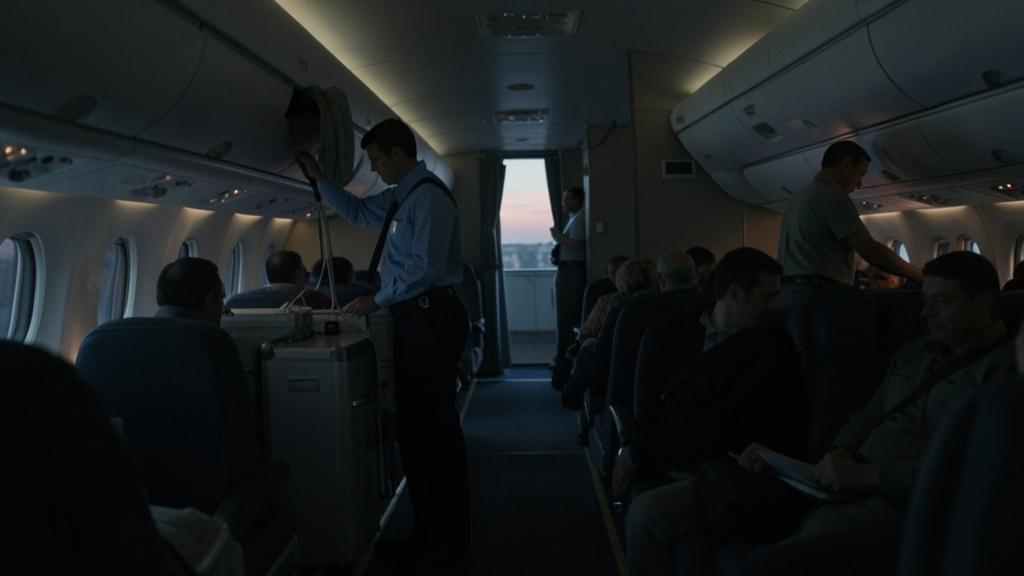
The passenger-free flight first. Ferry flight, empty repositioning, technical flight: the obligation falls away along with its condition, since there is no one to evacuate.
Then the turnaround, with passengers on board and doors open. The complement present may drop below the flight complement, in a proportion set by the regulation — typically half, rounded up, never falling below one member — and subject to conditions: evacuation means available, communication maintained with the flight crew, cabin surveillance in place. This reduction does not survive the closing of the doors.
Finally, the unforeseen circumstance. A member who becomes unavailable after duty has begun, a replacement made impossible: the flight may depart with a reduced complement if the number of passengers is reduced in accordance with a procedure written into the operations manual, and the operator reports to the authority after the flight. Two words govern this regime. “Unforeseen” excludes a scheduling shortfall known the day before. “After the flight” means it produces a file, not merely a captain’s decision.
In-flight incapacitation, finally, falls under none of these regimes. The requirement is assessed at departure: a member who becomes unfit in cruise does not require a diversion, and the manual provides for redistributing tasks and stations. The real issue is the next sector, where the aircraft finds itself on the ground with an insufficient complement and where the unforeseen-circumstance regime becomes applicable again.
| Situation | Required complement | What remains possible | What must be produced |
|---|---|---|---|
| Passenger-free flight | No cabin crew member required | Ferry flight, empty repositioning, technical flight, with no cabin-related restriction | Nothing specific in terms of complement |
| Turnaround, passengers on board, doors open | Reduced complement present, typically half the flight complement rounded up, never fewer than one | Boarding, disembarkation and ground operations under the manual’s conditions | Approved turnaround procedures: evacuation means, communication, cabin surveillance |
| Unforeseen circumstance arising after duty has begun | Reduced flight complement, within the limit set in the operations manual | Departure possible if the number of passengers is reduced under the written procedure | Report to the competent authority after the flight |
| In-flight incapacitation | The requirement is assessed at departure; it is not reapplied in cruise | Continuation of the flight, redistribution of tasks and stations | Manual instructions; the next sector becomes a full departure again |
| Shortfall known in advance during scheduling | Full complement, no accommodation | Nothing: the unforeseen-circumstance regime is not open | Replacement, delay, or cancellation |
Ask which of the three calculations produced the number written into your manual. The question belongs with the operations department, not the eve of a flight. If the number comes from certification, thinning out the cabin will only lower it in whole blocks of fifty seats, and any finer reduction requires an analysis accepted by the authority. If it comes from the one-in-fifty rule, the margin lies elsewhere: in the configuration, seat by seat.
The station matters as much as the headcount
A correct but poorly distributed complement does not reproduce the demonstrated performance. Assigned stations must be located as close as possible to the floor-level exits, and the crew must be seated there during critical phases. This is the direct translation of the test: it was conducted with members stationed at the exits, not merely with members present on board.
Three consequences follow. A member carried beyond the minimum only counts if they hold an assigned station and the corresponding training on the type. A member travelling as a passenger, even if qualified and in uniform, does not count. And when more than one member is required, a cabin manager must be designated: when it is that person who is missing, the operator must have a replacement meeting the required experience conditions, failing which the complement is complete but the crew is not constituted.
What to check in your own documentation
Open the part of the operations manual that sets crew composition and look for the origin of the number, not the number itself. A rigorous operator states whether it applies the certification value, the block deduction, or the one-in-fifty rule; many settle for a table by type and configuration, which is enough to fly but not to decide in a degraded situation.
Then look for the unforeseen-circumstance reduction procedure: who triggers it, by how many passengers it requires the reduction, within what deadline and in what form the report is sent. A procedure without a form is not usable on a Sunday evening on the ramp.
Look at the Minimum Equipment List entries relating to exits and slides: they give the number of passengers admitted with an exit out of service, and sometimes the relocation of a crew station. These are the only pages that explicitly link the two chains.
Finally, check the case of single cabin crew member operations, on aircraft whose configuration barely exceeds nineteen seats. It calls for its own training and procedures, and leaves no margin: the incapacitation of the sole member has no equivalent under the unforeseen-circumstance regime.
Two grey areas remain. The first is the boundary of the unforeseen: the same absence, known at different times, opens or closes the degraded regime, and the assessment varies from one authority to another. The second is the treatment of seats blocked off other than by removal, which some authorities accept under the approved configuration and others do not. Experience-sharing on these two points circulates on the FL330 forum; cabin qualification preparation modules are on the training side.
This article describes mechanisms and has no regulatory standing. The applicable regulation, the type’s certification specifications, the instructions of the competent authority, and the operator’s approved documentation — operations manual, Minimum Equipment List, cabin layout plan — prevail in all circumstances over what is written here.
Questions fréquentes
Can a flight depart with a reduced complement when there are few passengers on board?
Not on the sole grounds of load factor. The minimum complement is calculated on the passenger seats installed on the deck, not on the passengers boarded: an aircraft with one hundred and eighty seats requires the same crew with forty passengers as with one hundred and seventy. A reduction is only available under the unforeseen-circumstance regime, which requires an unavailability arising after duty has begun, a reduction in the number of passengers in accordance with the operations manual procedure, and a report to the authority after the flight.
Can two operators of the same aircraft type have different minimum complements?
Yes, and it is the normal situation. The number is not tied to the type but to the cabin configuration actually operated, and to the calculation path that corresponds to it: the complement established at certification for that configuration, failing which the complement for the maximum certified capacity reduced by one member per whole multiple of fifty seats below that maximum, or the floor of one member per block of fifty installed seats. Two cabins that differ by a few seats on either side of a multiple of fifty therefore give two different numbers. A complement noted in another operator’s documentation proves nothing for one’s own.
Does removing seats lower the required complement?
Yes, but only in whole blocks of fifty and provided the removal changes the approved configuration. Blocking a row, leaving it empty, or closing it to sale removes no installed seat and therefore changes nothing. The change goes through the cabin layout plan, weight and balance, and the approved documentation; it is not decided at the parking stand.
Does an exit rendered unusable reduce the number of cabin crew required?
No, and this is the most disorienting asymmetry of the subject. An exit out of service is handled through the Minimum Equipment List or the Configuration Deviation List: it lowers the number of passengers that can be carried and generally blocks off the neighbouring seats. The cabin crew complement, however, remains calculated on the installed seats and does not move. You end up with the same crew for fewer passengers, which is coherent since the working side of the cabin must still be able to evacuate everyone.
What happens if a cabin crew member becomes unfit during the flight?
The flight continues. The minimum complement requirement is assessed at departure and is not reapplied in cruise; the operations manual provides for redistributing tasks and shifting stations toward exits left unmanned. The difficulty shifts to the next sector, which constitutes a new departure: at that point either a replacement is needed, or the unforeseen-circumstance regime applies, with its passenger reduction and its report.
Does an additional crew member travelling as a passenger count toward the complement?
No. Only members who hold an assigned station, possess the corresponding training on the type, and are seated at that station during critical phases count. A member travelling as a passenger, even if qualified and in uniform, holds no station and is not included in the count. The same logic applies to the cabin manager: when more than one member is required, their designation is a condition distinct from the complement itself.


Leave a Reply
You must be logged in to post a comment.