
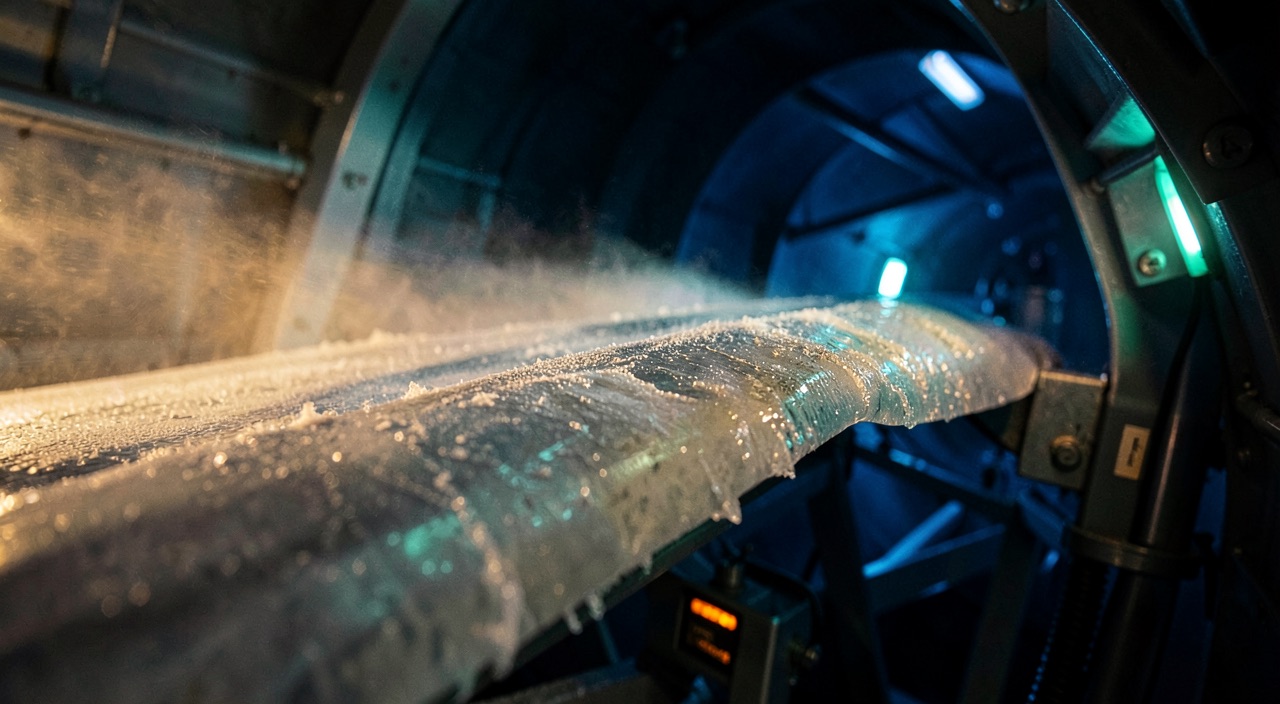
The hold has lasted twenty minutes in a layer a few degrees below zero, the boots are cycling normally, and yet ice is forming well aft of the treated zone, on bare skin that nothing protects. The flight manual says « approved for flight in known icing conditions, » and it isn’t lying: it’s the cloud that isn’t the one the aircraft was certified for. Knowing where that boundary sits — what the envelope covers, what the industry has since added to it, and what has no data at all — is written in the certification file, not on the limitations page.
What an icing flight approval actually covers
A single line in the limitations is the visible tip of a demonstration that answers three separate questions, and it pays to keep them apart. In which cloud? On which surfaces, with which protection system? And assuming what crew action, at what point? An approval never says « this aircraft tolerates ice. » It says that, in a cloud defined by measurable quantities, with ice shapes recorded in the file, and provided the system is operated according to the published procedure, the aircraft remains controllable, retains a usable stall warning, and keeps known performance.
This structure explains something practitioners notice without always naming it: the performance penalties in icing configuration, the increased speeds, the restrictions on deflection or on automation are not prudential margins. They are test results, obtained with precise ice shapes. Leaving the reference cloud means leaving the validity domain of those numbers — with no warning light coming on, and with no guarantee the aircraft’s behavior will give any notice.
The certification cloud is a statistic, not today’s weather
The original envelope describes supercooled water clouds through three linked quantities: liquid water content, the median volumetric diameter of the droplets, and static temperature, all paired with a reference horizontal extent. Two families coexist here: stratiform layers, with moderate content over long traverses, and cumuliform clouds, with markedly higher content over just a few miles. These envelopes do not describe the worst imaginable cloud; they describe the point beyond which encounters become rare enough for the residual risk to be accepted.
Two practical consequences follow. First, these envelopes are not read by adding up the maximums: the highest liquid water content, the largest droplet, and the lowest temperature do not coexist in the same cloud, and the envelope should be read as a set of coherent triplets. Second, horizontal extent matters as much as intensity. A two-minute penetration and a half-hour hold in the same layer do not consume the same portion of the envelope: beyond the reference extent, the retained content decreases, which amounts to saying that a cloud that is both long and intense does not exist in the statistics — but also that a prolonged hold brings you to the edge of the envelope far faster than a traverse does.
The certification covers specific cloud conditions based on droplet size, water content, and temperature. Just because you’re in a cold cloud doesn’t mean it’s the one the plane was tested in. Long holds use up the envelope faster than quick passes through.
An Airbus A320 flying through a stratiform cloud with 0.5g/m³ liquid water content at -5°C for 30 minutes is within its certified envelope. But if that same cloud has 1.0g/m³ content and the plane holds for 45 minutes, it’s outside the tested conditions – even if the temperature is the same.
Supercooled large droplets: a domain added by the industry
Supercooled drizzle and rain long remained outside this framework, not through oversight but because the framework described the clouds one flies through, not the precipitation encountered inside them. The industry forced their inclusion. The mechanism is purely physical: a droplet several hundred micrometers across has too much inertia to follow the airflow around the profile. It strikes well aft of the leading edge, outside the treated zone, and sometimes breaks up and runs back before freezing. The result is a ridge of ice on the upper surface, ahead of a control surface or a flap, exactly where no system can reach it.
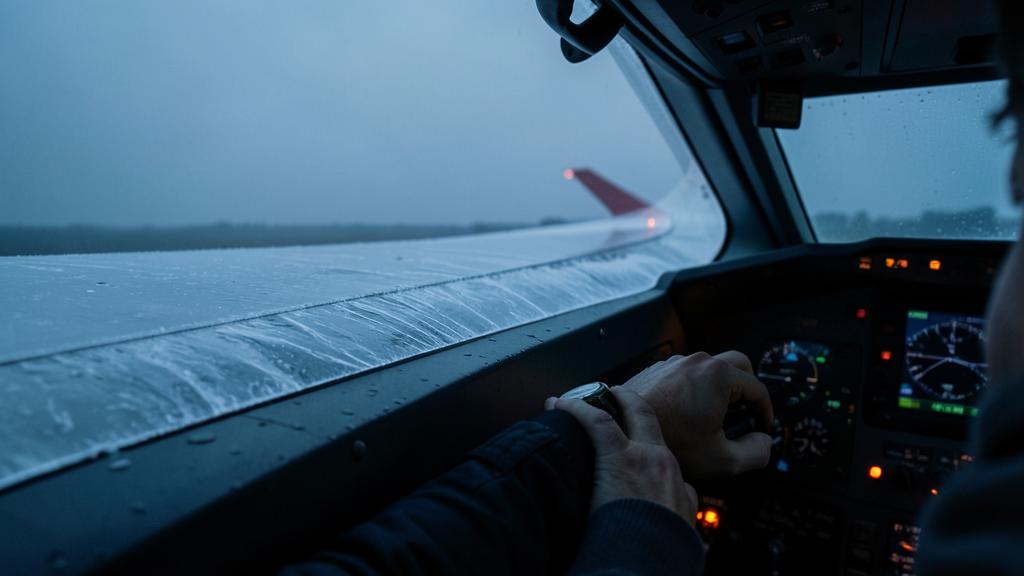
This ridge weighs almost nothing and degrades glide performance only marginally. What it does is more brutal: it separates the flow ahead of the hinge and alters the hinge moment. Depending on the configuration, this shows up as a control force that lightens and then reverses, a roll upset masked by the autopilot until it disconnects, or, on a tailplane, a stall as the flaps extend, at a local angle of attack that is nothing out of the ordinary. The stall warning, calibrated for a wing whose ice shapes are known, is no longer looking in the right place — it was never designed to cover this one.
The certification response has not been uniform, and that is exactly why reading the manual is essential rather than optional. Three paths coexist, and two of them leave part of the protection to the crew.
| Path taken | What is demonstrated | What the flight manual carries | What is left to the crew |
|---|---|---|---|
| Full envelope | Handling and performance established across the full range of supercooled drizzle and rain conditions | An approval with no restriction on this point | Apply the normal protection procedures |
| Partial envelope | Handling demonstrated in part of the domain, plus a means of detecting entry into the rest | Detection cues and an exit procedure | Recognize the condition and leave the layer per the procedure |
| Detection and exit | No handling demonstrated in these conditions, only the ability to get out of them | An explicit limitation and an exit procedure | Exit as soon as recognized, without delaying or negotiating |
The trap: boots cycling cleanly and a clean leading edge prove nothing about what is happening much farther aft. The large-droplet ridge forms outside the field of view from the flight deck, and a detector calibrated for fine droplets can stay silent in a genuine supercooled drizzle. The only usable cues are the visual references defined for the type: ice on an unheated part of the windshield, on a post, on a wiper arm, on the spinner, or aft of the treated zones. They should be learned once and for all, calmly — not at night, while holding, when the question has already arisen.
Ice crystals: a different water, a different domain
At high altitude, near convective anvils, the water is no longer supercooled: it is already solid. The crystals bounce off a cold surface, so the airframe stays clean, the ice detector sees nothing, and neither does the crew. But wherever a surface is warm and moist — the inside of an engine, the body of a probe — they partially melt, adhere, build up, then shed in a mass. The consequences are of a different order than accretion on a wing: rollback, flameout, inconsistent airspeed indications, without a single gram of visible ice on the wing.
The corresponding domain is written in different quantities. It is no longer liquid water content that governs but total water content, and particle size does not carry the same meaning as for a droplet. It was added for engines and for probes, not for the airframe. An older type can therefore be fully approved for flight in icing conditions and never have been demonstrated in this domain: what protects it is then operational — distance from cells, continuous ignition, recommended technique — not structural.
| Family | Nature and size of the water | Where it is encountered | Main threat | What the demonstration must establish |
|---|---|---|---|---|
| Classic supercooled clouds | Droplets of a few tens of micrometers, moderate content in layers, higher and brief in cumuliform clouds | Layers and cumulus, from the surface to mid levels | Accretion on the leading edge and just downstream | Controllability, stall warning, and performance with the retained shapes, across the whole flight envelope |
| Supercooled large droplets | Supercooled drizzle and rain, droplets several hundred micrometers across, low content | Layers in cold air, precipitation under an inversion, often at holding altitudes | Ice ridge well aft of the treated zone | Either demonstrated handling in these conditions, or a means of detecting them plus an exit procedure |
| High-altitude ice crystals | Already-solid ice, high total water content, no supercooled water | Near convective anvils, in cruise | Accretion inside engines and probe blockage | Engine operation and integrity of airspeed measurement; airframe not affected |
The ice shapes that actually carry the demonstration
The file does not retain a single ice shape: it retains a collection, and each answers to a moment in the flight or to a failure. Holding ice, obtained through prolonged exposure at low angle of attack, is often the most penalizing for performance. Take-off ice, thin, mainly affects the stall margin. Intercycle ice is what remains between two boot inflations; residual ice is what the system never removes; delayed-activation ice corresponds to the delay between entry into the cloud and system start-up. Added to these are failure-case shapes, obtained with a partially inoperative system, which have a different geometry and different consequences.
This breakdown is worth more than an intuitive sense of thickness. On a cyclic protection system, it is not the peak reached just before inflation that governs, but the floor that settles in: each cycle leaves a film it does not strip away, and this floor rises from one cycle to the next before stabilizing. Near zero degrees, glaze ice adheres better and sheds less readily, so the floor rises further — exactly the situation of a long hold in a layer just below freezing, precisely the one that is endured rather than chosen. On a continuous evaporative protection system, there is no cycle but a different risk: if the energy is not enough to evaporate the whole film, the water runs back and freezes outside the heated zone, reproducing with ordinary water the same ridge geometry that large droplets produce.
How the demonstration is made, and what it leaves uncertain
Four means combine, and none suffices on its own. The icing wind tunnel gives real shapes on a wing section, with calibrated spray rakes, but it is limited in size and in similitude. Accretion codes predict the shape at one point in the domain, once recalibrated against these tests. Dry-air flight with attached artificial shapes — machined profiles, roughness strips — makes it possible to explore the flight envelope right up to its limits, stalls included, which will never be done in an actual cloud. Natural-icing flight, finally, verifies that the system works and that the predicted shapes resemble those that actually form.
The weakness lies there, and it is structural: natural icing cannot be ordered up. A campaign takes what the season offers, and the certified domain covers conditions the test team may never have actually encountered. Most of the envelope is therefore demonstrated through the calculated shape, then flown in dry air. What remains uncertain is not the method but the combinations: a shape close to the limit, with roughness that is poorly modeled, together with a failure, an aft center of gravity, and turbulence. Each of these factors has been addressed; their product has not — and it is precisely that product which describes the difficult days.
The right reflex: read the icing section of the manual as three separate answers, not as one paragraph — which domain, which means of detection, which exit procedure. Note along the way what the exit procedure requires in terms of space, altitude, and time: that is what decides whether it can still be flown at the moment you realize it needs to be flown.
What has never been part of the domain
Some situations are not at the margins of the envelope: they do not belong to it at all, and no flight data covers them.
- Contamination present before departure. Frost, snow, or ice deposited on the ground fall under a different regime, that of the clean-aircraft concept at take-off and of fluid holdover times. No certification credit follows from this: the in-flight demonstration assumes a clean wing at the moment of entering the cloud.
- Snow and ice pellets in flight. Frozen or mixed precipitation does not appear in the supercooled-water envelopes; ice pellets primarily raise a problem for air intakes and probes.
- Unprotected surfaces, beyond what has been considered. Antennas, radome, unheated probes, side windows: the file does record accretion on these surfaces, but calculated for the certified domain. Outside that domain, it is no longer the right accretion.
- Combination with an unstudied failure. A partially inoperative protection system has been demonstrated with certain shapes; two simultaneous failures combined with the most penalizing shape, rarely so.
This list is not a legal reservation. It describes exactly where the margin stops being quantified and becomes judgment — that of the crew, that of the certifying personnel who decide whether a worn boot, a questionable detector, or a damaged unheated probe still leave the aircraft within its domain.
What to go check in your own documentation
The useful question is not « is my aircraft certified for icing » but « how far, and with how much left to the crew. » Five points can be found in a few minutes in the approved manual, and are worth knowing before you need them.
- The domain actually covered: has the airframe been demonstrated in large-droplet conditions, or merely equipped with a means of getting out of them?
- The visual cues specific to the type: which unheated surface serves as the tell-tale, and what appearance triggers the decision to exit.
- The exit procedure: heading, altitude, configuration — and above all what it forbids, since a turn back within the layer is not always the right maneuver.
- The duration of validity of the penalties after leaving the cloud: residual ice does not vanish the moment the edge is crossed, and the increased speeds remain applicable until an explicit criterion is met.
- The restrictions on automation: many types limit it in icing conditions, precisely because an autopilot masks the control force until it disconnects.
One gray area remains that no documentation will resolve: telling apart, in real time, a layer of the classic domain loaded with large droplets from genuine supercooled drizzle. No cockpit instrument measures a median volumetric diameter; the decision rests on indirect cues, and it has to be made quickly. That is why a type’s visual cues are worth a limitation, why they belong in rating training just as much as in a procedures review, and why exchanges between practitioners on a given type often say more, about where to look, than the note that summarizes them.
This article describes mechanisms; it does not replace any binding document. The certification specifications applicable to the type, the approved flight manual, and the approved operating documentation prevail over everything above, and it is their wording that governs the moment any discrepancy appears.
Questions fréquentes
Does “approved for flight in known icing conditions” mean the aircraft can handle any icing?
No. The wording refers to a cloud envelope defined by liquid water content, droplet size, temperature, and horizontal extent. Beyond that envelope — notably in supercooled drizzle or rain if the type has not been demonstrated in those conditions — the ice shapes recorded in the file are no longer representative and the published performance figures no longer apply. The flight manual specifies, type by type, how far the approval actually goes.
How can a crew recognize in flight that they have left the certified domain?
No cockpit instrument measures droplet size, so recognition relies on visual cues defined for the type. These are typically ice accretion on an unheated part of the windshield or a post, on a wiper arm, on the spinner, or ice appearing noticeably aft of the treated zones. An ice detector calibrated for fine droplets can stay silent in a genuine supercooled drizzle, so it does not replace these cues.
Why does residual ice matter more than the thickness reached before a cycle?
Cyclic de-icing removes the fresh ice but leaves an adherent film that the next cycle does not strip away. This residual floor rises from one cycle to the next early in the exposure, then stabilizes, and it remains present as long as the aircraft is in the cloud. It is this floor, not the transient peak just before an inflation, that sets the aerodynamic degradation held during a long hold, and therefore the performance penalties recorded in the file.
Do high-altitude ice crystals fall under the same domain?
No, they form a separate domain, written in total water content rather than supercooled liquid water. The crystals bounce off the cold surfaces of the airframe, which stays clean, but accumulate wherever a surface is warm and moist: inside engines, on probe bodies. This domain was introduced for engines and instruments, and an older type can be approved for icing flight without ever having been demonstrated in it.
Does certification cover contamination already present on the aircraft before departure?
No, these are two separate regimes. The in-flight demonstration assumes a clean wing at the moment of entering the cloud; frost, snow, or ice deposited on the ground fall under the clean-aircraft concept, de-icing fluids, and their associated holdover times. No in-flight certification credit applies to a surface contaminated before power application.
What does a failure of the protection system change for the authorized domain?
The file contains so-called failure-case ice shapes, obtained with a partially inoperative system, and the manual derives specific limitations and penalties from them. These cases are demonstrated one at a time, not in combination: two simultaneous failures paired with the most penalizing ice shape generally fall outside what has been established. The required course of action is found in the type’s abnormal procedures, and it takes precedence over any general rule.


Leave a Reply
You must be logged in to post a comment.