
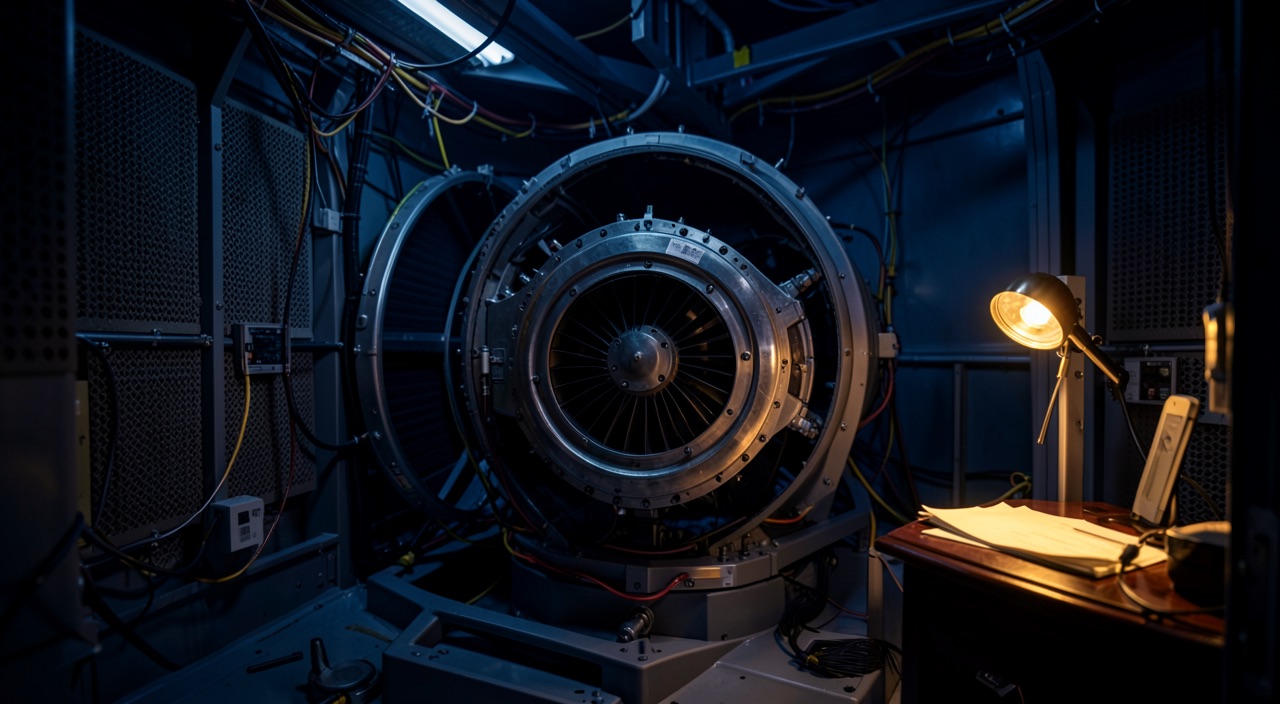
A fan blade severed at its root by a pyrotechnic charge, engine at maximum rating, inside a test cell instrumented all the way to the mounts: the event lasts a few tens of milliseconds and costs a brand-new engine. The slow-motion footage then circulates through every design office, and the conclusion fits in one word, contained. What matters to the practitioner is what that fraction of a second actually commits in the type certification file, and the precise point where the demonstration changes in nature because no casing can stop anything anymore.
What the containment demonstration commits to
The requirement fits in one sentence followed by a long list of conditions. The engine must be able to lose its most critical blade — the one whose release produces the most unfavourable unbalance and energy — without a hazardous fragment penetrating the casing, without fire, without loss of the mounts, and while retaining the possibility of a shutdown through the normal controls. The criterion is therefore not « nothing breaks ». After a blade failure, almost everything breaks: neighbouring blades are shaved off, labyrinth seals are ploughed through, stators are bent, the rotor rubs and the engine destroys itself within seconds. The criterion is that this destruction stays inside and that the crew keeps control.
The test conditions matter as much as the criterion itself. The blade is released at the rating retained as the most unfavourable, on an engine representative of the production standard, and the test does not stop at the instant of failure: it continues, with the rotor left spinning and then windmilling, for a duration fixed by the specification. This is where delayed mechanisms are tracked down — the ones that do not show up on the high-speed camera: progressive loosening of a fastener, debris migration toward the hot stages, fluid leakage onto a hot part, any of which would turn a contained event into a hazardous one ten seconds later. This is also why the instrumentation does not serve compliance judgment alone: the loads recorded at the mounts, the rotor displacements and the temperatures then feed an entirely different demonstration, the one on the airframe side.
The test proves that when a fan blade breaks, the engine can keep the damage inside itself. The crew can still control the plane, and the engine won’t catch fire or break apart in a dangerous way. But everything inside the engine gets destroyed—just not in a way that hurts the plane or the people on it.
On an Airbus A320 with a CFM56-5B engine, a fan blade release test is conducted at takeoff thrust. The blade is fired at 100% N1 speed. The containment shell (made of Kevlar and titanium) stops the blade, but the engine is destroyed inside. The test lasts 10 seconds of windmilling to check for delayed failures. The data shows the pylon can handle the loads, and the plane can fly safely to a diversion airport.
The casing itself follows two schools of thought. Hard containment opposes the fragment with a thick metal shell that stops it by sheer mass. Soft containment opposes it with a wrap of high-tenacity fabric over a lighter shell: the energy is absorbed through deformation, and the fragment is caught as if in a net. In both cases, the effective thickness is not spread evenly along the engine’s length. It is concentrated in line with the plane of rotation, with the longitudinal margin imposed by a fact well known from testing: a released blade never departs exactly within its own plane — it tumbles, ricochets and strikes the shell obliquely.
A family of tests that speak to each other
Containment is never assessed on its own, and the confusion on this point is stubborn, even among professionals. The ingestion tests and the blade release test do not demonstrate the same thing and are not interchangeable. Ingestion of a large bird is assessed on the engine’s ability to shut down cleanly, or to keep running depending on the case retained, without producing a hazardous condition. Ingestion of a flock of medium-sized birds, by contrast, is assessed on the residual thrust maintained over a fixed duration, because that is the scenario that governs the initial climb and the return to the field. Water and hail target flameout and surge. Each of these tests interrogates a different failure mode of the same object.
The link between the two families is nonetheless direct. No ingestion test aims to release a blade; but if the impact did release one, the containment requirement would apply immediately, and it is this chain that drives the blade’s design. A leading edge sized for impact, a hollow wide-chord titanium blade or a composite blade protected by a metal shield, a dovetail root fitted into the disc slot, sized so that failure, should it occur, takes place where the demonstration assumes it will and nowhere else. A blade that failed higher up would release less mass; a blade that dragged its disc slot along with it would take the subject outside the demonstrated envelope.
| Demonstration | Event represented | What is judged | What remains to be demonstrated elsewhere |
|---|---|---|---|
| Ingestion of a large bird | Single impact on the fan, typically during initial climb | Absence of a hazardous condition, controlled shutdown or continued operation depending on the case retained | The fate of debris ejected through the nozzle or thrown back toward the airframe |
| Ingestion of a flock of medium-sized birds | Passage through a flock, multiple closely-spaced impacts | Residual thrust maintained for a fixed duration, without a commanded shutdown or crew action | Flight handling if both engines are affected |
| Ingestion of water and hail | Passage through a convective cell | Absence of flameout and surge, ability to reaccelerate | Avoidance, which remains a flight-handling decision |
| Fan blade failure | Loss of the most critical blade at the most unfavourable rating | Containment, absence of fire, mount integrity, shutdown possible through normal controls | Loads transmitted to the pylon and wing, demonstrated on the airframe side |
| Rotor integrity and burst margin | Rating beyond the operating envelope, temperature effects | Absence of failure, margin established by test and by validated calculation | Tracking of declared life limits, which is an operational matter |
The trap. « Contained » does not mean « without consequence for the aircraft ». The demonstration covers the engine, and the engine alone: it rules out neither debris ejection through the air intake or the nozzle, nor the loss of fan cowls, nor fluid spray, nor the unbalance loads absorbed by the pylon and wing. A perfectly contained event can still pierce a panel, damage a flap, sever a wiring bundle and lead to an evacuation. Reading an occurrence report on the assumption that containment bounds the damage systematically underestimates what follows, and miscalibrates the risk analysis drawn from it.
Why the disc follows a different logic
Between a blade and a disc segment, the gap is not a matter of degree. A fragment’s energy grows with its mass and with the square of its velocity; a disc third carries a mass with no common measure to that of a blade, at a radius where the peripheral velocity remains considerable, and it strikes the casing as a compact projectile instead of a thin part that bends. The amount of structural mass that would need to be added to stop it grows far faster than the energy to be dissipated, because both material and volume are needed to deform it. One leaves very early the domain where containment is a design option: a casing capable of retaining a disc would weigh more than the service it renders.
The strategy therefore reverses, and this is the point rarely retained when reading the single word « containment ». Instead of containing, one prevents. Parts whose failure would be hazardous — discs, shafts, drums, spacers — are treated as critical parts: material traced back to the melt, qualified processes, non-destructive testing imposed at sensitive steps, a calculation plan validated by test, a burst margin established at overspeed, a declared life consumed cycle by cycle. The consequence for operations is immediate: these parts are not tracked in flight hours but in cycles, and their record amounts to a title of ownership. A part without a complete history is not a used part: it is a part with no demonstrable life remaining.
What remains is the residual probability that neither approach removes, that of uncontained failure. It is addressed at aircraft level, through routing. The authorities’ guidance material describes typical fragments — a disc third, an intermediate fragment, small fragments — and, for each, a dispersion cone on either side of the plane of rotation, wider for small fragments than for the major one. The manufacturer then shows that no single fragment deprives the aircraft of all its hydraulic sources, of an entire control run, or of its ability to shut off fuel: physical separation of routings, redundancy staggered out of the rotor plane, local shielding where separation is not possible. The demonstration does not say the event will not happen; it says it will not take everything with it.
The unbalance does not stop at the casing
A fan missing a blade spins with a considerable unbalance, and that energy does not stay within the engine: it passes through the mounts, the pylon and the wing. Three regimes follow one another within minutes. The transient spike, at the instant of release, when the rotor begins turning about an axis that is no longer its own. Then deceleration, which sweeps the engine-pylon-wing assembly through its natural frequencies, with amplitudes that can locally exceed the initial spike. Finally the steady windmilling regime, less violent but sustained throughout the diversion, and therefore read by the structure as a fatigue loading and by the equipment as a sustained vibratory environment.
Some architectures deliberately introduce a weak link: a bearing support or a mount calibrated to fail beyond a given load. The rotor is then released, it recentres on its new centre of inertia, and the transmitted loads drop by a notch. The engine is lost either way; what is preserved is the pylon and the wing. The airframe-side demonstration is therefore twofold: absorb the transient loads up to ultimate loads, then fly with the windmilling unbalance for the diversion duration retained. For extended-range operations, this duration is anything but incidental, and it governs the structural analysis as much as the qualification of the equipment left in service.
Added to this is what no calculation restores: at this level of vibration, instrument readability degrades, some equipment moves outside its qualified envelope, alarms multiply and the crew works in a din the simulator does not reproduce. The certification demonstration does not claim to cover this aspect. Training, and the design of the procedures, take care of it.
From the test bench to the approved documentation
What reaches the operator is the concentrated residue of everything that precedes it: a few limitations, a procedure, some thresholds, sometimes a placard. The distinction between engine failure and severe engine damage, in particular, is not a nuance of vocabulary. It decides whether a relight is attempted, how a fire indication is handled, the order of actions and the moment of final shutdown. It rests on the assumptions of certification: an engine that has lost a blade is not a failed engine that could be relit, it is an unbalanced rotor that any powered rotation would drive outside the demonstrated envelope.
On the maintenance side, the same demonstration imposes servitudes less visible from the flight deck. Fan blades are replaced in balanced sets, with an unbalance moment recorded for each root, because a faulty distribution imposes on the disc a loading the life calculation did not anticipate. Cycle tracking follows the part, not the aircraft. An overspeed, a serious ingestion, a ground strike trigger an inspection imposed by the manufacturer’s documentation, not a shop-floor judgement call. Each of these rules is, in operation, the trace of an assumption made at the time of the demonstration.
The right reflex. Faced with a real case, open two documents rather than one: the approved procedure that distinguishes engine failure from severe engine damage, and the life-limited parts cycle record for the engine concerned. The first says what the crew was meant to do and why; the second says whether the part still sat within the envelope where the certification demonstration applies. On an aircraft taken over from another operator, this record is the first thing to request: reconstructing a disc’s cycle history after the fact is expensive and does not always succeed.
What the test does not cover, and what must be checked separately
The test covers one blade, at one rating, on a new engine. The simultaneous release of several blades, the failure of a blade already repaired or eroded by years of sand, an event on an engine near the end of its potential whose clearances have evolved: none of this is redone on the bench. These cases are covered by calculation, by similarity with configurations already tested, and by in-service experience — that is, by reasoning rather than by direct observation. Reasoning is only as sound as its assumptions, and this is precisely what the authorities reopen when an in-service event falls outside the assumed frame — hence the airworthiness directives that bear, not on the casing, but on blade inspection and disc tracking.
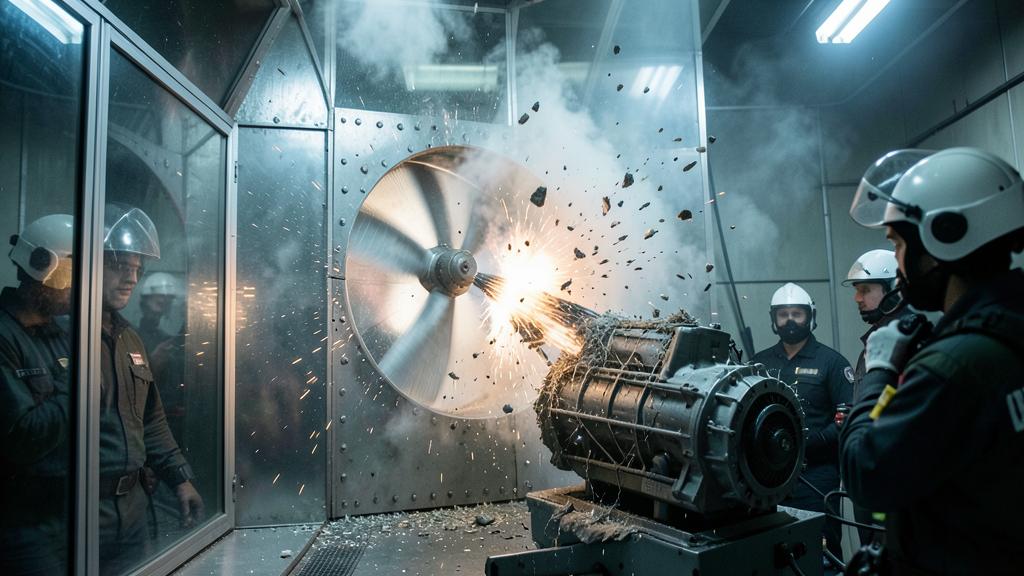
- The test only checks one blade breaking at full power on a brand-new engine. It doesn’t test multiple blades breaking at once, or blades that are already damaged or worn out. These cases are covered by calculations and past experience, not by new tests.
- If a real event happens differently than the test, regulators may issue new rules (like airworthiness directives) to check blades and discs more carefully.
The spread of composite blades shifts these limits further still. The acceptance criteria for an impact, the inspection methods, the authorised repairs and the degradation modes no longer have much in common with those of titanium, while the containment requirement itself has not moved a line. The same word covers two very different demonstrations, and experience gained on one generation of engines does not transfer mechanically to the next.
In your own documentation, three points deserve to be opened once and for all rather than on the day the case arises: the exact criterion that triggers shutdown in the event of high vibration and how it interacts with the other engine indications; the diversion duration retained for your fleet and what it assumes about the aircraft’s operation with an unbalanced windmilling rotor; and finally the inspections triggered by an ingestion, including when the parameters have returned to normal. For anyone preparing a type qualification or a certifying-staff function, following a single requirement — containment — from the test cell all the way to the checklist line remains the best angle of entry into a certification file; the FL330 training courses cover the subject along this thread, and operational cases are discussed on the forum.
The certification specifications in force, the means of compliance retained for the type concerned, and the operator’s approved documentation take precedence over this article, whose sole purpose is to shed light on the mechanism.
Questions fréquentes
Does the blade release test have to be redone for every engine evolution?
No, not systematically. As long as the modification touches neither the blade, its root attachment, the disc, nor the containment shell, compliance is established by similarity with the test already performed and by the calculation validated against that test. As soon as one of these four elements changes significantly, the question reopens and the authority may require a new demonstration, possibly a partial one.
Can a contained failure still damage the aircraft?
Yes, and it is common. Containment covers the casing: it prevents neither debris ejection through the air intake or nozzle, nor the loss of fan cowls, nor the unbalance loads transmitted to the pylon and wing. A perfectly contained event has already led to structural damage, fuselage perforations and evacuations.
Why is no attempt made to contain the disc as well?
Because the structural mass required grows far faster than the energy to be absorbed. A disc fragment arrives with a mass and compactness bearing no relation to those of a blade, and the shell capable of stopping it would weigh more than the benefit it provides. Safety is therefore achieved upstream, by preventing failure: critical parts, qualified processes, burst margin and declared life.
Is continued flight after the loss of a blade demonstrated?
Yes, but on the aircraft side, not the engine side. The airframe must absorb the load spike at the instant of release, then fly with the windmilling rotor’s unbalance for the diversion duration retained. This demonstration covers the structure and the operation of the equipment left in service, which makes it decisive for extended-range operations.
What distinguishes an engine failure from severe engine damage in operation?
The approved procedure defines it explicitly, based on the indications available rather than a general judgement call. The distinction governs whether a relight is attempted: a simple engine failure can sometimes be relit, a severely damaged engine must not be, because any powered rotation would drive an unbalanced rotor outside the demonstrated envelope.
What does a composite fan blade change for in-service tracking?
The containment requirement is unchanged, but everything around it differs. The acceptance criteria for an impact, the inspection methods, the repair limits and the degradation modes are specific to the material and are set out in the manufacturer’s documentation. Experience gained on titanium blades does not transfer as-is, and post-ingestion inspections must be read in the manual of the engine concerned.


Leave a Reply
You must be logged in to post a comment.