
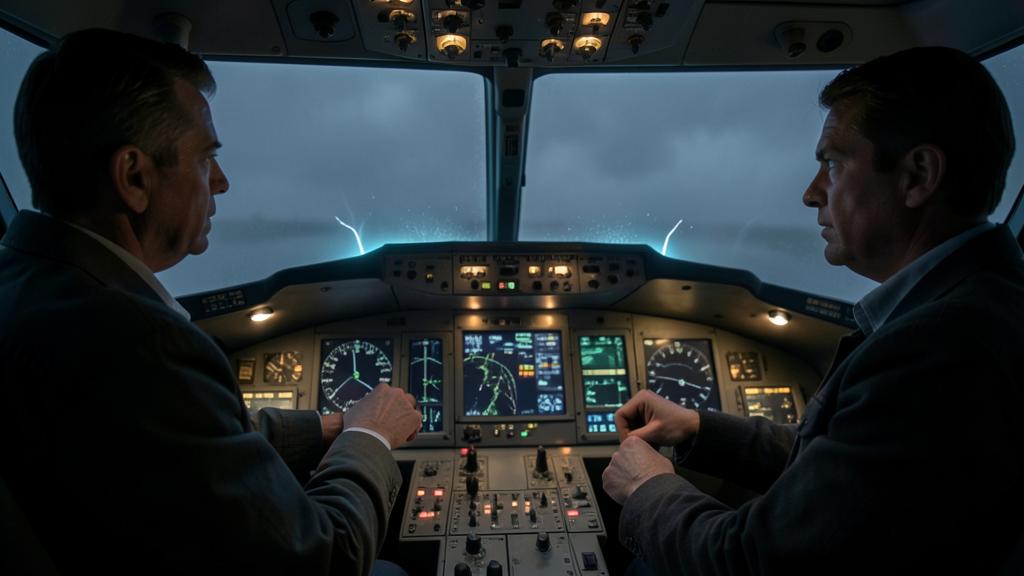
A pungent odor in the cockpit, a bluish glow on the windshield, a milky haze around the reading lights — and a perfectly clean weather radar. No alarms, no engine parameters moving, and half the decision is already made: the following minutes decide whether the engines will come out operational. Here are the signs in the order they arrive, and the physical reason for the order of actions.
What is perceived before the first alarm
The crew is the first detector: the odor comes first, sulfurous, pungent, often described as electrical. It passes through the engine bleed air, so it reaches the cockpit and cabin at the same time, with no identifiable source.
Then comes the haze, dry, which gives a halo to the reading lights and deposits a very fine gray dust. Then the electrostatic effect, the most characteristic sign at night: St. Elmo’s fire on the windshield, discharges on the leading edges, glow in the air intakes. The cloud is charged, and the aircraft discharges into it, without turbulence or echo.
During the day, the color changes: the horizon loses its definition, the light browns, visibility drops without any form suggesting a water cloud. Sometimes the airspeed indicators are affected — the pressure ports ingest the same material as the engines, and discrepancies between systems are a documented symptom of penetration.
None of these signs triggers an alert: all require being named aloud.
Why the weather radar won’t warn you
The onboard radar is designed for water droplets. Its reflectivity strongly depends on particle size and liquid water content; dry ash, a few dozen microns in size, returns negligible energy. A cloud capable of shutting down both engines can therefore be invisible on the screen.
This is not a matter of adjustment: the sensor is blind by design, and no gain or antenna setting changes that. The consequence is brutal — a clean screen is not information about ash. Detection is upstream, never onboard: advisories from consultative centers, in-flight warnings, reports from preceding flights. In cruise, only the senses remain.
The radar can’t see dry ash because it’s too small and doesn’t reflect well. You won’t get a warning from the plane itself – you have to rely on your own senses and reports from other aircraft.
In 2010, a Boeing 747 flying at 37,000 feet near Jakarta encountered ash from Mount Merapi. The crew noticed the sulfurous smell and haze, but the radar showed nothing. Both engines flamed out, and the aircraft glided to a safe landing. The ash cloud was completely invisible to the radar.
Technical emissions or ash: two opposite responses
Here is the most costly recognition trap, because it never presents itself as a trap. An unusual odor and a haze in the cabin is the clinical picture of a technical emission: compressor seal, hydraulic fluid, electrical overheating. The associated response isolates the bleed air and seeks the source by elimination.
The « ash » response demands the opposite: maximum bleed air, conditioning and anti-icing systems on. The reason has nothing to do with cabin ventilation — extracting air from the high-pressure compressor moves its operating point away from the surge line, thus regaining exactly the margin that the deposit consumes.
| Indice | Émanation technique | Ash encounter |
|---|---|---|
| Odeur | Localised, rather electrical or oily | Sulphurous, simultaneous in flight deck and cabin |
| Appearance of the air | Smoke with a source and a direction | Dry, uniform haze, fine deposit, no source |
| Électrostatique | Absente | St Elmo’s fire, glow in the engine inlets |
| Electrical indications | Abnormal load, tripped protection | No associated anomaly |
| Bleed air | To be isolated to find the source | To be kept at maximum (surge margin) |
| Thrust | No effect on the cause | First lever, to idle |
| Contexte | Independent of geography | Volcanic activity known before departure |
The right reflex. Name the doubt aloud and treat it as ash until proven otherwise. The « ash » response costs nothing to an aircraft not encountering any; the opposite error cannot be recovered, as isolating the bleed air in an ash cloud removes the surge margin at the moment it is being attacked.
Ash doesn’t break the engine, it vitrifies it
The image of the engine shredded by stones is false, and it leads to wrong decisions. Ash is finely ground silicate glass, with a melting point, depending on its composition, around 1,000 to 1,200 degrees — well below the gas temperatures measured at the exit of the combustion chamber at cruise thrust, even more so during climb.
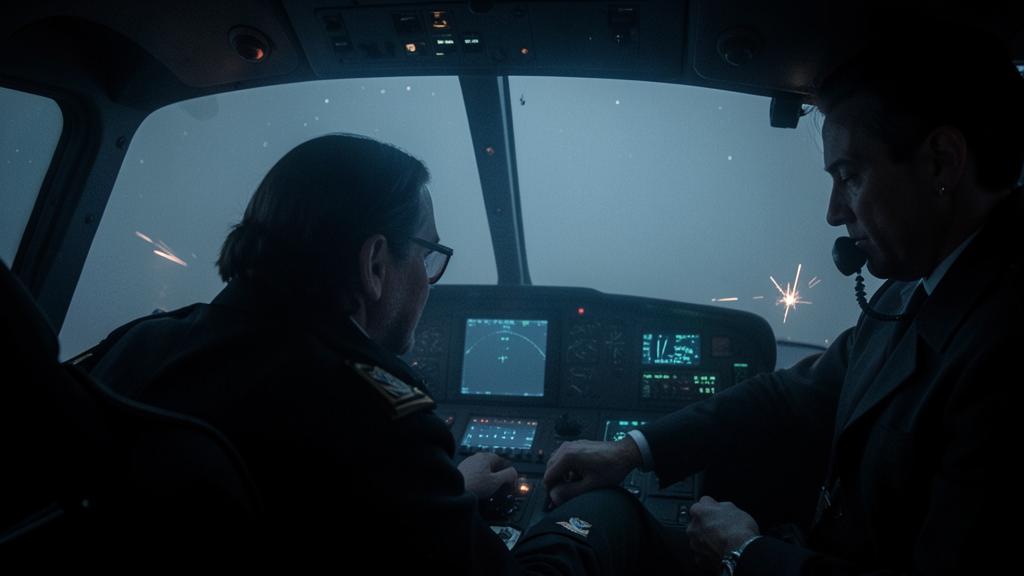
The particle therefore melts in the hot flow, but it does not remain liquid: it immediately encounters the first cooled surfaces — high-pressure distributor, aerofoil platforms — whose skin is kept much lower by cooling air. On contact, the glass solidifies and adheres: it is the gap between the gas and the wall that creates the deposit.
First chain, the flow section. The high-pressure distributor is the throat that sets the flow rate of the gas generator; the glass that accumulates there narrows it. The compressor delivers into a narrower orifice, its operating point rises toward the surge line, and frank surges — flameouts, violent oscillations — then shutdown are obtained.
Second chain, cooling. The cooling orifices of the blades become clogged with the same glass. The protective air film disappears, the metal operates beyond its design temperature, and the damage is permanent. This chain survives exiting the cloud and is not visible on any cockpit indication.
Erosion also exists — blades, headlights, windshield — but it is slow. What shuts down an engine in a few minutes is the glass.
Thrust first, turnaround afterward
The order is surprising: you penetrate a cloud that destroys the engines, and the first action is not to exit. Three physical reasons impose it, and the timeline surpasses them.
- Thermal. Idle reduces the gas temperature below the melting point of silicates, or close enough for most of the material to pass through while remaining solid. You don’t reduce the deposit, you change the regime.
- Flow rate. The gas generator airflow drops with thrust: fewer particles ingested per second, thus a proportionally reduced integrated dose.
- Margin. The reduction, combined with maximum bleed air, moves the operating point away from the surge line: you intentionally open the margin that the deposit closes.
The timeline, above all. Bringing the throttles back takes a few seconds; the turnaround typically takes one to two minutes spent where you don’t want to be. The protective action must cover the maneuver, so it precedes it: reversing the order means doing the entire turn at the vitrifying regime.
| Rang | Action | Effet physique | Why this rank |
|---|---|---|---|
| 1 | Autothrottle off, thrust levers to idle | Gas below the melting point, reduced ingested flow | Achieved in seconds, valid for the whole encounter |
| 2 | Maximum bleeds, anti-ice on | Surge margin regained by bleeding off | Protects the manoeuvre, at no cost if the diagnosis is wrong |
| 3 | Allumage continu | Faster relight after flameout | Prevents nothing, reduces the delay |
| 4 | Respiratory protection depending on type | Crew operational despite degraded air | Rank varies by manufacturer |
| 5 | 180° turn, descent if minimum altitude allows | Exit through the only air known to be clean | Takes minutes: carried out under protection |
| 6 | Distress message, diversion, report | Flight path priority, following flights warned | Safe flight path already established |
The trap. Speed decreases, the aircraft descends: the reflex learned in the first hours of flight is to add thrust. This is the one that finishes the engines — the gas temperature rises above the melting point and the deposit resumes, on an already clogged distributor. The throttles remain at idle until the aircraft is out, even if an engine shuts down.
What the exit trajectory must avoid
Do not climb. Climb requires maximum thrust, thus maximum gas temperature, thus the most effective deposition regime. The top of the plume is unknown and may be above the practical ceiling at cruise weight. And the maneuver is slow: you prolong the exposure while making it worse.
The turnaround. The only volume of atmosphere for which you have proof of cleanliness is the one you just traversed, and it only covers the last few tens of seconds of the trajectory. Any other direction is a hypothesis about the geometry of a radar-invisible cloud.
The turn. Every second of turning is a second of ingestion: you turn at the highest rate compatible with maintaining speed at reduced thrust, the maneuver margin at cruise level being narrow. A wide turn doesn’t cost comfort, it costs deposited material.
The descent. Free in thrust, it increases density, brings you closer to the windmill relight domain, and often exits through the bottom of the layer. Conditioned by the minimum safe altitude and terrain, it combines with the turnaround: descending straight means traversing the lower part of the plume, which is not cleaner. Remains the temptation to aim for the nearest visible edge — at night there is no edge, and during the day the visible limit is not that of contamination.
After exiting: what remains degraded
Air data. The pressure ports have ingested the same material as the engines, and partial obstruction does not signal itself: it produces plausible and false values, more dangerous than a frank failure. The matter is treated as doubtful air data — comparison of systems, reference attitude and thrust — the defect possibly only appearing during approach.
The windshield. It is sandblasted: the result is a translucent frosted surface, not a scratch. At night, with headlights on, light diffuses through it and can make the approach impractical head-on. The wipers worsen the frosting instead of cleaning it: early consideration of an automatic landing, or the side window, is necessary.
The engines. An engine that has restarted and holds its parameters is not a healthy engine: the glass remains in the flow path, the cooling orifices may remain clogged, and none of this appears on the cockpit indications. Post-penetration inspection is mandatory by the engine manufacturer, with its own criteria for removal.
Relight. After shutdown, descent is not a comfort option: the windmill relight domain has a ceiling, and the cruise level is above it. Attempts may be numerous, and success is more likely the farther you are from the contamination.
The report. A special volcanic activity report transmitted in flight protects the next aircraft. It is often the only direct observation that consultative centers will have, whose models work only on an estimated source and forecast winds.
What to check in your own documentation
The mechanism is universal, the procedure is not. Four points deserve to be read calmly, because they differ from one type to another.
- The rank of respiratory protection. Placed before thrust reduction in some, after in others. This is read on the ground, not with an odor in the nose.
- The auxiliary power unit. Requested here at a specific moment, excluded there: it ingests the same ash and can shut down as well.
- Relight in the cloud. Attempted immediately or deferred until exit, depending on whether available power or remaining hot section is prioritized.
- The operator’s criteria. The ash risk assessment sets what is accepted, circumvented, or refused in the flight plan — this is where most encounters are avoided.
The gray area remains, and it is wide. Low diffuse concentrations produce no odor, no St. Elmo’s fire, no haze: nothing perceptible. They do not shut down any engine that day, but they wear out the hot parts, and the bill arrives later in the shop, without being able to link it to a flight. No crew detects this in cruise: it is a planning and fleet monitoring issue. It is also the least well-treated part of the qualification oral, where the mechanics of vitrification are worth more than a recitation of items — the qualification tracks regularly show this.
This article describes a mechanism, not a procedure. The aircraft operating manual, the operator’s approved documentation, and the applicable regulatory text prevail over everything that precedes, item by item; in case of discrepancy, the onboard documentation is authoritative.


Leave a Reply
You must be logged in to post a comment.