

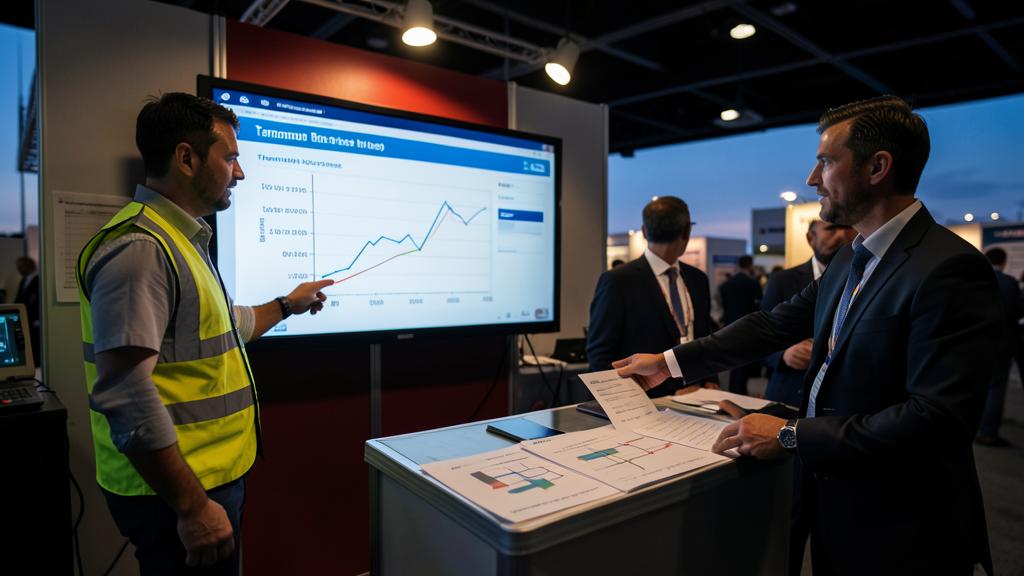
At a technical trade show, a maintenance organization’s booth pitches its argument in one line: an average turnaround time, in calendar days, shorter than what your recent projects actually took. The figure isn’t false—it’s an average, calculated on closed projects, and that’s precisely the problem. Here’s how this turnaround time is built, what it aggregates, what it excludes, and why it fails as soon as a project reveals unexpected findings.
What an average turnaround time actually measures
The showroom figure is almost always an arithmetic average calculated on closed projects from a rolling period. Three construction choices weigh more on this figure than the performance of production teams—and none of the three appear on the display.
The first is the choice of boundaries. Depending on the organization, the clock starts with the aircraft’s arrival at the site, the kickoff meeting, or the effective availability of access and documentation; it stops at the approval for return to service, the end of tests, or the formal handover. Two workshops can measure different windows on identical projects and publish incomparable figures, without either lying.
The second is the handling of interruptions. Most organizations exclude from their statistics the days they consider the client’s responsibility: waiting for a decision on additional work quotes, waiting for a part supplied by the operator, changes to the scope during the project. The showroom time is workshop time, not the downtime as seen by the fleet.
The third is the population. The average aggregates everything the organization has processed: light visits and heavy visits, recent aircraft and end-of-life aircraft, bare scopes and scopes loaded with modifications. The higher the share of short projects, the lower the average, without demonstrating the ability to handle a heavy project. Some calculations further exclude projects deemed atypical—precisely those most similar to what an aging aircraft with a loaded scope will face.
La moyenne affichée est trompeuse car elle mélange des projets très différents. Les petits travaux font baisser la moyenne, mais les gros travaux (ceux qui comptent pour vous) sont souvent bien plus longs. La moyenne ne dit rien sur votre cas précis.
Un atelier annonce une moyenne de 15 jours pour les visites lourdes. Mais sur 100 projets, 80 durent 10 jours (visites simples) et 20 durent 40 jours (visites complexes). La moyenne est bien 15 jours, mais votre A320 vieillissant, avec des modifications, aura probablement besoin de 40 jours.
An average aggregates projects that have nothing in common
The distribution of downtime durations is not symmetrical. The bulk of projects close near the nominal time; a minority stretches out, driven by structural findings, rare parts, or out-of-manual repairs. On such a distribution, the average is above the median but far below the tail—and it’s in the tail that heavy visits on aging aircraft live. In other words, the probability that your project will last exactly the advertised average is low: it will last less, or significantly more, and the contract must be written for the latter case.
The useful conversation is therefore not about the average but about how the figure is constructed. The table below summarizes what separates the commercial statistic from the time that actually binds you.
| Criterion | Showcase average | Contractual work package turnaround time |
|---|---|---|
| Population measured | Work packages closed over a rolling period, all scopes combined | Your work package, with its negotiated scope |
| Starting point | Varies by organisation: aircraft arrival, induction meeting, actual access | Defined in the contract, enforceable |
| Interruptions | Silently subtracted from the calculation | Listed, capped, with symmetrical response times |
| Unexpected findings | Diluted in the bulk of short work packages | Handled by written rules: quotes, delegation thresholds, amendments |
| Legitimate use | Commercial order of magnitude, not comparable from one shop to another | Basis for commitment, penalties and incentives |
The trap: comparing the averages of two workshops as if they measured the same thing. Different boundaries, different exclusions, different project mix: the gap between two showroom figures reflects calculation conventions first, not a performance difference. And applying one workshop’s average to your own project is like betting you’ll be on the good side of the distribution.
Unexpected findings break the nominal critical path
A visit file consists of routine cards—known in advance, quantified in hours, scheduled—and off-routine cards, opened on findings. The time promise is built on the former, with a provision for the latter calibrated on the workshop’s history. As long as the volume of off-routine work stays within the envelope, findings are absorbed into the flow: scheduling smooths the load, and the critical path remains that of the nominal schedule.
Everything shifts when a finding exceeds the envelope, and the discovery timeline is stubborn: the first days concentrate the opening of areas, removals, and inspections, hence most of the findings. The cumulative findings curve rises quickly during this opening window, then plateaus—beyond this point, the actual scope is known. The departure date is therefore decided at the start of the project, where long-lead part orders are placed, not in the final weeks where you still think you can defend it.
A single major finding is enough to shift the critical path. The dimensioning sequence is no longer the longest chain of routine cards but the chain of the worst finding: damage classification, search in approved data, engineering disposition if necessary, procurement, repair, checks. Meanwhile, the rest of the project progresses and finishes; the aircraft is waiting for just one work chain—and the showroom average never said anything about that.
Each treatment branch adds an order of magnitude
The fate of a finding hinges on two questions: is the repair covered by existing approved data, and is the part available? The answers outline three trajectories with very different time scales.
- Covered and in stock. The off-routine card is inserted into the flow, scheduling absorbs it: the impact is measured in hours, sometimes days.
- Covered, but part to be ordered. The procurement lead time applies: standard exchange when an agreement exists, repair of the removed item otherwise. Workshops provision foreseeable findings for each type of aircraft; a rare reference imposes its own schedule.
- Outside approved data. An engineering disposition is needed—design organization, repair data, approval—before even discussing the part. This is the longest trajectory, and the one that no average announces.
The showroom promise therefore depends on things invisible on the booth: the depth of the stock provisioned for your type of aircraft, exchange agreements on long-lead items, and the workshop’s access to reactive engineering capacity. These three points, far more than team cadence, separate a project that slips from one that holds.
The contractual clock: what counts, what stops
The contract defines what the showroom omits: the start of the countdown, its stop, and the list of events that suspend the clock. Classic suspensions—waiting for a client decision on a quote, waiting for a part they supply, additional work added during the project—are legitimate: the organization is not responsible for what it does not control. But their wording makes the difference. A clock stop that runs as soon as the quote is issued, without a symmetric obligation to respond quickly to the client’s questions, turns every exchange into a suspension; a bounded stop, with a response deadline on both sides, keeps the clock honest.
The most effective lever is not the late penalty, it’s decision speed. Every additional work quote waiting for a signature is another suspension; every internal validation that goes too high costs days that no one bills. Two practices change the face of a project: pre-negotiated delegation thresholds, below which the workshop engages work without waiting, and a daily production review where the operator is represented with real authority—not just an email inbox.
In front of the booth: the questions that shift the conversation
A trade show remains a good place to evaluate an organization—provided you shift the conversation from the figure to its construction. The questions that make the difference are short:
- on what population and period is the advertised time calculated;
- what are the median and upper end of the distribution for projects comparable to yours—same type of visit, same aircraft generation, similar age;
- where the clock starts and stops, and what events suspend it;
- what volume of off-routine work the workshop finds on your type of aircraft, and what it provisions accordingly;
- what access to engineering disposition during the project, and typical lead times;
- what actual entry slots are available—a short lead time on a distant slot shortens nothing at all.
The right reflex: ask, for projects comparable to yours, the median and upper end of the distribution rather than the average, as well as the clock start and stop rules. An organization that provides these elements without hesitation says more about its mastery than the showroom figure.
Before signing, the rest plays out in your own documentation. Review the clock rules in your standard contract, check who holds the delegation thresholds for additional work in your organization, and see what your previous visit reports allow for pre-provisioning. The gray area remains: the part of the delay that the operator creates for itself—internal validation circuits, late-supplied parts, deferred decisions—does not appear in any workshop statistic, even though it is often the first reserve of days to reclaim.
These mechanisms describe a general practice, not your particular situation: the applicable regulations, the signed maintenance contract, and the operator’s approved documentation take precedence over this article for any operational or planning decision.


Leave a Reply
You must be logged in to post a comment.