
A passenger stiffens, lets out a brief cry, and convulses in row 32, two hours from the nearest runway. The spasms stop on their own before the cabin chief finishes the call for a doctor. Everything is textbook—including the two reflexes that make things worse: holding the body, inserting something between the teeth. And the most counterintuitive part: the dangerous phase begins when the spasms stop. Here, we dismantle the inherited gestures, then detail the post-critical phase, where the prognosis is truly decided.
Two minutes that stop on their own
A generalized tonic-clonic seizure is a hypersynchronous neural discharge that affects both hemispheres: first, a tonic contraction—the body stiffens, a cry may accompany the forced expiration, ventilation is blocked—followed by the clonic phase, rhythmic spasms that impress the cabin. Facial cyanosis during the tonic phase is common—the breathing is suspended by the contraction—and resolves when the spasms stop.
The point training should hammer home: this crisis is self-limiting. Inhibitory mechanisms take over in one to two minutes in the vast majority of cases, and no action by the crew shortens it. However, it can prevent injury and provide the one piece of data no one else can: the exact time of onset. Everything that follows—escalation decision, medical liaison, possible diversion—relies on this timeline.
The seizure stops by itself in most cases, and nothing the crew does can make it stop faster. The most important thing they can do is note the exact time it starts, because that helps decide what to do next.
On a flight from Paris to Tokyo, a passenger in row 32 has a seizure at 14:32. The crew notes the time, clears the space around the passenger, and cushions their head. The spasms stop after 90 seconds, and the passenger is placed in the lateral position. The crew continues monitoring, and the passenger regains full consciousness after 15 minutes.
Contain, wedge, insert in mouth: the same misconception in three gestures
Restraining the limbs of a convulsing passenger means opposing a static force to a massive, involuntary muscle contraction. The muscle doesn’t give way—it’s the joint or bone that takes the strain. Restraint doesn’t shorten the seizure by a second; it adds dislocations and injuries, to the passenger and the rescuer. The only exception is emergency extraction: if the person is convulsing against a structure that injures them with each spasm, the body is moved along its axis, without restraining the limbs.
The second inherited reflex—spoon, wallet, fingers—relies on a false timeline. Tongue biting, when it occurs, happens with the initial tonic contraction: it’s already done before anyone reaches the passenger. An object inserted afterward prevents nothing; it breaks teeth, fragments, may obstruct the airway, and injures lips and palate. Fingers, meanwhile, come out bitten. The rule is simple: never put anything in the mouth of a convulsing person.
During the crisis: protect, clear, time
The useful work is about space. The cart is moved away, the tray table is raised, bags and glasses are cleared, anything compressing the neck is loosened, glasses are removed. The head is the only part that is supported—not held, but cushioned—with a folded blanket, pillow, or jacket between the skull and the floor or seat leg. Supporting means cushioning the spasms; holding means opposing them.
Timing is the most medical gesture in the sequence, and the most poorly executed. Under stress, perceived time dilates: a real seizure lasting less than two minutes becomes “five good minutes” in the report, and this skewed estimate weighs on escalation in both directions. When staffing allows, three roles: one crew member at the head, one keeping time and reporting to the cockpit, one managing the space and neighbors.
The right reflex: from the first second, check the time and announce it aloud—“seizure started at 14:32”—then have it recorded. The timed duration is the first piece of data medical liaison on the ground will ask for, and the only one that can’t be reconstructed afterward.
The post-critical phase: where the event is decided
The trap: the end of spasms is perceived as the end of the emergency. The cabin relaxes, the crew redeploys, the passenger “sleeps.” It’s the opposite: the post-critical phase combines abolished consciousness, complete hypotonia, and airway obstruction—the exact configuration where an avoidable cause becomes a fatality. The critical risk of the sequence lies after the convulsions, not during.
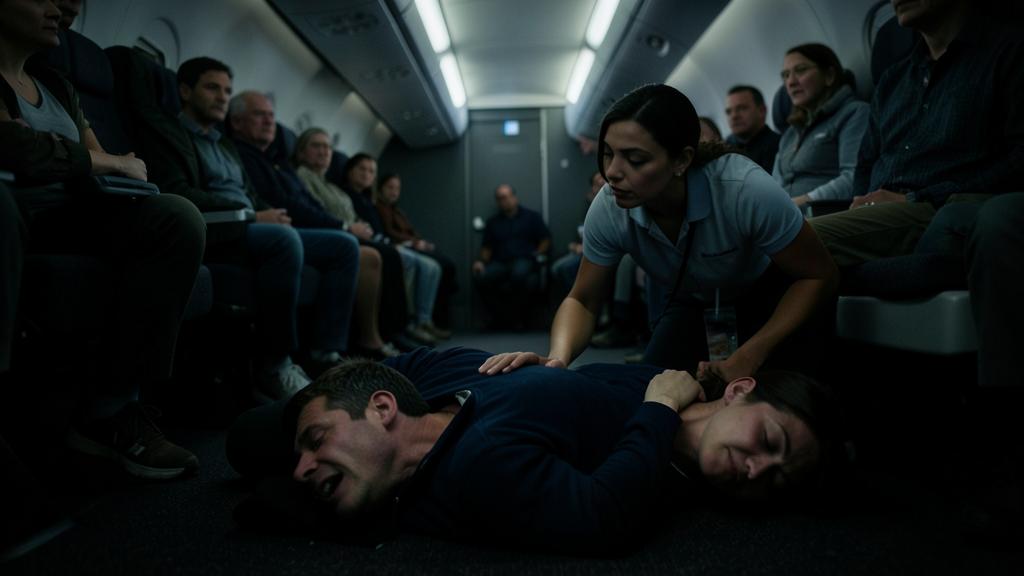
The passenger emerges from the crisis in a post-critical coma: no muscle tone, protective reflexes abolished, secretions in the mouth, possible vomiting. On the back, the base of the tongue tilts, and everything converges toward the pharynx. The lateral position is therefore not a comfort option: it’s the gesture that reverses the flow. Cabin space requires adapting the textbook position, but the principle is non-negotiable: mouth oriented downward, slight head tilt, nothing under the occiput that flexes the neck.
Breathing that resumes is initially noisy, stertorous—this is expected, and the lateral position should improve it within a few cycles. What must never happen: respiratory pauses, persistent cyanosis, obstruction that the position doesn’t clear. These three signs trigger escalation without further deliberation. Onboard oxygen is used here, in the post-critical phase, according to the operator’s procedure—not during the spasms.
| Aspect | During convulsions (typically one to two minutes) | Post-critical phase (minutes to tens of minutes) |
|---|---|---|
| Priority objective | Avoid additional injury | Keep airways clear, detect complications |
| Useful actions | Clear what may injure, cushion the head, loosen what compresses, time | Lateral position, respiratory monitoring, time-stamped reassessments |
| What not to do | Restrain limbs, insert anything in the mouth, move unnecessarily | Sit up too soon, give fluids, leave unmonitored |
| Dominant risk | Impact against cabin structures | Obstruction, aspiration, fall on first attempt to stand |
| End-of-regime signal | Spontaneous cessation of spasms | Full orientation: name, place, situation |
Monitor, record, assess recovery
Consciousness doesn’t return all at once: it recovers in stages—confused awakening, answers to simple questions, full orientation, then only the first assisted stand. Each stage is observed; none is anticipated. Sitting up a still-confused passenger, giving fluids “to revive them,” letting them return to their seat alone: three classic gestures, three stage errors; falling on the first stand remains the typical avoidable injury of the sequence.
Post-critical confusion can be ambulatory and agitated: the passenger stands, walks, manipulates whatever is within reach, without intent or memory. They aren’t reasoned with—the cortex that would reason isn’t back yet—only accompanied: calm voice, slow movements, gentle physical guidance to a seat, and a crew member positioned between them and anything they might handle.
The right reflex: a nominal assignment. “Someone keeps an eye on them” in practice means no one is monitoring. A crew member is assigned with the sole task of watching this passenger; the relief is announced, and the assignment isn’t lifted until full orientation.
Decide: monitoring or escalation
The usual medical convention defines around five minutes of continuous convulsions as status epilepticus—a different kind of emergency that won’t resolve on its own. The operational translation is simple: spasms lasting beyond a few timed minutes, recurring, or consciousness that doesn’t recover between episodes close the debate. Onboard medical support is sought, ground liaison is established, and the commander has the elements for the diversion decision—which is theirs.
| Criterion | Monitoring in cabin | Escalate: support, medical liaison, commander’s decision |
|---|---|---|
| Duration of convulsions | Spontaneous stop in less than a few timed minutes | Convulsions that continue or resume |
| Consciousness | Progressive recovery in stages | No recovery between crises, prolonged stagnation |
| Respiration | Noisy then normalized in lateral position | Pauses, persistent cyanosis, obstruction not cleared by position |
| Context | Known epilepsy, treatment followed, episode deemed usual by companion | First episode, injury during crisis, pregnancy, diabetes, recent head trauma |
Ground medical liaison works with what the cabin provides. Its raw material isn’t the general impression but the time-stamped chronology: start time, timed duration, phase descriptions, respiratory status in lateral position, consciousness stages with their times, noted injuries—the lateral tongue bite, discovered afterward, is actually a useful orientation sign—and known treatment if a companion provides it. Poor reporting impoverishes the decision, including the decision not to divert.
What your documentation must clarify—and what it leaves open
Before the next flight, three checks are better than a general review. Role distribution during a medical event: who times, who reports to the cockpit, who stays assigned to the passenger. The actual contents of onboard kits and access conditions to the emergency medical kit, distinct from the first-aid kit. And the medical liaison procedure: who calls, through which channel, with what data—it’s during the call that you discover the chronology is missing.
Remain the gray areas that documentation rarely clarifies. The oriented passenger who refuses continued monitoring: the refusal is documented, and discreet reassessments are maintained: refusal doesn’t extinguish vigilance. The companion who offers to administer the passenger’s personal treatment: the decision isn’t the crew’s alone, it goes to medical liaison or the onboard doctor, and anything administered is recorded. Finally, the same crisis recurring while still open falls under a different decision regime—a great case to work in safety-recycling, because it forces separating the identical gesture from the different decision.
The procedures published by the operator, the training it provides, and the instructions from the medical service it works with take precedence over this article: it illuminates the mechanism under the rule, it doesn’t replace it. In case of discrepancy, the approved documentation is authoritative.


Leave a Reply
You must be logged in to post a comment.