
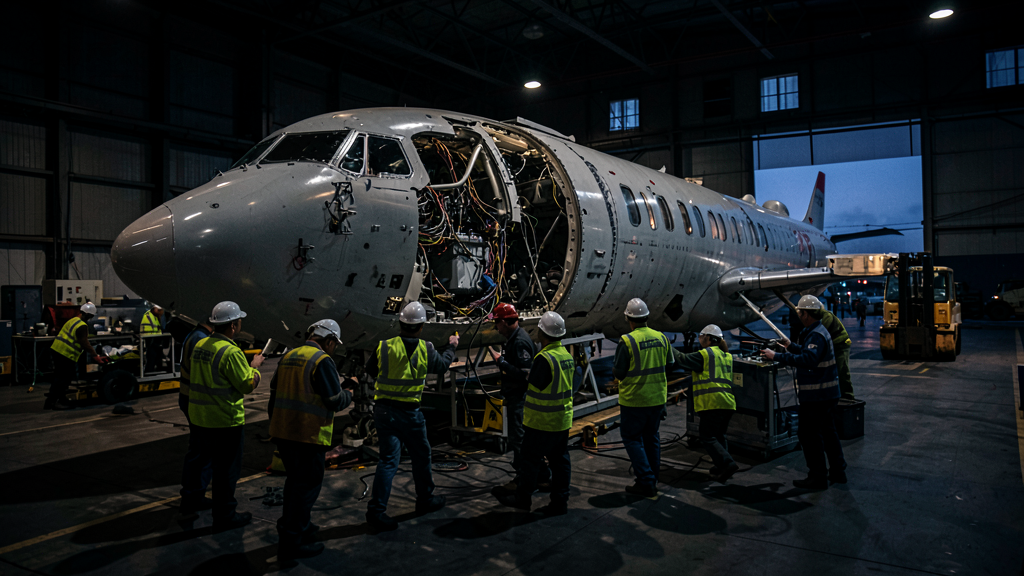
A manufacturer announces a rate, misses it, announces it again, and the industry treats this as a failure of forecasting. It is closer to a law of the system. Every constraint that is relieved promotes another one, and the new constraint is usually further from the final assembly line, harder to see and slower to fix. The announced rate is a target for one station in one moment. The stable rate is what the whole chain can hold while absorbing the variability of a normal week — and those are almost never the same number.
Rate is arithmetic before it is ambition
Production rate is usually quoted in aircraft per month, which hides what it actually demands. Convert it into takt time — the interval at which a completed unit must leave the line — and the demand becomes concrete, because takt is what every station has to beat.
The conversion is simple and unforgiving. Take the working time available in a month, divide it by the units required, and the result is how long each station may hold an aircraft. The table below works it through on stated assumptions rather than on any manufacturer’s real figures, because the point is the shape of the curve, not the specifics of a programme.
| Monthly rate | One shift of eight hours | Two shifts of eight hours | Three shifts of eight hours |
|---|---|---|---|
| 10 aircraft | Roughly 17 hours per station | Roughly 34 hours | Roughly 50 hours |
| 20 aircraft | Roughly 8 hours | Roughly 17 hours | Roughly 25 hours |
| 40 aircraft | Roughly 4 hours | Roughly 8 hours | Roughly 13 hours |
| 60 aircraft | Under 3 hours | Roughly 6 hours | Roughly 8 hours |
Two consequences fall straight out of this. First, doubling the rate does not require doubling the factory as long as a shift can be added: the same jigs, stations and floor space are worked twice instead of once, and only the direct labour has to be duplicated. That is why the first rate increases look cheap. Second, once the shift pattern is saturated, further rate gains have to come from reducing work content per station or from adding stations or lines — and those are capital projects with lead times measured in years, not decisions taken in a planning meeting.
The line runs at the speed of its slowest station
A final assembly line is a chain of stations, and its output is set by the longest cycle time in the chain, not by the average. This is why line balancing dominates industrial engineering on an aircraft programme: work content is shuffled between stations so that no single one becomes dominant. Adding work to a fast station is free — right up to the moment it becomes the slowest, at which point it is the whole line’s problem.
When a station cannot finish inside its takt, the work does not disappear. It travels. Jobs that should have been closed at station three are carried to station four, where they compete with station four’s own content and with access constraints that did not exist earlier — an installation that was straightforward with the fuselage open becomes awkward once the interior is in. Travelled work is therefore not a neutral transfer of hours; it is a transfer at an unfavourable exchange rate, and it propagates. A line that is visibly recovering work at the flight line is almost always reporting a shortage that occurred much earlier and much further upstream.
The trap: a line that is delivering to plan while accumulating travelled work is not at rate. It is borrowing, and the debt is denominated in hours that are worth more where they are being repaid than where they were incurred. The metric that exposes this is not units delivered but work completed at the station where it was scheduled. Any rate discussion that does not include that figure is measuring the wrong thing.
Every station on an assembly line must finish its work within a set time, or the whole line slows down. If one station falls behind, the extra work moves to the next station, making things even slower. The real measure of success isn’t just how many planes are finished, but whether each station is keeping up with its own tasks.
On a Boeing 737 MAX line, if the wing installation station (Station 3) takes 10 hours instead of the planned 8, the extra work moves to the fuselage closing station (Station 4). Now, Station 4 has to do its own work plus the leftover from Station 3, causing delays. The line might still deliver planes on time, but it’s building up a hidden debt of extra hours that will slow things down later.
Relieve the constraint and you have only moved it
The theory of constraints made this explicit decades ago and it has not been improved on: identify the constraint, get everything possible out of it, subordinate the rest of the system to it, then increase its capacity — and then start again, because the constraint has moved. The last step is the one that gets forgotten, and it is the one that explains the pattern of announced rates.
The reason the movement is so disruptive in aerospace is that the successive constraints live in different organisations, on different timescales, under different approval regimes. A bottleneck inside the final assembly hall can be attacked with people and tooling in weeks. The next one may be a structural casting from a supplier with a two-year capacity expansion, or a special process that needs accreditation before a second source can be used, or an authority approval for a new production facility. The system does not degrade gracefully as it accelerates; it hits a series of walls of increasing thickness.
| Constraint location | Typical symptom | Realistic lead time to relieve |
|---|---|---|
| Station work content and balance | One station consistently overruns takt; travelled work appears downstream | Weeks to months — rebalancing, tooling, additional shift |
| Skilled labour | Positions filled but productivity below plan; quality escapes rise | Months to a year — recruitment plus the time to become genuinely productive |
| Tier one structures and systems | Shortages arriving at the line; sequencing broken; out-of-station build | Quarters — capacity, tooling and their own labour problem |
| Deep tier: castings, forgings, fasteners, bearings, electronics | A single small part gates a large assembly; allocation between programmes | Often years — furnace and press capacity is capital-intensive and shared across industries |
| Special processes and qualification | An alternative source exists but cannot be used yet | Months to years — accreditation, first article inspection, design approval where the change is not minor |
| Physical plant: jigs, autoclaves, paint, test, flight line | Aircraft complete but queued for a facility | Years — construction and, where applicable, extension of the production organisation approval |
| Engines, cabin monuments, seats | Gliders parked awaiting a supplier-furnished item | Quarters to years, and often outside the airframer’s control entirely |
| Delivery and acceptance | Aircraft finished but undelivered at month end | Weeks to quarters — customer readiness, financing, acceptance crews, ferry |
The constraint that is not physical
The bottleneck that surprises people most often is not a machine or a part. It is engineering capacity consumed by non-conformance. Every deviation found on the line needs a disposition, and dispositions are produced by design engineering, stress, materials and quality. At low rate, that load is manageable. At high rate the number of units passing through per week multiplies the number of findings, and the queue for a disposition becomes the thing that holds aircraft in station.
This creates a feedback loop with an unpleasant sign. Rate pressure encourages out-of-sequence work; out-of-sequence work generates more non-conformances; non-conformances consume the engineering capacity that would otherwise be improving the process; and the process therefore stays as it was, generating more findings. Programmes that break this loop usually do so by attacking the source of the findings rather than the speed of the disposition process, which is counter-intuitive when the visible queue is at the engineering desk.
Labour has a similar hidden dynamic. Aerospace assembly has always followed a learning curve — unit cost falls by a roughly consistent percentage each time cumulative output doubles — and the effect is large enough that it dominates early programme economics. But the curve describes a stable workforce accumulating experience. A rapid ramp dilutes that experience with new hires, and the average skill level of the person doing the work can fall even as headcount rises. The curve does not run backwards, but it flattens, and the recovery takes as long as it takes to train people properly.
Why running flat out guarantees queues
There is a result from queueing theory that every rate discussion should include and almost none do: as utilisation approaches one hundred per cent, waiting time does not rise smoothly — it rises towards infinity, and it does so faster the more variability there is in arrivals and in processing times. A system with no variability can be run at full utilisation. No aircraft factory has no variability.
The practical translation is that a factory planned to run every resource at full capacity will not achieve its planned output. It will achieve something lower, with long and unpredictable queues in front of the busiest resources, because every disruption — a late part, an absence, a machine down, a finding — has no slack to be absorbed into. Stable high rate requires buffers, and buffers are either inventory, capacity or time. All three cost money, which is why they are the first thing removed from a plan and the reason the plan then fails.
The right reflex: when reading a rate announcement, ask what buffer is planned at the constraint. A programme that names its constraint, states the buffer it holds in front of it and explains how the buffer is replenished is describing a system it understands. A programme that describes only the target rate and the date is describing an intention.
Announced rate and stable rate are different quantities
Part of the confusion is linguistic. The word rate is used for at least four distinct things, and the difference between them is exactly the difference between an announcement and a delivery record.
| Meaning | What it describes | How to test it |
|---|---|---|
| Instantaneous rate | What the line achieved in its best week, annualised | Ask for the worst week in the same quarter |
| Entry rate | The rate at which aircraft start down the line | Compare against completions; a growing gap is work in progress, not output |
| Exit or delivery rate | Aircraft actually handed over | The only figure a customer’s fleet plan can use |
| Stable rate | The rate the whole chain can hold through a normal quarter, including disruption | Sustained delivery over consecutive quarters, with travelled work flat or falling |
An announcement usually refers to an intended exit rate at a future date. It becomes a stable rate only when the deep supply chain has been at that rate long enough to have refilled its own buffers, which typically lags the assembly line by several quarters. This is why ramps so often show a promising first year followed by a plateau: the line reached rate, the chain behind it did not, and the line then runs at the chain’s speed.
The ramp is asymmetric, and that shapes behaviour
Going up and coming down are not mirror images. Ramping up requires spending — hiring, tooling, inventory, supplier support — before the revenue arrives, and much of that spending is committed at the deep tiers by suppliers who are smaller, less capitalised and more exposed than the airframer. Ramping down strands that investment, and a supplier who was burned in the last cycle will be slower to commit in the next one. The memory is real and it is rational.
The consequence for anyone reading rate announcements is that supplier commitment lags manufacturer announcement by design. A tier three foundry does not order a furnace on the strength of a press release; it orders on the strength of a contract with volume commitments, and negotiating those takes time that is invisible from outside. When the deep tier does commit, the ramp becomes credible. Before that, the announcement is a request for the chain to believe.
What this means for the operators at the other end
For an airline, a lessor or a maintenance organisation, the practical value of understanding the mechanism is that it changes what you watch. A delivery slot is not a date; it is a position in a queue whose service rate is set by whichever constraint is currently active, and its risk profile depends on where that constraint sits. A constraint inside the assembly hall is recoverable within a planning cycle. A constraint at a sole-source special-process supplier is not, and no amount of contractual pressure on the airframer will change the lead time of a qualification programme.
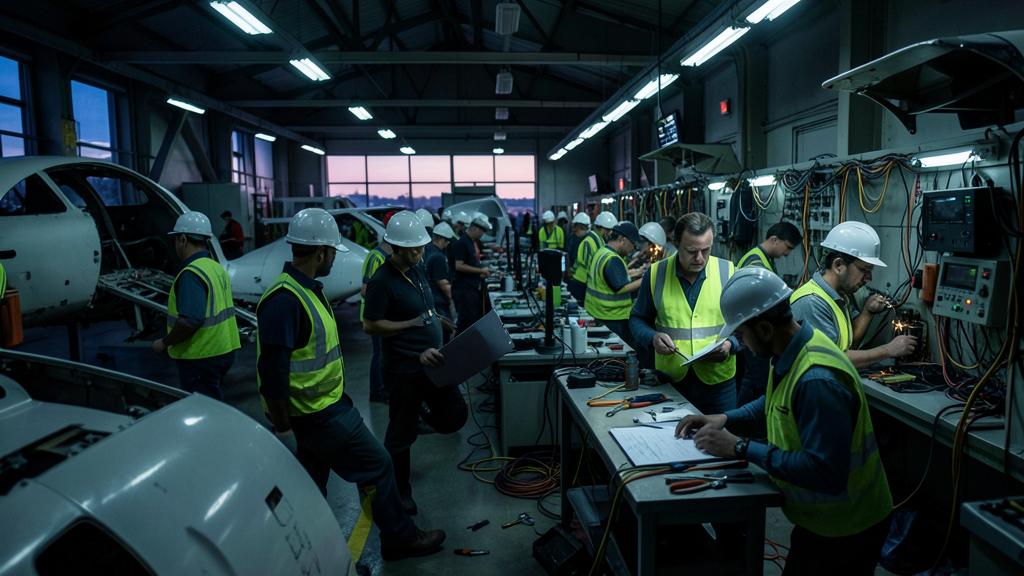
That distinction should feed directly into fleet planning: lease extension options, crew recruitment and type rating scheduling, maintenance slot booking, and the network commitments made on the assumption that an aircraft arrives in a given month. Recruitment in particular tends to be planned against the announced date rather than the credible one, which produces crews rated on a type that has not arrived — a cost that is entirely avoidable if the delivery date is treated as a distribution rather than a point. Anyone building crew plans against announced deliveries will recognise the pattern in the hiring cycles visible on FL330 jobs.
The mature reading of a ramp is not cynicism. It is understanding that the manufacturer is telling the truth about the constraint it can currently see, and that the next one, by definition, has not revealed itself yet.


Leave a Reply
You must be logged in to post a comment.