
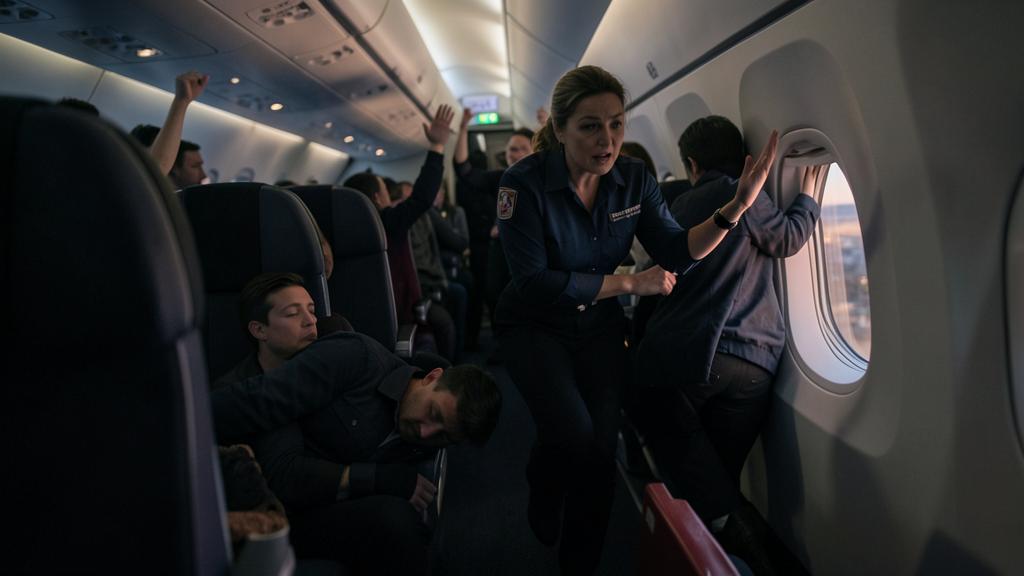
A call light comes on in row 24. A passenger is slumped against the window, the neighbour is waving, and the first words out of most crew members’ mouths are “what’s wrong?”. That question is not wrong so much as premature: it assumes the person can answer, that the answer will be reliable, and that it will add something the scene has not already told you. Four observations made before you speak — context, position, level of consciousness, breathing — settle most of the response. Here is why they come in that order.
The question that should not come first
Asking a collapsing passenger what is wrong looks like care and behaves like a trap. Three things go wrong at once. The passenger who is genuinely unwell is the least able to describe it: syncope leaves people briefly confused, hypoglycaemia makes them argumentative, hypoxia makes them cheerfully insistent that they are fine. The embarrassed passenger will minimise, and embarrassment is the dominant emotion in a cabin full of strangers. And a question anchors you: once someone says « it’s my stomach », you will spend four minutes looking at a stomach.
The sequence below is not a different protocol from the one taught in initial cabin crew first aid. It is the same one with the order made explicit, because the order is what gets abandoned under pressure. Every element is observational: none of it requires equipment, consent, or a common language.
| Gate | What you take in | What it settles | Order of magnitude |
|---|---|---|---|
| Context | Phase of flight, what the passenger was doing, where you are in the cabin, who else is involved | The plausible causes, and whether this is one person or several | While walking to the seat |
| Position | Seated, slumped, on the floor, in a lavatory, rigid, curled | Whether the body went down, was put down, or never went down | On arrival, before touching |
| Consciousness | Response to your presence, then to voice, then to touch or pain | Whether an interview is even possible | A few seconds |
| Breathing | Airway open, chest movement, sound, normality of the pattern | Whether this is a first aid case or a resuscitation | Ten seconds, no more |
Gate one: the context you read on the way there
Context is free information collected while you walk. Phase of flight narrows the field immediately: an event in the first minutes of cruise after a long taxi in a hot cabin has a different prior probability than one in descent, when ear and sinus pain, and decompensation in marginal cardiac reserve, become more likely. An event in the lavatory has already been running for an unknown time — and that unknown is itself a finding.
What the passenger was doing matters more than what they will say they were doing. Someone who has just stood up after five hours seated, walked to the galley and gone down there is describing orthostatic physiology without a word. Someone who collapsed while sitting still, without warning, is describing something else, and the something else is a shorter and more serious list.
Finally, count the affected. One passenger is a medical event. Two or more, in the same zone, with similar symptoms, is a cabin environment question until proven otherwise — smoke, fumes or any suspicion of contamination belong to a different procedure, and the flight deck needs to hear about them in seconds.
Before asking anything, look around. The situation itself often tells you more than words. A passenger who faints after standing up might just need to lie down, while one who collapses without warning could have a serious issue. If multiple people are affected, it might not be a medical problem but something in the cabin air.
On a Boeing 737 at 35,000 feet, a passenger in row 12 suddenly slumps forward. The crew observes that the passenger was seated for 3 hours before standing to use the lavatory. The context suggests orthostatic hypotension (a drop in blood pressure when standing), a common cause of faints in flight. The crew helps the passenger lie down, and they recover quickly without further intervention.
Gate two: position is the witness that cannot lie
Position at discovery is the single most useful observation available, and it is destroyed the moment anyone helpful moves the passenger. Train the reflex to look before hands go on, and to ask the neighbour one narrow question — “did you move him?”
The reasoning is simple. Faints resolve once the head is level with the heart again. A passenger flat on the floor and still unresponsive after a short interval is telling you that recumbency did not fix it — which uncomplicated syncope should. A passenger slumped forward but still upright in a seat has never had that correction: the seat has held the head above the heart throughout, and what you are looking at may be a faint prolonged by the furniture. Getting that person flat, seat belt sign and turbulence permitting, is both treatment and diagnostic test.
| How the passenger is found | What it suggests | What it makes urgent |
|---|---|---|
| Slumped in the seat, head unsupported | Faint prolonged by the upright position, or something worse masked by it | Get flat if the cabin allows; re-assess consciousness after the change |
| On the floor, unresponsive, flat | Recumbency has already been tried and has not worked | Airway and breathing immediately; treat as high acuity |
| Found in a lavatory | Unknown downtime; confined space; door may need to be opened from outside | Extraction plan and floor space before any assessment |
| Rigid, jerking, or post-event drowsy and incontinent | Seizure activity, witnessed or just missed | Protect the head, time the event, do not restrain; expect a confused recovery |
| Curled, guarding, refusing to lie down | Pain-driven; some cardiac and abdominal causes will not tolerate flat | Position of comfort, early call to the ground |
Gate three: consciousness, graded rather than guessed
“Conscious” and “unconscious” are not the two available answers, and treating them as such produces the classic failure — a passenger declared awake because their eyes were open, who was in fact responding to nothing. A graded scale removes the judgement call. The four-level scale used across first aid systems runs alert, responds to voice, responds to pain, unresponsive, and its virtue is that each level maps to a different action, not a different adjective.
Note that your approach already performs the first level of the test. If the passenger tracks you as you arrive, they are alert, and you can proceed to an interview. If they do not, the interview is off the table and you have saved yourself from asking questions into a void.
| Level | What you observe | What it changes |
|---|---|---|
| Alert | Eyes open spontaneously, tracks you, speech is oriented | Interview is possible and worth having; look for a cause you can act on |
| Responds to voice | Opens eyes or answers only when spoken to loudly; confused or slow | Short closed questions only; assume the history is unreliable; treat as deteriorating |
| Responds to pain | Reacts only to a firm stimulus | No interview; protect the airway; ground medical advice now, not later |
| Unresponsive | No reaction at all | Airway and breathing check immediately; prepare for resuscitation and mobilise the defibrillator if carried |
Gate four: the airway and ten seconds of breathing
For an unresponsive passenger the airway comes before everything, and the reason is mechanical rather than medical: an unconscious person seated upright with the chin on the chest has an airway obstructed by posture alone. Opening it can restore normal breathing in someone who appeared not to be breathing at all — which is why the airway manoeuvre precedes the breathing assessment.
The breathing check is deliberately time-boxed. Resuscitation guidance across the major councils converges on the same instruction: look, listen and feel for no more than ten seconds, and decide. The reason for the cap is that the ambiguous cases are the dangerous ones, and lingering on an ambiguous case is how a cardiac arrest gets treated as a faint for four minutes.
The specific thing to be ready for is agonal breathing. In the first minutes after a cardiac arrest, a substantial proportion of casualties display slow, noisy, irregular gasping. It looks like breathing and it is not, and it is the commonest reason a bystander concludes that chest compressions are not needed. The rule is short: gasping is not breathing. If the pattern is not clearly normal, treat it as absent.
The trap. “He’s still breathing” spoken by a passenger, a relative or another crew member is an interpretation, not an observation, and it is the interpretation most often wrong in the first two minutes of an arrest. Verify it yourself, at the mouth, against the chest, within the ten-second window — and if the pattern is gasping, irregular or noisy, act as though there is no breathing at all.
Now, and only now, the interview
Once the passenger is established as alert, the interview becomes the highest-yield tool you have, because most in-flight medical events are not resuscitations. In the large published series, faints and near-faints are the largest single category — roughly one event in three — with respiratory, gastrointestinal and cardiac complaints and seizures accounting for much of the rest. Cardiac arrest is rare, and diversion follows only a small minority of events. The everyday case is a conscious person who can tell you something useful, provided you ask in order.
The standard structure — symptoms, allergies, medications, past history, last oral intake, and the events immediately preceding — exists to stop the interview drifting. Two of its elements are systematically under-used in the cabin. Medications, because the answer routinely contains the diagnosis: an insulin pen in the cabin bag, a nitrate spray, an anticoagulant, an anti-epileptic that was skipped because of a night flight and a time-zone change. And last oral intake, because a long fast before departure, an empty stomach and alcohol at altitude appear together in a great many cabin faints.
Ask the neighbour separately, and ask what they saw rather than what they think happened. “How long was he out?” and “did he hit anything on the way down?” produce facts. “What happened?” produces a theory.
The right reflex. Time the event from the moment of discovery and write the time down. Onset time, duration of unconsciousness, and the time of any intervention are the three data points the ground medical service and the receiving hospital will ask for, and they are the three that memory reconstructs worst. A note on the back of a service card, with real clock times, is worth more than a detailed narrative written after landing.
What the cabin does to the assessment
The environment distorts every measurement you take, and knowing the direction of the distortion is part of the assessment.
Cabin altitude is the first factor. Transport aircraft are certified to keep cabin altitude under a defined ceiling — 8 000 ft in the long-standing rule — and several recent types are flown lower still by design choice. A healthy adult sits comfortably with an oxygen saturation somewhat below their sea-level value in that environment; a passenger with marginal cardiac or respiratory reserve does not, and a condition compensated at the gate can decompensate in the cruise without anything else changing. This is also why a pulse oximeter reading needs care: the normal range is shifted, and a cold, poorly perfused finger reads low regardless of the patient.
Noise, vibration and lighting degrade the classic observations. Auscultation is close to useless at cruise noise levels, skin colour is unreliable under cabin lighting, and a radial pulse is hard to feel through vibration. Prefer observations that survive the environment: chest movement seen rather than breath heard, capillary refill, level of response, and sweat.
Finally, space is a real constraint on the sequence, not a detail. High-quality chest compressions cannot be delivered to a passenger in a seat, and an aisle is narrow enough that the mechanics are compromised. Identifying the floor space you will use — an exit row area, a galley, a cross-aisle — is part of the plan, and it is faster to decide it while the assessment is running than to improvise it afterwards. Turbulence overrides all of it: crew who are injured are no longer part of the response.
Equipment, the ground and the flight deck
The equipment question is answered per aircraft, not per type. First aid kits are carried universally; an emergency medical kit intended for a qualified professional is required above certain aircraft sizes; universal precaution kits are standard. Defibrillator carriage is where the rule sets diverge most visibly — the FAA mandates one on most large scheduled aircraft, while in Europe carriage depends on the operator, the aircraft and the authority. The only reliable answer is the one in your own operations manual for the aircraft you are on today.
Therapeutic oxygen is a separate item from the drop-down masks, which are a decompression provision and not available on demand. Know which bottle, which outlet and which flow rate your operator specifies, and the fire and pressure restrictions attached.
The ground medical advisory service most operators contract is not a formality for when things are already bad. Its value is highest early, while the question is still “diversion or not”, because that decision has a lead time — fuel, weight, weather, a suitable aerodrome — and it belongs to the commander, who can only act on what reaches the flight deck. A structured handover passed early costs a minute; passed late it costs an hour of flying. Crews comparing handover formats and diversion experience will find the discussion active on the FL330 professional forums.
Volunteer medical professionals are an asset with a procedure attached. Most operators require identification and define what a volunteer may and may not do; in the United States a federal provision limits the liability of a good-faith volunteer responder, while elsewhere it turns on national law. Follow the operator’s procedure rather than improvising the legal question in the cruise.
Where the sequence breaks
Three failure modes recur, and all three are failures of order rather than of knowledge.
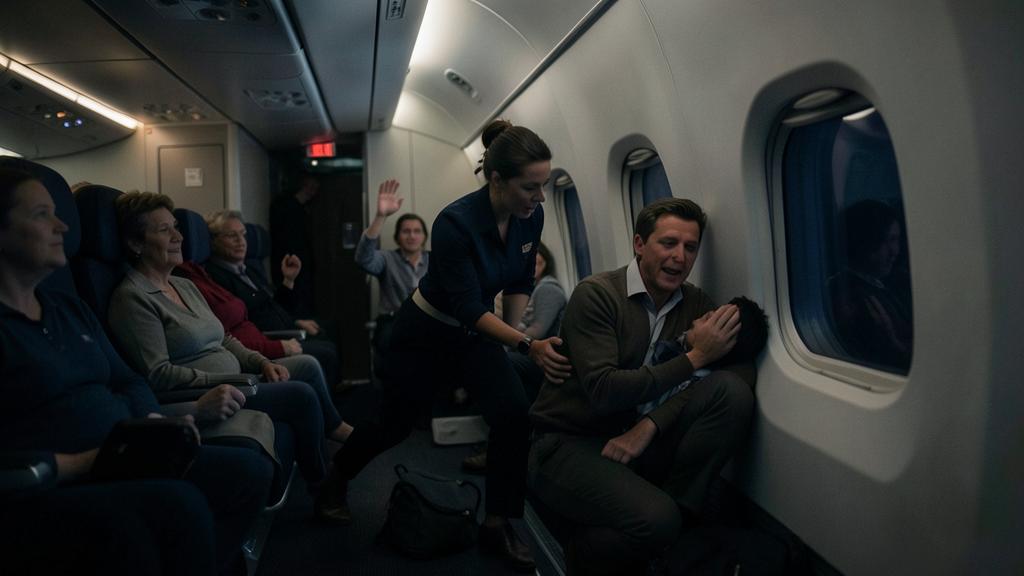
- The first is the interview that starts too early.
- The second is premature reassurance: the passenger recovers within a minute, says they are fine, and the crew close the event. Recovery from a faint is genuinely quick, but so is the deceptive lucid interval in several conditions that are not faints. The passenger who declines help is the one whose observations should be repeated, not the one released from them — agree an explicit interval, a check every few minutes and again before descent, and record it.
- The third is the assessment that stops at the first plausible answer. Someone can be dehydrated and having a cardiac event. The context gate tells you what is likely; it does not tell you what is happening. When the picture does not fit the story, trust the observation.
None of this is exotic. It is the ordinary content of recurrent first aid training, whose practical element is commonly rehearsed on a multi-year cycle rather than every year — which is exactly why the order deserves rehearsing between sessions instead of being rediscovered on the day. The cabin safety modules at FL330 training are organised along the same sequence.


Leave a Reply
You must be logged in to post a comment.