
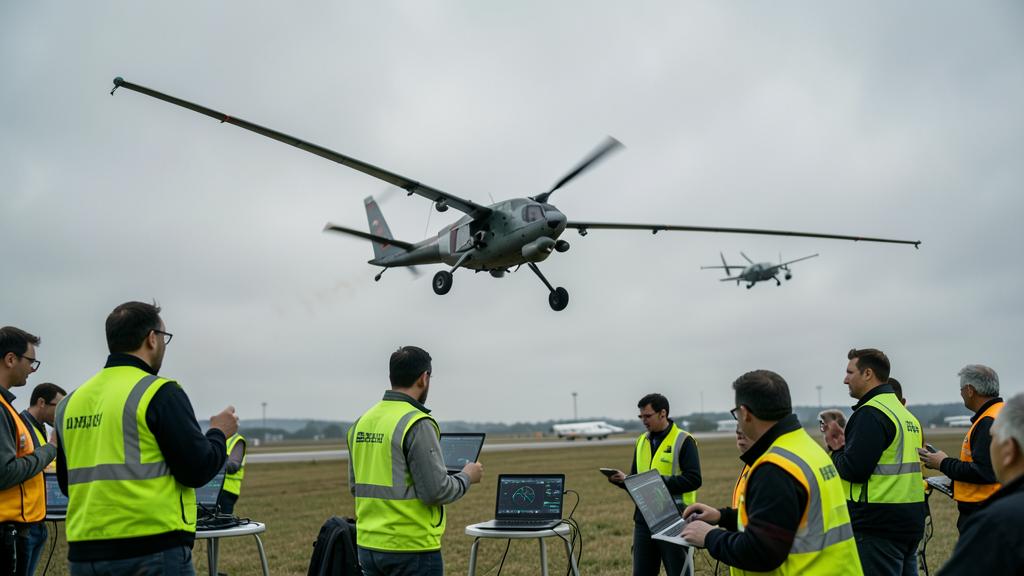
In the handover area, the buyer’s representative asks to see a full stall and an engine failure on takeoff before signing the acceptance report. The aircraft is new, compliant, its type has been certified for years, and the crew that brought it is type-rated without ever having attended a test pilot school. The refusal that must be given is not commercial: these two points belong to a campaign completed long before this aircraft existed, and no one on board that day is able to repeat them.
Two activities united only by the word « test »
Development flight and acceptance flight pursue opposing goals. The first creates knowledge that does not yet exist: actual behavior of the machine, available margins, deviations from the model, data that feed the flight manual. The second checks whether an already approved definition has been correctly reproduced on a specific aircraft. One asks: « Does the machine perform what we believe? » The other asks: « Is this aircraft the one from the drawing? » Everything else—the aircraft, the instrumentation, the crew, the acceptance criteria, the document created—flows from this difference in the question.
The development flight is itself divided. There are the test flights for fine-tuning, which belong to the design office: we explore, correct, and repeat, and a failed point is only a point that needs to be redone. Then there are the certification test flights, carried out according to a test plan accepted by the authority, sometimes with one of its pilots on board, and whose results are added to the compliance file. The same aircraft, the same crews, often the same flight—but not the same status. The first group produces design decisions; the second produces compliance documents, and we do not re-fly them because they are unpleasant.
Acceptance is also divided. The manufacturer first conducts its production test flight on each airframe leaving the line, according to a fixed program that does not change from one aircraft to another; then comes the customer acceptance flight, during which the buyer checks what he ordered; finally, the ferry flight, which is neither one nor the other. Three flights in the same week, sometimes with the same crew, and three different frameworks.
Development flight tests explore the limits of what an aircraft can do, while acceptance flights just check if a specific plane matches the approved design. They’re completely different jobs with different tools and goals.
When testing a new Airbus A320neo, development flights might push the aircraft to its maximum speed and altitude limits (Mach 0.82, 39,800 ft) to verify performance. Acceptance flights for each production aircraft will only check basic parameters like takeoff distance (typically 1,900m at MTOW) and climb performance, never approaching the extremes.
Instrumentation determines what we can prove
A development aircraft carries its own measurement chain: calibrated and traceable sensors, an air data probe offset from the disturbances of the airframe, acquisition racks, telemetry to a ground station where a team monitors the parameters in real time and can call a stop. Added, depending on the campaigns, are ballast systems to sweep the center of gravity range, and emergency equipment. The consequence is crucial: a development point produces a measurement with its uncertainty, correctable to standard conditions, reusable months later by someone who was not on board.
A production aircraft has none of this. It has the displays from its cockpit and, depending on manufacturers, a maintenance log that is erased after the flight. This results in a mechanism that few formulate: a production test tolerance can only be applied to what a crew reads from their seat with the installed instruments during flight time. This is what explains the seemingly coarse form of these criteria—a timed acceleration, a course deviation held for a certain duration, an alarm triggered before a reference point is crossed, a pressure that stabilizes after closing a valve.
What cannot be read in this way cannot become an acceptance criterion. It must be assigned elsewhere: to a ground test, a bench test, an in-production inspection, or a demonstration performed once and for all on the type. A customer demanding an unobservable criterion in acceptance is actually demanding a development test, with the aircraft, crew, and means that go with it.
Development aircraft have special sensors to measure everything precisely, while production aircraft only have standard cockpit instruments. This means acceptance tests can only check things that pilots can see during flight, not hidden technical details.
During acceptance of a Boeing 737 MAX, the crew might check that the maximum takeoff weight (MTOW) of 82.2 tonnes is achievable by verifying engine performance using cockpit instruments. They wouldn’t measure the exact thrust margin like development tests did, because they don’t have the special sensors needed.
Two crews, two ways to prepare a flight
On the development side, the crew comes from a test pilot school and pairs a test pilot with a flight test engineer. The title of the French school—flight test and acceptance personnel—says it all: these are two curricula, not one. A point is prepared with a test card that specifies the objective, the configuration, the entry conditions, the recorded parameters, and the termination criteria; a risk analysis precedes the flight; progress is made in steps, from the least risky to the boundary, never directly to the extreme point; a test director on the ground holds the authority to stop. The flight is unique and will never be repeated identically.
On the acceptance side, the crew is type-rated and trained in the production test program. The program is fixed, ordered, and performed identically hundreds of times. The sought-after competence is not exploration, but repeatability, and above all the judgment of what constitutes a deviation: recognizing that a limit value is a symptom of something else requires a fine knowledge of the machine, not the ability to fly out of the envelope. European licensing regulations distinguish categories of flight tests and add a specific flight test rating only for the most demanding of them; production tests usually fall under the others.
This does not mean, however, that acceptance is a calm flight. The crew flies degraded configurations more frequently than anyone else—switching to the backup system, emergency descent, alarm check, generator shutdown—on an airframe that has never flown before, near the airfield, and under the pressure of a delivery deadline. The risk is not zero, it is of a different nature: development faces the unknown with significant means, acceptance faces repetition with onboard means.
Test pilots are like scientists – they explore and take risks. Acceptance pilots are like quality inspectors – they follow a checklist to make sure everything matches the design. Both jobs are important but very different.
When testing the Airbus A380, development pilots might spend hundreds of hours pushing the aircraft to its limits (like crosswind landings at the edge of what will be demonstrated). Acceptance pilots for each production A380 spend only a few hours checking that the systems work as specified, such as the autopilot modes during a standard acceptance profile.
The acceptance criterion: a measurement on one side, a judgment on the other
What a development point produces is a value, its uncertainty, and its deviation from the prediction. « Accepted » means here that it is consistent with the model, and for a certification point, that it meets the targeted requirements. A result that exceeds the prediction is not a failure: it is information, and it can shift the definition, a data point in the flight manual, or a limitation entered in the file. This is even the purpose of the test—a point whose result we already knew in advance would not need to be flown.
What a production test point produces is a binary judgment in the light of a published tolerance. An exceedance says nothing about the type: it says that this aircraft is not yet the one on the drawing. No one revisits an approved definition because of one aircraft, and that is a good thing. Conversely, a compliant result proves nothing new; it confirms the fidelity of a copy.
The question of conditions remains. Most numerical criteria require a correction: outside temperature, pressure altitude, mass, sometimes configuration of the sampling. The program therefore limits the conditions under which the point is valid, and a point performed outside these limits does not produce a bad value: it produces no value at all.
The right reflex. Before takeoff, reread each numerical criterion with the three things that make it usable: the limits of the conditions under which it is valid, the correction that must be applied to bring the measurement to standardized conditions, and the instrument on which it is read. A point performed outside its limits is not a failed point, it is an unperformed point—and noting it as such avoids having to explain six months later why an outlandish value appears in the dossier of a delivered aircraft.
| Item | Development and certification flight | Production test flight and acceptance |
|---|---|---|
| Question asked | Does the machine perform what we believe? | Does this unit match the approved definition? |
| Aircraft | Prototype, moving definition, ballast and center of gravity controlled | Production aircraft, fixed definition, customer equipment |
| Instrumentation | Dedicated measurement chain, calibrated sensors, telemetry to a ground station | Onboard displays, at best a maintenance log |
| Crew | Test pilot and flight test engineer from a test pilot school | Type-rated crew, trained in the production test program |
| Preparation of a point | Test card, risk analysis, step-by-step progress, interruption criteria | Fixed program, predetermined order, conditions to be respected |
| Result produced | A value, its uncertainty, its deviation from the prediction | A judgment: compliant or non-compliant with a published tolerance |
| An unexpected result means | Information: the definition, the manual, or a limitation can shift | A defect of this unit, to be handled by the quality system |
| Repetition | The point is unique and will be evaluated for a long time | The point is identically repeated on the entire production |
| Document fed | Conformity dossier, type certificate, flight manual | Statement of conformity for the unit, acceptance protocol |
The customer acceptance flight certifies nothing
Two flights systematically confused, even in internal reports. The production test flight belongs to the manufacturer and its quality system: it feeds the conformity statement that the production organization issues for this aircraft, and on this basis the airworthiness certificate is issued.
The customer acceptance flight, on the other hand, is a contractual action. It checks compliance with the purchase contract: layout, options, equipment, operation of the ordered equipment, sometimes negotiated performance guarantees. It is signed by the parties and by no one else. A refusal of acceptance is a commercial event: it does not make the aircraft unfit to fly, and conversely, an acceptance is not an approval of airworthiness. Reservations are handled in a list of corrective actions, each with its deadline.
The case of the business jet delivered « green » makes the difference visible: the airframe leaves the line, undergoes its production tests, goes to an outfitter, returns modified, undergoes a campaign on what has changed, and then goes through acceptance. The same aircraft will have been accepted several times, each time on a different object.
The trap. A maneuver requested during the acceptance flight because it was in a certification demonstration. Full stall, engine failure on takeoff, shutdown and restart, steep turn: these points were demonstrated once on an instrumented aircraft, by a test crew, with preparation and emergency means that do not exist on that day. Performing them on a production aircraft proves nothing and shifts the risk from the campaign to the handover area. The right answer is documentary: show where the point was addressed, and on what basis it is not repeated.
| Flight | Subject | Who demands it | Effect of a refusal or deviation |
|---|---|---|---|
| Production test | Checking the conformity of the unit with its approved definition | The quality system of the production organization | The unit cannot be declared compliant: no airworthiness certificate |
| Customer acceptance | Checking conformity with the purchase contract, including equipment and options | The contract, never the authority | Commercial dispute and list of corrective actions: airworthiness is not affected |
| Ferry or delivery | Moving the unit from one location to another | The operator or the manufacturer, like a normal flight | No test is provided, no tolerance is checked |
The post-flight, or how to clear a signal without wanting to
The production test program has a rare property: it applies the same measurement under the same conditions to each finished object leaving the line. It is the last continuous control of the manufacturing process on the assembled product. Treated as a gate to pass, it only provides binary information per aircraft; treated as a measurement, it provides a population.
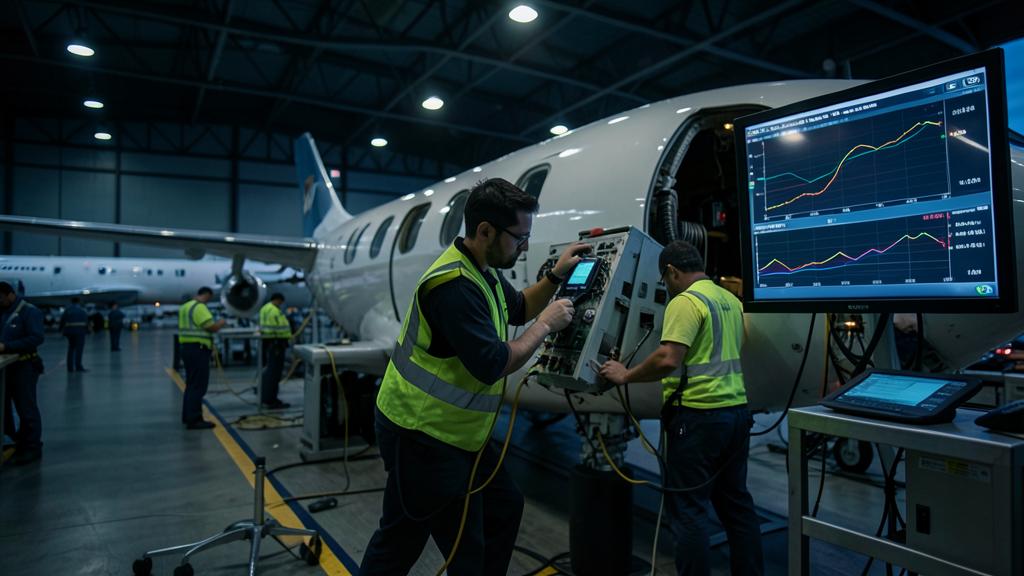
A population drifts. A wiring harness adjusted slightly differently since a tooling change, a slightly stiffer batch of seals, a reworded calibration procedure: none of this takes an aircraft outside its tolerance, and all of it shifts the cloud. Read one aircraft after another, the result remains compliant, until one day it is not, and on that day the question arises: since when, and on how many already delivered aircraft?
The trap. Repeating a point until it is passed, and then only recording the compliant result. Each repetition is honestly justified—a cold servo actuator, a poorly estimated mass, an unstable air layer—and the sum of these justifications destroys the only continuous measurement that the manufacturer has on its finished product. On the day when an aircraft clearly exceeds the tolerance, there is nothing in the archives that says when the drift began or which delivered aircraft are affected.
The right reflex. Record the first measured value and the conditions under which it was obtained, before repeating the point. These are the only data that feed the comparison between aircraft, and they are also the only ones that protect the crew: a value written before the discussion is not renegotiated. The compliant result obtained on the second pass is recorded next to it, not in its place.
The corollary concerns the treatment of the deviation. A point outside tolerance on an isolated aircraft is a manufacturing non-conformity: quality system, corrective action, re-flight of the affected point only, possibly a formal concession if the deviation is accepted as is. The same point outside tolerance on several consecutive aircraft is a signal about the process or the definition, and it goes beyond the workshop. The difference is not seen in flight: it is seen in the register.
What to check at home, and the area that remains gray
In the production test program that you apply, three lines, above all others, deserve to be found: the correction to standard conditions associated with each numerical criterion, the number of repetitions authorized for a non-compliant point, and the function empowered to authorize these repetitions. A program that is silent on these three points leaves the crew alone to decide, and the decision always tends toward the delivery deadline.
On the contractual side, check whether the acceptance protocol attached to the contract has its own tolerances or refers to the manufacturer’s program. Both designs exist and do not lead to the same dispute: in the first case, a buyer can reject an aircraft that nevertheless complies with its approved definition; in the second case, he only opposes what the manufacturer already imposes on itself.
The gray area is after delivery. An aircraft coming out of a major modification or heavy maintenance often flies with a verification program in hand. This flight is not a production test—the airframe is no longer in the hands of the production organization—nor is it an acceptance flight, since no one is buying. It falls under a third regime, that of the maintenance check flight, with its own requirements for preparation, crew composition, and flight execution. Treating it as a normal flight by default is the most costly of the three confusions and the most common.
For those preparing an application, finally, the two paths do not have the same starting point. One leads through a test pilot school and is prepared years in advance, with a heavy technical profile. The other leads through a type rating, solid experience with the machine, and internal training in the program; it relies on consistency and the ability to document a deviation, not on flying outside the envelope. A file that confuses the two disqualifies itself at first reading. The exchanges of the FL330 technical forum and the FL330 training courses address the question from this perspective.
The certification regulations applicable to the type, the manual of the production organization, the approved test program, and the contractual acceptance protocol take precedence over this article, whose purpose is to clarify a mechanism and not to replace it.


Leave a Reply
You must be logged in to post a comment.