
A passenger who cannot leave their seat without help does not create a problem at the moment of an evacuation. The problem, when it exists, was built hours before — in the reservation, at check-in, at the gate — every time no one decided who would move that person, which exit, and at what point in the flow. This article follows that chain, from the three-letter code in the passenger list to the individual briefing at the seat.
Ninety seconds, and who is inside them
Large transport aircraft are certified based on a demonstration that shapes the entire discussion: the total cabin evacuation capacity in ninety seconds, in the dark, with only the exits on one side available. Depending on the type, this case is shown through a full-scale test or through an analysis supported by partial demonstrations. Either way, the figure is not a goal for a real evacuation. It is a design constraint that sets the size of the exits, the width of the aisles, and the dimensions of the assistance space.
What matters for cabin safety is the population used in that demonstration. Its composition is prescribed — a mix of ages and genders, with dolls for babies — but each participant can leave their seat without help. No one in that cabin needs to be lifted. The certification base, therefore, says nothing at all about how long it takes to move a passenger who cannot get up, and it has never claimed to. The gap between the certified cabin and the real cabin is only filled with one thing: a plan made before takeoff.
That plan is not a document. It is three pieces of information that must exist in someone’s head before the doors close — who moves this passenger, which exit, and when in the sequence. If any of the three is missing at the boarding gate, it will be missing at the worst possible moment, because an evacuation is precisely the situation in which nothing new can be organized.
The evacuation plan is not about the aircraft’s design but about preparing for real passengers. The certification test assumes everyone can move fast, but real life includes people who need help. The plan must be made before takeoff, or it won’t work when needed.
On an Airbus A320, the certification test requires a full cabin of up to 180 passengers to exit in 90 seconds. But if a passenger in a wheelchair is seated on an aisle seat near an exit, the crew must have a plan to move them last, after the main flow, to avoid blocking the exit. The certification doesn’t account for this, so the crew must.
Reading the codes without relying on them
The passenger list arrives with special service codes. They are a common industry vocabulary and are useful, but they describe a service to be provided on the ground, not a capability in the cabin. A code tells you what assistance was requested; it does not tell you if the person can transfer to a seat, tolerate a brace position, hear a shouted order, or follow an instruction under stress.
| Code | Ground meaning | What it does not answer |
|---|---|---|
| WCHR | Wheelchair to the ramp; the passenger can handle the steps and reach the seat without help | Fatigue and pain after a long taxi, or ability to move quickly in a crowd |
| WCHS | Wheelchair to the aircraft steps; the passenger cannot handle the stairs | Whether a stair-based evacuation, or a slide, is even possible |
| WCHC | Wheelchair to the cabin seat; the passenger is immobile and must be carried | Weight, transfer technique, torso control, need for two or three lifters |
| DPNA | Assistance for an intellectual or developmental disability | Response to alarms, shouted orders, and strangers touching them |
| BLND / DEAF | Declared sensory disability | Whether the passenger will receive the command channel actually used in an evacuation |
| STCR | Stretcher case | Everything: this is a separate operation with its own medical authorization |
The code is a starting point for the conversation, never a substitute for it. The only reliable source of information about capabilities is the passenger, and the only reliable time to ask is before takeoff, in calm conditions, at the seat.
The trap. Two passengers coded the same way may need opposite plans. A young wheelchair user with full upper torso strength may reach an over-wing exit faster than most of the cabin. An elderly passenger with no code at all, traveling alone after surgery, may be the person who really cannot get out. The codes capture declared needs; they never capture undeclared ones.
The seat is a decision, not a preference
Seat assignment is where the evacuation plan is physically written. Several factors act at once, and sometimes pull in different directions.
The first is absolute where the rule has been written: a person who could not help open an exit and clear the path must not sit in an emergency exit row. This is not about dignity, it is about the exit itself — the seat that blocks the fastest path in the cabin must be occupied by someone who can operate it and then move immediately.
The second is the aisle. A movable armrest turns a difficult transfer into a manageable one, and its absence is what forces an uncomfortable lift over a fixed structure. The aisle seat is normally the right answer, but the aisle also carries the main flow of passengers heading to the exits, and a person who is lifted into the aisle at the wrong moment becomes an obstacle for everyone behind.
The third is proximity — not to any exit, but to an exit that will still be usable and to the crew member who will actually handle the situation. That crew member has an assigned door with assigned duties, and in a real evacuation will stay at that door. Understanding this is what makes the rest of the plan make sense.
The right reflex. When several passengers need assistance on the same flight, distribute them throughout the cabin instead of grouping them. Concentration creates a single zone where the flow stalls; distribution keeps the performance of each exit close to normal and gives each of them a different crew member and a different set of neighbors.
Who makes the move
This is the question that most frequently goes unanswered, and the answer is rarely « the cabin crew ». Crew members are assigned to exits. Their first duty in an evacuation is to open, assess, and control their door and then maintain the flow through it. A crew member who leaves the door to lift a passenger has removed the exit controller — which slows everyone down.
Therefore, assistance comes from one of three sources, in descending order of reliability.
- An accompanying person traveling with the passenger, who knows the transfer technique and the person’s tolerances. Both European and U.S. frameworks allow an airline to require an accompanying passenger of this type when the traveler could not participate in their own evacuation or could not understand safety instructions — but the conditions and language differ, and the decision belongs to the operations manual, not to the crew at the gate.
- A capable passenger identified and briefed before takeoff. Selecting one is a deliberate act: someone seated nearby, physically capable, calm, who speaks a language the crew speaks, and who has agreed. A capable passenger who has not been asked is not a plan.
- The crew, after the main flow, which is the backup plan and the reason the passenger is normally moved last. There is nothing cruel in « last »: the cabin empties in seconds, and moving a non-ambulatory passenger against the flow is slower and more dangerous than moving them behind it.
How many passengers of this type a single flight can carry is where practice diverges. In the United States, the framework of the Air Carrier Access Act prohibits an airline from limiting the number of passengers with disabilities on a flight. Many European operators publish an operational limit in the operations manual, derived from the number of cabin crew and available assistance. If you work on both sides of the Atlantic, do not assume that your company’s limit is a law of physics — it is a rule of your manual.
The individual briefing that must occur
Special categories of passengers receive an individual briefing. European operational rules arrive at this through the procedures an operator must establish for their transport, and it is standard practice elsewhere, but the requirement says less than the practice needs. A briefing consisting of pointing to the safety card and asking « is everything okay? » has satisfied nothing.
A useful individual briefing is a two-way exchange with fixed content, and it takes less time than the boarding announcement.
| What the crew says or asks | Why it is in the briefing |
|---|---|
| « Tell me how you normally transfer » and « what I should not do » | The passenger is the expert in their own body; an incorrect lift injures both parties |
| Location of the two exits to be used, in order, pointed out | Directional memory survives stress much better than a verbal description |
| The brace position that is actually possible for this person | A fused spine, a cast, or a prosthesis may make the standard position impossible |
| « You will be moved after the main flow, and someone will stay with you » | Eliminates the panic reflex of trying to get up at the first shout |
| Introduction of the accompanying person or briefed capable passenger by name | Turns an abstract plan into two people who have looked at each other |
| How the passenger will be alerted, if hearing or vision is affected | The cabin public address system and lighting are not universal channels |
| Where the mobility device is, and that it will not travel with them off the aircraft | Prevents the most common delay: a passenger who refuses to leave without their wheelchair |
That last line deserves emphasis. A personal wheelchair is not luggage to its owner; it is autonomy, and often adapted and expensive. Saying it explicitly on the ground — that the device stays, that it will be retrieved, that the priority is the person — is much more effective than saying it for the first time amid the smoke.
Boarding and disembarking: the flow that protects the plan
Pre-boarding exists for operational reasons, not courtesy. A transfer performed in an empty cabin is slower, quieter, and safer than the same transfer in an aisle full of people stowing luggage. It also gives the crew the only quiet window they will have to perform the individual briefing correctly, before boarding absorbs their attention.
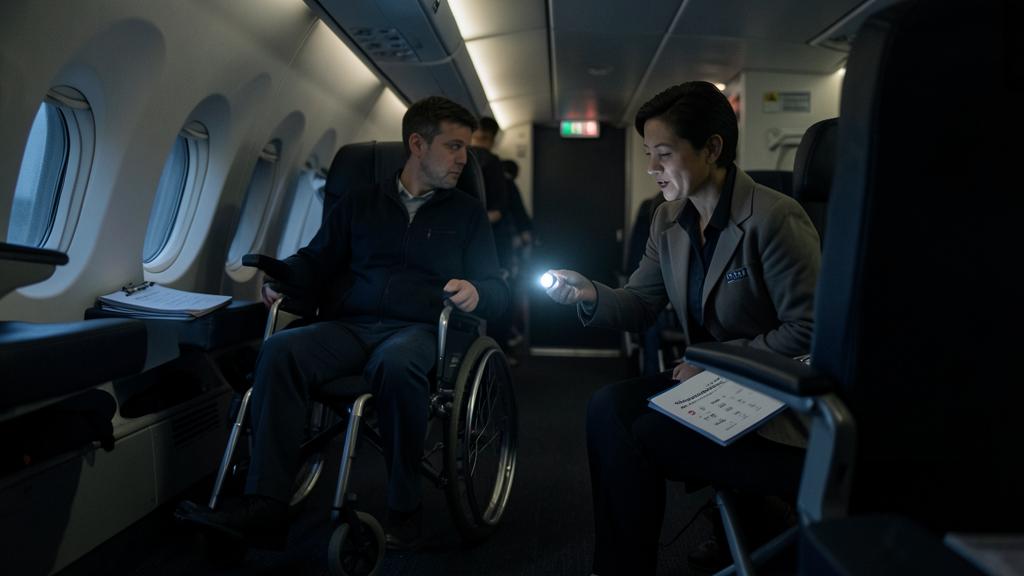
Disembarking works in reverse for the same reason. It also produces the moment when the plan most often fails: the aircraft is in the parking position, the cabin is empty, and the onboard wheelchair or ground assistance has not arrived. In Europe, that assistance is the responsibility of the airport operator rather than the airline, which is exactly why it may be missing — the chain crosses an organizational boundary at its weakest point. The advance notification on which the system is based, given a defined number of hours before the published departure time, only works if it survives every transfer between systems along the way.
| Step | What it protects |
|---|---|
| Pre-boarding, empty cabin | A transfer without an aisle full of people, and a briefing without interruptions |
| Individual briefing at the seat | Passenger capability learned rather than guessed from a code |
| Capable passenger identified and introduced | An assistant who has agreed, rather than one improvised in the dark |
| Handover at any aircraft, gate, or crew change | The plan being rebuilt rather than silently inherited as a list of names |
| Disembarking at the end, help recovered at the door | The passenger leaving without a struggle over the wheelchair |
The trap. A last-minute aircraft change, a gate change, or a crew change resets the plan to zero without anyone announcing it. The new crew inherits the passenger list, not the briefing; the new aircraft may have a different exit design and seats with fixed armrests. Treat any of these three events as a trigger to rebuild the plan from the seat up, not as an administrative detail.
The mobility device, the battery, and the dangerous goods regulations
The chair itself is a technical item, not just luggage. Where it carries a battery, the international dangerous goods framework applies: the distinction between spillable and non-spillable types, the treatment of lithium batteries, the obligation to protect terminals against short circuits, and the question of whether the battery is removable determine what is allowed and how it must be prepared. The applicable limits are set in the Technical Instructions and updated in a regular cycle — read the current edition and your own operations manual rather than a remembered figure.
Two operational points follow. First, the acceptance decision belongs to the ground and must be resolved before the passenger arrives at the aircraft; a discussion about the battery at the gate has already delayed departure. Second, the crew must know where the assistance device is stored, because the answer given to the passenger at the destination depends on it, and because a chair stored in the cabin must be secured to not become a projectile.
Where the responsibility really is
The uncomfortable part of this topic is that the plan spans four organizations that do not report to each other: the booking channel that captured the need, the airport authority that provides ground assistance, the handling agent that operates the equipment, and the operator whose crew will execute the evacuation. Only the last of these is on the aircraft.
That is why the useful mental model for the cabin crew is simple: everything before that may have failed, and the plan is still yours to make. The passenger list is an input. The service codes are an input. The presence or absence of the aisle chair is an input. The three questions — who moves this person, which exit, at what point in the flow — must be answered by the people who will be on board, before the doors close, every time.
Crews who compare how other operators structure the pre-takeoff conversation and the selection of a capable assistant will find the discussion open in the FL330 forums.
What good looks like
A cabin where this is handled well has recognizable signs. The purser knows the seats before boarding begins, by having looked at them rather than from the manifest. The passenger has been spoken to and has said something in return. A named person sits within reach. The seat has a movable armrest and is not in an exit row. The crew member responsible can name the primary and alternate exits for that specific seat.
None of that costs more than a few minutes at the gate. All of it disappears if the plan is only built when the alarm sounds.


Leave a Reply
You must be logged in to post a comment.