
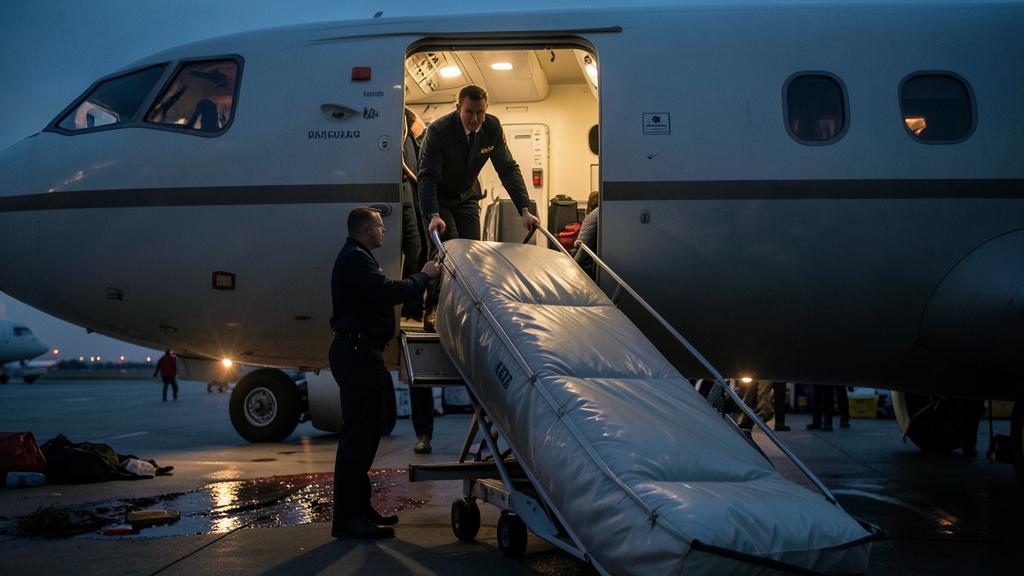
An evacuation slide either carries the column or it doesn’t, and the cabin crew member at the threshold has roughly the time it takes to take a breath to decide which. That decision isn’t a mechanical inspection. It’s a quick visual check with a binary outcome: flow or no flow, immediately followed by a command loud enough to redirect people who’ve already chosen their aisle. Everything that makes that decision viable must be in place beforehand: what the door does when it opens armed, what the visible failure modes are from the threshold, why an underinflated slide is usually still an exit while a twisted one never is, and where the redirected column gets stuck once a door has been blocked.
What the door does while you’re still on the handle
With the door armed — girt bar hooked to the floor fittings, or the automatic mode selected in types where the connection is made via a hinge instead of a bar — opening the door pulls the package out of its container and fires the inflation cylinder. The aspirators multiply the stored gas with ambient air, and the slide erects. Airworthiness codes for large aeroplanes require that erection be automatic and complete within a handful of seconds after the exit opens, and that the assembly remains usable in a specified wind from the least favorable direction; the exact figures live in CS-25 and its FAR Part 25 counterpart, and are the reason the sequence appears instantaneous from the cabin.
Two consequences matter operationally. First, none of that sequence is under your control once the handle has moved: you’re an observer of a mechanism, not an operator of it. Second, the sequence is fast enough that a slide that hasn’t visibly begun to erect by the time the door has reached its open, locked position isn’t delayed — it’s failed. Waiting for it is the most expensive habit in this part of the job, because the clock assumed by the certification basis isn’t generous.
That clock is worth stating clearly. The full-capacity evacuation demonstration behind every large transport certificate is performed with no more than half the available exits, on the assumption that the rest are unusable. Your aircraft was certified on the assumption that some doors would fail. Blocking one, therefore, isn’t a deviation from the design case. It is the design case.
The slide must inflate in seconds, or it’s broken. The plane was tested assuming some slides won’t work, so blocking one isn’t a failure—it’s normal. You have seconds to decide.
On an Airbus A320, the slide must be inflated and usable within 6 seconds of the door opening. If it isn’t, the crew must block the exit and redirect passengers. The aircraft was certified to evacuate with only 50% of the exits available.
The three seconds, and what they’re really for
The window between the door reaching the locked position and the first passenger arriving is short and not spent only on the slide. Most operators’ procedures encode the same three-part look, in this order, because reversing it wastes the only time you have.
- External conditions first. Fire, smoke, fuel on the ground, an engine still turning, an obstacle under the door. A perfect slide in a puddle of fuel is a worse exit than a hanging slide in clear air. This evaluation should already have been performed through the window before the door opened, but it’s confirmed upon opening because the picture changes.
- Then the slide. Shape, attachment, orientation, contact with the ground. No pressure readings, no condition of the fabric — geometry.
- Then the command. Either the flow command, or the block command. Silence at a door is read by passengers as permission.
What makes this viable is that the geometry check is coarse. You’re not judging degrees of inflation. You’re answering a question: Does this thing form a continuous, straight, attached path from my threshold to the ground? Everything else is a detail the debriefing can have.
Failure modes that are visible from the threshold
Slides fail in a small number of recognizable ways, and they look sufficiently different from each other that diagnosis is genuinely a glance. The table below establishes what you see, what has happened, and what the threshold decision is. The operator’s manual governs in each case; what follows is the reasoning those manuals encode.
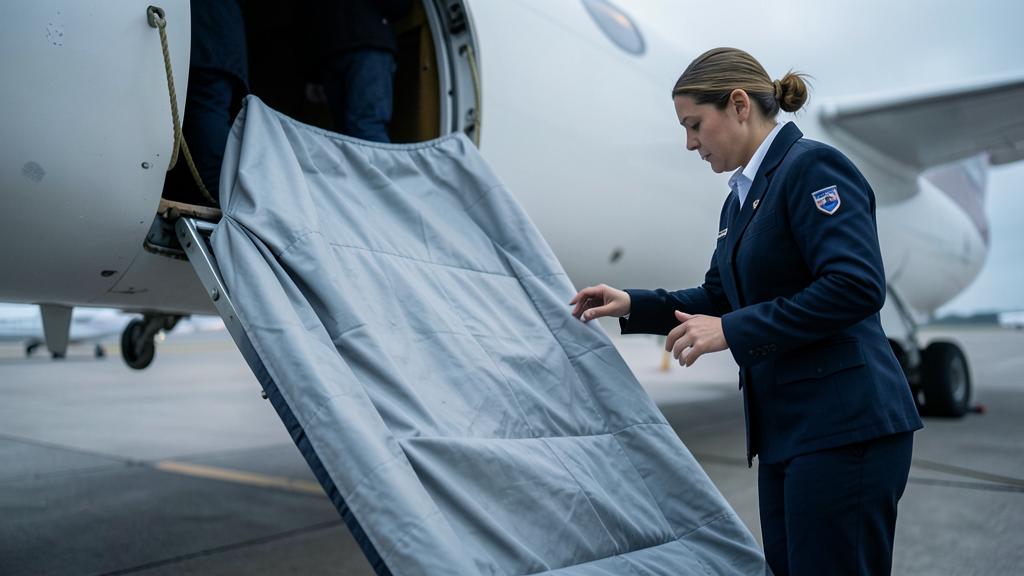
| What you see | What has happened | Threshold decision |
|---|---|---|
| The package falls, nothing inflates | Girt disconnected, the door wasn’t armed, or the inflation system didn’t fire | Manual inflation handle, once. If nothing, block and redirect |
| The slide erects but is soft and sagging | Partial inflation — undercharged cylinder, aspirator valve clogged, minor leak | Usable in most cases: flow with spacing, one at a time |
| The slide lies along the fuselage instead of away from it | Wind, or the slide has snagged on the structure during erection | Block. A slide parallel to the skin has no landing area |
| Inflated but rolled, twisted, or bent along its length | Deployment through an obstacle, or packing anomaly | Block. A twisted slide flings people to the sides at high speed |
| Slide inflated under the fuselage or trapped under the threshold | Aircraft attitude, landing gear collapse, or the package came out of the container wrong | Block. Don’t try to free it by hand |
| Slide inflated in the cabin | Container or door mechanism failure | Exit lost and door area lost. Redirect immediately, protect the aisle |
| Correct slide but not touching the ground | Unusual attitude, terrain, landing gear collapse on the opposite side, or water | Judgment call per operator criteria; a slide that stops short is a drop, not a slide |
| Slide progressively deflating after erection | Puncture by debris, hot brakes, or ground contact damage | Flow while it holds, prepare the redirect command before needing it |
The trap. The two failure modes that look most alarming — the soft slide and the slide that erects with an audible bang — are usually the usable ones. The two that look orderly from the threshold are the dangerous ones: a slide lying flat against the fuselage and a slide twisted along its axis present a broad, apparently continuous surface to someone looking down. Look for the lane, not the fabric.
Underinflation is not unusable
The slide’s pressure is a means, not an end. The end is a lane that supports a person’s weight and delivers them feet-first at the bottom. A slide holding well below its nominal pressure can still do that, more slowly and with more bounce, as long as it’s straight, attached to the girt, and touching the ground. That’s why crews are taught to modulate flow instead of closing the exit: single file, one at a time, hands and arms forward, sit and exit instead of jump and exit.
The distinction that decides the case isn’t the pressure, but the attachment and alignment. A slide still connected to the girt with both side tubes broadly parallel is a managed exit. A slide that has lost its geometry — because a tube didn’t inflate, because it’s bent, because ground contact is only at one corner — isn’t a degraded exit, it’s a different object that happens to be made of the same fabric. There’s no partial credit in that second category.
The correct reflex. Say what you decided, not what you saw. “Come this way, one at a time” and “Exit blocked, go ahead” are commands. “The slide looks weird” is an observation, and an observation delivered from a threshold during an evacuation will be interpreted by forty people in forty different ways.
Manual inflation: one handle, one decision
Slide installations on transport aeroplanes provide a means of manual inflation at the door, and every recurrent training programme drills its location because it’s the only intervention available to you after the automatic sequence has failed. It’s worth being precise about what it can and can’t recover.
It recovers a firing failure: the package is out, the girt is attached, the cylinder didn’t discharge. Pulling the handle fires it. It doesn’t recover a girt that never connected, because there’s nothing anchoring the slide to the aircraft; it doesn’t recover a slide that has deployed into an obstacle, because inflating it harder pushes it further into that obstacle; and it doesn’t recover a package still inside its container. Pulling in those cases costs the seconds you needed for redirection, and in the case of the obstacle may worsen the door area.
The sequence rule that most manuals apply is, therefore: one pull, one look, then commit. The exit is recovered or it’s discarded, and the crew member’s attention moves to flow rather than the mechanism.
Blocking is a command and a body, not a decision made in silence
A blocked exit fails as a control measure in a specific and repeatable way: the crew member decides it’s blocked, and the passengers don’t find out. In a cabin at evacuation noise levels, with people who’ve oriented toward the nearest door since the pre-flight briefing, an unusable exit has to be physically and verbally defended at the same time.
Physically means occupying the threshold with your body, arms outstretched, facing the cabin — not standing beside the door looking at the slide. Verbally means a two-part command that names the failure and gives the alternative: the destination has to be in the phrase. “Exit blocked” by itself stops the column at the door and creates the crush you were trying to avoid, because people who’ve been stopped and not redirected simply wait.
Where the redirected column really gets stuck
Redirecting flow isn’t a matter of evenly dividing passengers. Traffic arrives as a column that’s already committed, and the cabin geometry decides where it slows down. Bottlenecks are predictable enough to be briefed.
| Where | Why it restricts | What relieves it |
|---|---|---|
| The threshold you’re blocking | People stop instead of turning; the column compacts against your back | Name the destination in every command, not just the negative |
| The cross-aisle in the galley | Two columns merge into a door width, and carry-on bags appear here first | A second crew member positioned at the merge, not at the door |
| The overwing exits | Self-assist exits without crew, handling of the hatch, and a longer path to the ground | Assertive briefing of capable passengers before it’s needed |
| Pitch of seats row by row toward the rear | Passengers moving in the opposite direction to the expected travel | Commands that establish a travel direction by section |
| The far door itself | Arrival rate doubled versus the flow rate of a single slide | Flow discipline at the threshold: pairs where the slide is double-lane, singles where it isn’t |
The last line is the one that surprises crews. Blocking a door doesn’t halve the evacuation rate — it transfers part of that door’s demand to the receiving exit, which in the worst case approaches doubling it, and the flow capacity of a slide is determined by the recovery time at the bottom as much as by the lane itself. Anyone who stops at the bottom of a slide turns a functional exit into a blocked one in seconds, which is why the bottom of the slide is a crew position in its own right whenever the crew complement allows.
Wind, attitude, and the ground you didn’t choose
Slides are certified against a wind criterion, but the certification wind is measured in clean conditions with the aircraft on its landing gear in normal attitude. Several of the situations in which you’ll actually use a slide violate one of those assumptions. A collapsed nose gear tilts the forward slides and flattens the aft ones. A gear-up landing puts the thresholds close to the ground and gives you slides with almost no travel. An engine still turning on the same side completely changes the external conditions test, regardless of what the slide does.
None of that changes the threshold test, which is exactly why the threshold test is expressed in terms of geometry rather than a checklist of conditions. Continuous, straight, attached, touching. If those four hold, the exit works; if one fails, the exit doesn’t, and the reason belongs to the investigation rather than the next three seconds.
What the debriefing should capture, and why nobody does
Slide failures are rare enough that the profession learns about them through reports rather than experience, and the reports are frequently unusable because they describe the outcome rather than the image. “The slide didn’t deploy correctly” doesn’t support any engineering action. The details that matter to the manufacturer and the safety department are the ones that were visible in the first seconds: was the package out of the container, was the girt attached, did the cylinder fire, which tube was soft, in what direction the slide lay, what the wind was doing, what the aircraft attitude was.
The same applies to training. Crews are extensively trained in door operation and comparatively little in the threshold decision itself, which is the part that’s really critical in time and the part where hesitation is measured in lives. A useful recurrent exercise isn’t another door drill: it’s an image shown for two seconds, followed by a demand for the command — flow or block, with the destination. Operators who run it discover very quickly which failure modes their crews recognize and which produce a pause. Cabin safety discussions of this type, including how different operators word their block commands, are regularly held on the FL330professional forums, and the wording differences are more instructive than they appear.
The rule to take to the door
The slide isn’t the exit. The lane is the exit. You have three seconds, you spend them on external conditions, then geometry, then a command with a destination in it. Underinflation generally flows; twisted, flattened against the fuselage, trapped, or short of the ground never does. The manual handle gets one pull and only for a firing failure. And blocking a door isn’t an evacuation failure — it’s the condition under which the aircraft was certified to evacuate, provided the people at the blocked door are told, loudly, where to go instead.


Leave a Reply
You must be logged in to post a comment.