

A duty period that ends inside the limit is legal. Whether the crew member who flew it slept is a separate question, and the regulation does not ask it. That gap — between a rule that constrains hours and a physiology that responds to sleep — is the entire subject of fatigue risk management. Closing it means collecting data the roster does not generate on its own, and knowing which measurements are worth the trouble of collecting. This is how the prescriptive layer and the data layer are meant to fit together, and where they usually fail to.
Two regimes, one obligation
International practice, set out in ICAO Annex 6 and developed in the associated manual on fatigue management oversight, gives a State two ways to discharge the same duty. It must establish prescriptive flight and duty time limitations, and it may also approve a fatigue risk management system as an alternative means of compliance with some or all of them. These are not competing philosophies but two answers to one problem, working at different resolutions.
The prescriptive layer is a boundary condition. It encodes a defensible generic assumption about how much duty a typical crew member can absorb, and it applies to everyone identically. Its strengths are that it needs no data to enforce, no approval to use, and no interpretation to audit. Its weakness is the same sentence read backwards: it is generic, and no individual roster is.
The data layer is a control loop. It measures what happens on specific duties flown by specific crews, identifies where the generic assumption does not hold, and applies mitigations proportionate to what the measurement shows. It costs more, requires competence the operator has to build, and produces conclusions that can be uncomfortable.
| Prescriptive limits | Fatigue risk management within the limits | Full fatigue risk management system | |
|---|---|---|---|
| What it constrains | Duty hours, flight hours, rest periods, cumulative totals | The residual risk of schedules that are already legal | The risk itself; specific limits may be replaced |
| What it assumes | A typical crew member with a nominal sleep opportunity | That the typical case is not the whole population | Nothing that is not measured |
| Evidence required | None beyond records of compliance | Hazard identification, reports, risk assessment | A safety case with baseline data and continuous monitoring |
| Approval | Compliance is the default | Part of the safety management system | Explicit prior approval by the authority |
| Failure mode | Legal schedules that are nevertheless fatiguing | Reports collected and never acted on | A model relied on in place of measurement |
What a prescriptive limit actually promises
Read carefully, a flight time limitation scheme makes a narrower promise than most people assume. It says that the duty will not exceed a stated length, that the interval before the next duty will not be shorter than a stated minimum, and that the cumulative totals over a window will stay under a ceiling. It does not say the crew member will be rested.
The distinction matters because rest is defined as an opportunity. A rest period long enough to contain an uninterrupted sleep opportunity is a necessary condition for sleep and nothing like a sufficient one. Whether the opportunity converts into sleep depends on the time of day it falls, the time-zone displacement, the accommodation, the commute at either end, and the individual. None of those variables appear in the limit.
The European rules do encode some of the physiology directly, and this is worth recognising rather than dismissing. They define a window of circadian low — the period from two to six in the morning in the time zone to which the crew member is acclimatised — and they reduce the permitted duty when it intrudes on that window. They define an acclimatisation state that depends on time-zone displacement and elapsed time, so that a crew member who has crossed several zones is not credited with rest they cannot physiologically have taken. They count recovery in local nights rather than in hours. These are physiological ideas expressed as clock arithmetic, and clock arithmetic is where they stop.
The blind spot: the rules limit duty, not wakefulness
The most consequential omission in almost every prescriptive scheme is that it starts its clock at report time. Performance, however, degrades as a function of time since waking, and the two clocks are not the same one.
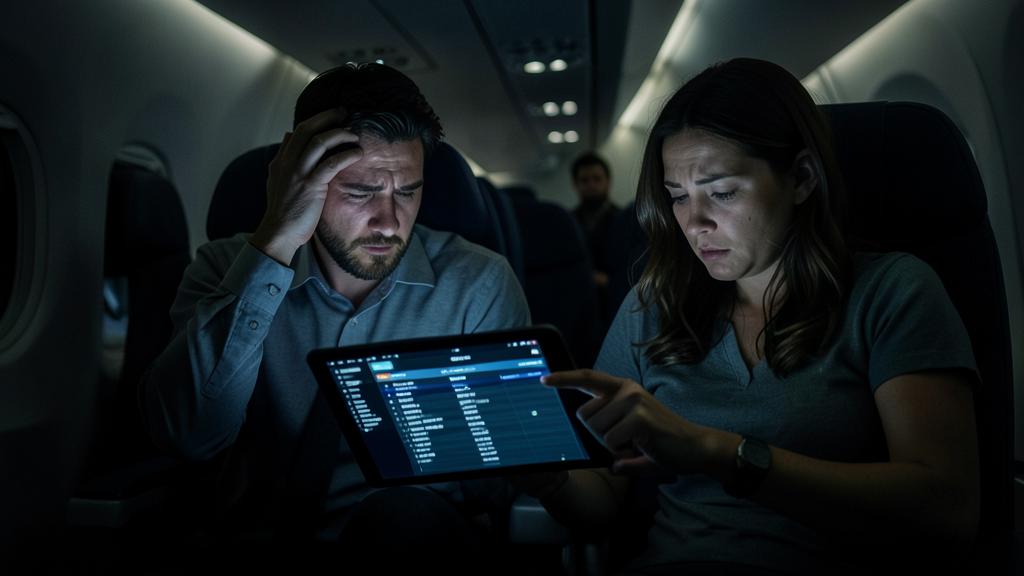
Take a duty reporting at five in the morning. Reaching the aeroplane means waking around half past three, which means a sleep period beginning in the early evening — at a point in the circadian cycle when falling asleep is physiologically difficult, in what sleep researchers call a wake maintenance zone. The crew member begins a legal duty on curtailed sleep and flies the last approach in the fourteenth hour of continuous wakefulness. The regulation has counted twelve.
Standby is the same problem with more variance. A crew member on home standby sleeps badly precisely because they may be called, and a call late in the standby window can be followed by a full duty period. The rules handle this by counting some fraction of the standby toward the duty period — a reasonable proxy, and still a proxy. Commuting compounds it: legally the crew member’s own responsibility, operationally a large and largely unmeasured contribution to time since waking.
The trap. « Within limits » is a defence against a finding, not evidence of a safe schedule. A roster can be fully compliant and still stack consecutive early starts, a late finish followed by an early report, a standby callout into a maximum duty period, and a multi-sector day landing inside the window of circadian low. Each element is legal on its own. Nothing in the compliance check looks at the sequence.
Prescriptive limits only check if a schedule fits rules, not if it actually lets pilots sleep. A pilot might follow all the rules but still be exhausted because they woke up too early, had a long commute, or worked during their body’s low-energy hours. The rules don’t track real sleep, just clock times.
An Airbus A320 crew is scheduled for a 12-hour duty starting at 05:00. They must wake at 03:30, cutting their sleep short. By the 14th hour of wakefulness, their performance is impaired, but the regulation only counts 12 hours. The rules don’t account for the extra hours of wakefulness before the official duty starts.
The physiology the limits approximate
Two interacting processes govern alertness, and every fatigue tool in use is a way of estimating one or both. A homeostatic process accumulates sleep pressure with time awake and discharges it during sleep. A circadian process oscillates on roughly a twenty-four hour period, largely independent of how long you have been awake, and produces a trough in the small hours and a lesser one in the early afternoon. The two combine: the same number of hours awake produces very different performance depending on where the circadian cycle happens to be.
Three consequences follow, and they explain most of what operators observe. A night duty is not a day duty moved: it sets maximum time awake against minimum circadian alertness. Sleep taken at the wrong circadian phase is shorter and more fragmented, so a rest period in a displaced time zone delivers less recovery per hour. And waking from deep sleep produces sleep inertia — degraded performance immediately after waking — which is why in-flight rest and controlled rest procedures specify a buffer before any operational task, and why the rest opportunity must end well before the descent briefing rather than at it.
What to measure, and what each measure is worth
An operator wanting to justify anything with data has a small number of instruments available. None is sufficient alone, and their weaknesses differ enough that a combination is stronger than the sum.
| Instrument | What it measures | Strength | Limitation |
|---|---|---|---|
| Crew fatigue reports | What crews judge worth reporting | Cheap, continuous, identifies specific pairings | Tracks reporting culture as much as fatigue; counts rise when trust rises |
| Subjective scales during duty | Sleepiness or fatigue at a moment, on a validated scale | Validated, quick, sensitive to time of day | Self-assessment degrades exactly when fatigue is worst |
| Actigraphy and sleep diaries | Sleep obtained, not sleep offered | The only direct measure of the variable that matters | Intrusive, personal data, feasible only in bounded studies |
| Reaction time testing | Vigilance decrement, typically counted as lapses | Objective, well characterised against sleep loss | Needs baseline per individual; test conditions on an aeroplane are poor |
| Biomathematical models | Predicted group-average alertness for a roster | Scales to a whole schedule before it is flown | Predicts a population, never a person; assumes sleep the crew may not get |
| Flight data monitoring | Operational events, analysable by duty hour and by time of day | Objective, already collected, large sample | Fatigue is one cause among many; association is not attribution |
| Roster analytics | Planned against actual duty, disruption, sequence patterns | Complete coverage, no extra collection | Says nothing about sleep or about the individual |
One practical point in Europe: actigraphy and sleep diaries are personal data with a health character, and a study routing them to the operator’s own management will not recruit, and should not. The workable arrangement is collection by an independent party, with informed consent, returning de-identified aggregated results. This is not a formality — participation rate largely determines whether the study means anything.
Reading the data honestly
Three analytical errors recur often enough to be worth naming.
- The first is treating fatigue report counts as a fatigue metric. They are a joint product of fatigue and of willingness to report, and the second term moves faster than the first. An operator that improves its just culture will see reports rise while risk falls, and an operator that quietly discourages them will see a flattering trend. Report counts are useful for locating specific problem pairings; they are close to useless as a longitudinal safety indicator on their own.
- The second is the missing denominator. Twenty reports mean nothing without the number of duties, sectors and crew members behind them. Rates per thousand duties, segmented by base and fleet, are comparable; raw counts are not, and a growing airline produces a frightening chart from a flat risk.
- The third is asking a biomathematical model to do the work of a measurement. These models are calibrated against laboratory sleep restriction data and predict a population average. Run against a roster, a model tells you where to look — genuinely valuable, and what it is for. It does not tell you what happened, because it assumed a sleep pattern nobody verified. A safety case resting on model output alone is a standing weakness in fatigue submissions.
The right reflex. Before designing a study, take the data already in the building. Flight data monitoring events, plotted against hours into duty, sector number and local time of the landing, cost nothing extra and frequently point straight at the two or three pairings worth measuring properly. Targeted measurement of a suspected pattern is affordable; fleet-wide measurement of everything is not, and it is not necessary.
From measurement to a case
The two data-driven routes are often confused, and the distinction is operationally important.
Fatigue risk management inside the prescriptive limits is not optional decoration: the European rules require such a process where certain relieving provisions are used, and it belongs to the safety management system like any other hazard. It identifies fatigue hazards, assesses them, applies mitigations and monitors whether they worked. It changes no limit.
A full fatigue risk management system replaces specified limits with an approved, monitored, evidence-based alternative. It is a far larger undertaking: a baseline measurement of the operation as currently flown, a predicted risk profile for the proposed schedule, defined mitigations, agreed indicators to monitor once running, and — the element most often missing — pre-agreed trigger values at which the variation is suspended and the prescriptive limit resumes. A safety case without a withdrawal criterion is a proposal, not a system.
Where EASA and the FAA part company
Two divergences are worth carrying in the head of anyone working across both systems, because both are routinely reported as universal rules.
The first is scope. The European flight time limitation rules for commercial air transport by aeroplane cover cargo alongside passenger operations, and cover cabin crew in the same instrument, a few specialised categories aside. In the United States the modern flight crew rules introduced after the 2010 legislation apply to passenger operations, while all-cargo operations continued under the older regime unless the carrier opted in — a difference argued over for well beyond a decade.
The second is controlled rest on the flight deck. Many authorities, including in Europe, permit a short planned nap by one pilot under defined conditions, with the other pilot alert, the cabin crew informed, and a mandatory buffer before top of descent to allow sleep inertia to dissipate. The FAA has long declined to authorise it for its scheduled carriers. Either position can be argued; what cannot be argued is describing one of them as the international standard. Crews and rostering staff comparing practice across operators will find the topic discussed at length on the FL330 professional forums.
What a defensible programme looks like on a roster
Reduced to essentials, a credible programme does four things and can show evidence of each. It looks at sequences rather than individual duties, because the risk lives in the pattern. It measures sleep obtained rather than rest offered, at least for the duties it has reason to suspect. It reports rates rather than counts, segmented finely enough to see a base or a fleet. And it states in advance what result would cause it to change something.
| Feature | Why it costs sleep | What to monitor |
|---|---|---|
| Consecutive early starts | Bedtime cannot advance as fast as report time; a sleep debt accumulates across the block | Sleep obtained on nights two and later, not on night one |
| Late finish followed by an early report | The rest period falls where sleep is hardest to initiate | Actual sleep in the rest period; reports concentrated on that transition |
| Standby ending in a maximum duty period | Anticipatory sleep loss during standby precedes the whole duty | Time since waking at duty end, not duty length |
| Multi-sector day landing in the circadian low | Peak workload coincides with the circadian trough and maximum time awake | Approach and landing event rates by local time |
| Short layover across several time zones | The rest period sits at the wrong circadian phase to be usable | Sleep obtained per hour of rest offered, by destination |
| Long commute to a distant base | Adds hours of wakefulness invisible to every roster system | Base allocation, crew accommodation policy, honest reporting |
None of this replaces the individual obligation, which sits in the rules in both systems and is not negotiable: a crew member who is fatigued does not operate. The purpose of everything above is to make that declaration a rare event caused by an unusual night, rather than a weekly decision forced by a schedule that was always going to produce it.


Leave a Reply
You must be logged in to post a comment.