
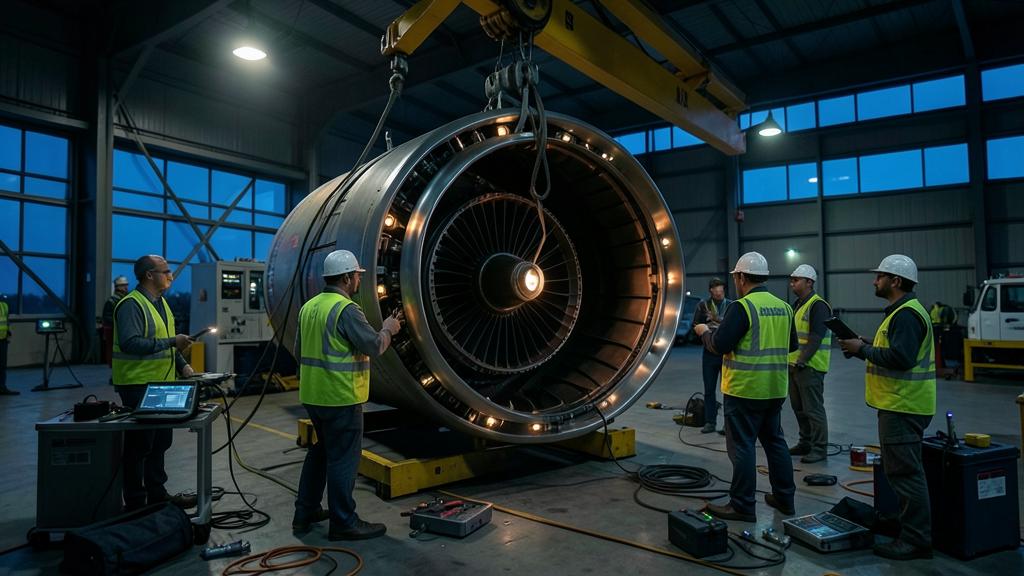
A shop visit workscope is written before anyone has seen the hardware. The engine is still on the wing, or already in a cradle waiting for a slot, and somebody has to decide which modules get opened, which get exchanged, and which are left sealed. That decision is not a pure engineering judgement about the state of the engine. It is a bet on how many cycles the engine has to deliver before it comes back, and on what a cycle costs. Get the bet wrong in either direction and you pay for it: once for work that bought nothing, or twice for a shop slot you did not plan to need two years early.
What a shop visit actually buys
A modern turbofan is not overhauled on a calendar. Apart from a small population of rotating parts carrying hard cycle limits, engine maintenance is on-condition: the engine stays on the wing until a parameter, a finding or a contractual clause forces its removal. A shop visit is therefore not a return to zero. It is the purchase of a defined quantity of three separate commodities, and confusing them is where most workscope arguments start.
- Exhaust gas temperature margin. The gap between the peak EGT the engine reaches at take-off and the certified limit. It erodes as tip clearances open, seals wear and hot-section airfoils lose their coatings. When it reaches zero for the operator’s usual derate, ambient temperature and airfield elevation, the engine comes off whatever else is true about it. Margin is restored almost entirely by work on the core.
- Authorised cycles on life-limited parts. Discs, drums, spools and shafts carry a published cycle limit that cannot be extended by inspection, by condition or by anyone’s opinion. Buying more cycles means fitting parts with more cycles left. There is no other mechanism.
- Freedom from a specific distress. A cracked case, a damaged bearing, a fuel nozzle set that has drifted, corrosion in a particular stage. These are found, not predicted, and they are the reason a workscope written in an office is always provisional.
The three commodities are bought in different places in the engine, at very different prices, and they run out on different clocks. A visit that restores margin brilliantly and leaves a disc with a short remaining life has bought an interval limited by that disc, not by the margin.
A shop visit doesn’t just fix an engine—it buys time. You’re paying for three things: performance margin, new life-limited parts, and repairs for hidden damage. The trick is balancing these to match how long the engine (and plane) will actually fly.
An Airbus A320neo with CFM LEAP-1A engines is due for a shop visit. The core’s EGT margin is down to 5°C, and a high-pressure turbine disc has 1,200 cycles left. A full overhaul (cost: $2.5M) restores the margin and replaces all life-limited parts, buying 10,000 cycles. A targeted visit ($1.2M) restores the core and replaces only that disc, adding about 3,000 cycles. The cheaper option is better if the aircraft is retiring within 3,000 cycles—but worse if it’s staying in service.
Modular architecture is what makes a choice possible
Large turbofans are built as modules: fan and low-pressure compressor, high-pressure compressor, combustor, high-pressure turbine, low-pressure turbine, accessory gearbox, and the associated externals. Each module has its own build records and, on most types, can be removed, exchanged and re-installed without disturbing the others. That is not a convenience for the shop; it is the structural reason a partial workscope exists at all. On a machine that had to be stripped to the last bolt to touch anything, the only question would be when, never how much.
Modularity also explains where the money sits. The core — high-pressure compressor, combustor, high-pressure turbine — is where the gas is hottest, where deterioration concentrates, where most of the EGT margin is lost and where most of the material cost lives. The fan and the low-pressure turbine deteriorate more slowly and are opened for cause more often than on schedule. A workscope discussion is, in practice, a discussion about the core, with the rest treated as exceptions.
Two families of workscope, and the names are not standard
Operators, manufacturers and independent shops all use their own vocabulary — minimum build, light workscope, performance restoration, full overhaul, and a dozen commercial variants. The words differ; the underlying split does not. Either the visit is scoped to fix the specific thing that caused the removal and get the engine back out quickly, or it is scoped to reset the whole core and buy a long interval.
| Targeted visit | Extended visit | |
|---|---|---|
| What is opened | The module implicated by the removal cause, plus whatever must come apart to reach it | The full core, usually with the fan and low-pressure turbine inspected to a defined standard |
| Primary aim | Return to service quickly, at the lowest cash outlay for this event | Maximise cycles delivered before the next removal |
| Life-limited parts | Replaced only where the limit would be reached inside the target interval | Replaced to a stated remaining-life target across the build |
| EGT margin restored | Partial and hard to predict — the untouched modules keep their deterioration | Close to the achievable maximum for the build standard fitted |
| Turnaround time | Shorter, with a smaller parts lead-time exposure | Longer, and more exposed to a single missing part holding the whole build |
| Risk carried | The next interval is short and its length is uncertain | Cycles bought may be stranded if the aircraft leaves the fleet first |
Neither column is the right answer. The right answer is whichever one produces the lower cost for each cycle the engine will actually be allowed to fly.
Cost per cycle is the only figure that compares them
Comparing two workscopes by their invoice is meaningless, because they are not selling the same interval. The comparison that means something divides the whole cost of the event by the cycles the engine is expected to deliver before it comes off again. That single ratio is what makes a large invoice defensible and a small one alarming.
| Side | Item | Why it counts |
|---|---|---|
| Cost | Labour and shop charges | Scales with what is opened, and with findings once it is |
| Cost | Material, dominated by life-limited parts | Usually the largest single line, and largely a decision rather than a discovery |
| Cost | Value of life left on parts removed serviceable | Cycles thrown away are cycles paid for; they belong in the numerator |
| Cost | Lease or ownership cost of the spare engine covering the gap | A longer turnaround is not free even when the shop invoice is unchanged |
| Cost | Transport, preservation, test cell running | Fixed per event — which quietly penalises frequent short visits |
| Cycles | Cycles to the next forced removal | Set by whichever limit arrives first, not by the one that was addressed |
Two consequences follow immediately. First, the fixed cost of the event itself — removal, transport, induction, test, installation — is spread over the interval, so a short interval carries a heavy per-cycle overhead before a single part is bought. Second, any life removed from the engine while it still had cycles left is a real cost, even though it never appears as a line on an invoice. That is the whole argument for an extended visit, and equally the whole argument against one when the airframe is leaving the fleet.
The trap. A workscope that produces the lowest cost per cycle on paper can still be the wrong choice, because the denominator assumes the engine will be allowed to run its full interval. A short interval on a fleet where shop slots are booked far in advance means committing to a second induction whose date you do not control. The cheap visit is only cheap if the slot exists when the engine needs it.
Life-limited parts dominate the arithmetic
The cycle limits on rotating parts sit in the airworthiness limitations of the type design. They are mandatory, they are not negotiable through inspection, and they are the one part of an engine’s maintenance that is genuinely hard-time in a system that is otherwise on-condition. A published limit changes only if the type certificate holder revises the airworthiness limitations and the authority approves the revision; nothing done in the shop, and no argument about the condition of the part, moves it. Every workscope decision runs into them because they are simultaneously the biggest material cost and the hardest constraint on interval length.
The practical difficulty is that the parts do not expire together. An engine strip typically reveals a spread of remaining lives across the life-limited population, and the build engineer has to decide where to draw the line. Fit only what has expired and the next removal is dictated by the part with the shortest remaining life, which may be very soon. Fit everything to full life and the visit pays for cycles that will outlive the aircraft’s time in the fleet. The middle route — building to a stated remaining-life target, using serviceable parts with partial life where they match — is standard practice, and it is exactly the arithmetic that makes an engine build a commercial exercise as much as a technical one.
The right reflex. Ask what limits the next interval before asking what the visit costs. If the answer is a life-limited part rather than performance, no amount of core refurbishment will lengthen the interval, and the extended workscope is buying margin the engine will never be allowed to use. If the answer is EGT margin, the reverse holds and replacing life is the money wasted.
What actually drives the next removal
A workscope is only defensible against a stated removal cause for the next visit. Writing one without naming that cause is how engines come back for a reason nobody scoped against.
| Driver | Clock it runs on | Predictable? | What a workscope can do about it |
|---|---|---|---|
| EGT margin exhausted | Cycles, accelerated by high ambient temperatures, dust and low derate | Yes, from trend monitoring | Core refurbishment; the main reason to open the hot section |
| Life-limited part expiry | Cycles, exactly countable | Completely | Fit parts with more remaining life; nothing else works |
| Hardware distress found in service | Boroscope and oil analysis findings | Partly | Only by opening the module concerned |
| Mandatory instruction compliance | Calendar or cycles, imposed externally | Once published | Bundle the embodiment into a visit already planned |
| Foreign object damage, bird strike, oil system event | None | No | Nothing — this is the reason a spare engine strategy exists |
| Contractual redelivery condition | Lease calendar | Completely | Build to the stated minimum margin and remaining life, no further |
Note the asymmetry in the last column. Only two of these drivers respond to how much of the engine you open. The others respond to which parts you fit, to what you cannot foresee, or to a date in a contract. A workscope argument that treats every driver as a performance question will systematically over-scope.
The workscope is a plan; the strip report is the truth
Everything above is written before induction. Once the engine is apart, the hardware has its own opinion. Blades that trend monitoring suggested were tired turn out to be repairable; a case that nobody was worried about shows cracking outside repair limits; a bearing shows distress that pulls in a module the workscope had explicitly excluded. The gap between quoted and final cost on engine shop visits is largely this, and it is not a failure of the estimate — it is the nature of on-condition maintenance.
Two habits reduce the pain. The first is scoping the decision points in advance: agreeing, in writing and before induction, what happens if a named module is found beyond a named limit, so the answer does not have to be negotiated with the engine in pieces and the slot clock running. The second is treating the strip report as a decision document rather than a formality. It is the only moment when the real remaining life of every part is known at once, and it is the last moment at which the interval can be deliberately chosen rather than inherited.
The constraints that have nothing to do with the engine
Several inputs to the workscope decision are not engineering inputs at all, and they routinely dominate.
- How long the airframe stays. Cycles bought beyond the aircraft’s planned time in the fleet are cycles given away, unless the engine has an onward market. On an aircraft in its final years, a short targeted visit is often the honest answer.
- Redelivery conditions. Lease agreements commonly state a minimum EGT margin and a minimum remaining life on life-limited parts at return. Those figures are a workscope specification written years earlier by someone who never saw the engine.
- Spare engine cover. The number of spares available sets how long an engine can be away. A fleet that is thin on spares has a structural bias toward shorter turnarounds, whatever the per-cycle arithmetic says.
- Shop slot availability. Induction slots for a given engine type are booked well ahead. Choosing a short interval means committing to a future slot that must exist, at a shop with the right approvals and the right build standard capability.
- Support agreement structure. Under a flight-hour agreement the operator is buying availability rather than events, and the workscope trade-off moves onto the provider’s balance sheet. The arithmetic does not disappear — it changes owner, and the operator’s leverage moves to the contract’s exclusions and redelivery terms.
Where the paperwork closes the loop
Whatever is decided, the release side is unambiguous. The work is performed by an appropriately approved maintenance organisation, the engine is released to service with the applicable release document, and the build standard, the parts fitted and the remaining lives are recorded so that the next operator, the next lessee and the next shop can reconstruct exactly what was bought. Under the European framework that means an approved organisation working to Part-145 and a continuing airworthiness organisation owning the maintenance programme; the corresponding obligations exist at State level through ICAO Annex 6. The FAA framework arrives at the same requirements through a different structure, which matters when an engine moves between registries mid-life.

The record is not administrative overhead. An engine’s remaining value is almost entirely the documented remaining life of its rotating parts and the traceability of what has been fitted. A visit that restores performance beautifully and leaves the records ambiguous has destroyed value that the shop invoice will never show. That, more than any technical argument, is why the workscope is written down before the engine is opened and why the deviations from it are recorded as decisions rather than as discoveries.
The engineering questions behind these choices come up regularly in the maintenance and powerplant discussions on the FL330 forums, usually in the same form: not what the shop should do to the engine, but how long the engine is expected to last and who is carrying the risk if it does not.


Leave a Reply
You must be logged in to post a comment.