
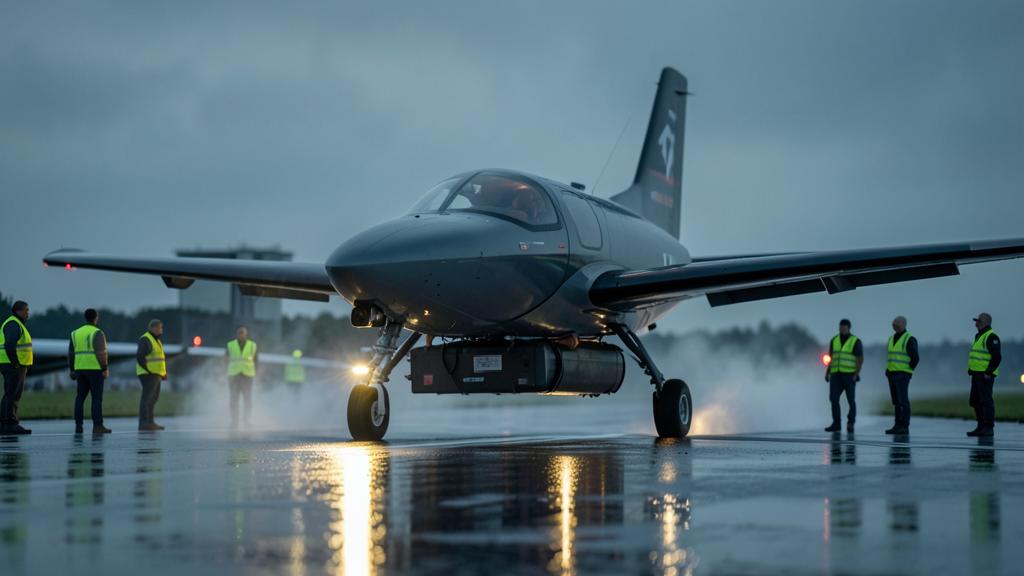
Every discussion of electric aviation eventually reduces to specific energy, as though the only obstacle were how far the aeroplane can go. The more consequential fact is quieter and harder to design around: a battery weighs the same when it is empty as when it is full. Removing the mass decrement between take-off and landing does not merely shorten the range — it removes a structural allowance that conventional aeroplanes have been quietly spending since the beginning, and it moves the binding constraint of the whole mission from the departure runway to the arrival one.
The line of arithmetic that reorganises the aeroplane
A kerosene-burning transport aeroplane converts stored chemical energy into work and expels the products overboard. The mass of the fuel consumed leaves the aircraft. On a long sector that decrement is a large fraction of the take-off mass, and it arrives exactly where the designer wants it: the aeroplane is heaviest when it needs lift and thrust to get airborne, and lightest when it needs structure and brakes to stop.
A battery-electric aeroplane converts stored electrochemical energy into work and expels nothing. Discharging a cell rearranges ions within a closed system; the atoms stay aboard. To within the mass of any coolant vented and the fuel of any auxiliary system, take-off mass and landing mass are the same number. The aircraft that leaves at its maximum permitted mass arrives at its maximum permitted mass, on every flight, including the diversion, including the return after a technical problem five minutes after departure.
That is why the certificated maximum landing mass of a battery-electric aeroplane is effectively forced up to the maximum take-off mass, and why the design consequences propagate outwards from that single equality rather than from the energy density figure everyone quotes.
A battery doesn’t get lighter as it discharges, unlike fuel. This means an electric plane lands at the same heavy weight it took off with, forcing its landing gear, brakes, and structure to handle that weight every time.
An Eviation Alice electric aircraft (max takeoff weight: 12,000 lbs) must land at 12,000 lbs, just like at takeoff. Its landing gear and brakes must handle this max weight on every flight, unlike a conventional plane that lands lighter after burning fuel.
What the mass decrement was quietly buying
The gap between maximum take-off mass and maximum landing mass on a conventional aeroplane is not an accounting artefact. It is a deliberate design allowance, and it pays for several things at once.
It lets the landing gear and the surrounding structure be sized for a lower mass than the wing and the powerplant. It gives an operational escape route: an aeroplane that must return shortly after departure is above its landing mass, and the crew either holds to burn down, jettisons where the type is equipped for it, or accepts an overweight landing with the inspection that follows. It creates margin on landing distance and brake energy for the normal case. And it means the worst structural landing case is a rare event rather than a daily one.
An electric aeroplane has none of these. It cannot burn down, because nothing burns. It cannot jettison, because dissipating energy into resistors produces heat, not a lighter aeroplane. There is no overweight landing, because every landing is at the maximum. The margin has to be designed in from the start, and paid for in structure that is carried on every flight.
The trap. Treating the removal of the take-off/landing mass gap as a small penalty on empty mass. It is not one number — it changes which certification case sizes the gear, the brakes, the tyres and the go-around performance, and each of those is then carried for the life of the aeroplane.
The gear is sized for the worst day, every day
Large aeroplane certification requirements specify landing load conditions in terms of a limit descent velocity at touchdown, and they deliberately specify two of them: a higher descent velocity at the maximum design landing mass, and a lower one at the maximum design take-off mass. In the transport category the pairing is well known — a limit descent velocity of ten feet per second at the design landing mass, and six feet per second at the design take-off mass. The structure must absorb both.
The logic behind the pair is statistical. Heavy landings happen; very heavy aeroplanes making very heavy landings do not, because an aeroplane at its take-off mass is at the start of a flight rather than at the end of one, and the situations that put it on the runway at that mass are rare and usually flown carefully. When maximum landing mass and maximum take-off mass become the same number, the two conditions collapse into one, and it is the demanding one that survives. The gear, the backup structure and the attachment fittings are then sized for the higher sink rate at the higher mass, on an aeroplane that will experience that combination routinely rather than exceptionally.
Distance and brake energy do not scale the same way
Two quantities that people treat as interchangeable behave very differently with mass, and the difference decides how an electric aeroplane is operated.
- Reference approach speed is set by a margin above the stall speed, and stall speed varies with the square root of mass.
- Kinetic energy at touchdown is proportional to mass times the square of the speed, so it varies with the square of mass.
- Braking force available on a given surface is proportional to the normal load, which is proportional to mass.
- Braked ground roll comes out roughly proportional to mass — while the energy the brakes must absorb, and then reject as heat, goes as mass squared.
| Quantity | Approximate variation with landing mass | Why it behaves that way |
|---|---|---|
| Reference approach speed | Square root of mass | Set by a margin above a stall speed that itself varies as the square root of mass |
| Kinetic energy at touchdown | Mass squared | Energy goes as mass times speed squared, and speed squared goes as mass |
| Braked ground roll | Roughly proportional to mass | Energy grows as mass squared, available braking force grows as mass, and the ratio is the distance |
| Brake energy to absorb and reject | Mass squared | The whole touchdown energy less the share taken by drag and any residual thrust |
| Tyre loads and touchdown speed | Mass, and square root of mass respectively | Both feed directly into tyre load and speed ratings, which are hard limits |
The practical reading is that an electric aeroplane operating short sectors performs the maximum-energy braking case several times a day, whereas a conventional aeroplane on the same sectors performs it essentially never. Brake cooling therefore stops being a hot-and-high curiosity and becomes a routine turnaround constraint, sitting alongside the recharge time and competing for the same minutes on the ground.
The balked landing is the sizing case, and it happens at the worst moment
Certification requires demonstrated climb performance in the landing configuration — a gradient with all engines operating in the balked-landing case, and a lower gradient with one propulsion unit inoperative in the approach configuration — and the mass at which those gradients can still be met is one of the things that sets the maximum landing mass admissible in the conditions of the day. For a conventional aeroplane, that mass is comfortably below take-off mass and the powerplant delivers essentially the same thrust whether the tanks are full or nearly empty. A turbine does not weaken as the fuel runs down.
A battery does. Available power at the terminals falls as the state of charge falls, and it depends on cell temperature, which at the end of a mission is itself a function of how the flight was flown. So the electric aeroplane must demonstrate its go-around gradient at maximum mass, using a battery near the bottom of its usable band, possibly hot from a full discharge, in whatever ambient conditions the certification basis demands. Every one of those factors moves the wrong way at the same time.
This is the single hardest coupling in the architecture. It means the pack cannot be sized by energy alone: it must simultaneously satisfy an energy requirement for the mission and a power requirement at the end of the mission, and the second frequently sizes the pack. Adding cells to guarantee the go-around adds mass that must then be landed, which raises the landing mass, which raises the gradient requirement in absolute terms. Designers recognise the shape of that loop immediately.
The useful habit. When reading a manufacturer’s claim, separate the energy statement from the power statement. A pack that stores enough kilowatt-hours for the sector says nothing about whether it can deliver go-around power at the end of it, and it is the second number that bounds the operation.
Reserves stop being a mass question and become a state-of-charge question
Fuel planning is built on a chain of masses: trip, contingency, alternate, final reserve, extra. Each element is a quantity of fuel loaded, and the reserve elements are, in the normal case, still aboard on landing — which is precisely why maximum landing mass matters on a conventional aeroplane at all.
For an electric aeroplane the chain has the same logical structure and a different physical meaning. The reserve is a band of state of charge that must remain unused, defined by the power the aircraft must still be able to deliver rather than by the energy it must still be able to spend. Below a certain charge, cells cannot supply the current a go-around needs, and repeated deep discharge accelerates their ageing irreversibly. So the bottom of the usable band is set jointly by a power floor and by a cell-life constraint, and neither is a mass at all.
Two consequences follow for operations. The energy actually available for a mission is a fraction of nameplate capacity rather than the whole of it, and that fraction is not constant — it moves with temperature, with pack age and with the power profile flown. And a diversion costs charge without returning any mass, so the aircraft arrives at the alternate later, colder or hotter, and no lighter.
The payload-range diagram loses its hinge
The familiar payload-range diagram of a conventional aeroplane has a characteristic elbow: up to a point, range increases at full payload; beyond it, further range is bought by removing payload and loading fuel in its place. That trade exists because fuel and payload are both mass, interchangeable within the same maximum take-off mass.
| Architecture | Can range be bought with payload? | What the mission is bounded by |
|---|---|---|
| Kerosene, fixed tanks | Yes — fuel replaces payload up to tank capacity | A continuous trade between payload and range, with maximum landing mass rarely binding |
| Battery, fixed installed pack | No — the pack is structure and its mass is present whatever the mission | Landing mass and end-of-mission power, both fixed by the installation |
| Battery, modular or swappable packs | In discrete steps — modules can be removed to carry payload, at the cost of energy | The step size of the modules, plus certification of multiple mass and centring configurations |
| Hybrid | Partially — the fuel fraction restores a continuous trade and a mass decrement | A mixed case, with a smaller but non-zero gap between take-off and landing mass |
The modular route is technically attractive and administratively expensive: each configuration is a mass and centring case to be substantiated, and a maintenance state to be tracked. It also complicates the one genuine advantage of the fixed installation, which is worth stating plainly — a battery pack does not slosh and its centre of gravity does not migrate as it discharges. The pack contributes no centre-of-gravity migration of its own, so the fuel-transfer and trim scheduling that a long-haul aeroplane manages in flight has no equivalent here.
Ageing: capacity fades, mass does not
A pack loses usable capacity with cycles and with calendar time. It loses no mass at all. The aeroplane therefore carries an unchanging structural burden in exchange for a shrinking mission, and the certification basis has to decide which state of health the published performance refers to.
If performance is guaranteed at end of pack life, the aeroplane is conservative for most of its service and the operator carries mass it cannot use. If it is guaranteed at beginning of life, the operator must derate the mission as the pack ages, and the maintenance programme has to define what triggers a replacement. Either way, state of health becomes an airworthiness parameter tracked over time, closer in spirit to a life-limited part than to a consumable — with the continuing-airworthiness consequences that implies.
Where hybrid and hydrogen break the symmetry
The interest of the alternatives is precisely that they restore, wholly or partly, the mass decrement that the battery removed.
| Carrier | Order of magnitude, specific energy | Does aircraft mass fall in flight? | Dominant penalty |
|---|---|---|---|
| Jet fuel | Around 43 megajoules per kilogram, and roughly 34 per litre | Yes, substantially | Combustion emissions |
| Lithium-ion pack | Best cells reach a few hundred watt-hours per kilogram; the installed pack is materially lower | No | Mass, permanently, plus power fade at low charge |
| Liquid hydrogen | Around 120 megajoules per kilogram, but under 10 per litre | Yes | Volume, and the mass of a cryogenic tank that stays aboard |
| Hybrid combinations | Between the two, by design | Partially | Two powertrains, two failure sets, two maintenance regimes |
Hydrogen is the instructive contrast. Per unit mass it beats kerosene comfortably, and it is consumed, so the aeroplane does get lighter and the take-off and landing mass gap returns. Per unit volume it loses by a wide margin even as a cryogenic liquid, which is why hydrogen concepts are drawn around their tanks rather than around their cabins, and why the tank — heavy, insulated and permanent — reintroduces a fixed mass of its own.
What it means for mission design
Put the constraints together and a coherent picture emerges, and it is not the one the range figures suggest. Battery-electric aeroplanes are pushed towards short sectors, because that is where the mass of stored energy stays tolerable. Short sectors mean many cycles per day, and every cycle is a maximum-mass landing with maximum-mass brake energy and a maximum-mass go-around case. The architecture that makes the energy problem tractable is the same architecture that makes the structural and thermal problems relentless.
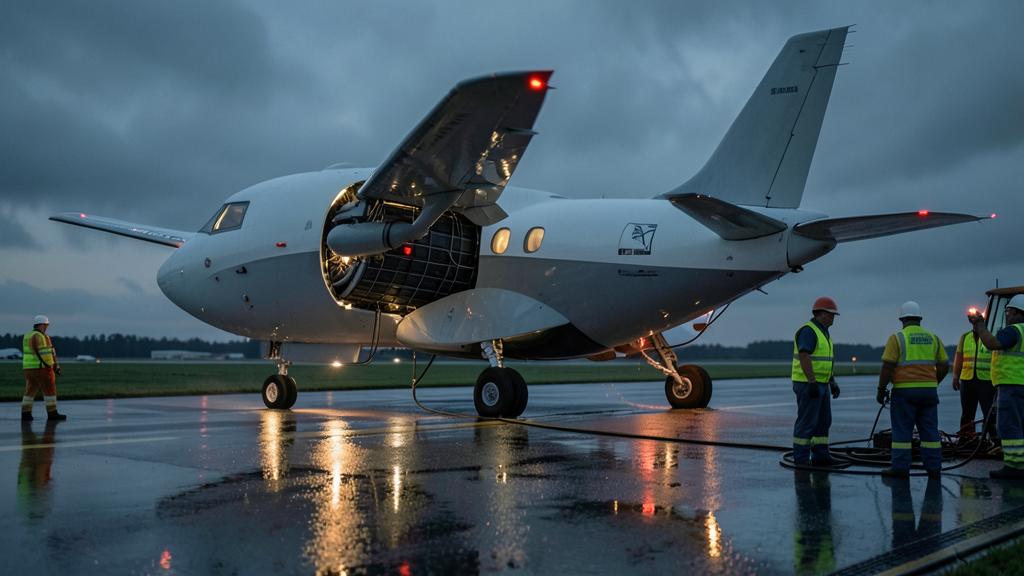
Which is why the useful question about an electric design is rarely how far it flies. It is what its landing mass forces the gear, the brakes and the go-around to be, how much of the pack the power floor makes unusable, and how the turnaround absorbs charging and brake cooling at the same time. Those are the numbers that decide whether a route can be flown twelve times a day. Discussion of these programmes as they reach certification is collected on fl330.com.


Leave a Reply
You must be logged in to post a comment.