
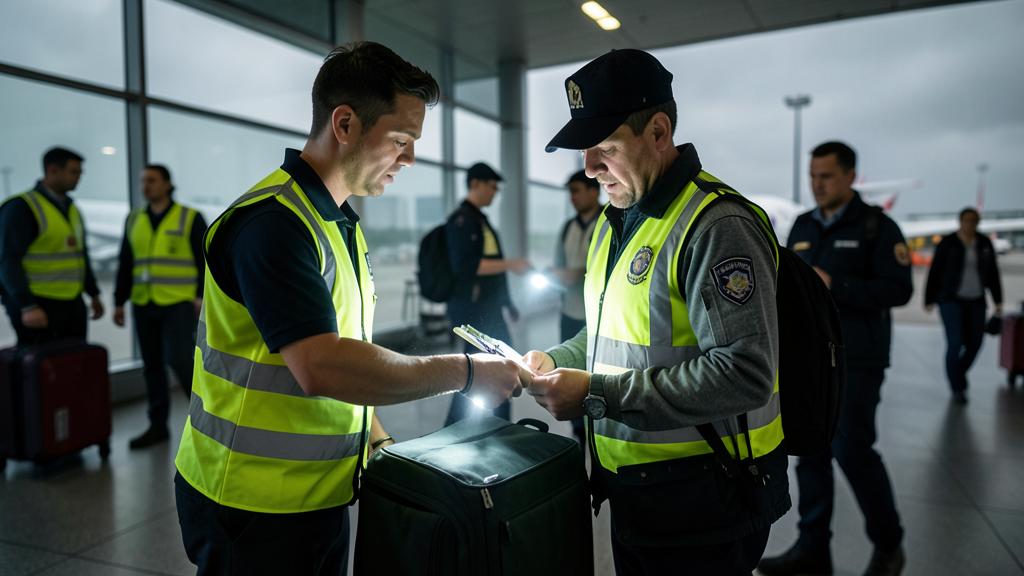
Random screening of staff is one of the least popular controls in aviation security and one of the most misunderstood. Airside workers experience it as an arbitrary tax on their shift; managers defend it with detection statistics that mean almost nothing; and both sides argue about the selection rate as though the rate were the point. It is not. A randomised control is not primarily an interception device. It is a device for making a certain kind of behaviour unaffordable, and it works through arithmetic that is entirely explicit and rarely written down. Setting out that arithmetic makes it obvious what such a control genuinely defeats, what it cannot touch, and how a well-intentioned regime quietly stops working.
Interception and deterrence are two different products
A control that intercepts stops the specific attempt in front of it. A control that deters changes what people decide to attempt in the first place. Both are legitimate outputs, but they are measured differently, they fail differently, and they respond to entirely different design choices — and confusing them is the origin of most of the bad arguments about staff screening.
Interception scales with coverage. Screen everyone and you intercept everything the method is capable of finding; screen one in twenty and you intercept, at best, one in twenty. Deterrence does not work that way at all. It scales with what the person contemplating the act believes the risk to be, integrated over every occasion on which they would have to accept that risk. Those two quantities can diverge enormously, and for the threats that actually matter airside, they do.
| Profile | Exposure to random screening | Effect |
|---|---|---|
| Single-occasion insertion of a prohibited article | One pass, one chance of selection | Weak. A low rate means a low probability, and the actor only needs one clean pass |
| Sustained smuggling, for profit or coercion | Dozens or hundreds of passes | Strong. Cumulative exposure approaches certainty and the business model fails |
| Testing and reconnaissance | Repeated, deliberately low-risk passes | Strong, provided the pattern of selection cannot be mapped |
| Knowledge-based act by an authorised worker | Nothing carried through a checkpoint | None. The checkpoint is not in the path of the act |
| Coerced worker acting once, under duress | One pass | Weak on interception, but the deterrent may fall on the person coercing them |
Random screening is not about catching every bad actor. It’s about making repeated bad behaviour too risky. If someone tries to sneak something through once, they might get away with it. But if they try it over and over, the odds of getting caught go way up. That’s why it works best against people who need to keep doing it, like smugglers.
Imagine an airport where staff are screened 5% of the time. A smuggler trying to sneak in a prohibited item once has a 95% chance of success. But if they try 50 times, the chance of getting caught at least once jumps to 99.5%. That’s why random screening is tough on repeat offenders.
Read down that table and the design intent becomes legible. Random screening is a control aimed squarely at repetition. It is at its strongest against the threat that has to come back, and at its weakest against the one that only has to succeed once.
The arithmetic of repetition
The mechanism is a single line of probability. If each pass through the control carries an independent probability p of the article being found, then over n passes the probability of being caught at least once is one minus (1 − p) raised to the power n. Small numbers compound fast.
| Per-pass probability | 5 passes | 20 passes | 50 passes | 100 passes |
|---|---|---|---|---|
| 2 % | 10 % | 33 % | 64 % | 87 % |
| 5 % | 23 % | 64 % | 92 % | 99 % |
| 10 % | 41 % | 88 % | 99.5 % | above 99.9 % |
| 20 % | 67 % | 99 % | above 99.9 % | above 99.9 % |
A five per cent control looks derisory against a single attempt and is close to inescapable against someone making fifty. That asymmetry is the entire justification for accepting a low rate, and it is also the reason a low rate is defensible only where the threat model is genuinely one of repetition. Where it is not, the same number is close to decorative.
The trap. The table assumes independence, and independence is exactly what an adversary works to destroy. Someone who can observe when checks happen is not making fifty independent draws; they are making fifty draws from the moments they have judged safe. The arithmetic then collapses toward the single-pass column, no matter what the declared selection rate says.
Two probabilities hiding inside one number
The per-pass figure above is not the selection rate. It is the product of two things: the probability of being selected, and the probability that the method applied actually finds the article once selected. A hand search finds different things from a walk-through detector, which finds different things from explosive trace detection, which finds different things again from the X-ray of a bag.
This matters more than it sounds. A regime advertising a high selection rate, applying a method that the article in question defeats, produces a per-pass probability near zero and a compounding curve that never rises. Conversely, a modest selection rate combined with a method well matched to the threat produces real cumulative pressure. The honest question is never « what is our rate », it is « what is our rate multiplied by our effectiveness against the specific thing we are worried about » — and only the second half of that product can be measured by testing.
Where the framework actually puts randomness
It is worth being precise here, because practice diverges across jurisdictions and generalising is a good way to be wrong. Two architectures exist side by side. In the first, screening on entry to a security restricted area is the general rule, and randomness lives elsewhere: in which method is applied to a given person, in additional and unannounced measures applied inside the area, in vehicle checks, and in a standing requirement that measures be applied unpredictably, so that their timing and location cannot be anticipated. In the second, entry rests on credential control plus a sampled inspection, and the selection rate carries the load described above. European rules sit at the systematic end of that spectrum. What binds at a given airport, though, is the national programme, which fixes the methods, the rates and the exemptions — and it is that document, not the general text, that has to be read.
In the United States the picture is more varied. Full employee screening is in place at some airports, while at many others the model rests on credential control at access points, randomised inspection, and a set of parallel layers including background vetting and insider threat programmes. The debate about extending full screening has run for years and is a live policy question rather than a settled one. Underneath both models sit the ICAO Annex 17 provisions on the protection of security restricted areas, on background checks for persons granted unescorted access, and on unpredictability — which is why the vocabulary is shared even where the implementation is not.
Three ways a random regime stops being random
Randomisation is fragile in a specific and predictable way: it degrades toward a schedule. Nobody decides to make it predictable; operational pressure does it slowly, and it does it without generating any finding at all, because the declared rate is still being met.
| Failure mode | How it arises | What detects it |
|---|---|---|
| Concentration in time | Checks are run when the queue is short, so they cluster away from shift changes | Distribution of selections by hour of day, compared against staff flow by hour |
| Concentration in place | One access point is easy to staff, others are rarely visited | Selections per access point, normalised by throughput at each |
| Selection by human judgement | The officer chooses, believing they are choosing well | Demographic and role profile of those selected; absence of a mechanical selector |
| Rate quietly reduced under load | Throughput pressure at peak, restored afterwards | Achieved rate by hour, not the daily average |
| Self-selection by the workforce | People who see a check in progress wait, or use another door | Roving and unannounced checks inside the area, plus access-record analysis |
The last of these deserves emphasis. A control at a fixed post with a visible queue is not sampling people; it is sampling the moments at which people are willing to be sampled. That is why unpredictable measures applied away from the access point, inside the security restricted area, carry a weight out of proportion to their number: they are the ones that cannot be waited out.
The selection mechanism matters for a second reason, independent of security. Selection made by an officer’s judgement is not only more predictable to anyone who watches the officer; it invites bias, produces grievance, and corrodes the cooperation the whole system relies on. A mechanical selector — a device, an indicator, a counter — is defensible to the person selected precisely because nobody chose them.
What a checkpoint structurally cannot see
The most important limitation is not a matter of rate at all. A great deal of what an insider can do involves carrying nothing whatsoever.
- Information: access codes, patrol timings, the layout of a control, the identity of who checks what and when.
- Omission: a check recorded as performed and not performed; a seal accepted without verification; a door not observed while it should have been.
- Placement rather than transport: an article legitimately airside for a legitimate purpose, moved to a place it should not be.
- Exempted items: tools, engineering equipment, catering items and other articles that airside workers are entitled to carry for their duties. Every exemption is a category the checkpoint is instructed to pass.
- Systems: the access control database, the roster system and the badge issuance process are information systems, and a compromise of any of them is a security event that no physical control is positioned to observe.
That last point is the one the industry has been slowest to internalise. A credential is only as trustworthy as the process that issued it and the system that stores it, and a stolen, cloned or improperly issued badge presents itself at the door as an entirely legitimate person. Screening tests what someone is carrying. It does not test whether they should be there.
The layers that catch what screening misses
Random screening is meaningful only as one member of a set, and the other members are the ones that address the profiles it cannot touch: background checks before unescorted access is granted, repeated at intervals rather than performed once at hiring; recurrent security awareness training that gives staff a route for reporting what they notice; supervision and two-person practices for the highest-consequence tasks; tamper-evident sealing and documented chains for supplies and cargo; aircraft security checks and searches; and analysis of the access records themselves.
That last item is chronically underused and costs nothing but attention. Badge data is a complete record of who went where and when. Compared against rosters, it exposes access outside duty periods, access to areas unrelated to a role, patterns of movement that no checkpoint would notice, and — a question worth asking bluntly at any station — the elapsed time between a badge being revoked and that badge physically failing to open a door.
The right reflex. When someone asks whether the screening rate should go up, ask first which threat profile the increase is aimed at. If it is repetition, the cumulative table already tells you what the current rate is achieving and whether more is needed. If it is a single-occasion act, raising the rate buys very little, and the same effort spent on vetting, on supervision or on access-record analysis buys considerably more.
Measuring a control whose success looks like nothing
Detections are close to useless as a performance measure, because zero has two completely opposite meanings. A perfectly deterred workforce produces no detections. A control that has quietly degraded into a predictable formality also produces no detections. The number cannot distinguish the best possible outcome from the worst, which is a poor property for a metric.
What can be measured is the process. Covert testing, conducted under the national quality control programme with its audits, inspections and surveys, measures the second half of the per-pass product: whether the method finds the thing. The distribution of selections across hours, doors and roles measures the first half, and specifically measures whether randomness has decayed into a schedule. The achieved rate under peak load — not the daily average, which peak load hides — measures whether the regime survives the only conditions in which it is really tested. And the reconciliation of access records against rosters measures the layer that catches what screening cannot.
What to check at your own station
Four questions are enough to establish whether a staff screening regime is doing what its designers intended. Can anyone in your workforce describe when and where checks tend to happen? If they can, the control has already lost most of its value. Is selection made by a mechanism or by a person? Does the achieved rate hold during the shift-change peak, or does it fall silently at exactly the moment the flow is largest? And when did the last covert test take place, against which threat, and with what result?
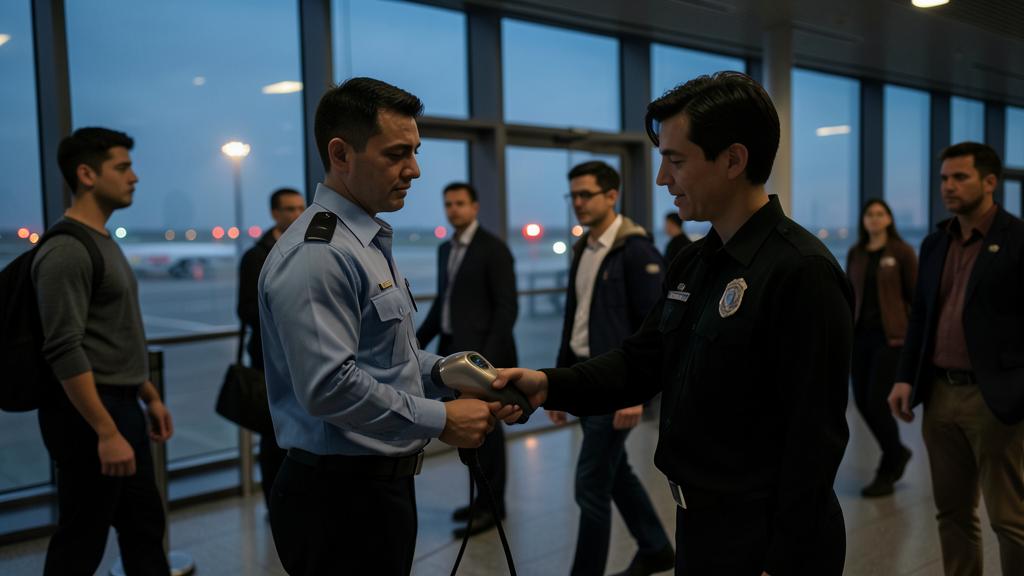
None of these questions is about the rate, which is the point. The number everybody argues over is the least informative variable in the system. Practitioners comparing how national implementations differ on precisely these points — and they differ a great deal — will find the detail discussed among colleagues on the FL330 forums, which is generally more useful than any single national reading of a common text.


Leave a Reply
You must be logged in to post a comment.