
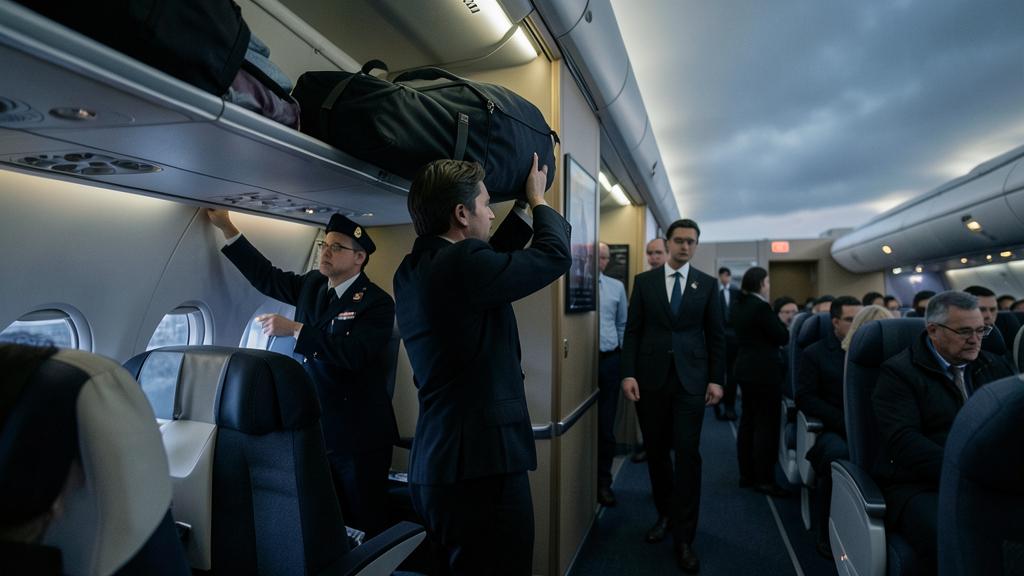
The cabin secure check is one procedure. It does not change at the curtain, and no service standard may modify it. Yet any crew member who has worked both ends of the aircraft knows the same check is not the same job in row 2 and in row 41. What changes is not the rule but everything around it: how many passengers one pair of hands is responsible for, how fast a request is expected to be answered, and how much explaining a refusal is assumed to need.
The rule does not read the boarding pass
Start with what is fixed, because the rest only makes sense against it. Safety procedures in the cabin are written for the aircraft, not for the fare. Doors are armed and disarmed the same way, cross-checked the same way and reported the same way at both ends. The pre-departure safety briefing is given to every passenger. Baggage stowage, seat back and table position, restraint of infants and of loose items, exit-row suitability, the securing of galleys and trolleys before take-off and landing — all of it is identical, and all of it is drawn from the operator’s manual under the same rules.
The authority of the cabin crew member is equally indifferent to the cabin. The person who decides that a bag will not fit in the overhead is the crew member, in every row. The person who decides that alcohol service stops for a particular passenger is the crew member, in every row. Both decisions are protected by the operator’s procedures precisely because they are unpopular, and both are more likely to be argued with in the cabin where the passenger has paid the most.
So the honest framing of the premium question is not « does the procedure change? » It is: given that the procedure does not change, where does the extra work go?
Where the difference actually comes from: the ratio and the clock
Two structural facts explain nearly everything that follows.
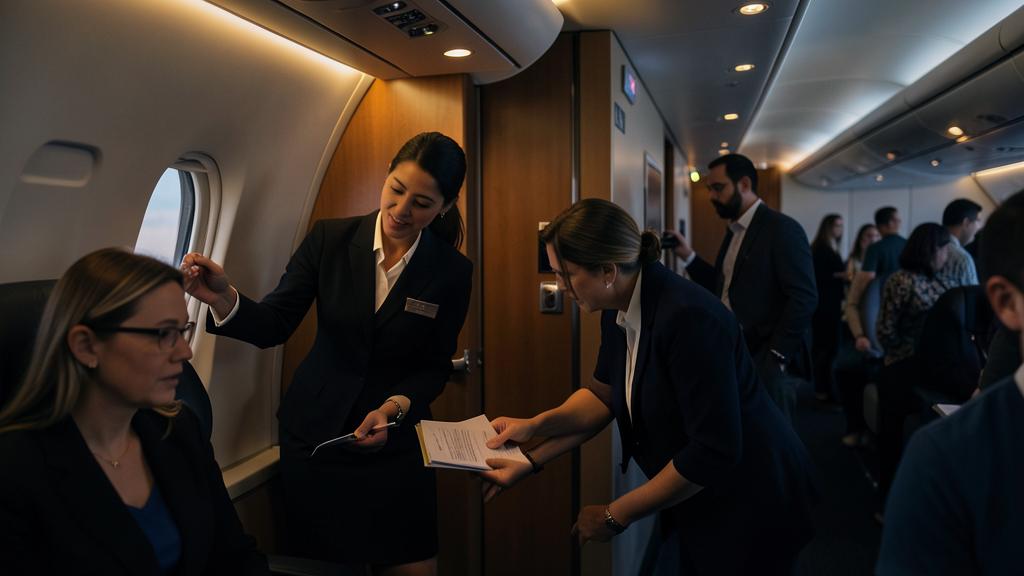
The first is staffing. The regulatory minimum number of cabin crew is tied to the passenger seating of the aircraft — in Europe, one cabin crew member for every fifty passenger seats, or fraction of fifty, installed on the same deck, with the FAA reaching a comparable result through a stepped table based on seating capacity. That minimum is a safety figure derived from evacuation and from the ability to manage the cabin, and it applies to the whole aircraft. How those crew members are then distributed between cabins is a commercial decision. An operator that puts one crew member with eight business seats and two with a hundred and forty economy seats has not broken anything; it has bought a service ratio at the front and accepted a workload at the back.
The second is the clock. Premium products are sold, explicitly or implicitly, on responsiveness: the call bell answered before it has finished chiming, the request acknowledged even when it cannot be met, the meal timed to the passenger rather than to the trolley. Nothing in any regulation says this, and it is nonetheless the measurable difference between a satisfied premium passenger and a complaint.
Put those together and the picture is clear. The same procedure, executed under a tight ratio and a short tolerated delay, becomes a piece of individual conversation. Executed under a wide ratio and a longer tolerated delay, it becomes a piece of flow management. The gesture differs because the constraint differs.
The rules are the same, but the way they’re applied changes based on how many passengers a crew member is responsible for and how quickly they’re expected to respond. In premium cabins, it’s about personal attention, while in economy, it’s about keeping things moving smoothly.
On an Airbus A350 with 300 seats, the FAA requires at least 6 cabin crew members, but the operator flies with 12 for service reasons. If it assigns 3 crew to the 30 business-class seats (1:10 ratio) and 9 to the 270 economy seats (1:30 ratio), the premium crew will handle requests individually, while the economy crew will manage the cabin in bulk to keep the service on schedule.
| Procedure | Invariant | Forward cabin | Aft cabin |
|---|---|---|---|
| Cabin secure before departure | Same criteria, same deadline, same report to the flight deck | Item by item, individually, often against an ongoing conversation or a laptop | By sweep and by eye, using announcements and visible progression down the aisle |
| Baggage stowage | Nothing loose, nothing blocking access, mass in the bin respected | Crew often stows for the passenger; the negotiation is about a garment or a case that will not go in the closet | Bin capacity itself is the problem; the decision is where the bag goes, and it costs boarding time |
| Seat belt sign on in flight | Passengers seated and belted; crew secure the cabin | Individual reminders, one row at a time, expectation that service resumes quickly | Announcement plus a walk-through; the trolley in the aisle is secured first |
| Refusing further alcohol | The decision is the crew member’s and does not depend on the fare | Delivered as a discreet, individual, face-saving exchange | Delivered plainly and often visibly, because the row is watching |
| Answering a call bell | Every call is answered | Answered within seconds; the delay itself is read as the service | Answered within the flow; batching several calls into one trip is normal practice |
| Exit-row briefing | Suitability assessed, briefing given and understood | Applies only where a premium seat sits beside a door | Routine, on rows where passengers may have chosen the seat for legroom alone |
Boarding: two bottlenecks, one identical deadline
Boarding is where the two cabins look least alike and where the shared constraint is hardest.
At the front, the work is individual: greeting by name where the operator does it, coats taken and stowed, a pre-departure drink where it is part of the product, a request logged for a special meal or a different seat. Each of those is a one-to-one interaction that cannot be batched.
At the back, the work is hydraulic. The aisle is a single-lane road; a passenger reorganising a bag at row 20 stops everyone behind them. The competent crew member is not the one being charming but the one keeping the flow moving: anticipating the bin that is about to fill, redirecting a bag before it is lifted, keeping the aisle clear.
Both cabins have to be finished at the same moment. That is the point that service design often misses: the deadline is set by the departure, and a premium cabin that is still being served champagne while the aft cabin is complete does not buy extra time — it consumes the margin of the crew member who has to complete the secure check anyway. When a delay is announced as a cabin-readiness delay, it usually started as a service sequence that assumed a longer boarding than the schedule allowed.
The right reflex. Brief the boarding sequence with the closing time, not with the service. Agreeing before the door opens on the moment premium service stops and the secure check starts converts a recurring conflict into a decision already taken.
Turbulence: the moment the two cabins diverge most
Nothing exposes the difference like a seat-belt sign in the middle of a meal service.
The procedure is identical and simple: passengers seated and belted, service suspended, trolleys and loose items secured, cabin checked, report to the flight deck. Everything after that is context.
At the back, the priority is physical. A loaded trolley is the largest unrestrained mass in the cabin and it is secured first; the announcement does the rest of the work, and passengers who have just been served hot drinks are the immediate concern. The service is not resumed until it can be resumed as a whole, and everyone understands that.
At the front the same suspension is read differently. A plated meal is in progress, a passenger is halfway through a course, and the expectation — never stated, always present — is that the interruption will be managed rather than merely imposed. The crew member’s real task becomes communication: saying what is happening, saying what will happen next, and doing so without giving anyone the impression that the decision is negotiable. That is genuine work, and it is work that the aft cabin does not require in the same form.
The failure mode is the same in both cabins and it is worth naming: continuing a service after the sign has come on because it feels almost finished. Turbulence is a leading cause of in-flight injury to cabin crew, and the fact that a premium passenger would prefer the course to be completed does not enter into it.
The trap. Treating a premium expectation as a reason to delay a procedure by a few seconds. Procedures in the cabin are timed against events the crew cannot see coming — that is precisely why they are procedures. A service standard may shape how something is said. It may never shape when it is done.
Saying no where everything is included
Refusal is the clearest case of a gesture reshaped by expectation.
The decision to stop alcohol service to a passenger, to insist a bag is checked, to require a seat back upright, or to move a passenger away from an exit row rests on the same basis in every cabin. But in a cabin where the product is defined by availability — where the passenger has paid for the fact that things are not rationed — a refusal contradicts the commercial promise, and the crew member is the one holding both.
Experienced crews resolve this the same way everywhere: the decision is not softened, the delivery is. Naming the decision rather than the person, offering an alternative where one exists, keeping the exchange out of the hearing of other passengers, and above all not entering into a negotiation about whether the decision applies. What must not happen is the version where the refusal becomes a suggestion because the passenger is in row 2 — that is not service, it is a procedure quietly abandoned.
This is also where the crew member most needs the operator behind them. A service standard that promises unlimited anything without stating, in the same document, that safety decisions override it is a standard that has put its crews in an impossible position. Good operators write the override explicitly, and brief it.
| Dimension | Premium cabin | Main cabin | Consequence for the crew member |
|---|---|---|---|
| Passengers per crew member | Few, by commercial choice above the regulatory minimum | Many, close to the staffing the aircraft is planned around | Individual handling at the front, flow handling at the back |
| Tolerated delay before response | Seconds; the delay is itself part of the product | Minutes; batching requests is accepted | Interruption-driven work versus sequence-driven work |
| Visibility of each act | Total; every gesture is observed by a few people | Diluted; the crew member is seen in passing | Consistency matters more at the front, endurance more at the back |
| Form a refusal takes | Private, explained, alternative offered | Plain, audible, often to a row rather than a person | Same decision, different delivery cost |
| Detection of a problem | Direct observation by the crew member | Call bell, or a neighbouring passenger | Deliberate walk-throughs are the only substitute at the back |
| Recovery when something goes wrong | Expected to be personalised and immediate | Expected to be fair and applied to everyone | Two different definitions of a good outcome |
The medical event: identical procedure, unequal detection
A passenger becoming unwell is handled the same way in every cabin. The crew member assesses, calls for help, uses the emergency medical equipment carried for that purpose, seeks a medical professional on board or through the operator’s ground medical service, and informs the flight deck so that the commander can weigh a diversion. None of that is fare-dependent, and the equipment carried is defined by the operator’s approved list, not by the cabin.
What is unequal is detection. In a small premium cabin the crew member sees almost everything and often notices the problem before the passenger reports it. Forty rows back, a passenger who is deteriorating quietly may be noticed only by a neighbour, or when a call bell is finally pressed. The procedure has not changed; the time to trigger it has.
This is the strongest operational argument for structured cabin walk-throughs at intervals, particularly on long sectors and overnight. They are not a service ritual. They are the only mechanism that gives the aft cabin something approaching the passive surveillance the front cabin gets for free.
What a service standard may and may not do
It is worth stating the boundary plainly, because it is the whole subject of this article.
- A service standard may set the order of tasks — who is served first, when a meal is offered, how a cabin is presented — as long as the safety-related deadlines are met.
- It may set the register: wording, tone, level of individual attention, how a passenger is addressed.
- It may set the recovery: what is offered when something has gone wrong, and who is allowed to authorise it.
- It may not move a safety-related deadline, in either direction, for any cabin.
- It may not weaken a criterion: the definition of a secured cabin does not vary by fare.
- It may not transfer a decision away from the crew member to whom the operator’s procedures give it.
When a crew feels a service standard is pushing against a procedure, that is a reportable observation and not a personality problem. It usually means a commercial document was written without the operational one open beside it, and it is fixed at the level of the two documents rather than by asking crews to reconcile them in the aisle.
What good operators do about it
Three practices distinguish operators that manage the two-cabin problem well.
They brief the whole aircraft as one cabin. A pre-flight briefing that covers safety collectively and then splits into two service worlds produces two crews. A briefing that names the closing times, the expected pressure points and how the cabins will support each other produces one.
They train the delivery, not just the decision. Recurrent training teaches what to do about an intoxicated passenger; comparatively little teaches how to say it to someone who has paid a great deal and is being watched by the person beside them. That gap is filled by whoever the crew member happened to fly with in their first year, which is not a training system.
They rotate crews between cabins. The most reliable cure for the belief that the other end of the aircraft has it easy is to work it. Crews who move between cabins across a roster arbitrate far better in the moments when the two logics collide — and cabin crew comparing operators, on the FL330 forums or between bases, consistently rate rotation as the practice that changed the atmosphere on board.
The conclusion is not that premium service is harder or easier. It is that the same procedure carries a different load depending on where in the aircraft it is executed, and that pretending otherwise is how a service standard ends up quietly eroding a safety one.


Leave a Reply
You must be logged in to post a comment.