
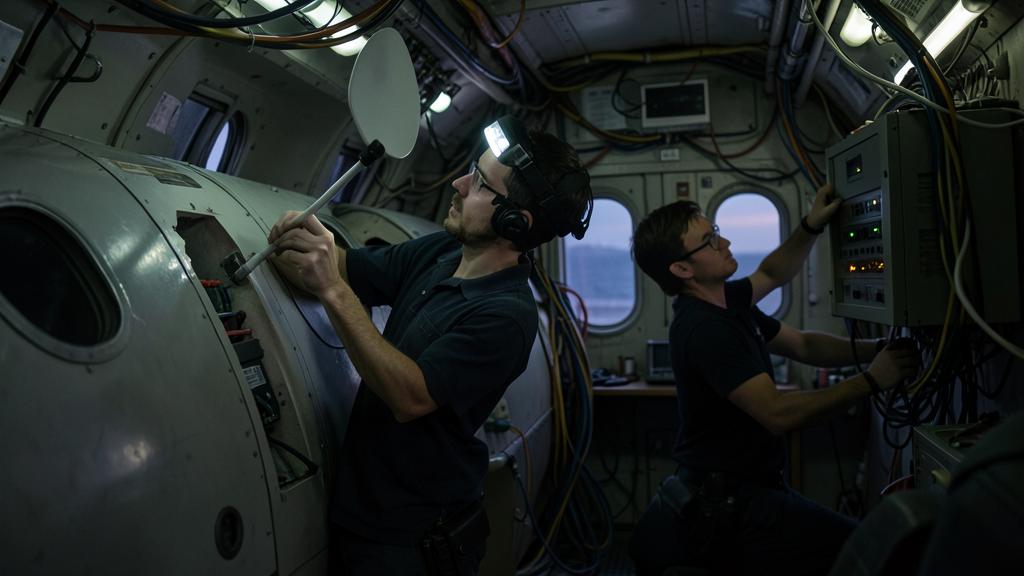
Before the retrofit, the aircraft was an island. Its networks talked to each other, to a maintenance laptop on the ground and to nothing else, and the safety analysis could reasonably assume that whatever went wrong went wrong by accident. Bolt on a satellite antenna, a cabin server and wireless access points, and one assumption dies: the aircraft now has a permanent, addressable path to the outside world, open in flight. From that moment the separation between the control, information and entertainment domains stops being an architectural habit and becomes something the applicant has to demonstrate to an authority, with evidence.
What connectivity actually changes
Cabin connectivity retrofits are sold as a passenger product and delivered as a network project. The visible deliverables are the radome, the antenna, the modem, the server, the access points and the cabling. The invisible one is an external interface that did not exist and now does, permanently, at altitude, addressable by anyone who can reach the satellite network or associate with a cabin access point.
The awkward part is that the retrofit rarely stops at entertainment. The business case usually includes at least one of: real-time engine and systems data offload, electronic flight bag connectivity, electronic techlog transmission, cabin crew applications reading load or passenger data, and remote software or database loading. Each of those is a data path that begins in a domain the passenger can touch and ends somewhere the passenger must never touch. The moment such a path is drawn, the question « how are the domains separated? » stops being rhetorical.
This is why the same modification that would once have been a cabin change is now handled as a design change with a security dimension, approved through a supplemental type certificate or a major change, and why the applicant’s data package looks nothing like a seat reconfiguration.
When an aircraft gets internet access, it’s no longer isolated. Now, data from passenger devices can reach critical systems unless properly separated. The retrofit forces airlines to prove this separation works.
On an Airbus A320neo with a retrofitted connectivity system, a firewall separates the passenger Wi-Fi from the flight control systems. If a hacker breaches the Wi-Fi, the firewall must block access to flight controls. The airline must prove this firewall works under all conditions.
Naming the domains, and why the naming matters
The industry vocabulary comes from the ARINC 811 framework, and it is worth using precisely, because the domain a function belongs to determines what may connect to it.
| Domain | Typical content | Worst credible consequence of compromise | External exposure |
|---|---|---|---|
| Aircraft control | Flight controls, engine and fuel management, flight management, displays, warning systems | Loss of a function required for continued safe flight and landing | None permitted by design |
| Airline information services | Maintenance and cabin support applications, electronic techlog, performance and loading tools, administrative data | Corrupted operational data reaching a crew decision, loss of maintenance integrity | Controlled, authenticated, and normally not continuous |
| Passenger information and entertainment | Seatback systems, cabin server, media, connectivity portal, cabin wireless | Service loss, passenger data exposure, a foothold for lateral movement | High and deliberate |
| Passenger-owned devices | Phones, tablets and laptops brought on board | Assumed hostile from the outset; what matters is how far such a device can reach | Uncontrolled |
Two things follow from the table. First, the consequences are not on the same scale, so the protection cannot be uniform; the effort belongs where the consequence is severe. Second, the exposure is inverted relative to the consequence — the domain with the highest exposure has the lowest consequence, and the one with the highest consequence should have no exposure at all. The whole architectural problem is to keep that inversion true after the retrofit has connected the low-consequence domain to the internet.
Safety analysis assumed accident; security has to assume intent
The classical airworthiness argument is built on failure. Functions are assessed for the severity of their failure conditions, probabilities are allocated, redundancy and dissimilarity are designed in, and software and hardware are developed to assurance levels matching the severity. That machinery is excellent at what it does and structurally blind to the case at hand, for one reason: it reasons about random and independent failures, and an attacker is neither random nor independent. An adversary chooses the failure, chooses the moment, and chooses to defeat exactly the redundancy that was installed to help.
The response the industry converged on is a parallel process rather than a patch to the old one. The airworthiness security process specification and its companion methods document — known to most engineers as the DO-326A and DO-356A pair, and as ED-202A and ED-203A on the European side — set out a security risk assessment that mirrors the safety assessment in shape while replacing failure conditions with threat conditions. The applicant identifies the assets, the attack paths that reach them, the security measures that interrupt those paths, and then has to show that the measures are effective, which is where the work actually is.
Certification specifications followed. Large aeroplane certification specifications now carry a general requirement on the protection of equipment, systems and networks from information security threats, where earlier programmes were handled through special conditions issued case by case. In Europe an additional layer arrived at organisation level, through the Part-IS information security rules, which oblige design, production, maintenance and operator organisations to run a management system for information security rather than treating each aircraft modification in isolation.
Declared segregation and demonstrated segregation
Here is the sentence that decides most retrofit programmes: a firewall rule is a claim, an air gap is a fact, and certification is interested in the difference. Both can be acceptable, but they carry different evidence burdens, and the burden is what drives cost and schedule.
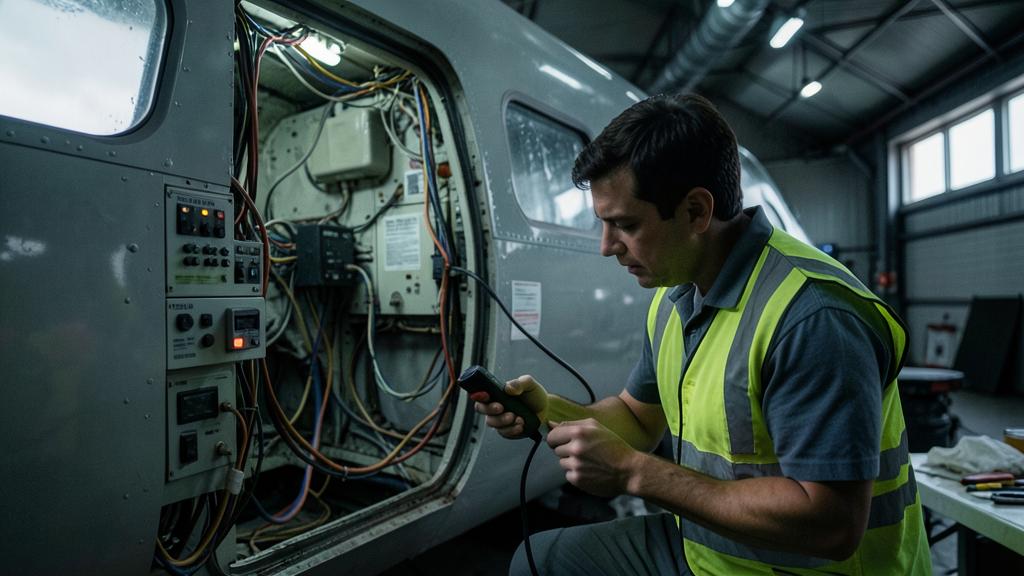
The strength of a segregation argument depends on how much has to remain true, over the aircraft’s life, for the separation to hold. A physically separate wiring run with no connection remains true unless someone changes the aircraft. A unidirectional link remains true because of the physics of the medium and the topology of the interface. A filtering gateway remains true only as long as its configuration, its software version and its key material remain correct — which converts a design property into a continuing maintenance obligation.
| Mechanism | How separation is obtained | What must remain true over the life of the aircraft | Evidence typically expected |
|---|---|---|---|
| Physical separation | No shared medium, no shared equipment, distinct racks and wiring | That nobody connects them later | Wiring diagrams, installation drawings, configuration control |
| Unidirectional link | Transmit-only interface or a medium that carries data one way by construction | Very little; the property is structural | Interface design, hardware description, demonstration that no reverse path exists |
| Protocol break with a data diode or one-way gateway | Data crosses, control does not; no session is established across the boundary | The device’s integrity and its configuration | Device design assurance, configuration baseline, verification testing |
| Filtering gateway or router | Rules permit specific flows and deny the rest | Configuration, software version, rule set, key and certificate validity | Assurance level of the device, rule review, penetration testing, continuing airworthiness procedures |
| Cryptographic authentication of loads and data | Only signed, authenticated content is accepted | Key management, certificate lifecycle, revocation | Key management plan, procedures at organisation level |
| Procedural control | Rules about what staff connect and when | Human compliance, indefinitely | Weakest as a standalone argument; acceptable only as a supplement |
The right reflex. Ask, for every crossing between domains, what would have to be misconfigured, out of date or wrongly loaded for the separation to fail. If the honest answer is « nothing, the wire does not exist », the argument is short and durable. If it is « the rule set on this box », you have accepted a lifetime obligation, and it belongs in the instructions for continued airworthiness rather than in a commissioning report.
The shared resources nobody drew
Domain diagrams show data. Aircraft have more than data in common, and the boundaries that fail in service are usually the ones that were never on the diagram.
- Shared physical media. A retrofit that reuses spare pairs in an existing loom, or spare ports on an existing switch, has created a shared medium regardless of what the logical diagram says. Reuse of installed infrastructure is the single most common source of unintended adjacency, because it is exactly what makes a retrofit affordable.
- Shared endpoints. A crew tablet that receives performance data from an airline application and also connects to the cabin network is a bridge with legs in two domains. So is a maintenance laptop used on the aircraft and on an office network. So is a portable device used to load software and also to browse. The endpoint does not know it is a boundary; the architecture has to.
- Shared wireless. Cabin access points serving both passenger entertainment and an airline application on the same radio infrastructure need the separation demonstrated at the radio and network layers, not merely asserted through different service set names. Association is not authorisation.
- Shared loading paths. The most valuable and most dangerous capability a connectivity retrofit enables is remote loading of software and databases. It turns an on-aircraft, physically supervised action into a remote one, which is why authentication of the load and of its origin, and control of the part number that ends up installed, become airworthiness matters rather than IT convenience.
- Shared power and cooling. Not a data path, but a common-cause consideration the safety assessment already knows how to handle. A cabin server installed on a bus or in a bay shared with equipment supporting a required function reintroduces an interaction the segregation argument did not cover.
The trap. Treating the connectivity supplier’s security documentation as the aircraft-level argument. A supplier can demonstrate the properties of a box; only the applicant can demonstrate the properties of the installed architecture, including every shared resource above and every legacy system the box now sits next to. Two individually secure products installed on the same aircraft do not produce a secure aircraft, and the gap between them is exactly the applicant’s responsibility.
The obligation that begins at delivery
The certification effort ends; the security obligation does not. A retrofit that relies on configuration, software versions and cryptographic material has created a set of things that must remain correct for years, across maintenance organisations, on an aircraft that will change operators and registries.
Concretely, the modification has to leave behind instructions for continued airworthiness that cover the security-relevant items: the approved configuration of every boundary device, the procedure for loading and verifying software and databases, the management of keys and certificates including their expiry, the actions required when a vulnerability affecting an installed component is published, and the reporting path when an anomaly with a possible security cause is observed. The industry guidance on information security for continuing airworthiness — the ED-204 and DO-355 material — exists precisely because this part is routinely forgotten in the enthusiasm of a certification campaign.
There is an organisational consequence too. Continuing airworthiness and maintenance organisations inherit tasks they may not be equipped for: controlled software repositories, integrity checks on loadable parts, and a defined interface with the operator’s information security function. In Europe the Part-IS rules make that management system an explicit requirement rather than good practice. Elsewhere the same work is imposed through the modification’s own instructions and through the operator’s programme.
Where EASA and the FAA do not line up
Both authorities accept the same technical standards for the design argument — the airworthiness security process and methods documents are recognised on both sides, and the underlying engineering is the same. What differs is the wrapper.
On the design side the gap has narrowed rather than widened: both have moved the requirement out of case-by-case special conditions and into the airworthiness standards themselves, so an installation is now assessed against a stated rule on either side of the Atlantic. The divergence sits at organisation level. Europe added a horizontal regulation obliging organisations along the whole chain — design, production, maintenance, continuing airworthiness, operators — to run an information security management system with defined detection and reporting duties. The United States has no equivalent blanket obligation on those organisations; the operational side is handled through an aircraft network security programme accepted for the operator concerned, aircraft type by aircraft type. The practical consequence for an operator flying a mixed fleet, or for a design organisation working both markets, is that the technical evidence is largely portable and the organisational obligations are not. Plan the evidence once; plan the compliance argument twice.
What to ask before signing the retrofit
Four questions separate a programme that will certify from one that will discover its architecture during the audit. Which domains does this modification connect that were previously unconnected, and is there a drawing that shows every crossing including reused wiring and shared endpoints? For each crossing, is the separation structural or configured, and if configured, who owns the configuration for the next fifteen years? What does the applicant’s security risk assessment identify as the worst threat condition, and does the assurance level of the boundary equipment match it? And what does the modification add to the instructions for continued airworthiness — if the answer is nothing, the argument has quietly been transferred to the operator without telling them.
The retrofit is not made difficult by cybersecurity fashion. It is made difficult because an aircraft designed as a closed system is being given a permanent door, and the burden of showing that the door opens only where it should falls on whoever installs it. Engineers and operators comparing approaches on that boundary will find the discussion running continuously on the FL330 forums.


Leave a Reply
You must be logged in to post a comment.