
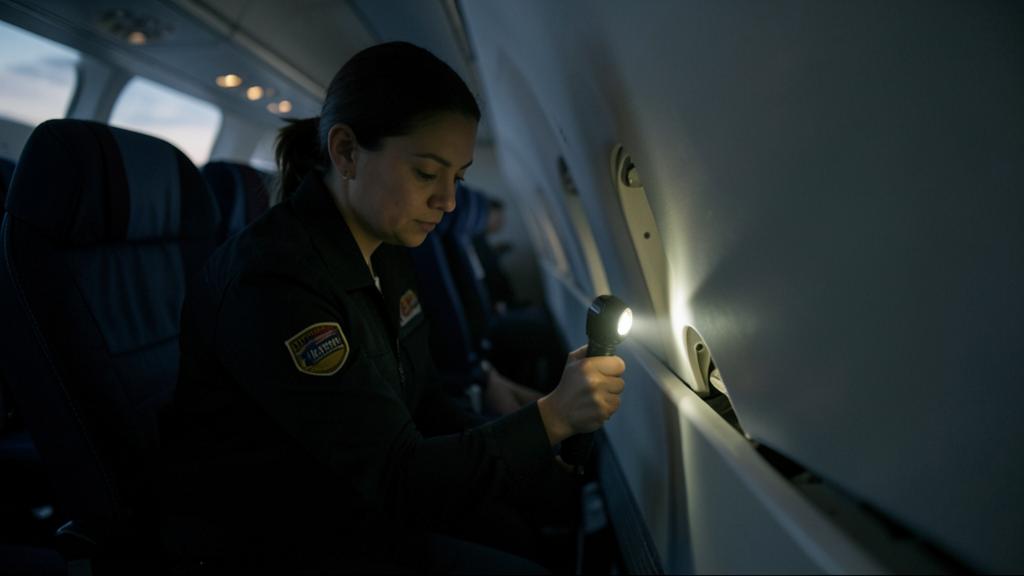
Ask any cabin crew member where a prohibited item was last found on their aircraft and the answer is almost never the overhead bin. It is under a seat cushion, inside a life vest pouch, behind the flap of a lavatory waste bin, or in the gap between the last row and the aft bulkhead. The list on the checklist is not wrong; it is simply written in the order of what is easy to see, while the person hiding something works in the order of what is easy to forget. Understanding why the search exists — what it resets, what it protects, and for exactly how long it stays valid — turns a routine sweep back into an inspection.
Two different tasks that share one name
The first thing worth fixing is the vocabulary, because in daily use the two words are interchanged and in the security regulations they are not. International civil aviation security standards distinguish an aircraft security check from an aircraft security search, and the difference is not one of thoroughness alone but of scope and of trigger.
A security check is an inspection of the interior of the aeroplane to which passengers may have had access, together with the hold, looking for suspicious objects, weapons or dangerous devices. A security search is a thorough inspection of the interior and the exterior of the aircraft for the same purpose. The check is the routine act performed on a normal turnaround; the search is the larger act performed when the circumstances demand a higher assurance — an aircraft that has been left unattended, an aircraft coming out of maintenance or long-term parking, a raised threat level, a specific flight or route so designated, or a report that gives grounds for suspicion.
| Element | Security check | Security search |
|---|---|---|
| Scope | Cabin areas accessible to passengers, plus the hold | Interior and exterior of the aircraft, including areas passengers cannot reach |
| Typical trigger | Routine turnaround before boarding | Aircraft left unattended, out of maintenance or parking, raised threat, designated flight, specific report |
| Who normally performs it | Frequently the cabin crew, under the operator’s programme | Frequently trained security staff, sometimes with crew support — the State and operator programme decides |
| Duration | Minutes, integrated into the turnaround | Substantially longer, and it usually costs a delay |
| What it establishes | That the accessible cabin was clear at a stated time | That the whole aircraft was clear at a stated time |
Both are worthless without the third element, which is what most crews under-weight: the access control that follows. A cleared cabin is only cleared until the next person who is not accounted for walks through the door.
A security check and a security search are not the same. A check looks in passenger areas and the hold, while a search covers the whole plane, inside and out. The check is routine, the search happens when there’s a higher risk. Both only work if you control who gets on the plane after.
An Airbus A320 left unattended at an airport in Europe would require a full security search before the next flight, not just a check. The search would take 30 minutes longer and involve trained security staff, not just cabin crew, because the plane was exposed to potential threats during its time alone on the stand.
Who actually decides what is on the list
Crews sometimes assume the checklist is an industry standard published somewhere they could read if they wanted to. It is not. The chain runs from the international security standards down through the State’s national civil aviation security programme, and from there into the operator’s own security programme, which is approved by the appropriate authority and which is the document that actually says which zones are inspected, by whom, in what order and with what record.
A significant portion of the detailed material at each level is deliberately not public. The international guidance manual on aviation security is a restricted document; in the European framework, the detailed measures sit partly in a classified decision rather than in the published implementing regulation. This is not bureaucratic secrecy for its own sake: a publicly available, exhaustive list of exactly which cavities are inspected and in which order is a gift to anyone planning to defeat it.
The practical consequence for a crew member is straightforward. There is no universal list to compare yours against, and the question « is this normal elsewhere? » is not answerable. The only authority is the operator’s security programme, and the only sensible response to a doubt about coverage is a report through the operator’s own channel rather than a comparison with another airline’s practice.
The sweep is a reset, and it has an expiry date
The most useful way to think about the pre-boarding sweep is not as a search for an object. Statistically, nothing will be found. It is a timestamped reset: at a stated moment, a named person established that a defined set of spaces contained nothing that should not be there. Everything of value flows from that idea.
It explains why the record matters as much as the act, since the record is what fixes the moment. It explains why a partially completed sweep is worse than useless, because it produces a signature asserting a state that was never established. And it explains the real vulnerability, which is almost never the sweep itself: it is the interval afterwards. Cleaners, caterers, engineers, loaders and crew all pass through the aircraft between the reset and boarding, and each unmonitored passage silently reduces the value of the earlier work. A sweep completed early and followed by two hours of uncontrolled access is a document, not a safeguard.
The trap. Completing the sweep before catering and cleaning have finished, because it fits the turnaround better. The record then attests to a state that was overwritten immediately afterwards. Where the operator’s programme allows the sweep to precede other activity, it also defines how the aircraft is protected in the interval — and that part is the one most often skipped.
The pre-boarding sweep is like a snapshot in time. It proves the plane was safe at that exact moment, but not after. If people come in and out without being checked, the sweep becomes useless. That’s why the record is just as important as the actual search.
On a Boeing 737 at a busy airport, a sweep done at 10:00 AM but with catering arriving at 10:30 AM is worthless. If the crew signs off the sweep at 10:00 AM, but caterers walk through unchecked, the plane is no longer secure. The sweep only counts if access is controlled right up to boarding.
Where things are actually found
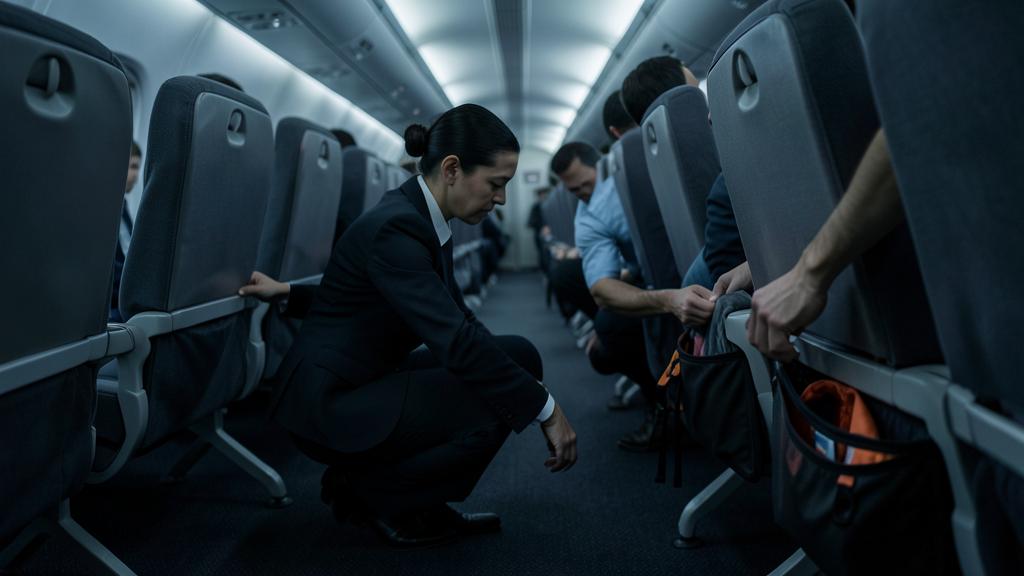
Overhead bins are inspected reliably because they are at eye level, they are opened for other reasons, and an empty bin is unambiguous. That is precisely why they are a poor hiding place. The zones that repeatedly produce findings share three properties: they require a physical action rather than a glance, they are inspected on a longer cycle than every flight, and they look plausible when closed.
| Zone | Why it is missed | What a completed inspection looks like |
|---|---|---|
| Life vest pouch under the seat | Verified on a periodic cycle rather than every flight; the pouch looks correct when closed | The pouch is felt or opened where the programme requires it, not merely seen |
| Seat cushion and the gap behind the backrest | Requires lifting or pressing; nothing is visible from the aisle | Cushions moved or compressed, the seam between cushion and back checked |
| Under-seat structure and inflight entertainment boxes | Below the sightline, partly hidden by the seat in front | Crouched inspection along the row, including the box housings and cable runs |
| Seat pockets and literature | Emptied by cleaners, so assumed clear | Pocket opened and the contents lifted, not pressed flat from outside |
| Lavatory waste bin flap and the cavity behind it | The flap swings shut and looks the same either way | Flap opened, the space behind the liner checked |
| Behind the lavatory mirror, under the sink unit, ceiling access panels | Not part of any other routine task | Panels and fittings checked for security and for anything placed behind them |
| Galley carts, ovens and empty container stowages | Assumed to be catering’s responsibility | Seals verified against the documentation; unsealed and empty stowages opened |
| Coat closets, crew stowages and crew rest areas | Not passenger areas, therefore mentally excluded | Included explicitly, because access is not restricted to crew during a turnaround |
| Last row, aft bulkhead gap and curtain hems | End of the sweep, in the least-lit part of the cabin | Reached deliberately, with a torch, and not treated as the finish line |
There is a pattern behind the table worth naming. The sweep degrades at exactly the places where two responsibilities meet: cabin crew assume the galley belongs to catering, catering assume the cabin belongs to the crew, and the boundary produces a strip of unowned space. The same effect appears between cabin crew and cleaners in the lavatories, and between crew and engineers around access panels. When a sweep is reviewed after an event, the gap is usually at an interface, not in a zone that someone genuinely forgot.
Emergency equipment: the inspection that decays into a formality
Emergency equipment stowages deserve separate treatment because they carry two independent obligations that use the same physical action, and crews routinely perform one while believing they have performed both. The safety obligation is that the equipment is present, in date, correctly stowed and serviceable. The security obligation is that nothing else has been placed with it. A sealed stowage satisfies both cheaply — provided the seal is actually read.
A seal is only evidence if its number is compared against a record. A crew member who confirms « seal intact » without checking which seal it should be has confirmed that a seal exists, which is a much weaker statement. This is one of the few places in the cabin sweep where the difference between a glance and an inspection is a single, quick, entirely concrete action, and it is also one of the places where the degradation is hardest to see afterwards.
The right reflex. Split the cabin by physical action rather than by geography. First pass: everything that must be opened. Second pass: everything that must be lifted or pressed. Third pass: everything that must be read — seals, numbers, dates. Crews who reorganise the sweep this way stop losing the actions that a zone-by-zone route quietly turns into glances.
Traceability: what a signature actually fixes
The record produced by the sweep is not an administrative by-product. In any subsequent investigation it is the instrument that divides time into a before and an after, and its usefulness depends entirely on what it pins down.
| Element recorded | Question it answers |
|---|---|
| Aircraft registration and flight identification | Which aircraft, on which rotation — essential where a crew works several airframes in a day |
| Time of completion, on an unambiguous reference | Where the boundary between covered and uncovered time actually falls |
| Named individual per zone, not one signature for the whole cabin | Who can be asked what they saw, and whether any zone was left unassigned |
| Explicit statement of zones covered | Whether a zone was inspected and clear, or simply never reached |
| Findings, including items found and released as innocuous | Whether a pattern is building across flights, stations or crews |
| Handover point and recipient | Who held responsibility for access control from that moment |
| Retention of the record per the operator’s programme | Whether the evidence still exists when it is needed weeks later |
The element crews most often compress is the third. One signature for a whole cabin is fast, and it destroys the only information that would matter afterwards: which pairs of eyes saw which spaces. Where the operator’s form allows it, assigning zones by name costs nothing and converts an assertion into evidence.
When something is found
Most findings are innocuous, and the discipline that matters is the one applied before that judgement is made. The distinction to hold is between an unattended item, which is an object apparently left behind and whose owner may still be traceable, and a suspicious item, which is an object whose placement, appearance or context does not make sense. A common way to test the second is to ask whether the item was deliberately hidden, whether anything about it is obviously abnormal, and whether it is typical of the environment it was found in. An item hidden inside a life vest pouch has already failed the first question, whatever it turns out to be.
From the point where an item is treated as suspicious, the cabin crew role narrows sharply and deliberately: do not move it, do not open it, do not allow it to be moved by anyone who arrives to look at it, and report immediately by the operator’s defined route. Many operators’ procedures also restrict transmitting close to a suspected device. What happens next — evacuation, isolation, whether an item is ever relocated — belongs to the operator’s security procedure and to the commander, and those procedures differ enough between operators that borrowing another airline’s technique is a genuine hazard rather than a helpful improvisation.
Through-flights, crew changes and the moment control lapses
Two situations account for most of the confusion about whether a sweep is required. The first is the through-flight where passengers remain on board or disembark and return; the second is a crew change on the same aircraft. In both cases the question is not « has the cabin been swept today » but « has anyone had unaccounted access since the last reset ». The operator’s programme states the answer, and it usually turns on whether continuous protection of the aircraft can be demonstrated.
The handover between crews is worth naming explicitly because it is where the reset most often disappears. An incoming crew that receives « cabin’s done » without a time, a zone list or a name has received a rumour. A handover that states when the sweep was completed, who has entered since, and which zones were covered gives the incoming senior something to act on — and it is the point where an incoming crew can legitimately decide that a fresh sweep is required.
Training the eye rather than lengthening the list
The instinctive response to a missed zone is to add a line to the checklist. It rarely works, because the problem is not that the zone is unknown but that the action it demands is inconvenient — crouching, lifting, opening, reading a number. Lengthening a list that is already performed under turnaround pressure moves the failure somewhere else.
What does work is rotating the route so that the same crew member is not always the one who finishes in the dim aft cabin, briefing which interfaces are unowned on this particular aircraft configuration, and reporting innocuous findings so that the pattern becomes visible before it becomes an incident. Crews and cabin managers comparing how their operators structure the sweep and its record will find the topic discussed at length in the FL330 community. The underlying discipline does not change with the airline: establish a moment, name what it covers, and protect it until the door closes.


Leave a Reply
You must be logged in to post a comment.