
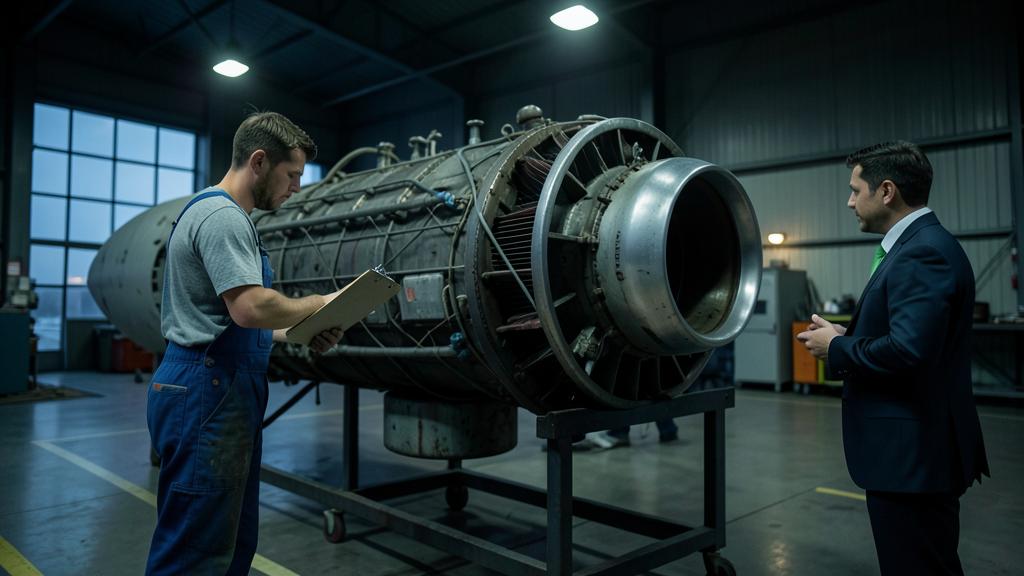
An engine that has almost run out is normally described as a problem. In the trading and leasing market it is often the more valuable of two identical assets, and the operator who has just paid to restore the other one can end up with less usable value than the one who did nothing. That inversion is not a market anomaly. It follows directly from the fact that a shop visit converts cash into cycles at a price, and that cycles delivered after your aircraft has left the fleet are worth exactly nothing.
What green time is, and what it is not
Green time is the usable potential remaining on an engine before it has to come off, sold or leased as it stands, with no restoration and no promise about what happens at the end. The seller is not offering an interval; the seller is offering whatever is left. The term has no technical definition in the maintenance documentation — it is a commercial description of a state, and the state is the ordinary one for a serviceable engine that has not yet reached its removal driver.
Two misreadings are worth clearing up immediately. Green time is not degraded time: an engine with a short remaining potential is not less airworthy than one fresh from a shop, it simply has less left. And green time is not the same as time since the last shop visit. What matters is the distance to the next removal, and two engines with identical hours since overhaul can have wildly different distances remaining, because the thing that will end their interval is not the same thing.
Green time is the remaining usable life of an engine before it needs to be removed. It’s not about the engine’s condition but how much time is left before it must be taken off the plane. Two engines with the same hours since overhaul can have very different green times because different parts wear out at different rates.
The three clocks, and why the shortest one is the asset
Remaining potential is bounded by whichever limit arrives first, and there are essentially three of them. Nothing about the engine’s value survives contact with the shortest one. An operator, a broker and a lessor looking at the same engine will each name a different number for its green time if they have each looked at a different clock, and that is the most common source of disagreement in a negotiation.
| Limit | What ends the interval | How it is reset |
|---|---|---|
| Performance margin | Exhaust gas temperature margin reaches zero for the operator’s usual derate, ambient conditions and airfield elevation | Work on the core; a workscope decision, priced in shop labour and hot-section material |
| Life-limited parts | A disc, drum, spool or shaft reaches its published cycle limit | Only by fitting parts with cycles left; frequently the largest single line of a shop visit |
| A mandated action or a finding | An airworthiness directive compliance date, a mandatory inspection interval, or a discovered distress | Not resettable by planning; it arrives when it arrives |
The interaction between the first two produces the two archetypes of the trading market. An engine with healthy performance margin but a stub of life left on one disc has a short green time and a long potential that cannot be reached without buying parts. An engine with plenty of life on every rotating part but no margin left is the opposite: a short green time and a restoration that buys a long interval, because the expensive parts are already in it. The first is a green-time asset. The second is a shop-visit candidate. Confusing the two is how people overpay in both directions.
A Boeing 737 operator has two CFM56 engines. One has 10,000 cycles left on its life-limited parts but only 2,000 cycles of performance margin. The other has 5,000 cycles of performance margin but only 1,000 cycles left on a critical disc. The first engine is a green-time asset—it can be flown for 2,000 cycles before needing a shop visit, with no expensive parts to buy. The second is limited to 1,000 cycles by its disc: restoring it means a shop visit and a new disc, an investment that only pays off if the engine stays in service for a full interval.
Cost per cycle is the only honest comparison
The argument for or against a shop visit is almost never settled by comparing an invoice with a purchase price, because the two buy different quantities of the same thing. The comparison that works is the cost of a cycle delivered, and it is built the same way on both sides.
On the green-time side: the acquisition or lease cost, plus transport, installation, any inspection required on receipt and the eventual removal cost, divided by the cycles the engine can realistically be expected to deliver. On the restoration side: the shop visit cost including the parts, plus the value of the capital tied up during a turnaround commonly measured in months, plus the cost of whatever covers the wing while the engine is away, divided by the cycles the new build standard is expected to buy.
Both denominators are estimates, and the estimates are not equally reliable. A restored engine’s interval is modelled from a build standard the shop can describe; a green-time engine’s remaining potential is modelled from trend data and a life status sheet, and it can be terminated tomorrow by a finding nobody predicted. That difference in variance is the real content of the negotiation, and it is why green time trades at a discount to its arithmetic value rather than at par.
The only fair way to compare a green-time engine and a restored one is to look at the cost per cycle. A green-time engine might cost less upfront, but its remaining cycles are uncertain. A restored engine costs more but gives a longer, more predictable interval. The choice depends on how much risk you’re willing to take.
The right reflex. Before comparing anything, write down the horizon: the date after which this aircraft, this fleet or this contract no longer needs an engine. Every cycle a shop visit buys beyond that date has a value of zero to you and a value to somebody else only if the asset can be sold. Most bad restoration decisions are not technical errors; they are perfectly good engineering aimed past the end of the requirement.
Who buys remaining potential, and why
Green time has buyers precisely because horizons differ. An operator retiring a sub-fleet over the next few years does not need a full interval and cannot recover the cost of one. An operator facing an unscheduled removal needs an engine on a wing in days, not a shop slot in months, and will pay a premium for immediate availability that no restored engine held in storage can match on price. A lessor bridging a transition between two lessees needs to keep an airframe flying without committing capital to it. And an asset manager who has already decided an engine will be dismantled will often fly out its remaining potential first, because the material inside it does not lose value while the engine is earning.
The common thread is that every one of these buyers is short-dated. They are not buying reliability over a decade; they are buying availability over a defined and usually short window. That is why the short-term lease market prices differently from the long-term one, and why an engine that looks nearly finished to an engineer can look ideal to a fleet manager with eighteen months to cover.
| Situation | Usual best route | Why |
|---|---|---|
| Long remaining fleet horizon, life-limited parts in good standing, margin exhausted | Shop visit | The expensive parts are already installed; a core restoration buys a long interval cheaply per cycle |
| Short remaining fleet horizon, engine still has usable potential | Fly it out, then sell or dismantle | Restoration would buy cycles beyond the requirement, recoverable only through a sale |
| Life-limited parts nearly exhausted, market for the variant weak | Dismantle for material | The parts are worth more separately than the cost of restoring them into an unwanted asset |
| Immediate wing requirement, no shop slot available | Short-term green-time lease | Availability, not interval length, is what is being bought |
| Strong demand for the thrust variant, slots scarce | Shop visit as an asset decision | The restored engine is saleable or leasable at a value that supports the visit independently of your own fleet |
When the shop visit wins anyway
The case against restoration is easy to overstate. There are three situations in which committing to the visit is clearly right even when the fleet horizon is short.
- The first is when the engine is an asset rather than a component. If the variant is in demand and shop slots are scarce, a restored engine has a market value that stands on its own, and the visit is an investment decision rather than a maintenance one.
- The second is the slot itself. Turnaround times and parts availability move with the cycle of the industry, and an operator who defers a visit into a period of shop congestion can find that the deferral cost more in aircraft on ground than the visit would have cost in cash.
- The third is contractual: a lease with defined return conditions does not care about your horizon. If the agreement specifies a minimum margin and minimum remaining life at redelivery, the visit is not optional and the only question is when to do it and how to avoid buying more than the condition requires.
Where the risk sits in the contract
Green-time transactions are distinguished less by the engine than by how the uncertainty is allocated. The characteristic structure is short, simple and blunt: a fixed rent for a defined period, no maintenance reserves accruing, redelivery in as-removed condition, and the lessee carrying operational damage and foreign object damage. Nobody is promising the engine will last, and the price reflects that.
| Risk | Where it usually sits | The clause that decides it |
|---|---|---|
| The engine reaches its limit earlier than modelled | Lessee loses availability; lessor loses future rent | Minimum guaranteed potential, if any, and the remedies attached to it |
| An unscheduled removal for a finding | Normally the lessee, unless a defined defect existed at delivery | Delivery condition, acceptance inspection and the exclusions list |
| Foreign object damage and operational damage | Lessee, almost universally | Operating condition covenants and the insurance requirements |
| Records gaps discovered later | Contested; commercially the seller, in practice whoever cannot prove otherwise | Records warranties and the definition of a complete life status |
| Removal, transport and preservation at the end | Negotiated; frequently underestimated on both sides | Redelivery condition and the preservation standard required |
Contrast this with a rate-per-flight-hour arrangement, in which the provider takes on the shop visit cost, and usually the provision of a replacement engine, in exchange for a price that carries the risk inside it. Neither structure is better. They are two different answers to the same question — who carries the variance — and an operator should choose the one that matches its own tolerance for a sudden capital call, not the one with the lower headline number.
What makes remaining potential sellable
An engine’s tradeable value is not only in its hardware. It is in the ability to prove what is inside it. Life-limited parts carry value because their remaining cycles can be demonstrated from the record; a part whose history cannot be reconstructed has, commercially, no remaining life at all, whatever the hours in the log say. Complete traceability, correct release documentation on every part fitted, a coherent record of every shop visit and a life status sheet that reconciles with the engine build are the difference between an asset and a heap.

The trap. Valuing an engine from its trend data and its hours, then discovering that one rotating part cannot be traced. The performance argument becomes irrelevant instantly: the part has to be treated as having no usable life, and either the engine is worth materially less or a shop visit that was optional has become mandatory. Records are checked before hardware in any serious transaction, and they should be checked before hardware in any serious valuation.
The regulatory frame around all of this is not exotic. The cycle limits themselves come from the airworthiness limitations published by the type certificate holder and are not negotiable by inspection or opinion. Work is performed by an appropriately approved maintenance organisation — under Part-145 in the European system — and the continuing airworthiness of the engine belongs to the operator’s continuing airworthiness organisation, with the equivalent State-level obligations expressed through ICAO Annex 6. Where an engine may cross registries during its remaining life, a dual release on the paperwork saves a great deal of later argument. These questions come up constantly in the powerplant and asset management threads on the FL330 forums, and they are usually commercial questions wearing technical clothes.
The sentence to keep is short. Remaining potential is sold; restoration is bought. The whole decision is about which of the two is cheaper per cycle over the horizon you actually have.


Leave a Reply
You must be logged in to post a comment.