

The first officer finishes his departure briefing just as the tug hooks up. It was all there: the runway, the standard departure, the acceleration altitude, the engine failure, the takeoff alternate. A few minutes of clean speech, in the order that was taught. A little later, control assigns the other runway, and nobody re-briefs — the briefing had been done. What has just happened is not an isolated lapse: it is the direct consequence of what the briefing had become, an act one performs rather than a content one installs in someone else. The useful question is therefore not what a briefing must contain, but what it must produce in the person listening to it.
A briefing transmits nothing: it manufactures common ground
Look at what the listener already knows the moment you open your mouth. He has the same clearance, the same chart, the same flight documentation, the same performance figures, often the same years on the line. In a standard departure briefing there is virtually nothing he does not already know. If the function of the briefing were to transmit information, the exercise would be empty — and that is precisely why it ends up becoming empty.
Its function lies elsewhere. A briefing produces three things, and they do not substitute for one another.
- A shared representation of the segment of flight to come: what is going to happen, in what order, and with whose hand on what.
- Decisions already taken, which will not have to be taken under time pressure. The content of the decision matters less than the fact that it is behind you rather than ahead of you.
- A set of expectations against which a deviation becomes visible.
The third product is the least discussed and the most important. Monitoring is not observation: it presupposes an expected value. The pilot monitoring who holds no expectation cannot detect a deviation, he can only notice an oddity — and an oddity triggers nothing, because it has no opposite. A heading that was never announced cannot be wrong. It is merely unusual, and the unusual is rationalised away in a second.
The same mechanism creates the right to interrupt. Someone who has heard a level-off announced now has something to hold up against it when the aircraft flies through it. Without that announcement, he would have to invent his legitimacy at the very moment he needs to use it, and that costs the few seconds that are missing.
A good briefing doesn’t just repeat facts—it creates a shared mental map for the flight. It helps the crew agree on what will happen, what decisions are already made, and what to watch for. Without this, pilots might miss problems because they don’t know what to expect.
On a busy morning at Paris Charles de Gaulle, an A320 is cleared for Runway 26L. The briefing includes the usual departure, but the captain adds, “We’ll climb straight to 5,000 feet before turning left—air traffic is heavy, and we need to stay clear of the 747 ahead.” Later, when the aircraft overshoots the turn, the first officer calls it immediately because he knew exactly where the turn should have happened.
The recitation: why it forms, why it produces nothing
The recitation is not a character flaw, it is a product of training. In instruction, the briefing is assessed on its exhaustiveness: an examiner ticks items, and omitting an item costs more than having no effect on the other seat. So one learns to cover everything, in a stable order, at a constant rate. The behaviour that is rewarded is the one that demonstrates nothing was left out, not the one that installs something in the listener.
The mechanism by which attention drops away is simple. An item strictly identical to yesterday’s carries nothing: what was certain before being said teaches nothing by being said. The listener does not filter it item by item — he has no such precision. He disengages as a block, on recognising the format, within the first few seconds. And the useful item, the one that could have been otherwise, arrives during the disengagement.
The clinical signs are recognisable from outside: an invariable order whatever the aerodrome, no pause, no glance towards the other seat, a briefing given while the other pilot has his head in the flight management system, and above all an ending that asks for nothing — an “any questions?” pronounced while already folding the charts is not a question, it is a closing formula.
What this curve shows has an unpleasant consequence: lengthening a briefing does not make it safer. Past the point where the marginal value of an item falls below its attention cost, every addition is paid for out of the listening that remains, and therefore out of the items that follow. A complete briefing can install less than a short one.
The sort: three questions, item by item
The sort is not a list to be memorised, it is a test applied to each item, and it gives a different result from one sector to the next. A single “yes” is enough for the item to be included.
- Does this change today? The runway actually assigned, an intersection entry, a weight resulting from late loading, the thrust setting chosen, an unusual departure route, a weather phenomenon over the first minutes of the flight.
- Does this set a threshold or a decision point? What changes before and after the decision speed, the acceleration altitude if it is not the one flown every day, the minimum safe altitude for the sector, the limit beyond which the planned trajectory is no longer rejoined.
- Does this allocate roles or attention? Who flies, who talks on the radio during a failure, who disconnects the autopilot, which parameter each pilot holds in the first turn, and what call is being requested that standard procedures do not provide for.
What passes this test makes for a short, dense briefing. The core does not vary: the runway and what is left of it, the trajectory of the first minutes, the failure on takeoff with its trajectory, its acceleration altitude and the day’s takeoff alternate — together with the weather at that alternate, which is information and not a reminder — then the specific threats of the sector and the allocation that follows from them. The rest is already carried elsewhere, and carried better.
| Element | What the briefing says about it | What already carries it |
|---|---|---|
| Runway and entry point | The runway actually assigned, the entry chosen, and how much length is left if it is an intersection entry | The clearance from control and the performance calculation |
| Standard departure | The first turn, the first level-off, and the point where today’s departure differs from the one usually flown | The chart, checked item by item against the flight management system |
| Thrust setting and configuration | The choice made today and the reason for that choice | The performance calculation and the flight manual |
| Decision speed | What, today, makes stopping or continuing less obvious than usual | The standard operating procedures for the type |
| Failure on takeoff | The trajectory chosen, the acceleration altitude, the day’s takeoff alternate and its weather | The type procedure and the aerodrome documentation |
| Callouts and allocation | Only what departs from the normal allocation | The standard operating procedures |
| Type limitations | Nothing, unless one of them actually constrains today’s flight | The flight manual |
| Weather | The phenomenon that threatens the first minutes of the flight, and what will be done about it | The flight documentation and the weather reports |
| Specific threats | Taxiway works, contamination, forecast wind shear, terrain, birds: the action planned | NOTAMs and local instructions |
What clutters it
Reading the standard departure out in full, when both pilots have it in front of them and it will be checked against the flight management system anyway, produces nothing: it replaces a cross-check with a reading aloud, which is an unfavourable exchange. Type limitations belong in the flight manual, except the one that constrains today’s flight. Frequencies have no place there, except the one that poses a known problem. Destination weather has no business in a departure briefing, unless it is already deciding the quantity of fuel loaded.
The case of standard callouts deserves a word. Briefing them amounts to saying that they are not standard. If the urge arises — a crew that has never flown together, a return from a long absence, doubt about the allocation — then that is what should be said, in one sentence, rather than reciting what the procedures already fix. Naming the doubt is information; reciting the procedure is not.
The cost of the superfluous is not only time. It pushes the useful item towards the middle of the spoken list, that is, towards the place where what is said stands out least.
Hence an ordering rule that costs nothing: what changes today is announced first, before the body of the briefing, and not in its usual place in the sequence that was taught; the thresholds and the allocation come last, just before handing back the floor. The middle takes what one says because the company asks for it.
The trap is not the incomplete briefing, it is the briefing that has become false. A runway change, a departure change, an initial level modified, a weight revised after a last-minute load: the initial briefing does not erase itself from the memory of the two pilots because it has expired. It stays there as an expectation, and the deviation is no longer detectable since it has become what is expected. An incomplete briefing leaves a hole that one of the two can still fill; an expired briefing installs a false shared certainty, and there is no longer anyone left to contradict it.
The moment, the form, and the return channel
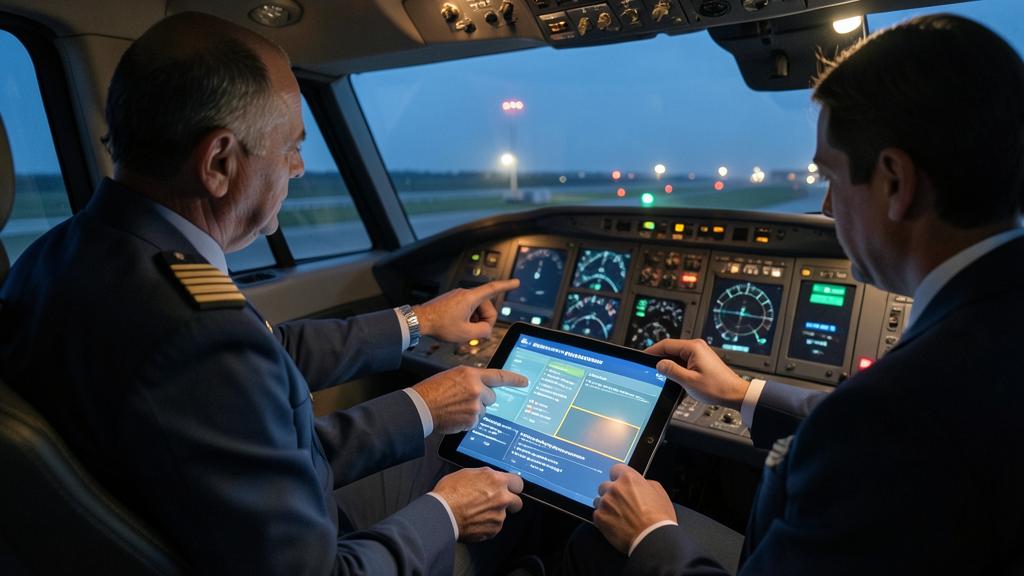
The moment is chosen on workload, not on position in the sequence. A briefing delivered while the other pilot is programming the flight management system, filling in the load sheet or talking to the purser has not taken place: it has been transmitted. The useful window is the one where both heads are up and the workload is still low, so early, before taxiing and the ground frequency take everything.
The form, next. Silence is not agreement: it is the default behaviour of someone who has stopped listening, and it is indistinguishable from the behaviour of someone who has understood everything. To lift that ambiguity, the listener has to produce something. The most economical way is not to ask whether there are any questions, but to leave an item for the other pilot to complete: the takeoff alternate, the acceleration altitude, the action planned if the runway is still occupied. A concrete answer proves listening; a nod proves nothing.
End with the day’s “what if”, and put it as an open question. A question whose answer you do not know in advance — what do we do if we are given the other runway at the holding point, if the forecast wind shear materialises in the first turn, if the takeoff alternate goes below minima during the climb — forces the listener to build something instead of validating. It is also the only way to discover, at that moment and not later, that the two of you did not have the same picture of the departure.
Finally, the re-briefing. It costs something in the order of a few tens of seconds and it covers only what the change affects: there is no need to go over everything, one must go over what is no longer true and what depends on it. The only moment when one believes one does not have those seconds is precisely the moment when one needs them most.
What the briefing settles between the two seats
A briefing is also the first technical exchange of the sector, and it sets a price. The way the first objection is received determines the mental price of the next one. A correction met with a justification, a sigh or a slightly irritated tone teaches the other seat what an intervention costs; a few hours later, in an ambiguous situation, that price will be paid in the form of delay. A correction met with a simple acceptance — “you are right, I will do that item again” — sets that price at zero for the rest of the day.
Both ends of the curve are met in line operations. Too steep a gradient produces the silence everyone knows. Too flat a gradient produces another silence, less commented on: nobody knows who decides, the call waits for a clarification that never comes, and the supposed sharing of responsibility becomes a dilution. The briefing is where this is settled without being discussed, simply by saying who does what and by leaving the other pilot room to complete.
For the less experienced of the two, the temptation is to cut it short so as not to bore a senior colleague. That is exactly the wrong move: what bores the senior is the recitation, not the content. Naming the variables of the day, saying what one is going to watch in particular, and saying what one has never done — a night departure at this aerodrome, a short runway at this weight — does not signal weakness. It is usable operational information, and it is precisely what a briefing is supposed to produce.
Everything above assumes two seats occupied. In single-pilot operations, the briefing loses its addressee and, with him, the return channel: nothing any longer proves that the representation holds, since there is nobody to complete the item left open. The workable substitute is the trace — saying it out loud, better still writing the variables of the day somewhere that will be read again at the holding point, because a decision one does not hear oneself take fades as fast as it formed. With an augmented crew or a pilot under line training on the jump seat, the problem is reversed: the expectation has to be installed in someone who will take the seat later, and a briefing given in front of him without being addressed to him does not install it.
What to go and check in your own operation
Nothing above removes the need to read what your operator actually requires, and that reading often holds a surprise: some of the items recited daily are required by nobody. Four checks are worth the time they take.
- The list of mandatory briefing items in the operations manual, and the distinction between what is required and what is recommended. The recitation feeds on the confusion between the two.
- The regime governing the abbreviated briefing: conditions of use, and what must be said all the same. An abbreviated briefing is not a short briefing: it is a briefing whose invariants were validated elsewhere, which only makes sense if the variables of the day are, for their part, actually named.
- The triggers for a re-briefing, if they are written down. Many manuals stop at a change of runway and leave aside a change of weight, of departure route or of takeoff alternate.
- The place of the briefing in the checklist sequence: whether it is a checklist item, at what point, and what that implies when the item is reached while the workload is already high.
There remains a grey area that nobody fills: no text defines the threshold beyond which a change requires everything to be gone over again. The workable rule follows from the three products set out at the start. If the change reaches the shared representation, a decision already taken, or an expectation against which one was monitoring, it has to be redone — at least that part of it. If it touches none of the three, it calls only for an announcement. For anyone preparing a type rating or a line check, it is this reading that distinguishes a briefing assessed as complete from a briefing that actually worked, and it is what an experienced examiner listens for behind the ticked items.
The applicable regulation, the standard operating procedures and the approved documentation of your operator prevail over everything above: this article describes a mechanism, it replaces no instruction.
Questions fréquentes
Which items must a departure briefing contain?
There is no universal list: the list that applies is the one in your operator’s operations manual, and it varies from one company and one type to another. The core found everywhere covers the runway actually assigned, the trajectory of the first minutes, the actions to be taken in the event of a failure on takeoff together with the takeoff alternate chosen, and the allocation of tasks. Anything added to that must pass the test of the three questions, failing which it consumes attention without installing anything.
Is an abbreviated briefing acceptable on a repeated rotation?
Yes, where the operations manual provides for it and its conditions of use are met, typically an unchanged crew flying a series of similar sectors. It should be remembered, however, that an abbreviated briefing is not a short briefing: it is a briefing whose invariants were validated on an earlier sector. It is legitimate only if the variables of the day are explicitly named; the abbreviated briefing that skips the variables is the most dangerous form of the recitation.
What has to be redone when the runway changes after the briefing?
You have to go over what the change makes false and everything that depends on it: available length and performance calculation, initial trajectory and first turn, obstacles and escape trajectory in the event of a failure, possibly the thrust setting and the configuration. Going over the whole briefing is rarely useful and often impossible at that stage of the preparation. The danger is not the omission of an item but the expired expectation that stays in place and makes the deviation undetectable.
How can you tell whether a briefing was listened to?
By making the listener produce something. Leaving an item for the other pilot to complete — the takeoff alternate, the acceleration altitude, the action planned in a particular case — gives proof of listening that a nod does not. The question “any questions?” asked while folding the charts tests nothing, because the silence of someone who has switched off and that of someone who has understood everything are identical.
Should standard callouts be briefed?
No: briefing them amounts to admitting that they are not standard. If the need is felt, it is a sign of something else — a crew that has never flown together, a return after a long absence, doubt about the allocation of tasks. It is then better to name that doubt in one sentence, which is usable information, than to recite what the standard operating procedures already fix.
How should you brief when you are the less experienced of the two?
Without cutting it short for fear of boring the other pilot: what wearies an experienced colleague is the recitation, not the content. Naming the variables of the sector, announcing what you are going to watch in particular and saying what you have never done at this aerodrome is operational information, not an admission of weakness. It is also the most direct way of flattening an over-steep authority gradient before you need it flattened.


Leave a Reply
You must be logged in to post a comment.