
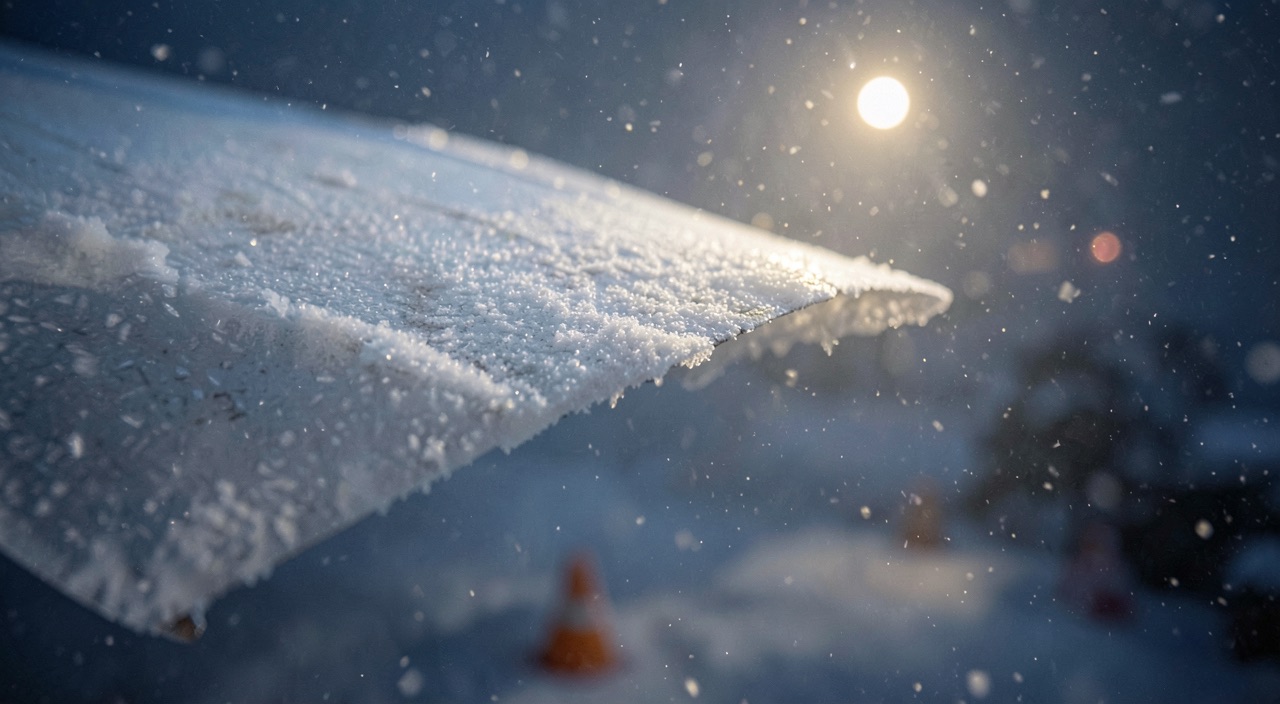
The « limitations » section of many flight manuals contains a phrase often read quickly: the aircraft is not approved for prolonged flight in icing conditions more severe than those considered during certification. This is neither a lawyer’s precaution nor a common-sense reminder. This phrase refers to a set of curves derived from instrumented clouds over half a century ago, and above all to everything these measurement flights never encountered.
An icing envelope is a set of measurements that became a rule.
The starting point is not a reasoning process; it’s a measurement campaign. Aircraft equipped with multi-cylinder piston engines flew through icing clouds for years: ice deposits more efficiently on a small cylinder than on a large one, and comparing the deposits weighed on the ground allows determining two quantities: the liquid water content of the cloud and the average diameter of its droplets. These crossings, repeated campaign after campaign, produced a cloud of data points, in all senses of the term.
From this cloud of points, a boundary was drawn. This is not a physical ceiling; it’s a rarity envelope, drawn to encompass almost all observed cases while excluding the most improbable combinations. Two families emerged, and they do not have the same physics or duration. The extended stratiform cloud carries little water but remains for a long time: the constraint is accumulation. The cumuliform peak carries much more water over a short distance: the constraint is the accretion rate, and therefore the system’s ability to evacuate a deposit that forms quickly. A protection system must pass both, and these are not the same tests.
Remembering the date of these campaigns is not a historian’s vanity. The instrumentation of the time measured very well what it knew how to measure, i.e., cloud droplets. The large droplets, those that fall instead of floating, largely escaped the sensors and were not sought. The envelope therefore bears the signature of its measuring tool as much as that of the atmosphere, and that’s where everything else comes from.
The icing envelope is based on old measurements that missed big, dangerous droplets. It’s like a safety net that only covers what they could measure back then, not everything that could happen.
An Airbus A320 flying through a cumuliform cloud with 0.8 g/m³ liquid water content and 20-micron droplets is within the envelope. But if it hits a freezing rain cell with 1 mm droplets, it’s outside the envelope, and the protections may not work as expected.
Four variables, a distance, and a family of reference accretions.
What the envelope defines is simple: the liquid water content, the average diameter of the droplets, the air temperature, and the altitude. The liquid water content-diameter pair is the heart of the system because it controls both the amount of water intercepted and where it deposits. Temperature, on the other hand, determines the texture of the deposit: near zero, the water does not freeze on impact; it spreads and forms dense, transparent ice, with horn shapes; much colder, it freezes on impact and produces white, porous ice, aerodynamically less harmful than it looks.
The fifth parameter is the one most often forgotten, and it’s a distance. The tabulated contents are averages over a reference horizontal extent: several tens of kilometers for the stratiform case, only a few kilometers for the cumuliform case. A correction factor accompanies the curves, and it increases as the crossing shortens. In other words, the envelope does not say what can be encountered in one second; it says what can be encountered on average over a certain distance. A brief, heavily loaded cell does not violate the envelope; it is read elsewhere on the same page.
From these atmospheric conditions, the certifier does not deduce a form of ice but a family of reference accretions, each attached to a flight phase: the deposit formed during takeoff, that of the climb and cruise, that of a prolonged hold, that of the landing configuration, that which remains between two cycles of pneumatic deicing, that which forms before the activation of an automatic system, and that which follows a failure of the protection system. The demonstration then involves aircraft carrying these forms, in wind tunnel, behind a tanker aircraft, in natural flight, and by calculation. This catalog is the true substance of the icing approval; the envelope is only the gateway.
The size of the droplets determines where the water deposits.
A droplet suspended in the air flowing around a wing is torn between two effects: the drag, which makes it follow the flow, and its inertia, which makes it continue straight ahead. The ratio of the two varies as the square of the diameter. A droplet of a few tens of microns is essentially transported by the air: it follows the streamlines, rounds the leading edge, and deposits only in a narrow band around the stagnation point. This band can be calculated, and it is the one that the protection covers, with a margin.
Multiply the diameter by ten, and the physics changes. The droplet no longer sees the contour: it continues its trajectory and strikes the surface well behind, on the lower surface as on the upper surface, where there is neither boot nor hot air circuit. Two effects further aggravate the situation. The large droplet does not necessarily freeze on impact: it splashes, fragments, and part of the water redeposits further back. And on a heated surface operating in wet mode, the melted water runs before refreezing at the edge of the heated zone—creating a ridge precisely where one thought the problem had been eliminated.
This ridge is the real problem. A thick horn at the nose of an aerodynamic profile degrades the maximum lift progressively and predictably. A fine ridge, a few millimeters high, placed across the upper surface somewhere behind the leading edge, acts as a flow separation trigger: the boundary layer separates very early, at a much lower angle of attack, and the lift loss that results is anything but progressive. If this separation occurs in front of a control surface, it also perturbs the hinge moments, and the control feel at the stick or yoke is no longer what the crew expects—including, and especially, when the autopilot disengages.
What remains outside: large droplets, ice crystals, mixed phase.
Three weather situations fall outside the historical envelope, and they do not resemble each other. First, large supercooled droplets: from freezing drizzle to freezing rain, they form either by coalescence in a relatively warm cloud, or by partial melting of snowfall crossing a warm layer at altitude, then supercooling as they fall into the underlying cold air. This second mechanism explains why they are often encountered under an inversion, during the descent to a runway: exactly where one is in a clean configuration, at low speed, and where the angle of attack margin is the smallest.
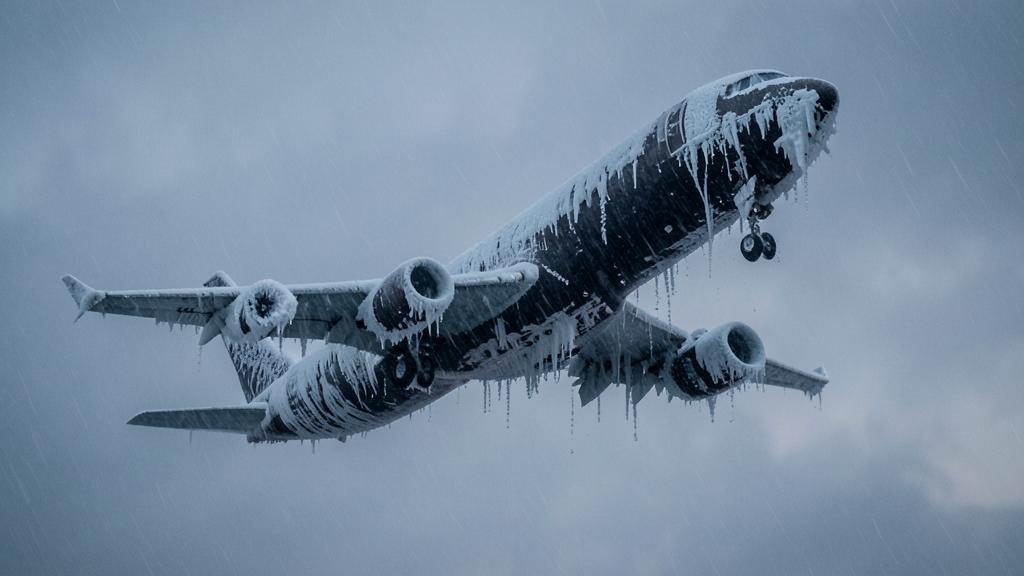
Then, ice crystals at altitude. Near convective tops, the atmosphere can contain ice concentrations well above what the liquid water envelope considers, without a single supercooled droplet. A crystal striking a cold surface bounces: the wing remains clean, the ice detector says nothing, and the crew logically concludes that there is no icing. On a hot surface, however, the crystal melts, the water film retains the following crystals, and the whole refreezes a little further. It is the engine intakes and heated probes that suffer, not the wing.
| Regime | Characteristic size | Where the water deposits | What the protection covers | Onboard signature |
|---|---|---|---|---|
| Reference supercooled water cloud envelope | A few tens of microns | Narrow band around the stagnation point | The entire impact zone, with a margin | Deposit on the usual references, regular deicing cycles |
| Large supercooled droplets, from freezing drizzle to freezing rain | Of the order of hundreds of microns, up to a millimeter and beyond | Behind the impact limits, on the upper and lower surfaces | The leading edge only: the aft band remains bare | Drops that flatten and freeze on the windshields, deposit behind the protected surfaces |
| Ice crystals and mixed phase at altitude | Fine ice particles, high ice content | On hot surfaces: engine flow, heated probes | Nothing of what was sized for liquid water | Total temperature anomaly, absence of deposit on unprotected surfaces, weak radar echo |
Finally, the mixed phase combines the two effects and disarms the detectors designed for one or the other. Ground icing must be considered separately: the concept of a clean aircraft before takeoff does not fall under these envelopes; it responds to pre-existing surface contamination, with its own rules for fluids and protection durations. Confusing the two domains leads to reasoning that stands up but is false.
The certification response: demonstrate, or detect and exit.
The accidents and research campaigns that followed led to complementing the framework with a second envelope, dedicated to large supercooled droplets, and with ice crystal conditions on the engine side. The interesting point is the form of the requirement. The manufacturer is not required to demonstrate that the aircraft flies indefinitely in the entire extended domain. It can also demonstrate a limited capacity, sufficient to exit safely, provided it provides a means of detecting entry and an exit procedure. Both paths lead to approval, but they do not lead to the same conduct.
This alternative has a direct consequence on the cockpit. On an aircraft with full capacity, encountering freezing drizzle is an operational event: it is managed, monitored, and continued. On an aircraft with limited capacity, it is the trigger for a procedure: it is recognized, announced, and exited. Two crews flying side by side on two different types therefore do not have the same obligation in the same cloud—and the flight manual is the only document that indicates which of the two contracts applies. A corporate culture, no matter how solid, does not replace this reading.
The detection means are often the eyes, and they are in the manual.
The required detection means is not necessarily a sensor. On many types, it takes the form of visual references listed in the flight manual, specific to the aircraft because they depend on its geometry and windows. The families resemble each other from one type to another: drops that flatten and freeze on the unheated part of the windshield, drops visible on the side windows, accumulation where it is never seen—behind a protected surface, on the side or bottom of the forward fuselage, on elements usually clean and unprotected. The common point of all these references is summed up in one sentence: they indicate water that deposits where it is not usually seen.
The trap. When the deposit stops growing on the leading edge, the spontaneous reading is reassuring: you are leaving the conditions. This can be exactly wrong. A transition to larger droplets shifts the impact zone to the rear: the leading edge remains clean because it no longer receives anything, while the water deposits on a band that is not visible from the cockpit. The protections work perfectly; they simply no longer cover the right area. A leading edge that becomes clean again in an active cloud is a signal to verify, not to savor.
The right reflex. Treat recognition as an investigation, not an impression. Set a time interval, and at each pass, check the references for your type in the same order—side window, unheated part of the windshield, visible unprotected elements, leading edge last. Trigger the procedure on the first reference, not on their accumulation: the logic of certification is to get you out early, not to establish a complete meteorological diagnosis.
What to check in your own documentation.
Three questions can be resolved in a few minutes in a flight manual, and they change the course of action. First: is your type approved for the entire domain of large supercooled droplets, or with limited capacity accompanied by detection means? The answer is in the limitations, not in the company’s usage. Then: what visual references does your manual retain, and are they really visible from both seats, day and night, with the available lighting to observe them? Finally: do your icing minimum speeds and approach increments apply only during the encounter, or also after the exit as long as there is ice on the airframe? This last condition is the one most often forgotten because it goes beyond the event that triggered it.
There remains a gray area, and it is not technical. Exiting without delay assumes available space: a change in altitude, a turn, a route deviation. No text quantifies this delay, and air traffic control does not know your limitation. This is a point that the operator can prepare rather than suffer—formulate the request, explicitly mention the nature of the constraint, choose by default between climbing and descending based on the suspected formation mechanism, since a layer of large droplets from melting at altitude is often thin and topped with warmer air.
For those preparing a type rating, finally, the oral question will not be about the list of envelopes. It will look more like this: how do you know you have entered, and what is your first action afterward, even before fully understanding the situation? Knowing where the curves come from serves exactly this purpose, because one only recognizes what one understands the mechanism of.
The applicable regulations, the type flight manual, and the operator’s approved documentation take precedence over everything written here; in case of divergence, they apply.


Leave a Reply
You must be logged in to post a comment.