
During climb in a stratiform layer, the pitch hasn’t moved, the throttles haven’t either, and the indicated speed is steadily increasing. Nothing in the aircraft’s behavior has degraded: what’s degrading is what we’re reading. On another flight, the same layer produced the opposite scenario — pitch maintained, thrust that needs to be increased, speed slowly fading. Both crews will write the same word in their report, yet neither the diagnosis nor the corrective action are the same.
One weather, two different failures
The supercooled water and crystals encountered in the layer cross paths with two categories of objects on the aircraft, and the result is not the same. On a leading edge, a radome, an air intake, the ice adds material: it modifies a geometry, therefore an aerodynamics. On a total pressure probe, a static port, an angle-of-attack vane, it doesn’t modify the aircraft’s aerodynamics — it modifies what the aircraft believes about itself. In the first case, the machine flies worse and shows it through its performance. In the second, it flies exactly as before and is mistaken about its state.
This fundamental difference dictates everything else, starting with the cockpit signature. An aerodynamic degradation is consistent: speed fades while required thrust increases, the autopilot compensates with pitch, vertical speed decreases, and all sources tell the same story because they’re telling the truth about an aircraft that has actually changed. A blocked probe, however, produces inconsistency: one parameter deviates alone, or two parameters diverge in opposite directions, while pitch, thrust, noise, and geometric altitude claim nothing has moved. It’s this disagreement, not the magnitude of the deviation, that identifies the failure.
Both occur in the same range of conditions, sometimes in the same minute, which explains why they’re confused. But the corrective action for one isn’t the corrective action for the other, and applying them crosswise is costly: adding speed won’t make a probe honest, and searching for an information failure while a wing accumulates consumes the time that should have been used to exit the layer.
There are two types of icing problems: one makes the plane fly worse (like rough wings), and the other makes the instruments lie (like blocked sensors). You can’t fix them the same way – one needs you to fly differently, the other needs you to ignore bad readings.
Accretion on surfaces: what’s lost first
The reflex is to think about weight and drag. They matter, but they’re not what closes the envelope the fastest. What closes it is the roughness installed in the very first percentage of chord, where the boundary layer is thinnest and most fragile. A thin but rough accretion, whose importance is hard to gauge from the cockpit, is enough to advance the transition then the stall: maximum lift decreases, and — what matters more — it’s achieved at a lower angle of attack than in clean condition.
On an Airbus A320 at 20,000 feet in moderate icing (OAT -10°C, LWC 0.5 g/m³), a 3mm ice accretion on the leading edge can reduce maximum lift coefficient from 1.8 to 1.5, requiring an increase from 130 to 150 knots to maintain the same lift at the same angle of attack.
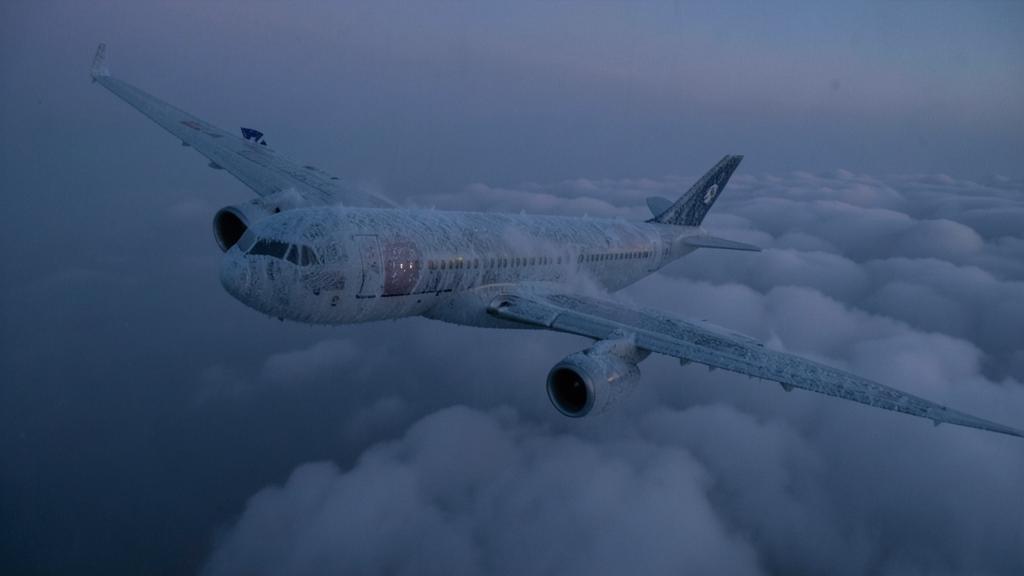
The second effect follows from the first. The stall warning system is calibrated for a clean wing: whether it works on angle of attack or a compensated speed, its threshold was determined for a certified geometry. Contamination brings the stall closer to this threshold, or even below it. The margin between the warning and the event thus closes silently, without any indication moving. This is the entire purpose of speed margins in icing: they don’t serve to fly faster, they restore the margin where it was demonstrated. Some types also adjust the threshold calibration upon activation of protections; the mechanism is worth knowing for the type being operated, as it changes how the display is read.
The third effect is the most discreet. The added drag and mass don’t just cost thrust: they accumulate while the autopilot absorbs the drift via the trim. The crew feels nothing because a servo feels for them, and the first clear sign arrives when maintaining the trajectory becomes impossible — i.e., too late. Hence the interest in monitoring the trim position and the thrust required at constant speed long before monitoring speed itself.
The horizontal stabilizer deserves a separate line. Its profile is thin, its leading edge radius small, and it operates at a negative angle of attack that the flaps increase. A contaminated stabilizer can therefore stall before the wing, and the picture is then reversed: pitch-up recovery upon flap extension, elevator becoming abnormally light, control to be pulled back and not pushed forward. The recovery isn’t that of a wing stall, and confusing the two means applying the exact opposite action. The type’s documentation states which of the two scenarios is demonstrated, and it’s the one that decides.
Ground contamination falls under a different regime, which must not be mixed with the previous one. It’s handled by the cleanliness of the surface before brake release, by fluids and their effective duration, and by a much stricter requirement than in flight: there’s no tolerable roughness on a critical surface at takeoff. What applies in flight — protect, increase, exit — has no equivalent on the ground.
Blocked probe: three failures, three signatures
The total pressure probe measures a stagnation pressure, the static port measures an ambient pressure, and the airspeed is nothing more than the difference between the two. Depending on the probe affected and the state of the drain hole, the blockage produces three distinct scenarios. Having them in mind is better than remembering « false airspeed, » which doesn’t guide any action.
- Blocked total pressure, drain clear. The trapped pressure leaks through the drain toward ambient pressure, the difference tends toward zero, and the indicated airspeed collapses more or less quickly depending on the leak rate. The scenario resembles a sudden loss of energy, but pitch and thrust haven’t changed and the aircraft isn’t sinking.
- Blocked total pressure, drain also blocked. The value remains frozen at what it was at the time of blockage, while ambient pressure, meanwhile, continues to follow altitude. The airspeed indicator then behaves like an altimeter: the indicated speed increases during climb, decreases during descent, with perfect precision. It’s the most dangerous of the three, because it pushes to act in the direction that feeds it.
- Blocked static port. Altitude freezes at the captured value, vertical speed cancels out, and the indicated speed drifts in the opposite direction to the previous case: too low during climb, too high during descent. As the same parameter also feeds altitude calculation, terrain monitoring, position transmission, and sometimes automatic calibration, the failure doesn’t remain confined to airspeed indication — it contaminates functions that aren’t spontaneously associated with a blocked probe.
In all three cases, it’s important to remember everything that the calculated speed feeds downstream: autothrottle, envelope protections, warning thresholds, autopilot mode transitions, presentation of characteristic speeds. A false but plausible source can be retained by the comparison logic between computers and cause the automatics to act in the wrong direction before the crew has decided anything. This is why the first useful action is almost always to take control and display a pitch and thrust, before any diagnosis.
The test that distinguishes the two
A single question separates the two families, and it’s asked without a manual: does the aircraft react? If speed moves away from its value while pitch is held, thrust is as displayed, and vertical speed hasn’t changed, the machine hasn’t moved and it’s the measurement that’s lying. If, on the other hand, thrust must be added to maintain the same speed, if the trim drifts, if vertical speed decreases, then the aircraft has actually changed and the lie isn’t in the instrument.
| What we look at | Airframe accretion | Port blockage |
|---|---|---|
| Grandeur atteinte | Actual performance: maximum lift, drag, mass | Information: measured total pressure or ambient pressure |
| Consistency of sources | All agree: they describe the same aircraft, genuinely degraded | One source drifts on its own, or two drift in opposite directions |
| Aircraft response | Thrust required increasing, trim working, vertical speed falling off | None: pitch attitude, thrust, noise and geometric altitude unchanged |
| Time constant | Gradual, a function of the time spent in the layer | Sudden, or tied to the change in altitude |
| Role of automation | It masks the degradation by compensating for it | It amplifies it by acting on a false value |
| First useful action | Protection systems on, leave the layer, applicable speed increments | Reference pitch attitude and thrust, automation disconnected |
| What makes it worse | Staying longer in icing conditions, waiting for visible accumulation | Continuing the climb, following the varying indication |
The trap. A total pressure trapped behind a also blocked drain produces an indication that increases during climb: it’s stable, it doesn’t flicker, and it’s consistent with the action in progress. Everything invites believing it, therefore to reduce thrust or pitch up to contain it, i.e., to approach the real stall while the screen announces the opposite. The counter-indication will never come from this screen: it comes from the held pitch, the displayed thrust, and the fact that speed follows altitude instead of following the throttles.
The right reflex. When faced with a speed you doubt, first stop altitude variation before opening anything. A frozen total pressure only produces an error because ambient pressure, meanwhile, continues to change: in stabilized level flight, the error stops growing and the discrepancy between sources finally becomes readable. Fixing a known pitch and thrust doesn’t diagnose anything, but makes diagnosis possible without consuming margin.
Two corrective actions that don’t resemble each other
Against accretion, everything happens upstream. Protections are activated according to the type’s prescription, which is often prior to entering the conditions and not subsequent to observing a deposit. The rest is a matter of trajectory management: changing level or heading to exit the temperature range where water remains liquid, avoiding prolonged waiting in a layer, applying the speed margins and configuration limitations provided, and remembering that some of them remain applicable after exiting the conditions until residual ice has disappeared. None of this is improvised during accumulation.
Against blockage, the corrective action is of a different nature: it’s made of verification and reference. Probe heating is activated before entering visible humidity, never after, because a already blocked probe takes time to clear and may not do so in flight. The control of the three sources is done early, during taxiing, when speed must animate all at the same time and altitudes must agree; it’s the only moment where a disagreement is still paid in departure delay and not in in-flight margin. Finally, the in-flight corrective action boils down to two numbers learned or immediately available: a pitch and thrust per phase and per weight. They don’t replace speed, they make its absence bearable.
The divergence between these two logics deserves to be stated frankly. The first is a policy, decided before entering and judged on the discipline with which it’s maintained. The second is a capability, judged on what the crew can do in the very first seconds following a false indication. An operator can excel in one and be helpless in the other, and training doesn’t work them in the same place.
What protections do, and where they stop
One thing explains the chronology of deposits on an aircraft: the capture efficiency depends on the radius of the exposed body. In front of a thick leading edge, the flow diverges far upstream and carries with it a large part of the droplets, which are light enough to follow. In front of a probe, an antenna, a wiper, or a thin stabilizer, the air doesn’t have room to diverge as early and the drops hit the surface. This is why these elements whiten before the wing, and why a probe requires dedicated heating while a thick wing tolerates modest conditions longer. It’s also why visual inspection from the cockpit, which focuses on the most visible parts, structurally underestimates what the thinnest parts are undergoing.
On surfaces, two families of protections coexist and don’t promise the same thing. Anti-icing prevents formation by keeping the surface above freezing temperature or by evaporating intercepted water; it consumes continuously. De-icing allows accumulation to occur then expels it in cycles, which implies that between two cycles a roughness exists and the aircraft flies with it. The old idea that one should wait for sufficient thickness before activating boots has been revised a long time ago: activation at the first signs is today the general procedure, subject to what the type’s documentation prescribes.
Finally, the protected zone must be distinguished from the rest. Behind the heated zone, water that hasn’t been evaporated can run off and refreeze, and this deposit is precisely where the profile is most sensitive to a discontinuity. Antennas, windshield frames, and supports aren’t protected. As for ice detectors, they detect conditions at the location where they’re mounted: they don’t measure the state of the wing, and the absence of indication isn’t proof of cleanliness.
What remains to be checked at home, and the gray area
The gray area has a name: outside the certified envelope. A type’s protections have been demonstrated for a domain of conditions defined by droplet diameters, water content, and exposure durations. Beyond — large supercooled droplets, freezing drizzle — nothing has been demonstrated, not out of negligence but because the domain stops there. The behavior of the deposit changes in nature: it settles behind the protected zones, on surfaces that nothing will de-ice. Some manufacturers publish visual signs to recognize this situation; the procedure is never to trust the system, it’s to exit the conditions, and the information deserves to be sought before the flight rather than during.
What needs to be checked in your own documentation boils down to a few precise points. Where is the pitch-thrust table, and does it really cover all phases and all weights? How far do the immediate actions of the « suspect airspeed » procedure go, and where exactly does the work on the checklist begin? Which speed margins apply, and for how long after exiting the conditions? What definition of icing triggers what, on this type, between total temperature, static temperature, and visible humidity? And what use of the autopilot is prescribed — because it masks degradation on one side and amplifies the error on the other. These answers aren’t deduced from a general principle: they’re written, and they differ from one type to another.
For those preparing a type qualification or a check session, a final point deserves to be heard. What’s observed in the simulator in front of a suspect airspeed isn’t the recitation of a procedure: it’s the delay between the doubt and the display of a pitch, the ability not to follow the varying indication, and the choice to stop the climb before trying to understand. These three behaviors go against instinct, and they’re acquired through repetition far more than through rereading; a dedicated preparation installs them more surely, and crew feedback on a type’s particularities is often found faster on the professional forum than in a manual.
The applicable regulation, the operator’s approved operations manual, and the manufacturer’s documentation prevail over everything written here; in case of discrepancy, they are the ones that apply.


Leave a Reply
You must be logged in to post a comment.