
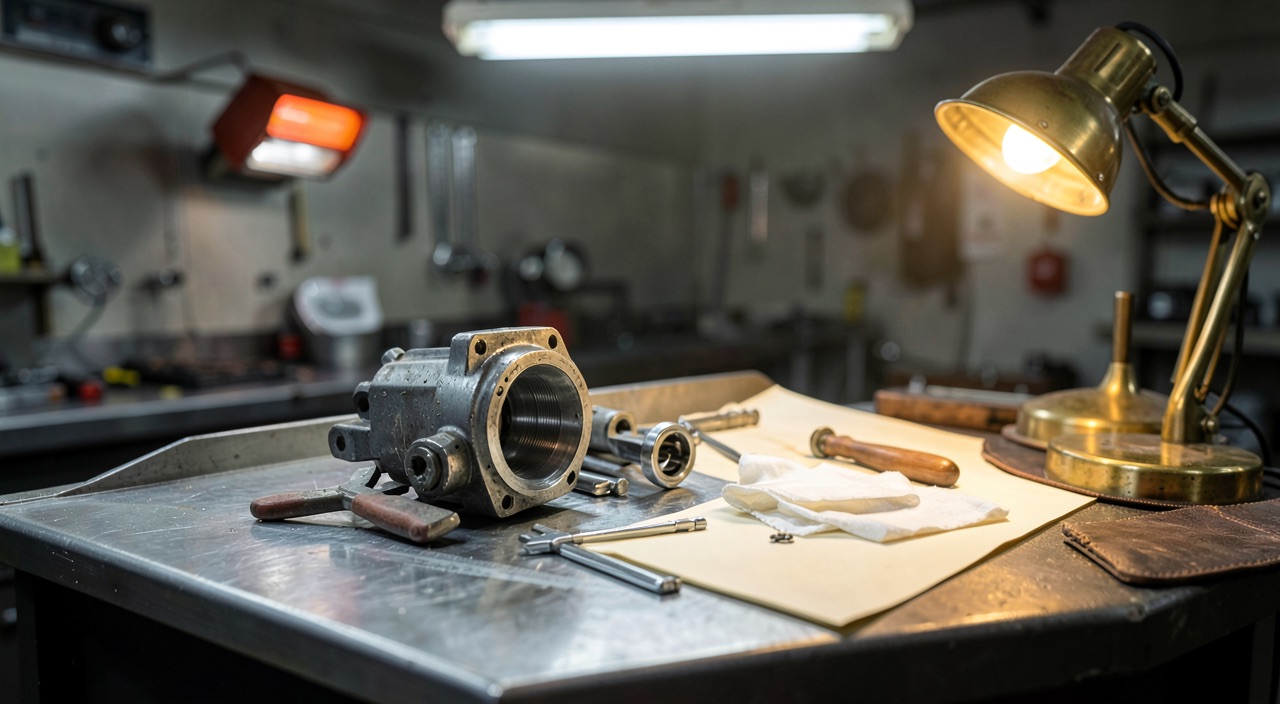
The job card says “removal and installation of the computer.” The technician reinstalls the unit, runs the final task test, receives an anomaly message, pulls out the wiring diagram, and starts measuring. At that exact moment, the task has changed category, and the certification that covered it no longer applies. The separation between airframe and avionics categories does not divide two professions by mood: it separates two levels of intervention, and what it prohibits from signing says more than what it allows.
It’s not the manual chapter that decides, it’s the depth
The most common workshop reflex is to decide by system: flight controls to the airframe technician, navigation to the avionics technician, case closed. This shortcut is wrong in both directions. The breakdown of maintenance license categories does not follow the table of contents of the documentation; it crosses two criteria, the nature of the work and the depth required to prove the system is good.
Category B1 covers, in its own right, the structure, the powerplant, mechanical systems, and electrical systems. Category B2 covers, in its own right, avionics and electrical systems. So far, the image of a division by profession holds up. It falls apart in the next line: each category can also intervene in the other’s territory, but only for tasks whose proper execution is proven by simple tests, and which do not require any fault isolation.
This clause is the true articulator of the system, and it’s the one that is often overlooked. It states that an airframe technician can install an avionics unit as long as the final task test is a functional check, and they can no longer sign anything as soon as a fault needs to be isolated. The transition is not symmetrical: the avionics technician does not inherit mechanical work; they inherit electrical and avionics tasks located within mechanical and engine systems. A landing gear actuator removal remains a landing gear actuator removal.
The key difference isn’t what system you’re working on, but how deep you need to go. Simple checks (like “does it light up?”) can be done by either category, but troubleshooting (like “why isn’t it lighting up?”) requires the specialist for that system.
On an Airbus A320, a B1 technician can replace the Flight Management Computer (FMC) as long as the test is just powering it on and checking the display. But if the display shows errors, they must call a B2 technician to diagnose the issue – even though the FMC is part of the “mechanical” flight control system.
Where does the breakdown come from: five workshop trades reduced to two licenses
Before European harmonization, national authorities issued titles based on the organization of workshops: airframe, engines, electrical, instruments, radio. Each title corresponded to a workspace, tools, and a team leader, and the system worked as long as the aircraft could be disassembled in sections. It broke down on the line, where a single intervention—a computer removal, a sensor replacement—required three signatures for one hour of work, and where the aircraft waited for the missing certification longer than the repair itself.
The consolidation carried out during European harmonization in the late 1990s did not group trades by affinity, but by diagnostic action. Everything that is diagnosed by disassembling, measuring a clearance, tracking a leak or a crack initiation ended up on one side: structure, engine, mechanical systems, and wiring, which is routed, secured, and inspected like a part. Everything that is diagnosed by reading, comparing a configuration, or interpreting an integrated test message ended up on the other.
Instruments and radio, long two separate worlds, merged for a material reason: their failures stopped being organ failures to become information chain failures. The day the needle and the transmitter shared the same data bus, they shared the same troubleshooting tool, and thus the same license. The trace of this genealogy is still visible in the basic programs: the common core—materials, rules of the art, human factors, regulations—remains largely shared, and it is from the systems modules that the two paths diverge sharply.
What each category opens, and what it leaves closed
The table below brings together what the text grants in its own right, what it authorizes to reach in the neighboring category, and what it locks. The last column is the one that should be displayed on the duty roster: no type training expands it.
| Category | Domaine propre | What it reaches in the neighbouring category | What remains closed to it |
|---|---|---|---|
| A | Minor scheduled line maintenance and simple defect rectification | Nothing beyond the tasks for which it has been trained | Any task it has not carried out itself; any troubleshooting |
| B1, in four subcategories: aeroplane or helicopter, turbine or piston | Structure, powerplant, mechanical and electrical systems | Work on avionics systems proven by simple test | Avionics troubleshooting; software configuration restoration |
| B2 | Avionics and electrical systems | Electrical and avionics tasks within mechanical and engine systems, by simple test | Mechanical and structural work; base check certification |
| B3 | Unpressurised piston aeroplanes below the maximum take-off mass threshold set by the regulation, around two tonnes | The entire aircraft within this scope, airframe and avionics alike | Everything outside this scope |
| C | Approbation pour remise en service d’une visite complète en base | Relies on the task sign-offs made by B1 and B2 staff | Carry out tasks; certify line work |
Two nuances deserve to be known. Category B2 does not automatically include Category A privileges, but the text allows them to be exercised provided the same task training and experience requirements are met—provided the company includes them in the certification, otherwise the privilege remains theoretical. Categories dedicated to light aircraft, gliders, and balloons also exist, with their own scope logic.
The common area: where the task changes hands
Take a common chain: a position sensor, a harness, a computer, a servo-control, a control rod. The sensor is bolted, so mechanical? It delivers a signal, so avionics? The question is poorly framed. What matters is the action the job card requires to close the task.
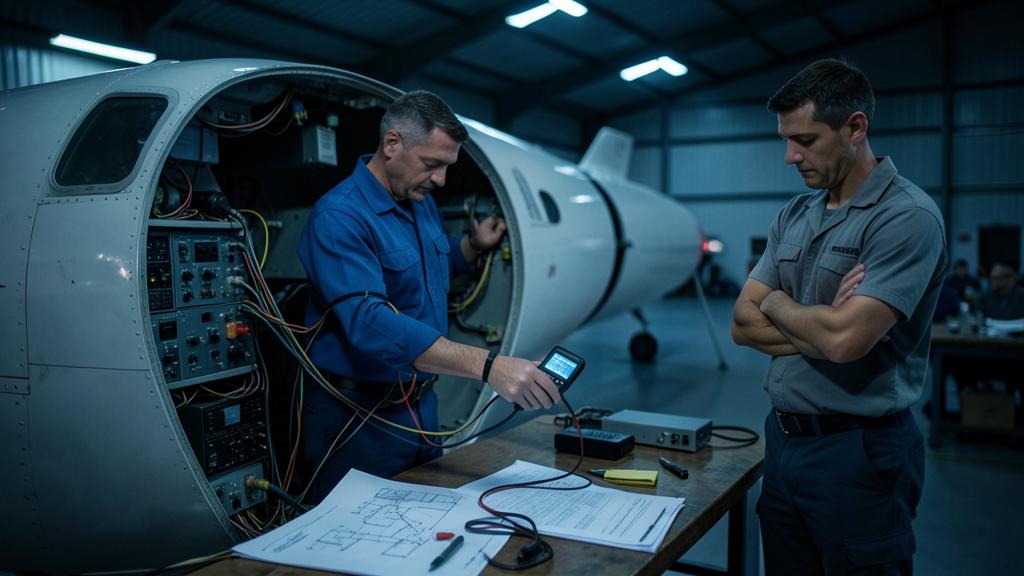
A removal-installation of equipment closed by a test that answers yes or no—light off, message cleared, travel within the template—remains in the category of the parent task, regardless of the box handled. A continuity to measure, a fault to locate between the sensor, the harness, and the computer, a configuration load to verify, an adjustment whose acceptance criterion is read on a system value: you have crossed over. The operational criterion is summed up in one question: does someone have to interpret a measurement? If yes, the signature belongs to the category of the system, not the task.
The trap. It’s the equipment exchange that degenerates into troubleshooting. The airframe technician removes and reinstalls the box according to the card, the test fails, and they naturally move on to the wiring diagram because they know how to do it and the aircraft must depart without delay. Technically, they are right; legally, the task has changed category without anything being written anywhere. The approval they will sign will cover work that their license does not cover, and the discrepancy will not be noticed on the same day or the next flight, but during an audit—or in the analysis of an event where the chain of signatures will be traced back.
The right reflex. Read the acceptance criterion of the card before deciding who signs, never the chapter number. If the closure requires interpreting a value, a trend, or an integrated test message, prepare two signatures from the start and split the work order at the handover point. Two signatures cost a few minutes; an approval without basis costs the file, and sometimes the authority’s trust in the company’s entire signing system.
Two models of responsibility: the individual or the workshop
The European breakdown seems natural to those who grew up with it; it is, however, a choice, and the North American comparison shows it. Across the Atlantic, the individual mechanic’s certificate includes airframe and powerplant mentions, with no avionics equivalent. The ability to approve avionics work does not come from an individual title but from the mentions on the workshop’s approval, supplemented if necessary by a repairman’s title tied to the position and which falls with it.
| Question | European model | North American model |
|---|---|---|
| Where the avionics privilege sits | On the individual licence, in a dedicated category | In the ratings of the repair station’s approval |
| Who certifies avionics work | A person authorised by the organisation, holding the category and the type | The approved repair station, through the signature of a person it designates under its own approval |
| What the person takes with them when changing employer | The licence and its type ratings; only the authorisation has to be redone | Nothing transferable on the avionics side: the capability stays with the organisation |
| Weak point of the model | Rigidity: two categories to keep up to date, two recent experience windows | Dependence on the organisation and difficult recognition abroad |
This divergence explains a good part of the misunderstandings in recognition files. A seasoned avionics technician trained under the second model has no individual title to convert: they have a skill set attested by an employer, which is not the same currency.
The license signs nothing: what the certification adds on top
It must be repeated with each promotion: the license is a competence title, not a signing right. The right to sign comes from the certification to certify issued by the approved maintenance organization, within the limits of its own approval. It names the categories, the aircraft, sometimes the systems, and distinguishes line and base. A technician certified on a type is not certified on the neighboring type from the same manufacturer.
Three conditions are often overlooked with deplorable regularity. The license has a limited validity period and must be renewed. The exercise of privileges requires recent maintenance experience—on the order of six months over the past two years—and this experience is counted by category exercised, not globally. Finally, type mentions are entered after a type course and, when the text requires it, on-the-job training evaluated. A B1 who has not touched an avionics task in two years keeps their category on paper; what they have lost is the basis of their certification.
What remains gray, and what needs to be checked in-house
The boundary blurs where the architecture of recent aircraft contradicts it. A generic computer hosting multiple functions in software partitions no longer belongs to a system: it belongs to a platform. An electric brake, an electromechanical actuator, a mechanical-free flight control shift failures that were hydraulic yesterday toward software. On these fleets, the dual category becomes a real asset, at the cost of two knowledge bases to maintain and two experience windows to feed. The qualification paths preparing an additional category never exempt from the corresponding experience.
Four checks are worth making in your own documentation. Reread the exact wording of your certification: scope, categories, types, line or base, limitations. Identify, in the job cards of your fleet, those whose final test requires interpretation rather than observation—these are your handover points. Check whether the procedures provide for splitting the work order at these points, or if practice leaves a single signature stretched. Finally, check how your recent experience is recorded by category: it is this record, and not the team leader’s memory, that will be used in case of inspection.
For those preparing for a qualification, the question is not which profession is most attractive, but which half of the chain they want to have the right to troubleshoot. Choosing the mechanical category or the avionics category is choosing which side of the measurement you will stand on the day the test fails.
These guidelines describe a mechanism, not a specific case: the applicable text, the authority’s decisions, and the approved documentation of the maintenance organization prevail in all circumstances over this article, and it is the wording of your certification that is valid at the time of signing.


Leave a Reply
You must be logged in to post a comment.