
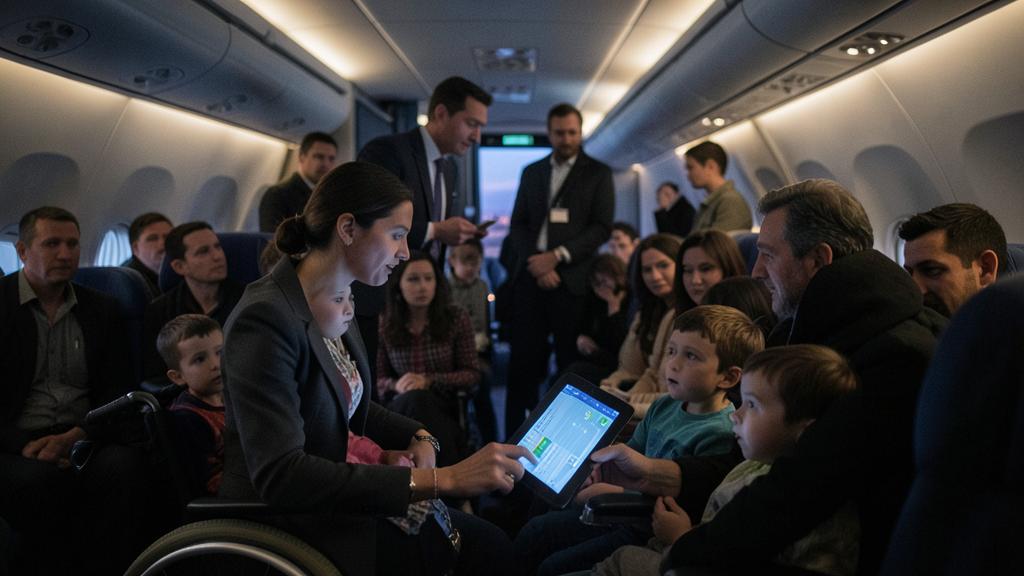
The passenger who will miss a connection knows it long before the doors open, and increasingly knows it before the crew do, because the aeroplane has wireless internet and the crew have a public address handset. The half hour or so between top of descent and the door is the only window in which the cabin can turn a rumour into a usable picture — and it is also the window in which a well-meant sentence can commit an airline to something it never agreed to. The distinction between the two is a procedure, not a personality trait.
The cabin holds one piece of the picture, and it is not the decisive one
Three organisations hold parts of a transit problem and none of them holds all of it. The flight deck knows the arrival time, the runway and the taxi expectation. Operations control knows the connecting flight’s real status, whether it will be held, and whether a rebooking has already been made. The ground handler at destination knows the gate, the walking distance, the border formalities and how many agents are actually at the aircraft door. The cabin knows something none of the others knows: who is sitting where, in what state, with what mobility, and what they have already been told.
That last piece is worth more than crews are taught to think. Operations can rebook a name; only the cabin can tell operations that the name belongs to a passenger travelling with two children and a wheelchair request, who will not be first off the aeroplane whatever anyone announces. The value of the cabin’s contribution is precision about people, not speculation about flights.
| Information | Held by | How it reaches the cabin | How solid it is |
|---|---|---|---|
| Actual arrival time and taxi expectation | Flight deck | Interphone, on request | Good, and improves during descent |
| Connecting flight status, holding decision, rebooking | Operations control | Company datalink message relayed by the flight deck, or a crew device where fitted | Authoritative but perishable; a status is true at a stated time, not indefinitely |
| Arrival gate and transfer route | Ground handler and airport | Rarely before landing; often changed after | Weak before the aeroplane is on stand |
| Departure gate of the connecting flight | Airport | Not through company channels at all | Weakest of all; announcing it is a mistake waiting to happen |
| Who is connecting, and their constraints | Cabin crew | Passenger list, plus the cabin’s own eyes | The one piece the cabin genuinely owns |
| What the passenger already believes | The passenger’s telephone | Wireless internet on board | Often more current than anything the crew has |
One ticket or two: the line that decides what is owed
Before any announcement, someone should know which side of a legal line each transit passenger sits on, because the two cases produce completely different obligations and completely different conversations.
On a single reservation — one ticket, whether or not the flights are operated by the same carrier — the carrier’s undertaking is carriage to the final destination. A missed connection is the carrier’s problem: re-routing, the duty of care that goes with a wait, and, where the European passenger rights regulation applies, compensation assessed on the delay at the final destination rather than at the intermediate stop. Baggage is normally through-tagged and follows the rebooking, except where the transfer airport requires it to be reclaimed.
On separate reservations, the second flight is a contract with someone who never promised to wait. The passenger’s bags will usually have to be reclaimed and checked in again, the fare may be lost entirely, and the onward carrier owes no re-routing. This is the case that produces the worst scenes at the door, and it is the case in which a sympathetic but inaccurate cabin announcement causes the most damage, because it creates an expectation the ground agent will have to destroy fifteen minutes later.
Two further complications are structural rather than commercial, and the cabin should know they exist. Some States require every arriving passenger to reclaim baggage and clear customs before re-checking, regardless of the ticket. And a transfer that crosses a border-control boundary — into or out of a common travel area — adds a formality that no amount of running removes. Both turn a connection that looks feasible on paper into one that is not.
If you’re on one ticket, the airline must help you get to your final destination. If you’re on two separate tickets, the second airline doesn’t have to wait for you, and you might have to rebook and pay again. Some countries also make you go through customs even if you’re just connecting.
A passenger on a single ticket from Paris to New York via London misses their connection due to a delay. The airline must rebook them on the next available flight to New York, cover any extra costs, and possibly pay compensation. But if the passenger had two separate tickets (Paris-London and London-New York), the second airline isn’t obligated to wait, and the passenger may have to rebook and pay again.
Building the picture during the cruise, not during the descent
The single most common failure is starting too late. By the time the descent checklist is done, the flight deck has other work, operations has moved on, and the cabin is securing. The picture has to be requested while there is still time for an answer and a second question.
| When | What happens | Who |
|---|---|---|
| Well before top of descent | Ask the flight deck for the expected arrival time and for a request to operations on connection status | Purser |
| On receipt of the answer | Note the status and the time it was issued; a status without a timestamp is not usable | Purser |
| Same period | Identify connecting passengers from the list, then walk the cabin and confirm; add mobility, children, language, medical constraints | Cabin crew |
| Before descent | Flag to operations, by name, the passengers who cannot move quickly, and any passenger whose onward journey has a hard constraint | Purser via flight deck |
| In the descent | One factual announcement: what is known, when it was known, what will follow at the door | Purser |
| After landing, before doors | Update only if something changed; otherwise repeat nothing | Purser |
| At the door | Written list handed to the ground agent, tightest connection first, constraints marked | Purser to handling agent |
The walk through the cabin is the part that gets skipped, and it is the part that produces the value. A passenger list shows a connection; it does not show that the passenger is asleep, has already rebooked himself on his telephone, is travelling with an infant, or is on the second leg of a separate ticket and does not know what that means.
What can be said, and what quietly commits the company
An announcement is made by an agent of the carrier, in the carrier’s name, to a cabin full of witnesses, some of whom are recording. Cabin crew are not expected to be lawyers; they are expected to speak in a form that reports rather than promises. The difference is grammatical and easy to learn.
| Situation | Reports — safe | Promises — avoid |
|---|---|---|
| Connection is tight | « At twenty past, our operations showed your flight departing on schedule. » | « You will make your connection. » |
| Flight may be held | « We have asked operations about the connection; staff will meet the aircraft with the answer. » | « They are holding the aircraft for you. » |
| Connection already lost | « Operations is aware of the connection and is working on the onward arrangements; the agent at the door will have your details. » | « You have been rebooked on the next flight. » |
| Passenger asks about compensation | « Entitlements depend on the ticket and the circumstances; the ground staff can go through it with you. » | Any figure, any condition, any assurance |
| Passenger asks why | « We were delayed leaving; the details will be on your documentation. » | Naming air traffic control, weather, a technical fault or another department as the cause |
| Gate of the onward flight | « The gate will be on the airport screens after landing. » | Any gate number heard from any source |
Two habits do most of the work. Attribute every fact to its source and its time — « operations told us at twenty past » — because that converts a promise into a report and remains true even when the situation changes. And never state a cause. Causation determines liability under the passenger rights regime and under the carriage convention, and it is settled afterwards, by people with the whole file, not in a cabin ten minutes from the gate.
The trap. « The aircraft is being held for you. » It is heard as a guarantee, it spreads through the cabin in a minute, and it is almost never within the crew’s knowledge — a holding decision belongs to operations and can be reversed while the aeroplane is still taxiing. When it is reversed, the passenger does not remember that operations changed its mind; he remembers that the crew told him it would wait.
Triage: the order in which people need attention
Not all connecting passengers are in the same situation, and treating them as one group wastes the little time available. A workable ordering:
- Passengers who cannot move quickly. Reduced mobility, unaccompanied minors, infants, the frail. They are usually last off, so their connection is decided before landing or not at all. Operations must have their names early.
- Passengers whose connection is genuinely marginal. Not the ones who have lost it and not the ones who are comfortable; the ones for whom minutes and information will decide. They are the only group for whom a personal briefing pays.
- Passengers who have already lost the connection. Their need is not speed, it is certainty and a named next step. Rushing them off the aeroplane helps nobody.
- Passengers on separate tickets. They need to understand, gently and early, that the onward carrier is not part of this arrangement — before they push through a cabin for nothing.
The good reflex. Write the list. Seat number, name, onward flight, constraint, in that order, on paper or on the crew device. Handed to the agent at the door it takes ten seconds and survives the noise; shouted over a disembarking cabin it survives nothing. It also gives the cabin a defensible record of what was passed on and when.
Announcements about disembarkation order rarely work, and that is worth knowing
Asking a full cabin to remain seated so that connecting passengers may leave first is a request with a poor record. It is worth making once, clearly and early, because it occasionally helps in a lightly loaded cabin — but building a plan on it is building on nothing, and crews who assume it will work stop doing the things that do.
What actually works is arranging matters before the aeroplane stops moving: knowing who is connecting, telling operations early enough to matter, having an agent at the door with names, and, where the operator’s procedures allow it, moving a passenger forward at a moment when moving is permitted. What does not work is a plan whose first step is the goodwill of two hundred tired strangers.
The handover, and why it is the part that gets remembered
Everything the cabin does in the cruise is destroyed or completed in the thirty seconds at the door. The agent who meets the aeroplane has usually been given a list of names by the system and nothing about the people attached to them. A purser who hands over a marked list — tightest connection first, mobility and language noted, separate-ticket cases identified — has converted an hour of cabin observation into something the ground can act on.
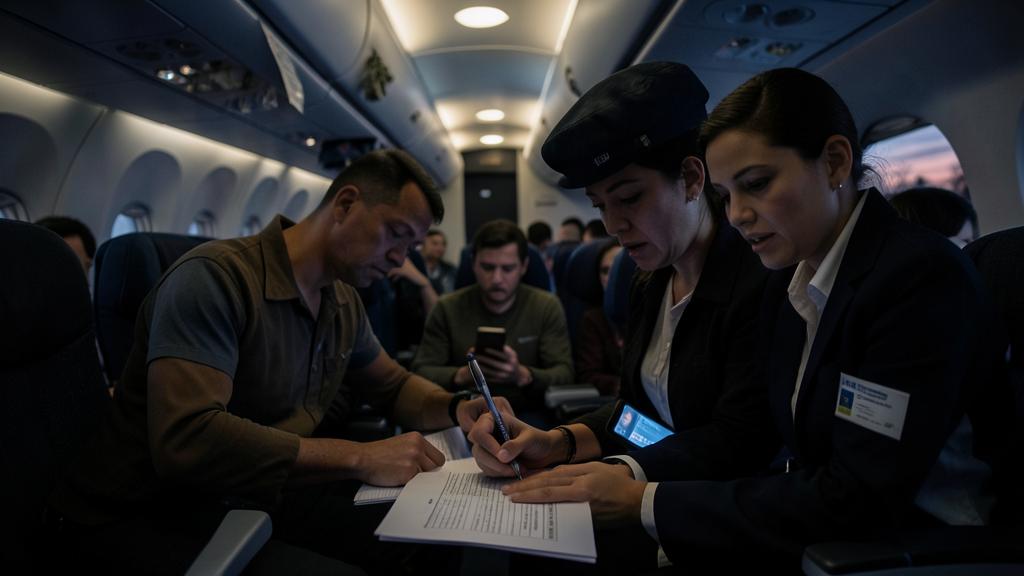
Then the cabin’s job is to stop. The onward arrangements belong to the ground, and a crew member who continues to advise passengers after the handover reintroduces exactly the risk the whole procedure was designed to avoid. A short entry in the voyage report closes it: how many connecting passengers, what operations said and when, what was passed to the ground. Operators that treat this as a trained procedure rather than an improvisation get consistent results from it; cabin service training that includes the transit sequence is measurably cheaper than the correspondence that follows a bad arrival.
The passenger will not remember the connection. He will remember whether he was told the truth, in time, by someone who clearly knew what they were talking about — and whether what he was told at thirty thousand feet was still true at the door.


Leave a Reply
You must be logged in to post a comment.