

A candidate leaves the session convinced they passed: a tight approach, a failure handled correctly, a clean landing. They are turned down. Another, who let half a dot slip on the localizer and had to resume an interrupted checklist, is retained. There is no arbitrariness here: the panel was not scoring what the candidate thought they were showing. Here is what a crew selection session actually observes, why raw handling precision counts for less than anywhere else in the profession, and what that changes for anyone preparing their own.
An operator is not buying a level, it is buying a slope
A selection session looks like a check, but it is not one. A check confirms that a standard is met on a given date. A selection answers a management question: how many sessions to bring this candidate up to the company’s standard, with what probability of success, and what residual risk once on the line? The operator is not assessing an instantaneous level, it is estimating a learning slope and the cost of the gap.
Seen this way, the two families of deviations do not carry the same weight. A trajectory deviation, an approximate handling of the automation, unfamiliarity with a guidance mode: all of this is corrected through repetition, with a written program, a predictable cost, and rapid convergence. A candidate who consistently arrives high and fast on approach is a problem of a few sessions. Someone who decides alone, does not verbalise their intentions, or does not hear a remark from the other seat belongs to a different economy: remediation exists, but it is slow, poorly tooled, and its outcome is not guaranteed within the hours an operator can fund between hiring and line release.
There is a second, more mundane reason why the stick discriminates poorly. The candidate is usually discovering the device, sometimes the aircraft, almost always the way the parameters are displayed. Their raw precision then measures their speed of adaptation to an unfamiliar environment as much as their actual level. Many grids weight trajectory downward for this reason: it is not leniency, it is a measurement correction.
The selection process isn’t just about how well you fly on the day. It’s about how quickly you can learn to meet the company’s standards and how much training will cost to get you there. Some mistakes (like flying off course) are easy to fix, but others (like not talking to your co-pilot) are much harder to change.
A candidate flying an Airbus A320 on a 2,500-meter runway at 30°C might handle the aircraft smoothly but fail to communicate a go-around decision. Another candidate, who overshoots the localizer by 0.5 dots but clearly states their actions, is more likely to be selected. The first candidate’s technical skill is high, but their lack of teamwork is costly to train.
A framework of behaviours, not of qualities
Selection grids derive from the same competency framework used for training and company checks: application of procedures and adherence to rules, communication, trajectory management through manual flying, trajectory management through automation, leadership and teamwork, problem-solving and decision-making, situational awareness and information management, workload management, application of knowledge. Nine entries in the most recent versions of the framework, only two of which concern handling the aircraft itself.
What makes this framework usable is not the headings but the behavioural markers that instantiate them. A usable marker has three properties: it describes an observable behaviour, it is tied to a precise moment in the session, and it states an effect. « The candidate is stressed » is not a marker, it is an interpretation. « He interrupts the checklist after a radio call, does not announce the stopping point, does not resume it, and the missing item is discovered at level-off » is one. The first formulation can neither be defended before the person concerned nor corrected by a programme; the second can be discussed, dated, and worked on.
The consequence for the candidate is almost reassuring: you cannot act out a character in front of a panel trained to spot markers. What is scored are acts — what was said, at what moment, with what effect on the other seat and on the trajectory. A posture does not survive workload, and the scenario is calibrated to reach it.
The scenario is built so the stick does not decide
A well-designed selection session does not stack failures on top of each other. It sets up a situation whose answer is not found in a checklist: partial and partially contradictory information, a degradation that leaves two equally defensible options, a time constraint that is not an emergency, and information split between the two seats such that neither one alone holds enough to decide.
This last point is the heart of the design: by making the decision impossible without an exchange, it forces the candidate to produce out loud what they would do silently in a familiar cockpit. The panel does not watch for the solution chosen — several are often acceptable — but for the path: detecting the gap, putting it into words, sharing it, building the option, announcing the decision, then revising when a new element arrives.
This path almost always breaks at the same point. The candidate detects, understands, and executes, skipping the verbalising and the sharing. In the moment the trajectory stays correct, and an untrained observer sees ease in that. Yet it is the costliest deviation of the lot, because it removes the only barrier the other pilot had: what they did not hear, they cannot contradict.
One last principle governs the scenario: it must be replayable identically. A selection compares candidates against one another; it is therefore scripted minute by minute, its triggers tied to flight cues rather than to the instructor’s mood, and the operator runs several versions so that no single one circulates.
The other seat: two setups, two biases
What remains to be decided is who occupies the other seat. Two setups coexist, and they do not measure the same thing: the choice determines what the session can prove and what it will leave in the shadows.
| Setup | What it measures well | What it measures poorly | What the candidate should infer |
|---|---|---|---|
| Candidate with a briefed company pilot | Identical stimulus for everyone, hence comparability; reaction to a deliberate omission or an erroneous proposal | The actual relationship between two crewmates: the candidate treats the other seat as an examiner and does not dare contradict them | Treat the other seat as a crewmate, not a judge; contradict when needed, with the right form and argument |
| Two candidates together | The authentic gradient: who takes the initiative, who follows, who follows up, who gives up under load | The performance is that of a pair; a struggling partner contaminates the session, and the running order matters | Do not play against the other candidate: a pair that works well raises both scores, not just one |
| Mixed sequence, roles reversed mid-session | The gap, within the same person, between conduct while flying and conduct while monitoring | Costs slot time and shortens each stage, risking a judgement based on too short a sample | Prepare for the pilot-monitoring seat as much as the other: that is where most candidates discover they go silent |
Many operators sequence the session: one stage as pilot monitoring with a company pilot, one stage as pilot flying with another candidate. The switch from one role to the other is the most cost-effective observable in the whole design — a candidate very much at ease while flying and non-existent while monitoring is spotted within a single stage.
The trap: when the company pilot omits an item — a forgotten mode selection, a wrong altitude set, a checklist left hanging — the experienced candidate’s reflex is to correct it without saying anything, because the trajectory is saved. This is most often a deliberate omission, and the silence costs twice over: detection is not proven, and sharing is missing. Correcting without naming it is scored exactly the same as not having seen it.
Scoring, calibration, and a debrief that counts double
Observers score separately, then compare notes. The gap between two scores is not a flaw in the design, it is its most useful piece of information: it points to where the behaviour was ambiguous, and that is where the decision is really made. A grid where two observers agree perfectly on everything is generally filled in after the fact, from an overall impression.
Two biases are known to everyone who has sat on a panel: anchoring on the first few minutes, which colours the reading of the whole session in light of the initial briefing, and the halo effect of good radio phraseology, which inflates unrelated headings. Both are countered simply: scoring as things happen and by phase rather than globally, having the least senior observer speak first, and rotating panels so that the same pair does not recruit an entire campaign.
The debrief is not an end-of-session courtesy, it is a test in its own right: a candidate’s ability to review themselves is regarded, by those who sit on panels, as one of the most useful indicators available to a jury, and one of the hardest to fake. A solid debrief is chronological, ranked by consequence; it opens with the candidate’s own deviations, names what was detected but not acted on, and proposes a workable remediation. A defensive debrief costs more than the deviation it comments on.
The right reflex: prepare your self-debrief during the session, not after. Retain three moments, in chronological order, and for each one note what you perceived, what you decided, and what you would do differently. Open with the costliest of your own deviations, without pinning it on the other seat. A panel that hears a candidate name what they themselves saw spends the time saved assessing the remediation proposed — which is exactly the point of the selection.
What actually eliminates a candidate
The grounds for elimination are far fewer than one imagines, and they are ranked by cost of remediation rather than by apparent severity. The table cross-references the nature of the deviation, its telltale sign in session, and what it would take to correct it.
| Nature of the deviation | How it shows in session | What remediation costs | Weight in the decision |
|---|---|---|---|
| Trajectory and handling | Deviations of track, path, speed; corrections that are late but conscious | A few targeted sessions, a written programme, fast and measurable convergence | Low, except for a gross deviation or one not perceived by the candidate |
| Automation management | Mode engaged without announcement, surprise at a mode change, late manual takeover | Moderate: type-specific instruction, largely standardised in the syllabus | Low to moderate, depending on the fleet targeted |
| Procedural knowledge | Hesitation over a sequence, reaching for the manual where memory should suffice | Low: this is precisely what type-rating training is built to install | Low, you do not hire on knowledge of a type |
| Detection | A deviation announced by the other seat produces no observable effect | High: requires training in the monitoring role, long and poorly tooled | High |
| Sharing the decision | Correct action, executed without announcing intent or stating an alternative | High and uncertain: this is a habit of practice, not a knowledge gap | High, often disqualifying |
| Response to error | Denial, immediate justification, blaming the other seat, or prolonged freeze | Very high, beyond the reach of an ordinary training programme | Disqualifying |
| Flexibility of the plan | Attachment to the initial plan despite the arrival of an element that invalidates it | High: worked through repeated exposure, with a variable outcome | High |
The reading fits in one sentence: it is never the error that eliminates, it is what it reveals about the recovery system. Someone who makes a mistake, sees it, says it, and corrects it has shown a complete chain. Someone with no apparent error but who shared nothing has shown nothing at all, and the absence of proof is scored as an absence.
What selection is not, in regulatory terms
This point needs to be stated plainly, because it worries many candidates: a selection session is not a regulatory check. It grants nothing, extends nothing, and enters nothing on the licence record. An unsuccessful application is not a failure at a skill test, and the authority has no knowledge of it. What falls under the regulations comes afterward: type-rating training, line adaptation, the operator’s line-oriented and non-line-oriented checks. Those are standardised, logged, retained, and enforceable.
There is therefore no universal grading scale. The competency framework is largely common across the sector, but the threshold, the weighting, and the composition of the panel belong to the operator. Two airlines can score the same session differently without either being wrong: they do not share the same fleet, the same network, or the same training capacity to make up a gap.
The type of operation shifts the emphasis more than the size of the company does. On a long-haul network, the crew changes over mid-flight, and the session first looks at handover between pilots who do not know each other: relief briefing, traceability of what was decided during the other pilot’s absence, resuming a situation you did not see develop. On a short-haul network with tight turnarounds, constrained time dominates: the ability to interrupt a preparation and then resume it at the right point matters more than the finesse of an isolated decision, because it is interruption, not difficulty, that produces omissions. In business aviation or aerial work, where the crew is reduced and sometimes limited to a single pilot depending on the aircraft, the scenario looks for something else again: self-monitoring discipline, verbalisation maintained in the absence of another crew member, and the handling of commercial pressure exerted directly by the client rather than filtered through an operations department. Three different economies, three different weightings of the same grid — and a candidate who prepares without knowing which one they are aiming for is working blind.
Two obligations frame the exercise nonetheless. The operator’s management system must describe how it ensures its crews are qualified and composed according to written rules: selection is the first link in that demonstration, and an auditor can request its criteria. And an evaluation report remains personal data: purpose, retention period, and right of access fall under data protection law, not under the recruitment department.
The trap: recording an unsuccessful selection in the « failed a check » box of a later application form. Forms almost always distinguish regulatory tests — skill test, proficiency check, line check — from an internal recruitment process. Answering the question as actually asked is not concealment; conflating the two creates an inconsistency that the licence file will later contradict, and it is that inconsistency, not the setback, that gets paid for at interview.
Preparing for the session: what pays off, what does not
Let us start with what does not pay off, since that is where most of candidates’ budgets go. Logging hours on a light aircraft rarely improves a score: the heading is weighted down and the skill practised is not that of the aircraft being targeted. Memorising a type’s immediate actions by heart does not pay off any more either — reciting where an intention should be announced backfires on the candidate. And rehearsing a posture is the worst of the three investments, since a panel scores acts.
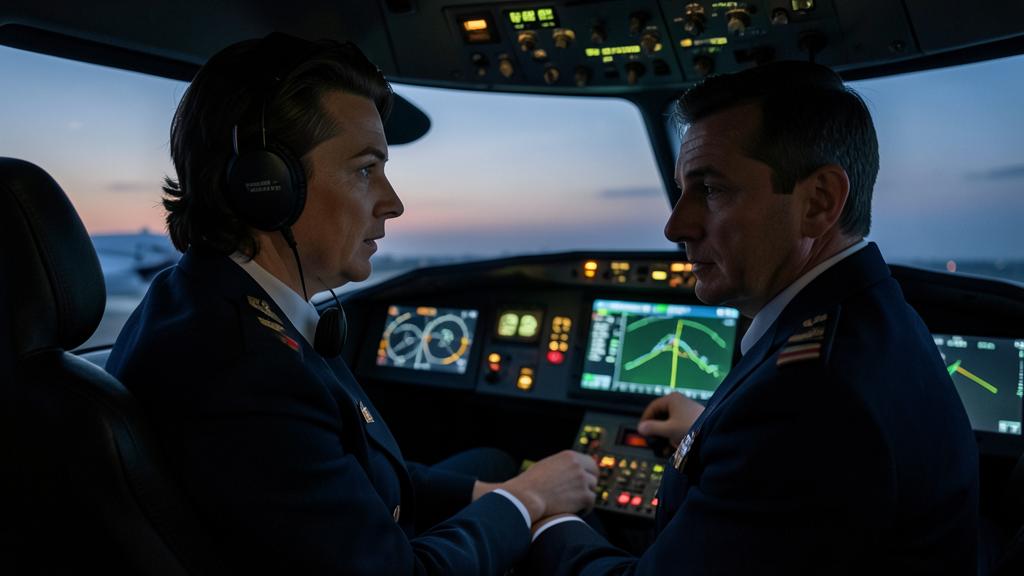
What pays off comes down to five habits, all of which can be practised on the ground. Announcing the intention before the action, even when the action seems obvious. Keeping to a single working language for the whole session, briefings included. Building a briefing that states the plan, its abandonment criterion, and what is expected of the other seat. Verbalising uncertainty with an actionable follow-up: saying you do not know, explicitly asking for time, handing the trajectory to the other seat while you decide. Finally, working the pilot-monitoring seat as much as the other one — calling out a deviation, following up when it has no effect, monitoring the modes — because that is where most candidates discover they go silent. A preparation course that offers nothing but hours in the device misses what is actually being scored.
On the panel’s side, five points deserve checking in its own documentation before the next campaign: written criteria predating the campaign, scenarios drawn from a rotating bank, observers calibrated by something other than habit, a debrief that leaves a trace, a retention period that is fixed and known to candidates. The absence of any one of them is never visible — until the day a decision is challenged.
One grey area remains that no one has closed. Communication markers are sensitive to language: a candidate assessed in a second language generally produces fewer words, and later ones; an uncorrected grid reads this economy as a lack of sharing. A panel made up of two pilots from the same fleet turns its own cockpit habits into the standard. And when an operator is recruiting under pressure, the technical bar stays high while the behavioural bar slips, because it is costlier to defend in front of a disappointed candidate. These drifts are discussed among peers, including in the profession’s own exchanges, and are rarely written down.
For anyone preparing a type rating, finally, the exercise is not a detour: the competencies observed in selection are the same ones that training and company checks will later score, using the same vocabulary of markers. What is worked on for one morning serves the rest of a career, right up to the day you fill in the grid instead of being subject to it.
The applicable regulations, the operations specifications, and the operator’s approved documentation — operations manual, training and checking programmes, internal recruitment policy — prevail over this article, which describes a mechanism and does not substitute for any company procedure.
Questions fréquentes
Should you log flying hours before a company selection?
Rarely, and never as a priority. The trajectory heading is deliberately weighted down because the candidate is discovering the device and the way the parameters are displayed, which skews the measurement. If you have not flown instruments in a while, a few sessions are usually enough to restore correct visual scanning: the goal is not precision, it is being available for the crew rather than absorbed by the trajectory.
Should you correct the company pilot when they make a mistake during the session?
Yes, and above all say so. These omissions are most often deliberate and are part of the scenario’s script. Correcting silently is scored exactly as not having seen it, since nothing proves the detection: announce the deviation, announce the correction, and check it was heard. Form matters as much as substance, but a lack of words cannot be made up for.
Does an unsuccessful selection need to be declared to another operator or to the authority?
No. A selection is an internal recruitment act: it grants or extends no qualification, does not appear on the licence record, and is not known to the authority. It must not be confused with failing a skill test or a proficiency check, which are logged regulatory events. Answer the question actually asked on the form, without conflating the two.
Can a candidate obtain the report of their evaluation?
The report is personal data, which opens a right of access for the person concerned. The operator may however give you a summary rather than each observer’s raw notes, and sets the retention period and the format of disclosure in its own policy. In practice, the oral debrief at the end of the session remains the richest source: ask it for dated examples rather than a general assessment.
In a two-candidate session, does the partner's level penalise your score?
A trained panel scores each candidate against individual markers, but the pairing effect exists and everyone who sits on panels knows it. The best response is to make the crew work: brief, share information, follow up with whoever is falling behind. Helping a struggling partner raises your own leadership and teamwork headings, whereas working against them degrades both scores.
Does the session take place on the type the candidate will actually fly afterward?
Often not: the operator uses whatever device it has available, sometimes an aircraft from its fleet that you will not fly, sometimes a generic device. This changes little, since the competencies observed are independent of the type and the trajectory is weighted accordingly. Do ask, however, which set of procedures and which phraseology are expected: that is the information that actually changes a session.


Leave a Reply
You must be logged in to post a comment.