
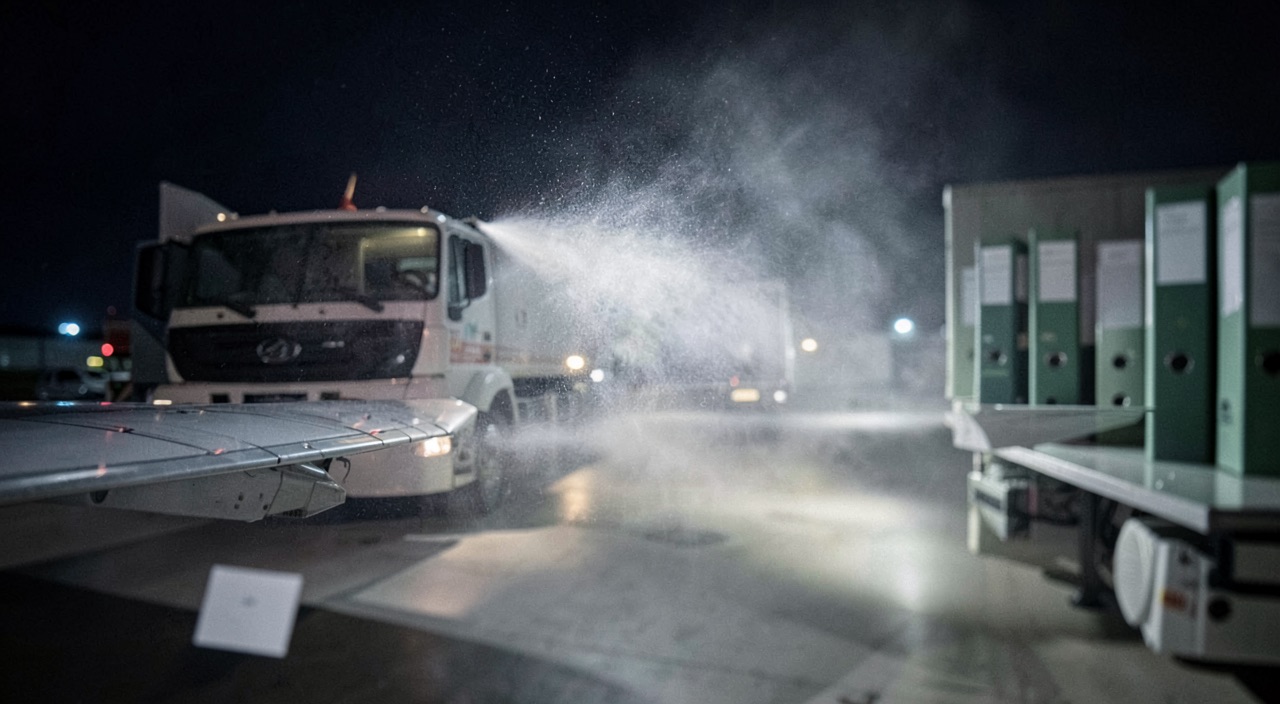
The truck pulls away, the operator calls out the code: Type IV, seventy-five percent mix, start time of the last pass. The crew inherits a figure they did not measure, drawn from a table they did not compile, for a wing that was never tested. Yet a holdover time is neither a guarantee of cleanliness nor a clearance to take off: it is an endurance duration obtained on a flat plate, transposed to an aircraft by convention. Knowing what that convention assumes, and where it stops holding, is worth more than knowing the boxes by heart.
What a Holdover Time Actually Measures
A holdover time is the estimated period during which the applied fluid prevents the formation of frost and the accumulation of snow on protected surfaces. Three words carry the rest of the meaning.Estimated: the value comes from a statistical treatment, not a measurement taken on the day’s aircraft.Prevents: the fluid does not melt what falls, it absorbs it. Protected: whatever has not received fluid is covered by no line of the table.
The mechanism is a dilution race. The fluid applied is a mixture of glycol and water whose freezing point is lowered well below ambient temperature; each snowflake, each supercooled droplet it absorbs brings in pure water and pushes that point back up. As long as it remains below the surface temperature, the captured water stays liquid and the wing stays clean. When the two meet, the surface layer turns to ice or slush. The protected duration is that of the race between the incoming mass of water and the reserve of glycol that was laid down.
Hence three dependencies, and essentially only three: the fluid and its mix, which set the reserve; the type and intensity of the precipitation, which set the water flow rate; the temperature, which sets the starting margin. Wing geometry, the condition of the skin, the way the fluid was applied appear nowhere in the table. These are assumptions, not variables.
A holdover time is like a race between the deicing fluid and the snow. The fluid starts with a certain amount of glycol, and as snow melts into it, the glycol gets weaker. The time it lasts depends on how much snow is falling and how cold it is. But it’s not exact—it’s just a guess based on tests, not real-time measurements.
On a cold day at -5°C, a Boeing 737 is treated with Type IV fluid at a 75% mix. The table says it has 30 minutes of holdover time in light snow. But if the snow suddenly gets heavier, that 30 minutes might not last as long—because more snow means the glycol gets diluted faster.
How the Tables Are Built
The published values come neither from flight tests nor from measurements on an aircraft, but from endurance tests on a plate: a flat metal plate, tilted by about ten degrees, marked with a grid of reference points, on which the fluid is applied under standardized conditions. It is exposed to natural snow at winter test sites, or to precipitation produced in a cold chamber for freezing fog, drizzle, and freezing rain. Failure is declared when a defined proportion of the reference points disappears under the contamination. The test is repeated for each fluid, each mix, each type and intensity of precipitation, and each temperature range.
The durations obtained are processed statistically, then reviewed before each season in technical bodies where manufacturers, laboratories, and authorities sit together. The table cell is therefore not a single value but a range: the lower bound at the strong end of the intensity class, the upper bound at its weak end. The choice within the range is not given by the table; it belongs to whoever is watching the snow fall.
The gap between the plate and the wing does not always work in the same direction, but it rarely favors the crew. The plate is flat, motionless, at air temperature, with no cold structure beneath it. A wing is curved, the film thins on the leading edge and flows off under its own weight, the skin conducts heat, and the fuel it contains can be much colder than the air. In the other direction, heat left by a hot first sprayed step delays icing for a while, and the blast of taxiing sweeps away some of the deposited snow: two favorable effects that no table accounts for and on which nothing allows one to rely. Hence the package of conditions of use that always accompanies the value, and which, unlike the value itself, is binding.
Two families of tables coexist. Generic tables give durations by fluid type, pegged to the least enduring product in the family. Fluid-specific tables cover a named product, tested on its own, and are generally longer. Two aircraft treated side by side, with a fluid of the same type but different brands, can therefore legitimately display different durations.
Two Publications, One Source of Data
Comparing the two systems often misses the essential point: the figures themselves do not diverge. The tests belong to a shared research program, the results are analyzed in the same technical bodies, and the tables published on both sides of the Atlantic are interchangeable for the practitioner. What differs is the status of the table and the path by which it becomes binding on the crew.
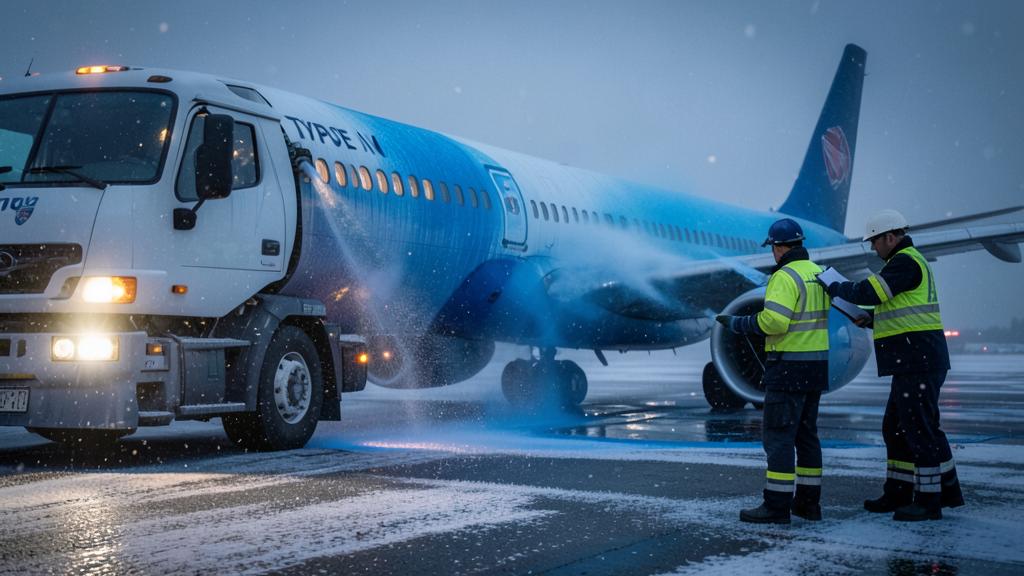
On the European side, the operating rule prohibits taking off with frost, ice, snow, or slush adhering to the surfaces, and requires the operator to establish its ground deicing and anti-icing procedures along with the associated checks. The authority publishes guidance material on holdover times before each winter: guidance documents. The operator transposes them into its manual, together with its list of fluids and its allocation of responsibilities. What is binding on the crew is not the authority’s publication, it is the manual.
On the American side, the provision devoted to operation in icing conditions prohibits takeoff with adhering contamination, then distinguishes two regimes. An operator with an approved ground deicing program — tables, checks, training, responsibilities — may rely on holdover times, and this approval is carried by an operations specification, a named document. One without such a program cannot invoke any table: it is left with a direct visual check of the surfaces. The federal authority also republishes its own tables every year, and the program may not be less demanding.
The two paths converge on the same constraint on board and diverge on traceability. Extending a duration, changing fluid, adopting a fluid-specific table goes, on one side, through a manual amendment justified to the supervisory authority, and on the other, through amending an approved program whose very wording is a regulatory act. The vocabulary of checks, by contrast, is shared, because it comes from an international standard. An operator working on both sides does not have two methods, it has two files.
| What Is at Stake | European System | American System |
|---|---|---|
| Status of the authority’s publication | Guidance document attached to the operating rules | Tables republished each season, minimum requirement of the program |
| What is binding on the crew | The operations manual, which transposes the guidance | The program named in the operations specification |
| Without prior authorization | Operator’s procedures, under the authority’s oversight | No duration may be invoked: direct check of the surfaces |
| Pre-takeoff check | Window defined by the operator in its procedures | Within the five minutes preceding takeoff, a window set by the rule |
| Changing a duration or a fluid | Manual amendment, justified to the supervisory authority | Amendment of the program and of the specification that carries it |
The Fluid Is Not a Generic Product
Type I is not thickened: viscosity close to that of water, sprayed hot, its work is thermal and mechanical — it removes. What remains on the skin is a thin film that flows off, and protection wears out quickly. Types II and IV are thickened by a polymer that gives them pseudoplastic behavior: highly viscous at rest, hence able to hold a thickness on an inclined surface, they collapse in viscosity as soon as they are sheared. Type III occupies an intermediate position, tailored for aircraft with a lower rotation speed.
The polymer buys time and in return imposes an aerodynamic constraint: the film must shed during taxi, before rotation, or else it thickens the boundary layer and costs lift. Qualification goes through a wind-tunnel acceptance test on a reference model, with a maximum admissible lift loss for a given rotation speed. Hence the rule of use: types II and IV above roughly one hundred knots of rotation speed, type III below.
The lowest use temperature of a fluid is not its freezing point. It is the more restrictive of two values: the freezing point of the mix plus a margin — on the order of ten degrees for a Type I, about seven for a thickened fluid — and the lowest temperature at which aerodynamic acceptance remains established. Below that, the product falls outside its domain and no line of the table applies. The mix is likewise not a mere dosing detail: a Type IV diluted in equal parts with water has neither the same low limit nor the same endurance as a neat Type IV, and the table reserves a column for each.
| Family | Thickener | Main Role | Rotation Speed | Relative Endurance |
|---|---|---|---|---|
| Type I | None | Remove contamination, sprayed hot | No specific constraint | The shortest: a few minutes in active precipitation |
| Type II | Polymer | Protect after deicing | At least about one hundred knots | Clearly higher than Type I |
| Type III | Polymer, intermediate viscosity | Protect slower-rotating aircraft | Below one hundred knots | Intermediate |
| Type IV | Polymer | Protect for the longest duration | At least about one hundred knots | The longest in the range |
What remains is what thickened fluids leave behind. Dried in aerodynamically quiet zones — control-surface cavities, hinges, gaps — polymer residues rehydrate, swell, and can freeze in flight, up to jammed controls or restricted travel. This is the reason residue inspection programs exist, unrelated to holdover time but inseparable from the choice of fluid.
The Clock: Where It Starts, Where It Stops
The holdover time begins at the start of the last fluid application. Not at its end, not when the truck departs; in a two-step treatment, it starts with the second step. The reason is physical: the glycol reserve begins diluting as soon as it is applied, and the area treated first is the oldest of all. The code communicated by the service provider carries precisely that time.
The time trap. On a long treatment, the gap between the start of the last application and the truck’s departure is counted in minutes, and those minutes are taken from the protection, never added to it. Logging the end-of-treatment time, or the time the message reaches the flight deck, amounts to granting oneself a margin that does not exist — all the more so since the first area treated is already the most diluted.
The clock stops at the deadline, but it can stop earlier. A change in intensity, a shift from snow to freezing drizzle, engine blast deflected onto the wing, waiting under a heavier shower: the condition under which one entered the table no longer exists. One does not subtract the elapsed time from a new duration; one re-enters the table at the current condition and retains the shortest of the reasonable readings.
Three checks follow one another, with three parties responsible. The post-treatment check falls to trained personnel, from a point where the surfaces are actually visible; it covers coverage, not duration. The pre-takeoff check falls to the crew, within the holdover time, on representative surfaces: the American system sets a fixed window for it, within the five minutes preceding takeoff, whereas the European system leaves the operator to define its own. The pre-takeoff contamination check comes into play only once the duration is exceeded: critical surfaces, from outside the aircraft, unless an approved procedure provides for another means.
The Boxes Where There Is Nothing
A table contains empty boxes, and these are the most important ones. Moderate or heavy freezing rain, hail, intensity beyond the tested range: no duration exists, not out of editorial caution but because the test does not hold. Falling outside the table does not forbid departure; it forbids relying on a duration to do so, and sends one back to a direct check of the surfaces.
Ice pellets fall under a regime of their own. They give rise to no holdover time, but allowance times have been published separately, based on dedicated tests, subject to narrow conditions — fluid type, mix, temperature range, mandatory pre-takeoff contamination check — and void as soon as the condition changes. Treating them as one more line of the table is an error of kind, not an approximation.
The line devoted to rain on a cold-soaked wing exists for a reason unrelated to air temperature: it is the skin that is colder than the water landing on it. The same mechanism works against the table after a long flight leg, with very cold fuel in the tanks and a short turnaround. One enters the table with the outside air temperature, while the physics plays out at the temperature of the skin.
The table is read at air temperature; ice forms at the temperature of the skin. After a long cruise followed by a short turnaround, the upper wing surface can remain several degrees below the outside air temperature: the film’s starting margin is then smaller than the table line suggests, and the end comes before the deadline. No text provides a numerical correction. The only tenable response is to treat the announced duration as a theoretical maximum and go look at the wing.
Intensity, finally, is not measured. Snow classes are read from prevailing visibility, corrected for day or night and for temperature: a convenient indicator, not a measurement of water flow rate. Two showers of the same visibility can carry very different masses of water depending on flake density. The table gives a range precisely because the input is uncertain.
What the Crew Checks for Itself
The treatment code is short, and each of its terms conditions a reading: fluid type, mix ratio, product name, local start time of the last step, confirmation that the procedure was carried through to completion. Three checks follow from it. Is the announced mix the one for the column about to be read. Is the outside air temperature above the low-temperature limit of use for that mix. Is the observed precipitation indeed that of the line selected.
The right reflex. Note three things, and three only, at the moment of the code: the type and mix actually applied, the start time of the last step, the weather condition retained for entering the table. Reading them aloud before leaving the deicing pad catches most reading errors — wrong mix column, fluid used outside its low-temperature limit, precipitation line that no longer matches what is falling.
Watch the film, not the clock. A sound film is glossy and smooth, and the snow landing on it disappears; a failing film loses its gloss, takes on a dull or grainy texture, and the snow begins to stick. The sign appears before the deadline when intensity has risen, well after it when intensity has eased. A check carried out within the announced time is never a mistake; skipping it because the clock has not run out is one.
At night, on a wet wing, these signs are hard to read from a window, which is why some operators require a physical check rather than a glance from the cabin. The aircraft documentation finally settles what the table ignores: which surfaces are critical and what residual contamination is tolerated. Some allow frost under the wing in the fuel tank area, subject to thickness and extent conditions, or a thin layer of white frost on top of the fuselage as long as surface reference marks remain discernible. None allows anything at all on the upper wing surface, the leading edges, and the control surfaces.
What to Check in Your Own Documentation
Three things deserve to be opened before winter rather than on the taxiway. The winter chapter of the operations manual: which tables the operator has adopted, generic or fluid-specific, and who decides the intensity class — the crew, the service provider, a ground observation. The aircraft documentation’s limitations on admitted fluids and tolerated residual contamination, which vary from one type to another more than one might imagine. Finally, the allocation of responsibilities at stations where the operator does not itself train the deicing operators: the announced code is binding, but one still needs to know who established it and under what qualification.
What remains is a gray area that no one has closed: the step from observation to intensity class, then from class to a point within the range. No text automates it, and this is where the discrepancies between two crews of the same operator, on the same ramp, at the same minute, take root. For those preparing a type rating or a winter course, this is also what is actually tested: not reciting durations, but the ability to say where the clock starts, to name a condition that appears in no table, and to state what triggers a contamination check.
The applicable regulatory text, the operator’s approved documentation, and the aircraft flight manual take precedence over this article, whose only purpose is to shed light on their mechanisms.
Questions fréquentes
Does the holdover time start at the beginning or the end of the treatment?
It starts at the beginning of the last fluid application, that is, at the start of the anti-icing step in a two-step treatment. This is the time carried by the treatment code communicated by the service provider, and it is the only one to log on the flight deck. Taking the end of treatment as the origin amounts to granting oneself the entire duration of the pass as extra margin, when the first area treated is already the most diluted.
What do you do when the holdover time has been exceeded?
Exceeding it does not prohibit takeoff; it only removes the right to rely on a duration. Either a new treatment must be carried out, or a pre-takeoff contamination check must be conducted, covering the critical surfaces and performed from outside the aircraft, unless an approved procedure provides for another means. The decision is based on the observed condition of the surfaces, not on the size of the gap from the deadline.
Why do some precipitation conditions have no value in the tables?
Because the plate endurance test yields no usable result beyond a certain water input, or for phenomena whose physics is not that of progressive dilution. Moderate or heavy freezing rain, hail, and intensities above the tested range fall into this case. The empty box is therefore not an oversight: it is the indication that the table has nothing to say about that condition.
Do the European and American tables give the same durations?
Essentially yes, since they rest on the same testing program and on analysis conducted in the same technical bodies before each season. What differs is the status of the document: guidance transposed into the operations manual on one side, tables incorporated into a program approved by operations specification on the other. The practitioner reads comparable figures, but does not hold them from the same authority nor by the same path.
Does a holdover time hold for a wing cooled by cold fuel?
One enters the table with the air temperature, while ice formation plays out at the surface temperature. After a long cruise followed by a short turnaround, the upper wing surface can remain markedly colder than the ambient air, and the actual protection duration shortens. Guidance documents flag the case without providing a numerical correction: the announced duration must then be treated as a theoretical maximum, with a close visual check.
Can a fluid-specific table be used instead of a generic table?
Yes, provided the operator has adopted it in its documentation and the product actually sprayed is indeed the one that was tested. Generic tables are pegged to the least enduring product in the family, hence shorter. A fluid-specific table often gives longer durations, but it makes the product name announced in the code as important as the type and the mix.


Leave a Reply
You must be logged in to post a comment.