

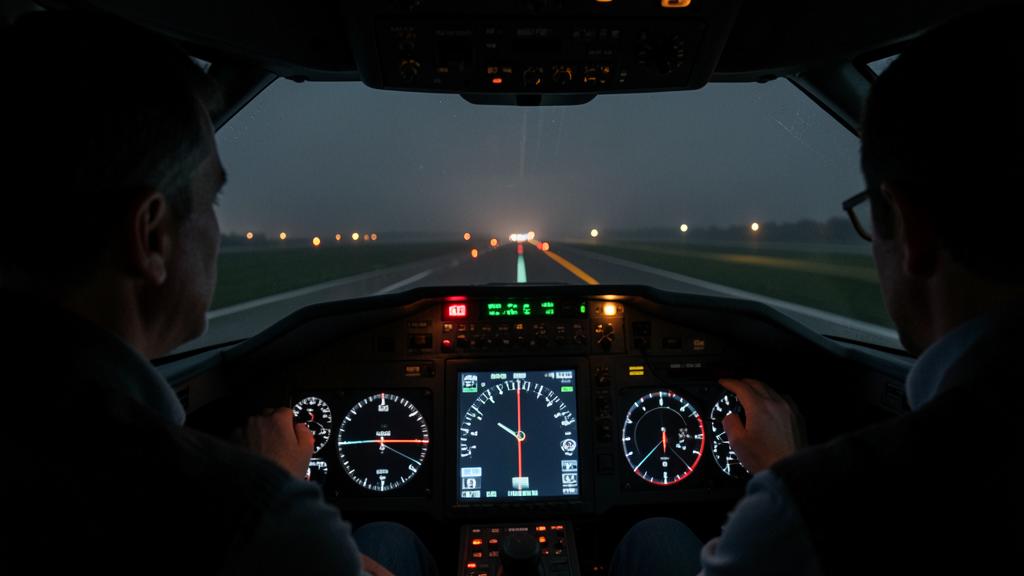
Decision altitude called, no visual references, go-around initiated. The aircraft climbs, the configuration changes — and the displayed track continues straight ahead toward the runway just overflown. No missed-approach leg has become active. The computer has not failed: it is waiting for something nobody gave it, and it will wait for as long as it takes. What remains to be determined is what that something is, and at what point it was still possible to notice.
Why sequencing suspends, and why it is deliberate
A flight management computer chains the legs of a plan because at every instant it knows which one comes next. At the end of the final segment, that certainty disappears: two futures are open, landing or going around, and no flight parameter can decide between them. Designers’ response is uniform in principle — automatic sequencing freezes, a suspension annunciation appears, and lateral guidance holds the extended runway centerline.
The missed-approach legs are nonetheless there, loaded, readable on the flight plan page: simply, none of them is active. The freeze is a protection. Without it, the first leg would arm while the aircraft is still on final, and guidance would depart the centerline to chase a turn planned several miles further on. Its cost is that an action is required to lift it, and that action is subject to conditions that are displayed nowhere.
A failure that is not immediately visible
During the suspension, guidance holds the extended runway centerline. Now that is exactly what the first leg of most missed approaches calls for: climb straight ahead to a given altitude. A go-around whose suspension has never been lifted is therefore correct for the first several tens of seconds. Nothing conflicts, no deviation sets in. The fault only appears at the moment the turn should have begun, and it appears in the form of an absence — the hardest kind of anomaly to detect under high workload.
The flight computer freezes the missed-approach sequence during a go-around because it can’t predict if the plane will land or abort. It waits for a manual command to continue, which can be tricky to spot if the plane climbs straight at first.
On an Airbus A320 flying an RNAV approach to Runway 27 at Paris-Orly, a go-around at 500 feet above the threshold (decision altitude) leaves the computer in suspension. The plane climbs straight ahead for 20 seconds before the crew notices the sequence hasn’t armed, delaying the turn to the missed-approach holding point.
The coded missed-approach point is not where the go-around is initiated
It is tempting to reason as if the go-around began at the missed-approach point. That is true for a line of minima without vertical guidance: a minimum descent altitude is held down to a fix with known coordinates, which the computer reaches and where it suspends its sequencing in a predictable way.
It is not true for a line of minima with vertical guidance. There, the crew leaves the path at a decision altitude reached at a variable point — it depends on threshold crossing height, the altimeter setting, the air column’s temperature, and ground speed — and that point lies upstream of the fix to which the database attaches the missed-approach legs, a fix generally close to the threshold. The go-around is therefore decided before the computer has reached the point where it would suspend its sequencing: the system is still normally running its final segment when the maneuver begins.
Most of what crews describe as inconsistent behavior from one approach to the next comes down to this: these are not two reactions from the same system, but two distinct logical situations.
| Element | Line without vertical guidance | Line with vertical guidance |
|---|---|---|
| Nature of the decision point | A procedure fix, with known coordinates | An altitude reached along a path, at a variable point |
| Position relative to the coded missed-approach fix | Coincides with it, or follows shortly after | In practice, always upstream of it |
| State of sequencing at the decision | Suspended, or about to be | Final segment active, normal sequencing |
| What the go-around command must produce | Lift a suspension already in place | Force abandonment of the final segment, then arm the next leg |
| Dominant failure mode | Suspension not lifted: straight climb, no turn | Phase change not triggered: the threshold stays targeted |
What must be true for the sequence to arm
The transition from the suspended state to the active state is not a single event but a conjunction: six conditions must all hold together, and the failure of just one leaves the aircraft in an indefinite straight climb. Two deserve a word. The phase change to go-around is generally permitted only from the approach phase: if that phase was never activated, the go-around command acts on modes and thrust without changing anything in the flight plan. And position integrity requirements change with the phase — the applicable alert limit reverts to the terminal-area value, less stringent than the final-segment one, but it must still be met.
| Condition | What is observed if it is missing | Immediate recovery |
|---|---|---|
| Missed-approach legs present in the active flight plan | Nothing displayed beyond the runway fix | Published route on the heading selector, then reload |
No discontinuity or destructive direct-to |
An isolated leg, followed by a gap | Selected heading, level-off reconstruction |
| Approach phase active before the command | Suspension maintained, plan unchanged | Lift the suspension with the provided command |
| Lateral navigation mode engageable | Go-around mode held, navigation only armed | Wait for engagement height, check the active leg |
| Leg terminator reachable | Straight climb that never breaks off | Check the target altitude, activate the next leg |
| Position and integrity available | Mode downgrade, navigation alert | Fly heading and altitude |
The right reflex. At the briefing, do not simply read the missed approach off the chart: cross-check it against the coding. Three checks cover the essentials. What is the termination of the first leg, and to what altitude does it apply? Does the first named fix actually appear in the flight plan, with no discontinuity upstream of it? Does the segment include a constant-radius arc, in which case there will be no manual recapture? Then brief the fallback explicitly: runway heading and hand-flown climb, followed by such-and-such selected heading if the sequence does not arm. A crew that has said this sentence on the ground recognizes it in flight.
Leg terminators, or what triggers the move to the next leg
A procedure leg is not a path alone: it is a path and a termination condition. The navigation database exchange specification codes this condition as a terminator, and it is the terminator — not the geometry — that triggers the transition to the next leg. Missed approaches use a narrow set of terminators, each with its own failure mode.
The dominant case is the heading-or-course-to-an-altitude leg, the one that carries the straight climb before the turn. The decisive point is that this altitude is barometric: it is compared against indicated altitude, not against a geometric height or a radio altitude. An incorrect altimeter setting or a very cold air column therefore shifts the actual turn point, in the direction that erodes the margin when the air is colder than the standard atmosphere.
| Termination type | Termination condition | Behavior when it is not met |
|---|---|---|
| Heading or course to an altitude | Climbing through the coded barometric altitude | Altitude never reached: endless climb. Altitude already exceeded: immediate turn |
| Course to a fix | Overflight or fly-through, within lateral tolerance | Fix missing from the plan, or leg not capturable |
| Intercept of a bearing or a distance | Ground facility tuned and received, or valid distance | Leg that never terminates, with no explicit alert |
| Constant-radius arc to a fix | Sequencing active at the arc start point | Cannot be rejoined from outside: arc permanently lost |
| Heading to intercept the next leg | Next leg defined and interceptable | Indefinite continuation of the heading |
| Holding with manual termination | Explicit crew action | Turn maintained: normal, often read as a lock-up |
The trap. A go-around decided high reverses the mechanism. If the first leg is coded climb to such-and-such altitude then turn and the aircraft is already above that altitude when the sequence arms — an interruption mid-final, an approach abandoned at the intermediate level, a go-around on instruction before the final descent — the termination condition is satisfied from the outset. The leg terminates instantly, the next one becomes active, and the turn begins right where the aircraft is, several miles upstream of the point the design had placed it at. The computer has done nothing abnormal: it applied coding whose initial assumption no longer held. The protected turn area, meanwhile, had been built for a turn initiated downstream of the missed-approach point.
The cases where the sequence does not arm at all
The list is short, and each item corresponds to an identifiable crew action, therefore predictable at the briefing.
- Approach rebuilt by hand. Chaining fixes entered one by one produces a correct final path and a nonexistent missed-approach segment: the missed-approach legs are attached to the selected procedure, not to the fixes that make it up.
- Discontinuity clean-up. Closing a discontinuity located downstream of the runway fix removes, on certain implementations, the first missed-approach leg — the very one carrying the straight climb.
- Late runway or procedure change. The plan is rebuilt, the missed-approach legs along with it: a go-around decided shortly after executes on coding that was never briefed.
- Approach phase never activated. Radar-vectored intercept,
direct-toonto the final approach fix, and the logic remains in descent: the go-around command then arms nothing. - Downgrade during the approach. Loss of required integrity drops the approach mode, but the runway fix may remain displayed: the plan’s appearance does not signal that guidance has changed in nature.
- Go-around on a different instruction. A heading and an altitude given by air traffic control replace the published procedure; the coded sequence is no longer the reference, and this is the only case on this list where the absence of sequencing is the right response.
- Temporarily amended procedure. An amendment promulgated by a notice to airmen is not reflected in the onboard coding: the chart describes a path the computer does not know about.
The flying that takes back control
The go-around is first a maneuver, not a mode transition. Attitude, thrust, configuration, then lateral reference — and that reference, in the first few seconds, is the runway centerline or the wings-level hold commanded by the go-around mode, which coincides with what the procedure requires. Restoring navigation guidance is a second action: distinct, deliberate, announced.
Task-sharing makes the difference. The pilot flying holds the flight path and does not leave the parameters; the pilot monitoring reads, in this order, mode status, the active leg, and that leg’s termination condition. Three pieces of information, one sentence. If the active leg is not the expected one, the doubt is resolved by flying, not by manipulating: published route on the heading selector, climb to the published altitude, which reproduces the nominal path without depending on the coding.
Two clean recoveries then exist, depending on the implementation: manually lift the suspension when the command is offered, or explicitly make the intended leg active. Both preserve the coded geometry, both are done once the flight path is established, and both are announced — a silent manipulation of the flight plan during a go-around is undetectable to the other pilot at the moment it matters.
The shortcut that removes the protection
The temptation, when the sequence does not arm, is to take a direct-to the first named fix, most often the holding fix. The action is immediate, it produces a clean path, and it is wrong.
A direct-to replaces the coded leg with a segment starting from the present position. It removes the straight climb: the turn begins at once, at an altitude and a point the design never evaluated. Yet the segment’s protection rests on two joint assumptions — a climb initiated downstream of the missed-approach point, from a start-of-climb point that absorbs the transition time, and a nominal gradient of roughly two and a half percent unless a steeper gradient is published — whose combination guarantees a minimum altitude at entry into the turn area. Cutting the climb leg means entering it lower and sooner than everything that was calculated.
The second trap. The constant-radius arc does not forgive. An arc cannot be rejoined from outside: it requires sequencing to be active at its starting point. If the suspension has not been lifted before that point, the arc is lost for good, and no direct-to its end fix reconstructs it — the direct-to cuts the chord, precisely what the arc existed to avoid. On a required-navigation-performance authorization-required approach whose missed approach includes an arc, the published lateral containment stops being guaranteed the moment the aircraft leaves the coded path. This is the only situation in this entire piece where recovery on the heading selector is not equivalent, and it is prepared beforehand, not during.
What to go check in your own documentation
Four questions remain to be settled fleet by fleet. Which action lifts the suspension, and under what phase and height conditions is it effective? Which lateral mode does the go-around command — runway heading, wings level, previous mode held — and above what height does the navigation mode become engageable? Is the operator’s policy on a direct-to a missed-approach fix written down, or is it a matter of local practice? Is the case of a go-around decided above the coded turn altitude addressed anywhere, or discovered in line operations?
Two gray areas remain. The late go-around, initiated after the runway fix, where the aircraft’s position may already be incompatible with the geometry of the leg the system has just activated. And the second attempt: after a go-around, the plan sits in the hold, and reselecting the approach rewrites everything, including what one thought had been checked an hour earlier. For anyone preparing a type rating or a performance-based navigation training module, the exam question is never about a terminator’s name: it is about what makes a leg active, and what happens when the termination condition is already satisfied at the moment of arming.
This article describes a mechanism and its usual handling; it does not constitute a procedure or an authorization. In case of discrepancy, the applicable text, the current charts, and the operator’s approved documentation take precedence over what is written here.
Questions fréquentes
Why does the flight management computer suspend its sequencing at the end of the final segment?
Because it cannot know whether the crew will land the aircraft or go around: no flight parameter can decide between these two futures. Freezing the sequencing prevents a missed-approach leg from becoming active while the aircraft is still on final, which would pull lateral guidance off the centerline to chase a turn planned several miles further on. It is therefore a protection, and its cost is that a crew action is needed to lift it.
Why does a go-around at the decision altitude behave differently from one at a coded missed-approach point?
On a line of minima with vertical guidance, the decision altitude is reached at a variable point that depends on threshold crossing height, the altimeter setting, temperature, and ground speed, and that point generally lies upstream of the fix to which the database attaches the missed-approach legs. The decision is therefore made while the computer is still normally running its final segment and has not yet suspended its sequencing. On a line of minima without vertical guidance, by contrast, the missed-approach point is a fix with known coordinates, reached and then suspended in a predictable way.
What happens if the first leg calls for climbing to an altitude the aircraft has already exceeded?
The termination condition is satisfied as soon as the sequence arms: the leg ends instantly, the next one becomes active, and the turn begins immediately, right where the aircraft is. This is the case for a go-around decided high, mid-final or at the intermediate level. The turn then begins well upstream of the point the protected area was built for, which is why it is better to fly the published path than to let the coded sequence run its course.
Can an unarmed sequence be recaptured with a direct-to the holding fix?
It is not equivalent, and it is often counterproductive. A direct-to replaces the coded leg with a segment starting from the present position: it removes the straight climb, so the turn begins at once, lower and sooner than the design ever evaluated. The sound method is to fly the published route on the heading selector while climbing to the published altitude, then restore navigation guidance once the flight path is established.
Why is a constant-radius arc in the missed approach a special case?
Because an arc cannot be rejoined from outside: it requires sequencing to already be active at its starting point. If the suspension has not been lifted before that point, the arc is permanently lost, and no direct-to its end fix reconstructs it, since the direct-to cuts precisely the chord the arc existed to avoid. On an authorization-required approach, the published lateral containment stops being guaranteed the moment the aircraft leaves the coded path.
What briefing checks catch these situations before the flight?
Three questions asked on the flight plan pages, not only on the chart. What is the termination of the first leg, and to what altitude does it apply? Does the first named fix appear in the plan, with no discontinuity upstream of it? Does the segment include a constant-radius arc, which rules out any manual recapture? Add to this the explicit briefing of the fallback: runway heading and hand-flown climb, then selected heading toward the published route if the sequence does not arm.


Leave a Reply
You must be logged in to post a comment.