
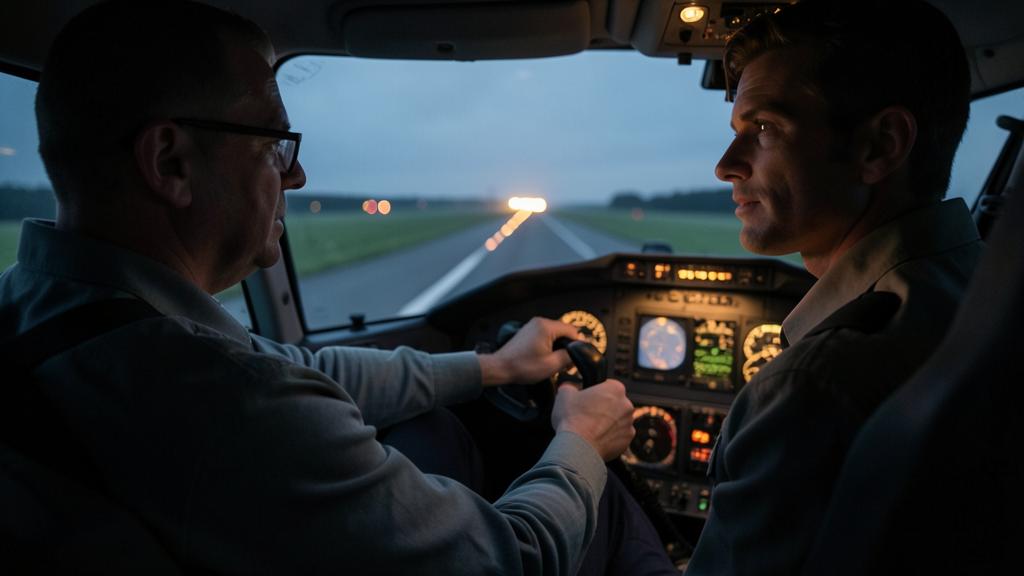
A crew member returning after two years away is put through a simulator session, passes it, and is released to the line. The session was not a formality and the pass was not generous. It simply measured the wrong things, because a check session is built to test rare, high-arousal events, and what degrades during a long absence is ordinary, low-arousal performance. The distinction between what comes back in an afternoon and what comes back only over sectors is the whole problem of a return to flying.
Recency, currency, competence: three different claims
The vocabulary of return blurs three claims that are not the same, and the blurring is where most of the trouble starts.
Recency is a countable fact about the recent past: the familiar requirement of three take-offs, approaches and landings in the preceding ninety days before carrying passengers is a recency rule. It is satisfied by doing the thing, and satisfying it proves that the thing was done, nothing more.
Currency is an administrative state: valid ratings, a valid medical, checks within their windows. In the European scheme this is maintained by a rolling cycle of checking — an operator proficiency check twice a year, a licence proficiency check for rating revalidation, a line check between them — and it is entirely possible to be current on paper on the strength of events that all took place before the absence began.
Competence is a claim about capacity: this person can fly this aeroplane, in this operation, on a bad day, while tired, with an unfamiliar colleague, and still have attention left over. Nothing in the first two claims establishes the third, and the checking system was never designed to. It was designed to sample competence periodically in a population that flies continuously, which is a different problem from certifying someone who has not flown at all.
What comes back quickly
Not everything decays, and being clear about what does not is what makes the rest credible.
Declarative knowledge — limitations, memory items, systems architecture, the content of the operations manual — decays predictably and restores predictably. It is the easiest thing to lose, the easiest thing to test, and the easiest thing to rebuild, because it responds to study. Focused reading restores most of it, and a check session detects its absence immediately.
Continuous motor skill — the tracking task of flying an approach by hand, the feel of the flare, rudder coordination — degrades less than returning pilots fear and recovers over a few repetitions. This is the part of rustiness people worry about aloud, and it is the part that a simulator session both measures well and fixes well. A crew member who lands three times in a session and is smoother on the third has demonstrated exactly what the session is good at demonstrating.
Discrete procedural sequences sit between the two. A flow that was automatic becomes a list to be recalled deliberately. The sequence is still known and can still be performed correctly, which is precisely why the degradation is invisible in a check: correctness is preserved. What is not preserved is the cost.
What degrades quietly
The common feature of everything in this section is that it does not produce errors under observation. It produces the same actions, performed correctly, at a higher price in attention — and attention is the resource that runs out first when something unexpected arrives.
Spare capacity
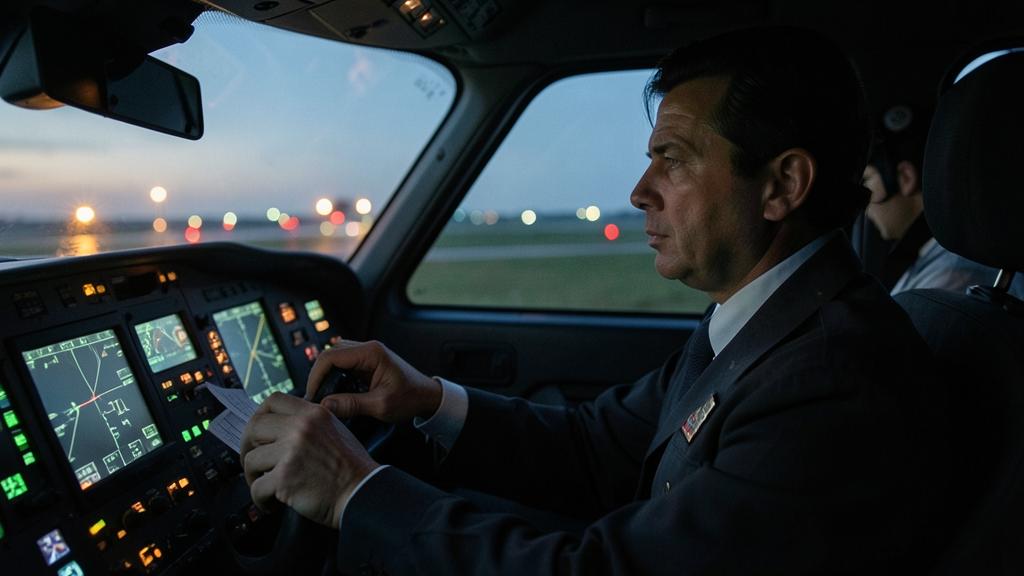
Automaticity is the ability to perform a routine task without spending attention on it. It is built by repetition and it decays without it. A returning pilot who has to think about the after take-off flow is not making an error; they are consuming capacity that a current pilot would have spent monitoring, anticipating or listening. The deficit only becomes visible when a second demand arrives at the same moment, which in a scripted session it usually does not.
Rhythm and anticipation
Experienced crews stay ahead of the aeroplane by running a continuous forecast: what happens next, what the controller is about to ask, when the descent has to start, what this arrival usually does at this time of day. That forecast is built from recent exposure to a specific operation, and it is the first thing an absence destroys. Its loss shows up as a subtle lateness — configuration a little behind, briefings begun a little too close to the point they describe, decisions taken correctly but at the last defensible moment.
Monitoring and the sense of the abnormal
Detecting an abnormality requires a model of normal that is current and detailed. A pilot who has not seen the aeroplane for two years has a coarser model, and coarser models raise the threshold at which something registers as wrong. Monitoring is also a low-arousal task, which makes it the first casualty of a raised attentional cost.
Crew calibration
Working with another pilot involves a set of judgements that are practised, not known: how much to say, when to intervene, how to challenge without derailing, how much of the task to take. A returning crew member frequently under-communicates — reluctant to speak up while feeling behind — or over-communicates in compensation. Both are recognisable to an experienced colleague and neither reliably appears in a session where the other seat is occupied by an instructor.
Language and radio under load
Radiotelephony fluency is a language skill under time pressure, and language skills under time pressure decay faster than the same skills at leisure. A returning crew member usually reads back correctly and hears correctly on a quiet frequency, and finds a busy one exhausting. Simulator frequencies are quiet, single-sector and spoken by an instructor who wants to be understood.
Physiological tolerance
Sitting for eleven hours, reporting at four in the morning, sleeping in daylight, eating at the wrong times: these are trained states and they detrain. Nothing in a check session touches them: whatever hour the slot falls at, it is not a duty day.
The simulator tests rare, high-stress situations, but what really suffers after a long break is the ability to handle routine tasks smoothly. Pilots may pass the simulator but still struggle with things like anticipating controller requests or managing attention under normal flight conditions.
A pilot returning after two years might handle a simulated engine failure flawlessly in the simulator, but on a real flight, they might struggle with the timing of a descent or miss a subtle change in air traffic control procedures because they’re not as familiar with the daily rhythm of operations.
| Capacity | Decays | Restores | Seen in a check session |
|---|---|---|---|
| Declarative knowledge | Quickly | Quickly, by study | Yes, immediately |
| Manual handling | Moderately | Over a few repetitions | Yes, and it is what the session is best at |
| Procedural flows | Moderately | Over sectors | Partly: correctness returns before automaticity |
| Spare capacity | Quickly | Slowly, only with real load | Rarely: the script does not stack demands |
| Anticipation and pacing | Quickly | Over sectors in a real network | No: the scenario is known and time is elastic |
| Monitoring threshold | Quietly | Slowly | No: abnormalities are inserted, not stumbled upon |
| Crew calibration | Quickly | Over sectors with real colleagues | No: the other seat is an instructor |
| Radio under load | Quickly | Over sectors | No: simulated frequencies are quiet |
| Circadian and postural tolerance | Quickly | Over weeks of duty | Never |
Why a check session is a poor detector
None of this is a criticism of simulator training, which does what it was built to do extremely well. It is a statement about what a session is designed to control. Every feature that makes a check session fair and repeatable also removes the conditions under which rustiness shows.
| In the session | On the line |
|---|---|
| Scheduled, announced, prepared for | Arrives at the end of a duty nobody prepared for |
| Aircraft positioned in a known state | Aircraft inherited mid-turnaround with a deferred defect |
| Failures inserted at phases where they are trainable | Problems appear where they are least convenient |
| An instructor available, and time that can be stopped | Nobody to ask, and time that cannot |
| No cabin, no passengers, no ground staff | Three parallel conversations during the same descent |
| No commercial consequence to being slow | A slot, a curfew, a connecting crew |
| Dense: an event every few minutes | Sparse: six hours of nothing, then one thing |
| The candidate revised last week | Nothing was revised; it either surfaces or it does not |
The last two lines carry most of the weight. A check session is a concentrated sequence of high-arousal events, and high arousal temporarily masks exactly the deficits described above: adrenaline buys attention. Line flying is the opposite — long stretches of low stimulation in which vigilance must be sustained rather than summoned. Rustiness lives in the boring hours. A session that never contains a boring hour cannot find it.
The trap. A pass reassures the person who most needs to stay cautious. Confidence recovers faster than capacity, and a successful session accelerates it: the returning crew member now has documented evidence of competence and stops watching themselves. The riskiest sector after a long absence is rarely the first one, when everybody is careful. It is the fourth or fifth, once the self-monitoring has been switched off.
Where evidence-based training changes the picture
The classic proficiency check answers a binary question against a list of manoeuvres, and its result is a pass. Evidence-based training was developed to answer a different question: how does this crew member perform across a set of competencies, observed in scenarios chosen because the operational evidence says they matter. The competency framework is public — application of procedures, communication, manual and automated flight path management, leadership and teamwork, problem solving and decision making, situation awareness and information management, workload management, and the knowledge underneath them.
Two items on that list are exactly what a long absence damages. Workload management and situation awareness are, in effect, the observable behaviours of spare capacity and anticipation. A programme that assesses them explicitly, and that records where a crew member sat on each rather than only whether they passed, is measuring something a manoeuvre-based check cannot express. It is still a simulator, and the artificiality in the table above still applies — but the instrument is at least pointed at the right target.
The practical consequence for a returning crew member is worth stating plainly: ask what your session is designed to produce. A pass, or a competency profile. If it is the second, the debrief is the most valuable hour of the whole return, and the weakest competency on it is the one to manage on the line.
What only the line restores
Spare capacity is rebuilt by using it, which means by flying sectors in which routine tasks gradually stop costing attention. Anticipation is rebuilt by exposure to a specific network: the arrival that always gets shortened, the frequency that is always busy at that hour, the stand that is always occupied. Crew calibration is rebuilt with real colleagues who have their own habits. None of this can be compressed, and none of it is a matter of effort.
Line flying under supervision exists for exactly this reason, and the number of sectors is not administrative padding. What varies is what the supervising pilot is asked to look for. A supervisor watching for errors will report that the returning crew member made none, which is usually true and rarely the point. A supervisor asked to report on pacing, on spare capacity, on whether the briefing came early enough and whether the second demand was absorbed, produces information that can be acted on.
Designing the return: the operator’s part
A staged return costs sectors and rostering flexibility, and it is far cheaper than the alternative. The principles are not exotic.
| Stage | Purpose | What it must not be |
|---|---|---|
| Ground and systems refresher | Rebuild declarative knowledge before it wastes simulator time | A slide presentation with attendance recorded |
| Simulator, training before checking | Restore handling and flows with time to practise | Compressed into the checking session to save money |
| Assessment against competencies | Produce a profile that names the weak areas | A pass with no usable debrief |
| Supervised line sectors | Rebuild pacing, capacity and crew calibration | Cut short because the first two sectors went well |
| Graded exposure | Easier aerodromes and daylight first, night and demanding fields later | Whatever the roster produced that week |
| Pairing control | An experienced colleague in the other seat, on the logic behind the European bar on pairing inexperienced crew members | Two people rebuilding their rhythm together |
| Deliberate follow-up | A conversation after twenty or thirty sectors, when the honest answers exist | A form signed on release to line |
Designing the return: the individual’s part
Some of the recovery cannot be delegated, and the weeks before the first duty are worth spending well.
Rebuild the knowledge before the session rather than during it, so that simulator hours go to the things only a simulator can give. Rehearse flows away from the aircraft; chair flying is unglamorous and it works, because it is repetition and repetition is what automaticity is made of. Re-establish the sleep pattern the roster will demand before the roster demands it, since circadian adaptation is one of the few elements that can genuinely be prepared in advance. Listen to live traffic on the routes you will fly, which restores radio rhythm at no cost. Read the recent occurrence summaries from your own fleet to reload the pattern library that used to update itself every week.
The right reflex. Tell the other pilot, at the briefing, that you are returning after a long absence and what you have asked yourself to watch. It costs nothing, it converts an unknown quantity into a managed one, and it gives the person beside you permission to monitor a little harder. Crews who do this report that it removes the exact pressure that was making things worse.
The same problem outside the flight deck
Nothing above is specific to pilots. A cabin crew member returning from a long absence recovers drill knowledge quickly and loses the practised choreography of a full service under time pressure, along with the calibration of a crew who read each other without speaking. A maintenance technician recovers the manual and the task cards quickly, and loses the feel for what looks wrong on a panel that has been opened a thousand times, which is precisely the perception that finds the unreported defect. A controller recovers phraseology quickly, and loses the traffic picture — the sense of what a sector is about to do, which is the same anticipation deficit under a different name, and which is why unit endorsements carry their own recency requirements rather than relying on the licence alone.
The pattern holds across all four: what is written down comes back fast, and what was built by repetition comes back only through repetition. Any return plan that measures only the first has measured the easy half. Those planning a return to the profession after an interruption will find the current openings, and the operators who run structured return programmes, at FL330 jobs.


Leave a Reply
You must be logged in to post a comment.