
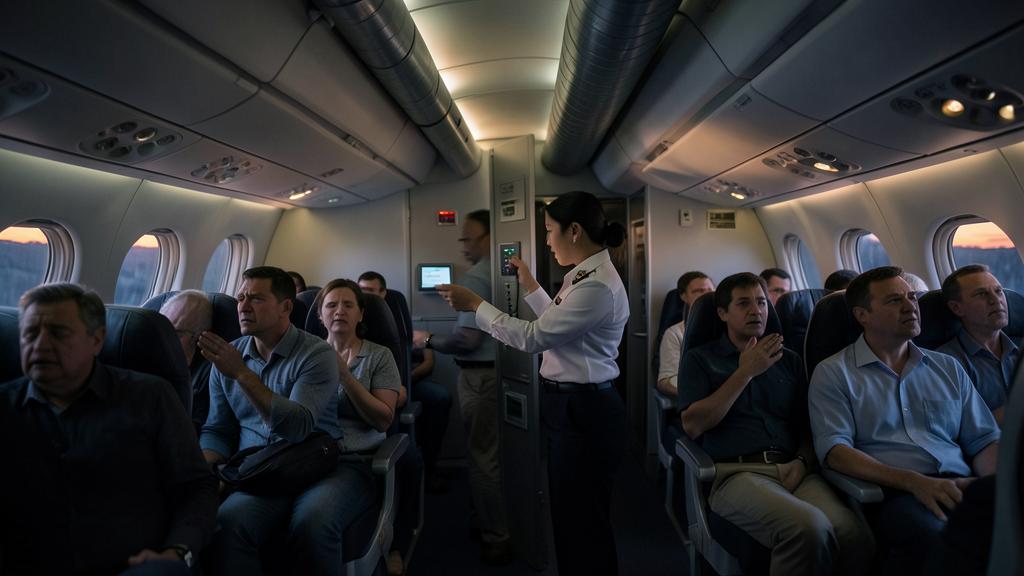
Nothing on board generates more complaints per unit of crew authority than the cabin temperature. A passenger in row 34 is cold, a passenger in row 12 is too warm, and both are addressing the same cabin at the same moment with equal conviction. The reflex answer — I will ask the flight deck to turn it up — is only half true, and the half that is false is the one that costs credibility twenty minutes later when nothing has changed. Understanding how the air actually gets conditioned, how long a correction takes to be felt, and where the crew’s authority genuinely ends is what turns an unwinnable argument into a manageable one.
How the air arrives, and why one control does not equal one temperature
On most pressurised transport aeroplanes, conditioned air comes from air conditioning packs fed with hot high-pressure air bled from the engines or the auxiliary power unit, or from a ground supply; a few recent types compress outside air electrically instead, but what happens downstream is the same. The pack cools that air a long way down. If the cabin needed nothing but cold air, the story would end there and the pack outlet temperature would be the cabin temperature.
It does not end there, because the aeroplane is divided into temperature zones — the flight deck and, depending on the type, two, three or more cabin zones — and each zone has a different heat load. A cabin zone full of passengers over the wing, with galleys and ovens working, is not thermally the same place as a lightly loaded rear zone with a large area of cold fuselage skin around it. So the pack air is cooled to satisfy the coldest demand in the aircraft, and each zone then gets a controlled quantity of hot air added back downstream, through what is usually called trim air.
That architecture has a consequence which explains most of what cabin crew observe. The zone with the coldest demand sets the pack outlet, and every other zone is warmed back up from there — but the warming has a limit. Trim air authority is finite. If one zone is demanding a great deal of cooling, the pack drives down, and the zones that want warmth may not be able to claw all of it back. The cabin does not have one thermostat with one setting; it has a shared cold source and several limited heaters competing on top of it.
Add to this the recirculation system. A substantial share of the air moving through the cabin — the proportion depends on the type — is not fresh pack air at all but cabin air drawn back through filters and mixed with the pack supply in a mixing unit. Recirculation is why the cabin does not feel like a wind tunnel and why fuel is not spent conditioning more air than necessary, and it is also why the cabin has thermal inertia: a change to the pack demand has to work its way through a mixed volume before anyone feels it.
The cabin temperature is controlled by a shared cooling system with limited heating adjustments for different zones. Changes take time because the air has to warm or cool the entire cabin, not just the air itself.
On an Airbus A320, a zone temperature adjustment request takes about 5-10 minutes to be felt by passengers. If the rear zone is set to 22°C and the front to 24°C, but the rear is near a cold fuselage wall, the pack may cool to 20°C, and the front zone may struggle to reach 24°C due to limited trim air.
| Cause | Where it is felt | Responds to a zone change? | Time to any effect |
|---|---|---|---|
| Zone genuinely set cool or warm | The whole zone, evenly | Yes | Minutes, not seconds |
| Radiant loss to a cold fuselage skin at cruise | Window seats, shoulder and arm on the wall side | Weakly — the air can be warmed, the wall cannot | Limited even after several minutes |
| Floor-level or sidewall draught from a riser or duct outlet | Feet, ankles, one or two seat rows | Barely — the flow is local | Not usefully |
| Galley or oven heat, equipment bay heat | Rows adjacent to a galley or a bay | Partly, and only by penalising the rest of the zone | Minutes |
| Solar gain through windows on the ground | Sun side of the aircraft | No — the cause is outside | Not until the shades are down or the aircraft moves |
| Doors open, ground supply undersized, hot or cold ramp | Whole cabin, worst near open doors | No — there is no spare capacity to give | After doors close and the packs get proper supply |
| Individual factors: metabolism, clothing, fatigue, dehydration, alcohol | One seat | No | Never, by that route |
The lag is the whole problem
The single most useful thing to understand — and the single most useful thing to explain — is that the cabin’s thermal response is slow, and slow in a way that guarantees a mismatch between what the passenger is describing and what the system is currently doing.
The mass that has to change temperature is not just the air. It is the seats, the sidewall panels, the overhead bins, the carpets, the catering, the baggage, and several hundred people, each producing heat continuously. Changing a zone selector changes the trim air valve position; the valve changes the supply temperature; the supply temperature slowly shifts the temperature of everything the air touches; and only then does a seated passenger notice. Several minutes is a realistic expectation for a perceptible change and longer for a settled one.
This produces a specific and very common failure of communication. A passenger complains. The crew relays it, the correction is made, and eight minutes later the passenger — who has been sitting in the pre-correction cabin the whole time, because that is what the cabin was — reports that nothing has happened. The crew, believing the matter dealt with, now looks either powerless or dishonest. The correction was real; the account of it was wrong.
The right reflex. Give a time, not a promise. « I have asked for that zone to be brought up; it takes several minutes to be felt, so let me come back to you after the service » is accurate, it sets the passenger’s expectation to match the physics, and it commits you to a follow-up that costs thirty seconds.
What the crew actually controls
The honest inventory of levers is shorter than passengers assume and longer than crews sometimes believe. On some types the cabin crew panel offers a direct adjustment of zone temperature within a limited band; on others the request goes to the flight deck, which holds the zone selectors. Either way, the adjustment is a request to a controller, not a setting of the cabin temperature, and it is bounded by what the system can deliver at that moment.
| Lever | Who holds it | What it can do | What limits it |
|---|---|---|---|
| Zone temperature selection | Flight deck, or the cabin panel on some types | Shift a whole zone up or down | Trim air authority, the coldest zone’s demand, pack capability |
| Individual air outlets where fitted | The passenger | Local cooling and air movement at one seat | Not fitted at every seat or on every type; it moves air and cools, it cannot warm |
| Blankets, and moving a passenger | Cabin crew | Solves the individual case immediately and reliably | Load factor, and having blankets on board |
| Window shades on the ground | Cabin crew | Removes a real and significant solar heat load | Nothing much — it is the most underused lever on board |
| Ground air or auxiliary power source selection | Flight deck and ground staff | Determines whether the packs have anything to work with at the gate | Ground equipment capacity, ambient conditions, doors open |
| Reporting a suspected fault | Cabin crew | Gets a defect entered, dispatch relief applied, engineering involved | Only works if the report is specific enough to act on |
Two items in that list deserve to be taken more seriously than they usually are. Moving a passenger solves the individual complaint completely, in seconds, with certainty — and it is very often available on a flight that is not full. Compared with a zone adjustment that will inconvenience a hundred other people to address one, it is the better engineering answer as well as the better service answer. And window shades on the ground, in sunshine, remove a genuinely large heat input; a cabin that is hot at the gate with the shades up is a cabin that has been allowed to become a greenhouse.
The gate is a different problem from the cruise
The most severe thermal complaints tend to happen on the ground, and the reason is structural rather than a matter of anyone’s attention. In flight the packs have engine bleed air of good quality and abundant quantity, the outside air is very cold, and the system has real capability. At the gate it may be running on the auxiliary power unit or on a ground supply, with the doors open and the airbridge feeding ambient air into the cabin, on a ramp that may be well above or well below any temperature the system was ever meant to hold against.
The result is that during boarding on a hot day the cabin frequently cannot be brought to a comfortable temperature at all — not because anyone has set it wrongly, but because the heat coming in exceeds the cooling available. That is worth saying to passengers in plain terms, because the alternative is for them to conclude that the cabin is uncomfortable through indifference. It also argues for the small physical actions that do work: shades down, doors managed, boarding paced.
The trap. Promising that it will get cooler « once we take off » and leaving it there. If there is then a departure delay with the doors closed, the promise has aged badly and the cabin has no obvious authority left. Say what the constraint is now, say what changes it, and avoid attaching relief to a departure time you do not control.
Dryness is not temperature, and it is often the real complaint
Cabin humidity at altitude is very low — the outside air at cruise levels carries almost no moisture, and what humidity the cabin has comes mainly from its occupants. Low humidity increases evaporative cooling from the skin, so the same air temperature feels cooler than it would on the ground. It also produces dry eyes, dry throat and dry nasal passages, which passengers frequently describe as a temperature problem because that is the vocabulary available to them.
This matters practically. A passenger complaining of feeling cold and unwell late in a long sector may be describing dehydration and dryness rather than an actual temperature deviation. Water, a blanket and a moment of attention will do more than any zone adjustment, and they can be delivered immediately.
Reporting it so that something can be done
The gap between a complaint and an action is almost always a gap in specificity. « The cabin is cold » cannot be acted on: it does not say which zone, it does not distinguish a system state from a local draught, and it does not tell the flight deck whether they are looking at a comfort matter or a defect.
A report that can be acted on carries four things: where, how many, how long, and how it differs from the rest of the cabin. Rows 30 to 38 rather than the back. Several passengers rather than one. Since top of climb rather than just now. Noticeably colder than the forward cabin rather than simply cold. That report lets the flight deck compare it with the indicated zone temperatures, distinguish a genuine system deviation from a comfort spread, and either adjust or enter a defect.
And when the indications and the cabin disagree — the panel shows a zone sitting at its target while a whole section is plainly cold — that disagreement is itself the finding. It suggests a sensor, a valve or a distribution problem rather than a setting, and it belongs in the technical log, not in a service report. Cabin crew who describe it in those terms tend to see it fixed; those who report the temperature alone tend to see the aircraft come back tomorrow with the same complaint. Cabin operations and communication are covered in more depth in the cabin crew modules at FL330 training.
Explaining it without over-explaining
Passengers do not need the air conditioning schematic. They need three things, in this order: acknowledgement that the discomfort is real, a short and honest statement of what is being done, and a time frame that will not embarrass anyone.
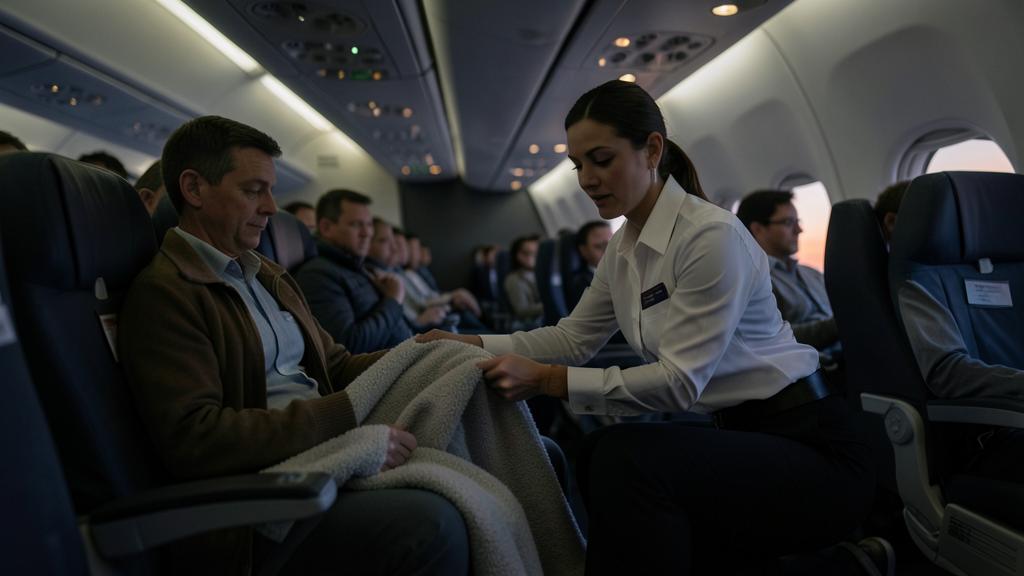
What works is brief and specific: the cabin is divided into zones, a change takes several minutes to be felt, the request has been made, here is a blanket in the meantime, and I will check on you shortly. What does not work is a technical lecture, a blanket denial that anything can be done, or a confident promise of a temperature. The first bores, the second reads as dismissal, and the third creates a debt that the system may not be able to pay.
The underlying principle is worth holding onto beyond the temperature question. The crew’s authority over the cabin environment is real but narrow, it is slow, and it is shared with the physics of a large insulated tube full of people. Saying that clearly, and then doing the small things that do work immediately, is more professional and considerably more effective than pretending to a control that nobody on board actually has.


Leave a Reply
You must be logged in to post a comment.