

Each month the captain invoices, through his own company, a flat fee that never varies by a single line. His roster reaches him from the operations department, he flies to the procedures in the operations manual, he is line-checked by the airline’s instructors, he wears the uniform and the badge. Neither the title of the contract nor his company’s registration number answers the only question that counts before a judge: who actually organises this work? Air transport, by construction, almost always gives the same answer.
The title of the contract decides nothing
A reclassification is not a penalty for poor drafting, it is a finding of fact. The existence of an employment relationship depends neither on the intention expressed by the parties, nor on the name they gave their agreement, but on the actual conditions in which the activity is carried out. A document headed “contract for the provision of services”, signed by two adults in perfect agreement, protects no one: parties cannot agree to set aside a status of public policy. The reasoning is conducted on dated facts — rosters, reports, invoices, message exchanges — which both parties produced without thinking about it, and which weigh infinitely more heavily than the heading they chose.
Registration does nonetheless play a role, but a limited one. A person registered as a self-employed trader or running his own company is presumed not to be an employee. That presumption is rebuttable: it falls as soon as proof of a permanent relationship of legal subordination is produced. In other words, self-employed status shifts the burden of proof, it does not close the debate.
It remains to be seen who opens that debate, because it is never the party one expects. Rarely the civil aviation authority, which does not rule on contracts. Most often an inspection by the social security contributions collection agency, the abrupt end of a relationship, a claim for unemployment benefit, an accident occurring on a mission — or the person concerned himself, years later, when he measures what those years failed to build up for him in entitlements.
Legal subordination, and nothing else
The test is a single one: the work is performed under the authority of someone who has the power to give orders and directives, to supervise their execution and to penalise breaches. Three powers, not three indicators — direction, supervision, sanction. Everything else, exclusivity, provision of the means of work, regularity, the amount of the invoice, exists only to prove or rule out those three.
From that construction follows a consequence that many cases overlook: no single indicator is sufficient on its own. A genuine contractor may have only one client, work on his premises, with his equipment, and remain perfectly independent. Conversely, an accumulation of weak indicators carries conviction as soon as they all describe the same thing: a person embedded in an organised operation whose hours, means and objectives he does not set.
One confusion deserves to be cleared up straight away, because it circulates widely in the sector: economic dependence is not legal subordination. Deriving the bulk of one’s turnover from a single principal is a factor of commercial fragility, it is not proof. What counts is not what one lives on, but who decides what one does, when and how.
A judge doesn’t care what your contract says. They look at how you actually work. If you follow someone else’s schedule, rules, and get punished for mistakes, you’re likely an employee, not a contractor. The name on the paper doesn’t change that.
A pilot invoices €10,000/month for 80 hours of flying. The airline sets his schedule, provides the aircraft, and suspends him for refusing a flight. Even if his company is registered, a court would likely rule this is employment, not a service contract.
Why aviation manufactures subordination
Here lies the mechanism that generalist legal analysis does not see. In an ordinary agency or workshop, subordination results from a choice of organisation, and it can therefore be avoided. In air transport, it is imposed by the regulations themselves.
The operator retains operational control of every flight. It has no right to divest itself of that control, including when it subcontracts: the regulations leave it responsible for the activities entrusted to third parties, which obliges it to prescribe, monitor and verify. Its operations manual sets the procedures, the operating minima, the fuel policy, the action to be taken in the event of a failure. No one boards to apply their own methods, and that is a good thing.
The chain continues through three further channels, all of them regulatory. Training and recurrent checking are the operator’s responsibility; it keeps the competence record and decides on the return to line duty. Rostering belongs to it as well, since it answers for the flight and duty time limitations and for the rest actually taken. Access, finally, passes through it: badge, clearances, accounts, authorisations. On the maintenance side the mechanism is identical — the holder of a maintenance licence certifies nothing until the approved organisation has issued him a certification authorisation, established in accordance with the organisation’s procedures, backed by his continuation training, and which the organisation can withdraw.
The result is that a scrupulous operator mechanically ticks the boxes of direction, supervision and sanction. That does not make every service contract impossible in the sector. It means that the demonstration of independence is not played out on that ground, and that it has to be built elsewhere: on the economics of the relationship, on the genuine freedom to refuse a mission, on the plurality of principals, on the non-permanent character of the position occupied.
The indicators read one by one
A case is not argued indicator by indicator, but it is prepared that way. The table sets out the criteria usually applied, adding the column that is missing from generalist analyses: their discriminating value in an environment where procedures and authorisations are imposed on everyone.
| Indicator | Weighs towards subordination | Weighs towards independence | Discriminating value in aviation |
|---|---|---|---|
| Directives | Imposed internal procedures, written instructions, a place in a hierarchy | Obligation as to result, method left free | Low: the operations manual applies to everyone |
| Rostering | Roster built by the operator, refusal difficult or penalised | Missions accepted one by one, refusal without consequence | High: this is the most closely examined indicator |
| Means | Uniform, badge, company address, equipment provided | Tools, insurance and business expenses borne by the contractor | Medium: the aircraft proves nothing, the accessories do |
| Remuneration | Unvarying monthly flat fee, revised unilaterally | Price negotiated per mission, varying with its content | High: how the price is set speaks louder than its amount |
| Exclusivity | A single principal for years, permanent availability expected | Several clients, demonstrable business of one’s own | Medium: economic dependence is not subordination |
| Sanction | Removal from a mission, summons, appraisal, exclusion from the roster | Reciprocal contractual penalties, provided for and quantified | High: this is the power that is hardest to disguise |
| Replacement | Person in fact irreplaceable | Substitution possible by another qualified professional | Low: the type rating rules it out in any event |
Two rows deserve comment. Replacement, often presented as the supreme indicator of independence, proves very little here: a type rating and an operator authorisation make substitution impossible for reasons unrelated to the contract. Remuneration, by contrast, is highly revealing. An identical amount every month, revised by the principal without discussion, describes a salary; a price debated mission by mission, varying with duration, difficulty and urgency, describes a service.
The arrangements that shift the risk without removing it
Three arrangements recur in the sector, and none of them neutralises the reasoning. They change the identity of the party who will have to explain himself, not the question asked.
- The first is invoicing through a company owned by the person concerned. It produces the presumption of non-employee status mentioned above, and nothing more.
- The second is umbrella company employment, where the person is genuinely an employee of the umbrella company. The arrangement is regulated and presupposes genuine autonomy: the umbrella employee finds his own assignments and negotiates his price. A crew member on an operator’s roster, who has never canvassed or negotiated anything, does not match that description, and the arrangement may then be analysed as a straightforward supply of personnel.
- The third is the crew supply intermediary, often established in another State. This is where the least understood risk is concentrated. Supplying labour for profit, invoiced by the hour or by the day, without transferring any know-how of one’s own or committing to an identifiable result, falls within a regime reserved for temporary work agencies. Outside that framework, the operation is unlawful for the intermediary and for the user alike, and the user is jointly exposed.
As for location, it is not a matter of choice. For flight and cabin crew, the home base — the place where one habitually starts and ends one’s duty — governs social security affiliation and weighs heavily in determining the applicable labour law. Yet the home base is a fact, recorded in the operator’s documents, not a clause that one drafts. The sector’s matching platforms, such as the FL330 freelance area, change nothing either: the intermediary does not determine the classification, the actual organisation of the work does.
The evidence file is the safety file. Training and checking records, certification authorisations, rosters, flight and rest time records are dated, named, kept for years and produced on the authority’s request. They constitute the most complete and most incontrovertible demonstration of subordination — and they are mandatory. No operator can both keep them and maintain that it was not directing the work.
What a reclassification produces, on each side
Reclassification does not open one dispute, it opens several at once, before different courts and with time limits that do not coincide. Employment tribunal litigation settles the individual relationship; the contributions inspection targets the company; the classification as concealed employment, if intent is established, adds a criminal dimension. The table distinguishes what each party bears.
| Area | For the operator or principal | For the crew member or the engineer |
|---|---|---|
| Contract | Relationship deemed open-ended from the first day | Seniority reconstituted from the first day, with its effects |
| Pay | Back pay, paid leave, collectively agreed bonuses over the unexpired limitation period | Sums received reclassified, tax regularisation to be expected |
| Contributions | Reassessment on all sums paid, surcharges, loss of exemptions | Rights reconstituted: pension, income protection, sick leave |
| Termination | End of the relationship treated as a dismissal without real and serious cause | Severance payments, possible entitlement to unemployment insurance |
| Concealed employment | Lump-sum indemnity, criminal penalties, joint financial liability along the chain | In principle no penalty, but possible repayment of benefits received |
| Insurance and operations | Personal injury cover to be reviewed, inexcusable fault possible in the event of an accident | Personal income protection and loss-of-licence policies potentially void of purpose |
One point deserves emphasis, because it locks the operator into a contradiction from which it cannot escape. To rule out subordination, it would have to maintain that it gave no directives, that it did not supervise performance and that it could not impose sanctions. That defence amounts to describing an operator that does not exercise operational control over its flights, that is to say to admitting before the authority a breach far more serious in its consequences than the contractual dispute at hand. The two arguments cannot stand together.
What to check in your own case
The reasoning is easily turned into a self-diagnosis, provided it is done on documents and not on memories. Three documents are enough to situate a relationship: the rosters for the last twelve months, the invoicing history with the rates applied, and the list of the other clients actually invoiced over the same period. The rest is a matter of interpretation.
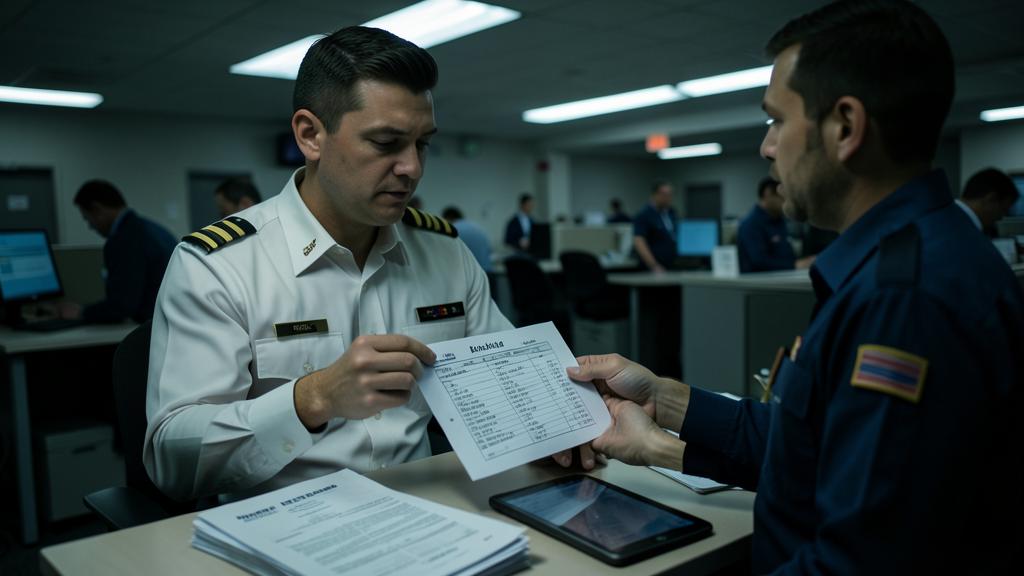
Two questions situate a case before any examination of the documents. Who builds the roster, and what actually happens if a mission is refused? If the answers are “the operations department” and “the relationship ends”, the content of the contract will not weigh heavily. Keep written evidence of the missions refused without consequence and of the other principals invoiced over the same period: that is the only document that fills the other pan of the scales.
Two dimensions intersect in this reading, and they do not carry the same weight: integration into the organised operation decides, the duration of the relationship aggravates. A short assignment that is nonetheless fully integrated — badge, roster, procedures, supervision — already raises a supply-of-personnel problem, even though it lasted only a few weeks. A long relationship that has remained outside the organised operation, by contrast, is very well defended, including with a single client and over many years. That is why a case is never judged on its length alone.
The grey area, for its part, will not disappear, and it is better to know it than to deny it. The instructor working for several organisations, the examiner, the occasional ferry flight, the internal audit entrusted to a third party, expert work on a defined deliverable, the brief replacement of a management post: these situations hold up because they have a bounded object, an identifiable result and a duration that does not settle in. It is that combination that holds, not the status of the party issuing the invoice.
One case remains that directly concerns those preparing a rating, and on which one must be clear. When the professional funds his own type rating and then his line hours in order to gain access to a position, the economics of the relationship are reversed: the person who works pays for what the regulations place on the operator, namely the training and checking of its own crew. Such an arrangement does not on its own prove subordination, but it puts in place two of the elements that characterise it — the training given by the principal and the integration into its organisation — while depriving the person concerned of the counterpart that would make the service credible, a negotiated price. This is the point most often underestimated at the moment of signing.
The applicable law, the state of the case law and the operator’s approved documentation prevail over everything set out here: this article describes a mechanism of classification, it replaces neither the examination of an individual situation by a legal professional, nor the procedures specific to each organisation.
Questions fréquentes
Does invoicing through my own company protect me from reclassification?
No. Registration creates only a presumption of non-employee status, which falls as soon as proof of permanent legal subordination is produced. The judge examines the actual conditions in which the work is performed, not the legal form chosen by the parties. A company owned one hundred per cent by the person concerned changes nothing in that analysis.
Is having only one principal enough to have the relationship reclassified?
No, exclusivity is only one indicator among others and it is never sufficient on its own. Economic dependence describes commercial fragility, not a relationship of subordination. It becomes decisive when it is added to an imposed roster, a unilaterally set rate and a possibility of sanction.
Who can trigger reclassification proceedings?
Mainly the social security contributions collection agency during an inspection, the labour inspectorate, or the person concerned himself before the employment tribunal, often after the end of the relationship. An accident occurring on a mission or a claim for unemployment benefit also frequently triggers the examination. The civil aviation authority, for its part, does not rule on the classification of contracts.
Does umbrella company employment shield the operator?
Only partially. Umbrella employment presupposes an autonomous employee who finds his own assignments and negotiates his price; a crew member integrated into an operator’s roster does not match that definition. The arrangement may then be reclassified as a supply of personnel, a regime reserved for temporary work agencies, with exposure for the user.
Does a home base abroad change the applicable law?
The home base is a fact, established by the operator’s documents, and not a clause that one chooses. For flight and cabin crew it governs social security affiliation and constitutes a major indicator of the place from which the work is habitually carried out. A contract designating another country is therefore not enough to move the applicable regime.
What does the reclassified professional personally risk?
In principle no penalty, since the concealment of salaried employment is held against the employer. He may nonetheless have to regularise his tax position and repay benefits wrongly received during a period now regarded as salaried. In return, he recovers seniority, social entitlements and, depending on the case, back pay and severance payments.


Leave a Reply
You must be logged in to post a comment.