
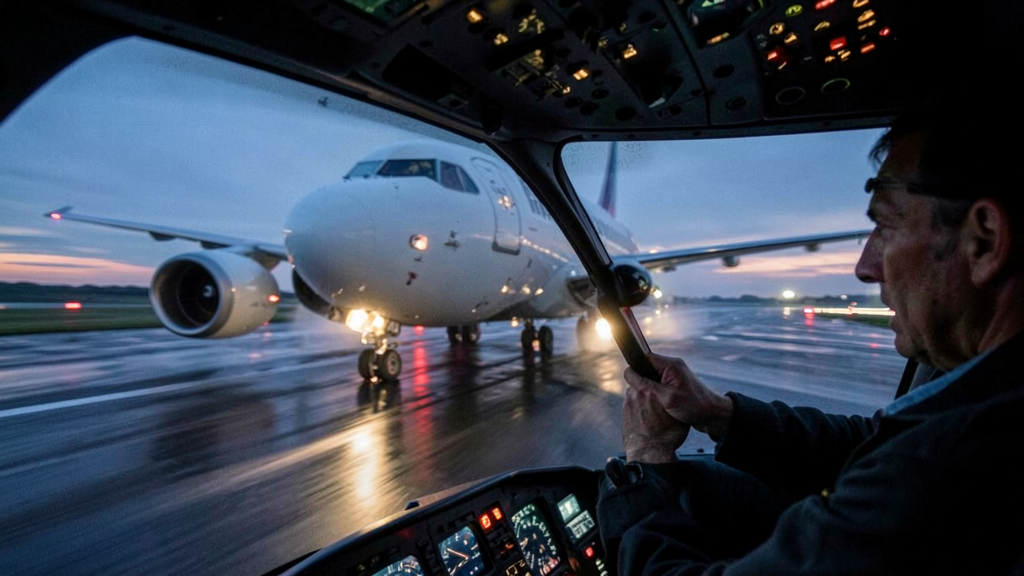
V1 is briefed as a decision speed, which is close enough to be useful and wrong enough to be dangerous. It is not a moment of judgement. It is a compromise point calculated from certification flight tests, resting on a reaction time, a braking coefficient and a surface condition that the line rarely reproduces. Knowing which parts of the figure are conservative and which are optimistic is what makes the number usable at 140 knots.
One speed carrying two definitions
The large-aeroplane codes define V1 twice, and both definitions have to hold simultaneously. It is the maximum speed at which the pilot must have taken the first action to stop — brakes, thrust levers, speedbrakes — in order to stop within the accelerate-stop distance available. It is also the minimum speed, following failure of the critical engine at VEF, at which the takeoff can be continued and the required screen height reached within the takeoff distance available.
Read those together and the character of the number changes. V1 is not the last instant to think. It is the last instant at which the first stopping action has already begun. Everything before it — recognition, diagnosis, the decision itself — has to have happened earlier, which is why the standard call is made so that it finishes before the speed is reached, and why the hand comes off the thrust levers at that point on many fleets.
The trap. Treating V1 as the moment the decision is made. If the reject begins at V1, the aeroplane is already past the point the accelerate-stop distance assumed, because that distance was built from an action initiated at or before V1, not from a decision taken there.
How the accelerate-stop distance is actually built
The certification chain starts earlier than V1, at VEF: the speed at which the critical engine is assumed to fail. VEF may not be less than VMCG, the minimum control speed on the ground, because an aeroplane that cannot be kept on the centreline has no meaningful continued-takeoff case.
Between VEF and V1 the code allows the speed gained while the pilot recognises the failure and initiates the first stopping action. In practice that interval is on the order of one second — an interval demonstrated in flight test, by a test crew, on an aeroplane instrumented for the event, expecting a failure that has been briefed.
Then comes the part that is genuinely generous. Since the accelerate-stop rules were amended in the 1990s, the certified distance also carries a flat addition: the ground the aeroplane would cover in two seconds at V1, credited with no deceleration whatever. That allowance is not a reaction time — the recognition interval is accounted for before it — it is a deliberate cushion for the untidiness of a real reject: a hand that reaches the speedbrake lever late, a thrust lever that does not come fully back at once, a second or two of the world not being a flight test.
V1 isn’t the moment to decide to stop—it’s the latest speed where stopping actions must already be happening. The numbers assume perfect reactions, but real life is messier, so extra runway is built in.
On a Boeing 737-800 with V1 at 130 knots, the flight manual assumes a 1-second reaction time after engine failure at VEF (say, 125 knots) plus a 2-second buffer for imperfect braking. If a pilot hesitates, that extra runway could be gone before the brakes even touch the runway.
Worn brakes, no reversers: the conservative half
Two more elements of the certification make the dry-runway figure harder to beat than crews often assume.
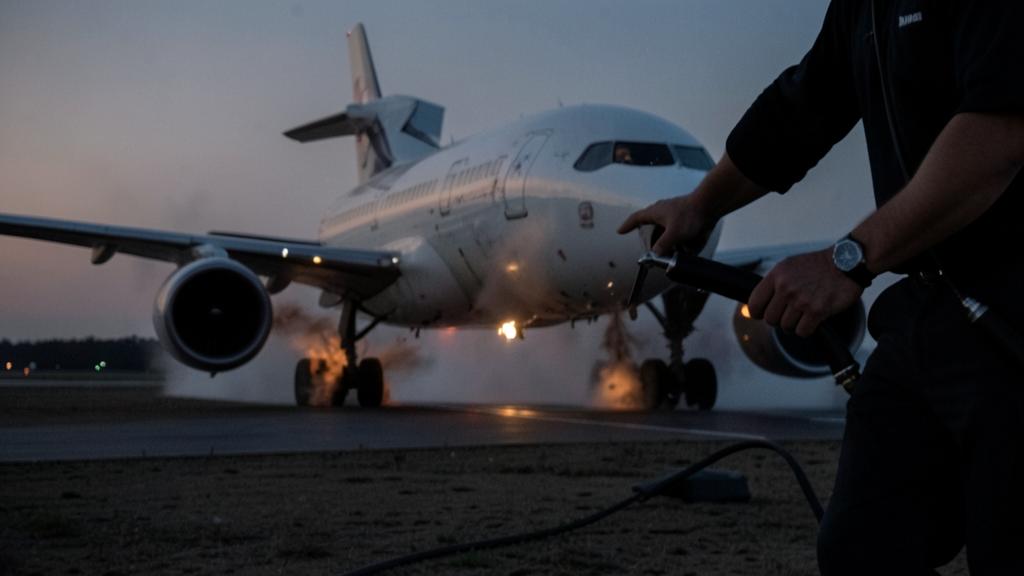
The accelerate-stop distances must be established with brakes worn to their permissible limit — not with new brakes on a new aeroplane. The demonstration is flown at the least capable end of the brake’s service life, which is exactly the end of the range you are statistically most likely to be operating in.
And on a dry runway, no credit is taken for reverse thrust. The stopping performance in the flight manual comes from wheel brakes and drag alone. Reverse is a bonus, not a component of the calculation — which is why an operator’s procedure calls for it on every reject and why its absence does not, by itself, invalidate the numbers. Whether any credit may be taken on a wet or contaminated surface depends on the certification basis of the particular aeroplane and on the conditions attached to it, so the flight manual, not a general rule, is the authority for your fleet.
| Element | How certification treats it | Direction of the margin |
|---|---|---|
| Brake condition | Fully worn to the permissible limit | Conservative |
| Reverse thrust, dry runway | No credit taken | Conservative |
| Post-action allowance | Two seconds of travel at V1, no deceleration | Conservative |
| Recognition interval | Roughly one second, test crew, briefed failure | Optimistic on the line |
| Braking technique | Immediate maximum braking, held | Optimistic on the line |
| Runway surface | The condition assumed when the figures were read | Unknown at the moment of use |
| Aeroplane condition | Systems as certificated, no deferred defects | Depends on the dispatch |
Where the conservatism drains away: the surface
Every reassuring element above concerns the aeroplane. The one variable that can consume all of it at once concerns the ground, and it is the only one nobody measures at the moment the crew needs it.
Dry-runway data rests on a friction level derived from testing. Wet-runway data rests on a modelled friction level for a smooth, hard surface, and grooved or porous friction-course runways may attract a credit where the certification basis allows it. Contaminated-runway figures — standing water, slush, snow, ice — are a different animal again: depending on the aeroplane’s certification basis, they may be certified performance in the flight manual or manufacturer advisory data supplied outside it. That distinction matters, because advisory data carries no guarantee of the demonstrated conservatism described above.
Since the global reporting format came into force in November 2021, the runway condition arrives in the flight deck as a runway condition code per third of the runway, derived by the aerodrome from what is actually on the surface, plus the depth and type of contaminant. It is a substantial improvement on the friction readings and adjectives it replaced. It is still an assessment made at a moment that is not your moment, on a surface that changes with traffic, temperature and time.
The good reflex. When the condition code is one step worse than the one behind the figures you used, treat the gap as spent, not as spare. The margin in the accelerate-stop distance was built for a sloppy reject on the surface you assumed — not for a firm reject on a worse one.
Balanced field is a convenience, not a law of nature
The balanced V1 is the speed at which accelerate-stop distance equals continued-takeoff distance. It is popular because it produces one number and, on a runway with no clearway or stopway, usually the lowest required field length. It is not a rule.
Where the declared distances are unequal, there is a range of usable V1 values, bounded by the lowest speed at which the takeoff can still be continued and the highest at which it can still be stopped. Inside that range, the choice is an operational one. A lower V1 buys stopping margin at the cost of continued-takeoff margin — the reasoning behind a reduced wet V1. A higher V1 does the reverse, which is what improved-climb techniques exploit when obstacles rather than field length are the constraint.
| Term | Composed of | Bounds which case |
|---|---|---|
| TORA — takeoff run available | The runway declared suitable for the ground run | The ground portion of both cases |
| TODA — takeoff distance available | TORA plus any clearway | The continued takeoff to screen height |
| ASDA — accelerate-stop distance available | TORA plus any stopway | The rejected takeoff |
| LDA — landing distance available | The runway declared suitable for landing | Landing, not the reject |
The screen height itself moves with the surface. With an engine failure on a dry runway the continued case is flown to 35 ft; on a wet runway the codes permit a reduced screen height of 15 ft, on the reasoning that the alternative — demanding the same height from a runway where stopping is harder — would push V1 up at exactly the wrong moment.
What bounds V1 from below and from above
V1 is not free to move wherever field length allows. It sits inside a corridor built from control, energy and structure, and understanding which wall you are against explains why the number sometimes refuses to behave.
| Limit | Direction | Why it exists |
|---|---|---|
| VMCG | Floor | Below it, directional control on the ground cannot be maintained after an engine failure |
| Continued-takeoff distance | Floor | Below it, the aeroplane cannot reach screen height within the distance available |
| Accelerate-stop distance | Ceiling | Above it, the aeroplane cannot be stopped within the distance available |
| VMBE | Ceiling | Above it, the brakes cannot absorb the energy of the reject |
| VR | Ceiling | V1 cannot exceed the rotation speed |
| Tyre speed limit | Ceiling, indirectly | It caps lift-off and rotation speeds; since V1 may not exceed VR, it caps V1 with them |
VMBE is the one crews meet least often and remember longest: high field elevation, high temperature, high mass, a downhill slope and a tailwind can bring the brake energy ceiling down to meet the field-length floor, at which point the takeoff is not performance-limited in the usual sense — it is simply not available at that mass.
The reject itself is what the number assumes
The distance in the flight manual describes a specific manoeuvre: stopping action initiated at or before V1, maximum braking applied immediately and held, thrust closed, speedbrakes deployed, directional control maintained, and the aeroplane brought to a full stop on the runway. Any deviation from that sequence spends the two-second allowance and then starts spending runway.
The industry work on rejected takeoffs — the takeoff safety material developed jointly by manufacturers and regulators and still the reference on the subject — keeps returning to the same two findings. A large share of rejected-takeoff overruns began at or above V1. And where the reject was begun in time, the stop was often still long because braking was not immediate, not maximum, or not held.
Both findings point at the brief rather than at the flight manual. What is decided on the ground is who calls the reject, what will and will not trigger one above eighty knots, and the acceptance that above V1 the aeroplane is going flying with whatever it has. Crews who work through these cases together — in the simulator, or in the discussions and refresher material collected at the FL330 training platform — tend to arrive at the runway with that conversation already finished.
What to carry into the takeoff brief
V1 is a computed compromise between two failures, built from a one-second recognition by a test crew, cushioned by two seconds of deliberate slack, proven on fully worn brakes with no reverse thrust credited on a dry runway, and entirely dependent on a friction assumption made by someone else at another time. The aeroplane side of that bargain is honest and slightly pessimistic. The ground side is an estimate.
Which is why the useful question in the brief is not « what is V1 » — the box computed it. It is « what did we assume about the surface, and what would have to be true for that assumption to be wrong by the time we use it ».


Leave a Reply
You must be logged in to post a comment.