

Eighteenth sector, an uneventful day: not one deviation from the flight path, not one missed call-out, a clean landing. And yet the report carries, against two competencies, a grading that does not yet permit release to the line. The bewilderment is a classic one, and it rests on a misunderstanding about the very object of the exercise: what is assessed is not the success of the sector, but the way in which it was obtained and what it allows one to predict about the next one — the one where nobody will be sitting beside you to catch things.
The simulator judges a session, the line judges a series
The simulator and the line are fundamentally different. In the simulator, the scene is bounded: the objective is announced, the failure occurs at a chosen instant, the exercise stops, the aircraft is repositioned in a known state and one starts again. Each sequence isolates one competency and puts it under strain. The session is judged on its own terms.
On the line, none of this holds. Time is never reset: a hesitation on the stand is paid for two hours later in fuel counted out and in a slot lost. Threats do not arrive calibrated; they arrive in clusters or not at all, and the day that brings them together is not necessarily the one on which the programme intended to work on them. Above all, the occupant of the other seat is not merely an assessor: he is the commander, responsible for the flight and for its passengers. That dual role explains almost everything that follows — how far he lets you go, the moment at which he takes over, and why he records the gap between what you would have done alone and what actually happened.
The result is a longitudinal assessment. An isolated sector proves very little; it is the series that speaks. An operator does not conclude that “this sector was good” but that “at the rate observed, autonomy will be reached by the planned deadline” — or that it will not.
| What is at stake | Simulator session | Line training sector |
|---|---|---|
| Origin of the threats | Chosen, calibrated, injected at the useful instant | Encountered, uncalibrated, clustered or absent |
| Continuity | Reset to the initial state between exercises | None: the next phase inherits from the previous one |
| Role of the occupant of the adjacent seat | Assessor, with no responsibility for the flight | Commander responsible for the flight, and assessor |
| What the grade bears on | The session, taken on its own | The series of sectors and the slope it traces |
| Effect of a bad day | Repeatable, often within the same session | Not repeatable: it becomes part of the record |
| Consequence of a decision | Confined to the exercise | Fuel, slot, connections, crew |
The simulator is like a video game where you can restart after a mistake. Line training is like real life: your choices affect the whole day, and mistakes can’t be undone. Instructors look at your progress over time, not just one perfect flight.
An A320 pilot on their 15th sector has a perfect approach at Paris Charles de Gaulle (LFPG) with calm weather. But during the previous sector at Amsterdam Schiphol (EHAM), they missed a callout during the descent. The instructor notes that while the landing was perfect, the missed callout shows they’re not yet consistently monitoring all phases of flight.
The grid exists, and it does not grade the result
The competency frameworks in force have abandoned the separation between technical and non-technical skills. Assessment rests on a limited set of competencies — application of procedures and compliance with regulations, communication, flight path management by manual control, flight path management through automation, leadership and teamwork, problem solving and decision making, situation awareness and management of information, workload management —, to which the most recent frameworks add the application of knowledge. Each one breaks down into observable behaviours: what the instructor must be able to see or hear, and not what he assumes you were thinking.
The consequence is counter-intuitive for anyone coming out of a training path graded on the manoeuvre. A successful landing is not a grade, it is a fact. The grade bears on the way it was obtained: was the approach stabilised by anticipation or by a late correction? Was the early configuration decided and announced, or endured? Symmetrically, a go-around — an event that many candidates experience as a failure — grades very well when it proceeds from a criterion stated in advance and held to without discussion.
An instructor trained in the competency framework does not stop at the observation: he has to attach the deviation observed to the competency that explains it. A descent started late may fall under flight path management, but also under situation awareness if the wind had not been read again, under workload management if the briefing had been started too late, or under communication if the request was never passed to air traffic control. The wording chosen decides what will be worked on during the next sector; that is why it should be listened to in the debriefing rather than argued with.
What is observed is a slope
Halfway through, an instructor does not ask himself whether the day’s sector was good, but whether the straight line drawn through the previous sectors crosses the required level before the end of the programme. Two files carrying the same grading on that day are therefore not of equal value: the one that gains a notch at regular intervals is reassuring; the one that started high and has not moved for several sectors is worrying, because there are no longer enough sectors left to close the remaining gap.
The most powerful signal is not raw performance, it is the rate of self-correction. A point raised in the debriefing that comes back corrected at the next sector is worth more than a flight without a rough edge: it demonstrates that the learning loop works, and therefore that the rest will follow. The same point coming back unchanged several times changes in nature — it no longer says “not yet acquired”, it says “not heard”, and one leaves the ground of competency for that of receptiveness, which is far slower to shift.
No average buys back a hollow. Authorisation to fly without supervision is not a total, it is a conjunction: every competency at the expected level, none below. A candidate who is solid everywhere except in workload management is not almost there, he is unavailable for the line — because the missing competency is precisely the one that will decide his behaviour on the day when three things happen at once.
The error that is owned, the one that worries
The threat and error management framework has rendered a considerable service to line training: it has made error describable without being accusatory. An error is an action or an omission that departs from the intention or from the procedure. It is expected, it is present in every flight, including those of the most experienced crews. It is therefore not its occurrence that is graded, but the place where the chain stops.
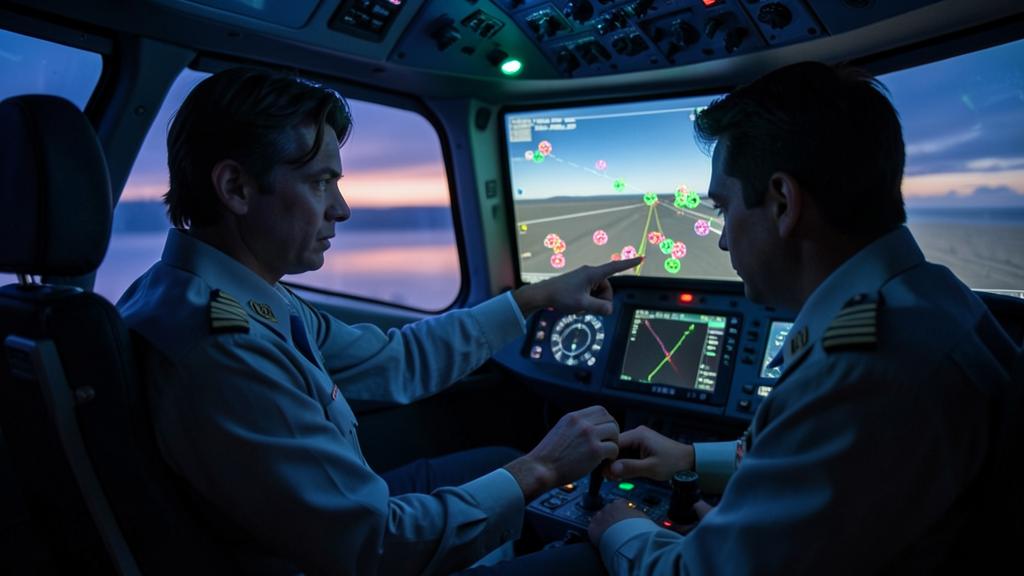
Only three outcomes. The error is detected, called out, corrected: the chain stops, and the episode demonstrates that monitoring works — the flight comes out of it safer, not less so. The error is not detected but remains without consequence: nothing shows, except to the instructor, who records that no barrier played its part. The error produces an undesired state — speed, configuration, altitude, position — and the register changes: it is no longer a matter of correcting, but of recovering, with whatever time and energy the phase of flight still allows.
From this gradation follows a hierarchy that every instructor applies, whether he formulates it or not. It explains why a sector containing several well-managed errors can conclude favourably, whereas a sector with no visible error but flown without call-outs or cross-checking leaves a lukewarm report.
| What is observed | What it demonstrates | Weight in the record |
|---|---|---|
| Handling error detected and called out by you | The monitoring loop works | Slight, sometimes favourable |
| Error corrected without being called out | Indistinguishable from a non-detection from the other seat | Unfavourable, on communication |
| Error detected by the instructor alone | No barrier played its part on your side | Notable, on situation awareness |
| Procedural deviation taken on and stated as such | A rule was knowingly set aside | Heavy: compliance is not a variable |
| Debriefed point that comes back identical at the next sector | The feedback was not taken on board | Very heavy: a matter of receptiveness |
| Plan maintained despite contrary indications | Rigidity, not mastery | Heavy: decision making and management of information |
| Go-around on a criterion announced in advance | The decision was prepared, not endured | Favourable |
The trap of the silent correction. Detecting your own error and correcting it without saying anything looks professional: the result is clean, nobody has been disturbed. Yet it is the manoeuvre that costs the most during line training, because it deprives the crew of the information and the instructor of the evidence. Seen from the adjacent seat, an uncalled correction is indistinguishable from an undetected error: the two look exactly alike on the controls, and in the absence of a call-out, it is the second reading that will go into the record.
Verbalise the doubt before resolving it. “doubt about the altitude constraint, reading it again” is not an admission of weakness, it is an observable behaviour, graded favourably in several competencies at once: situation awareness, communication, workload management. A candidate who announces his uncertainties in real time gives the instructor something to grade; a silent candidate leaves only the result, which is far poorer information.
Three moments weigh more than the flight itself
The first is preparation. The instructor’s opinion begins to form before pushback, and what shows in the briefing room is not the quantity of work done but its relevance: having read the items tolerated under the minimum equipment list and having drawn the operational consequences, knowing the particularity of the destination airfield, knowing what fuel is being carried and on the strength of which assumption. Conversely, reciting data that nobody asked for consumes the briefing time and signals a difficulty in setting priorities, which will show up again on the approach.
The second is the approach briefing. The exercise does not consist in reciting the chart, it consists in sorting: what is different today, what may not work, what will then be done, and at what moment the decision will be taken. A briefing that states a criterion and a threshold — such a configuration reached at such a height, failing which a go-around — turns a future decision into a simple observation. That is exactly the object of the manoeuvre, and it is what distinguishes a useful briefing from a recitation.
The third is the debriefing, and it is the one candidates underestimate most. Stating the two deviations of the sector yourself, in order of importance, before they are put to you, demonstrates a capacity for self-assessment that is worth, on its own, several sectors of progress: a pilot who sees his deviations will correct them without supervision. The reflex explanation — the wind, air traffic control, the workload, the colleague — produces the opposite effect: it places the cause outside, and suggests that no personal action will follow from it.
That leaves workload, which is not a moment but the underlying constraint. It is not constant across a sector: low in cruise, it peaks in the descent and on the approach, precisely where the available capacity of the pilot under line training is still reduced by the newness of the flight deck, of the route network and of the automation. What falls first when the margin runs out is always the same thing: the call-outs, the reading back, the expression of doubt — that is to say exactly what the instructor bases his grade on.
Move the work upstream. Everything that can be done before top of descent — briefing, calculations, selections, examination of the fallback option — is margin given back at the moment when it will be missing. An instructor does not grade speed on the approach; he grades the ability not to arrive there saturated, which is played out long before, in the phase where workload is still low.
When line training is extended
The number of sectors written into the approved programme is a minimum, never a guaranteed duration. Extending the programme is a normal instrument, provided for by the operations manual, and not a sanction: it records that a competency is not yet at the required level and allocates the sectors needed. Confusing it with a failure produces exactly the stiffening that will prevent progress during the added sectors.
Operators have several levers, generally used in this order: additional sectors targeted at the competency concerned, a change of instructor, an extra simulator session on a specific point, then a progress review bringing together the training management. The change of instructor deserves to be understood for what it is: a calibration measure. Agreement between instructors is never perfect, standardisation reduces the spread without eliminating it, and having the same candidate observed by another pair of eyes protects the candidate as much as the operator.
There remains a grey area that nobody claims to have resolved: the variety of the sectors. A programme can run entirely on familiar airfields, in clear weather, with no failure, no diversion and no prolonged holding. The record will be spotless, and it will have demonstrated nothing about the competencies that count on the day the flight becomes complicated. That is why some operators impose a minimum exposure to specified situations, and why an experienced instructor often prefers one difficult sector half succeeded to three easy sectors flown perfectly.
Line training that is too smooth demonstrates nothing. Stringing together sectors without a rough edge builds neither the margin nor the evidence: at the first real diversion, neither the candidate nor the operator knows what will happen. If your programme unfolds without a single serious threat presenting itself, ask for in-flight scenarios yourself — open questions about a plausible failure, preparation of an alternate that has actually been studied. What you will not have met during line training, you will meet alone.
What to check in your own documentation
The principles set out here are shared; their implementation is not. Before the first sector, a few points deserve to be read in the operator’s operations manual rather than guessed at through successive debriefings.
- The competency framework used and its grading scale: how many levels, which one is expected at which point in the programme, and what is recorded after each sector.
- The minimum number of sectors, the share flown from each seat, and the conditions under which that number is increased or reduced.
- What triggers an extension, who decides it, and in what form it is notified to you.
- How the end of line training connects with the line check: who conducts it, what it verifies, and what it does not verify.
- The rules for resuming after an interruption — leave, absence, season — and the duration beyond which refresher sectors become mandatory.
- How long sector reports are kept and how accessible they are, in particular when changing operator.
For anyone preparing a type rating, these elements also change the way to work upstream: the competency framework used on the line is the same as the one used in the simulator, which means that the expected behaviours can be installed from training onwards, before operational pressure makes their acquisition costly. Verbalising, setting priorities, announcing a decision criterion: none of this can be improvised at the eighteenth sector. The corresponding courses and programmes are detailed over on the training pathways, and practice from one operator to another is usefully compared among peers.
This text describes assessment mechanisms common to most operators; it does not replace any binding document. The applicable regulations and your operator’s approved documentation, the operations manual and the training programme first among them, prevail in all circumstances over what is written here.
Questions fréquentes
How many errors can be made during a line training sector without compromising your record?
The question is badly framed: the frameworks do not count errors, they look at where the chain stops. A sector containing several errors that were detected, called out and corrected demonstrates that monitoring works and often concludes favourably. Conversely, a single undetected error that ends in an undesired state of flight path or of energy weighs more than five well-managed deviations.
Should you call out an error you have already corrected yourself?
Yes, without hesitation. From the adjacent seat, a silent correction looks exactly like an undetected error: the controls move the same way in both cases. In the absence of a call-out, it is the least favourable reading that will go into the report, and the crew will in addition have lost information useful for the rest of the flight.
Is a go-around during line training held against you?
No, and it is frequently graded to the candidate’s advantage when it proceeds from a criterion stated in the briefing and held to without negotiation. What is assessed is the quality of the decision and its execution, not the fact of having landed on the first attempt. An approach continued outside the announced criteria produces a far heavier report than a clean go-around.
What does an extension of the line training programme mean?
It records that one or more competencies are not yet at the required level and allocates the additional sectors needed, in accordance with the arrangements laid down in the operations manual. It is not a sanction and it does not prejudge the outcome of the programme. It most often comes with targeted objectives, sometimes with a change of instructor intended to obtain a second view of the same progression.
Why is the instructor changed in the middle of a programme?
Because agreement between instructors is never perfect, even under standardisation: two observers may attach the same deviation to different competencies. Having the candidate observed by another instructor serves as calibration and protects both parties. It is also a way of exposing the candidate to another way of conducting the flight, which is part of what the line has to teach.
How can you prepare usefully before the first sector?
By working on behaviours rather than on knowledge, which is assumed to be acquired by this stage. In concrete terms: being able to state a plan and its decision criteria before needing them, verbalising your uncertainties, preparing the high-workload phases well in advance, and practising self-debriefing by listing your own deviations before they are put to you. These behaviours are the ones the competency grid observes.


Leave a Reply
You must be logged in to post a comment.