
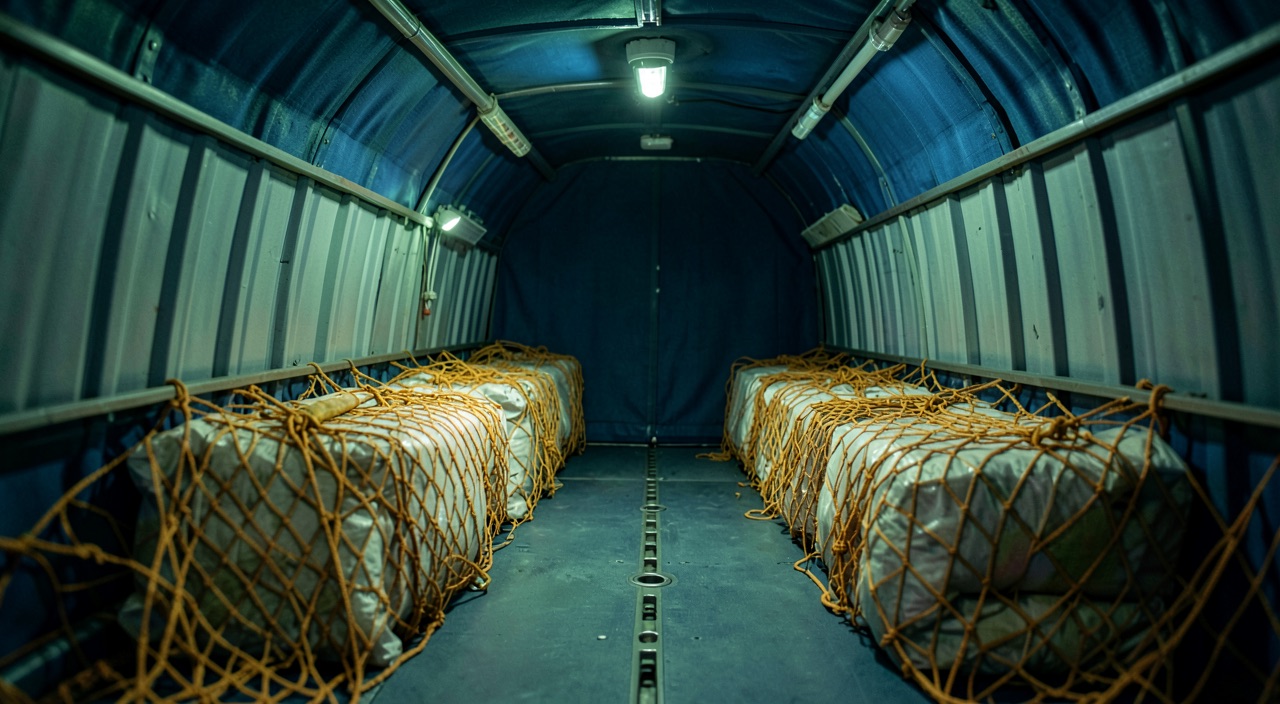
A pallet declared as « machine parts, » a hurried forwarder, an air waybill mentioning nothing out of the ordinary, and an operator whose operations specifications carry a « dangerous goods » line left blank: the ramp agent calls to ask whether he should load it. The answer is not found on the air operator certificate, nor in an approval that was never applied for. It is found in a chapter of the operations manual that many draft believing they are disposing of the subject once and for all, and which is precisely the chapter the authority opens first.
What the authority approves when it approves the carriage
The approval to carry dangerous goods is not granted on an intention; it is granted on a demonstrated chain. The authority does not check that the operator can recognise a Class 3 substance: it checks that the operator has, end to end, an acceptance procedure backed by a checklist, personnel trained and assessed at every post that touches the consignment, segregation and loading rules, written notification to the pilot-in-command, an occurrence-reporting arrangement, and in-flight response instructions. The approval itself is no more than a line in the specifications annexed to the certificate; the real substance of the authorisation lies in the manual that accompanies it.
This authorisation is bounded, and its boundaries come less from the wording than from the file submitted. An operator can be approved for all-cargo aircraft and not for passenger aircraft, for certain classes and not others, with or without radioactive material, at certain stations only — because the capacity for storage, segregation and response exists only where it has been demonstrated. An approval must therefore always be read together with its limitation. The useful question is never « are we approved? » but « for what scope, at which stations, with what response capability? »
One must also accept an obvious point of vocabulary: the operator is not the shipper. Classification, approved packaging, marking, labelling and declaration are the shipper’s responsibility; the carrier accepts or refuses, and its liability rests on verification, not on preparation. This division explains why the acceptance checklist is such a formal document: it is proof that the carrier did what fell to it, and nothing more.
The approval is not just a yes/no decision. It’s a detailed check that the operator can handle dangerous goods safely at every step, from acceptance to in-flight response. The approval has limits—like only certain aircraft types or stations—based on what the operator can actually do.
An airline approved for Class 3 (flammable liquids) on cargo flights but not on passenger flights must ensure its manual and training cover only cargo operations. If a Class 3 shipment arrives for a passenger flight, the answer is clear: refusal, because the approval doesn’t cover it.
Declaring that you do not carry only closes one door
An operator is entirely free to decide not to apply for the approval. Declared dangerous cargo is not its business, the investment in training and station resources does not pay for itself, the decision is sound, and the authority accepts it without argument. What it does not produce is an exit from the regime. It closes one door — that of cargo accepted as such — and leaves every other one open, because dangerous goods do not come on board solely through the cargo counter.
Passengers’ and crew members’ baggage and personal effects bring some, within the limits of the table devoted to them. On-board equipment contains some by construction: chemical oxygen generators, fire extinguishers, life-raft inflation devices, batteries, pyrotechnic slide-inflation cartridges. Spare parts carried in the hold for a station repair are no longer installed equipment but a consignment, with the regime that goes with it. Catering brings aerosols, alcohol, sometimes dry ice on board. In-flight medical assistance falls under the same body of rules. And mail comes in through a channel where the operator does not see the parcels one by one.
Each of these flows is the subject, in the technical instructions, of a bounded exception rather than an exemption. The exception applies under precise conditions: quantity, packaging, position on board, crew information, sometimes the operator’s prior approval. A non-approved operator is therefore not an operator outside the subject: it is an operator that lives entirely within the regime of exceptions, that is, in the part of the text easiest to apply wrongly, for lack of a form to bring it to mind at every consignment.
Verifying a declaration, or detecting its absence
The practical difference between the two regimes fits in one sentence, and it is not the one you would expect. The approved operator carries out a task of verification: a consignment presents itself with a shipper’s declaration, marked packaging, labels; the agent compares, ticks, accepts or refuses. The task is bounded, equipped with tools, traceable, and it can be taught. The non-approved operator carries out a task of detection: nothing presents itself, everything is concealed, and one must suspect from weak signs — a shipper’s trade name evoking chemistry, a vague description, a weight that does not match the volume, a reused original box, a house move, diving, camping, laboratory or scientific-shipment equipment.

Detecting an absence costs more, cognitively, than verifying a presence, and no checklist does it for you. This is why the authority, at an operator that declares it does not carry, takes no interest in the acceptance chapter: it takes interest in the training of those who look, the questions they ask the shipper, the trace of what they have refused, and the path a refusal takes to the occurrence report.
| Area | Operator approved to carry | Operator declaring it does not carry |
|---|---|---|
| Acceptance of declared cargo | Approved procedure and checklist, agent trained and assessed | Not applicable: the declared consignment is refused as a matter of principle |
| Detection of undeclared consignments | Required, in addition to acceptance | Required, and has become the main barrier |
| Training of personnel involved | Full programme, including the acceptance module | Programme without acceptance, but deepened on detection, cabin and loading |
| Passenger information | Owed, before and during check-in | Owed, in the same terms |
| Goods carried by passengers and crew | Applies | Applies identically, including the operator’s approval |
| Operator’s material and spares | Handled within the acceptance procedure | Handled outside acceptance, therefore often nowhere |
| Written information to the pilot-in-command | Systematic for accepted consignments | Not applicable to cargo; information on exception-based loadings is settled in the manual |
| Occurrence reports | Owed | Owed, and they form the main monitoring signal |
| In-flight response | Instructions and resources sized to the approved scope | Required for the cabin incident: battery, aerosol, smoke from a personal item |
| Operations manual chapter | Approved, detailed, kept up to date | Also required, and it is the first document opened in audit |
Reading the table often surprises the practitioner: out of ten lines, only one truly disappears. The rest changes shape, not nature. The non-approved operator saves an acceptance procedure and inherits a duty of vigilance that, itself, cannot be equipped with a form.
The operator’s own material, the most costly grey area
The most frequent point of failure for a non-approved operator is not a customer’s cargo: it is its own material. A mounted wheel, a battery, a fire extinguisher, an inflation device, a chemical oxygen generator, a can of cleaning product, a toolbox with an aerosol at the bottom: all of it moves between bases, shipped by people who do not think of themselves as shippers and who have never filled in a declaration. The parcel is not cargo in their mind; it is in the text.
The modern doctrine on this subject does not come from a declared-cargo accident. It comes from a load of chemical oxygen generators shipped as company material, declared « empty, » without approved packaging or declaration, in the hold of a passenger aircraft. The word « empty » is not a regulatory state: an unfired generator remains a source of intense heat, a container declared emptied remains under pressure until its purge is attested, a flat battery remains a battery.
The exception authorising the carriage of aircraft equipment and spares exists, but it is conditional, and its conditions are demonstrated by documents that maintenance does not produce spontaneously: identification, condition, packaging, quantity, position on board, information. An operator that has not put in writing who authorises an internal shipment, on what basis and with what trace, maintains a permanent grey area between its store and its stations — the only one where it is both shipper and carrier, hence responsible for both ends of the chain.
The « empty » and « unserviceable » trap. A component removed and shipped for repair remains what it is: an unfired generator, an unpurged extinguisher, a pressurised shock absorber, a battery even when discharged. The unserviceable tag changes nothing about the classification, and the word « empty » has value only if a certified purge accompanies it. It is through this door, left open between the workshop and the ramp, that non-approved operators end up carrying undeclared dangerous goods: their own.
Just because a part is “empty” or “unserviceable” doesn’t mean it’s safe. A chemical oxygen generator, for example, can still produce heat even if unused. The operator must track these items as dangerous goods, even when shipping them internally.
An airline ships a used fire extinguisher between bases for maintenance. Without proper documentation (proof of purge, approved packaging), it’s an undeclared dangerous good. If caught in an audit, the operator faces penalties, even if the extinguisher was “empty.”
What comes on board through the cabin
The other half of a non-approved operator’s exposure lies in baggage. The table devoted to dangerous goods carried by passengers and crew members is not a tolerance: it is a regime, with its quantities, its mandated positions — cabin or hold — and its cases where the operator’s approval is required. That approval is a decision, which means someone at the operator must be designated to make it, reachable when the question arises, and know what they are ruling on.
Lithium batteries account for most of the exposure. The governing rule is simple and yet poorly applied: a spare battery or a power bank does not travel in the hold, it travels in the cabin, terminals protected against short-circuit. The thresholds are expressed in watt-hours; beyond the first, the operator’s approval becomes necessary, beyond the second the battery does not board. The trend observed in recent years, among several authorities as among operators, has been to also govern in-flight use — keep in view, no charging — because thermal runaway can only be dealt with if it is seen immediately.
Battery-powered mobility aids, electronic cigarettes, dry ice from a food parcel, a laboratory passenger’s samples, a can of spray paint brought back from a job site: none of this needs a cargo approval to be on board. All it takes is a quick check-in and a question that was not asked. An operator that does not carry dangerous goods therefore carries them every day — legally, as long as the regime of exceptions is respected.
The right reflex: ask by function, never by regulation. A shipper or a passenger rarely knows how to say « Class 9, » but knows how to answer « is there a battery, an aerosol, a flammable liquid, a magnet, a pressurised cylinder, a chemical product or a biological sample? » The closed question by category of use gets through where the regulatory wording fails, and its written trace serves as proof of diligence on the day something still gets through.
Training: who, in what, and until when
Training is the point where a declared refusal costs the most in credibility, because it is the first sample an auditor draws. The technical instructions have progressively moved away from classifying personnel by category in favour of a competency-based approach: a category is no longer trained, it is demonstrated that a person is capable of holding the function entrusted to them, with an assessment that proves it. For a non-approved operator, the consequence is clear: the programme loses the acceptance module and deepens on detection, passenger information, loading and cabin response.
The functions to be covered are more numerous than one might think: counter and check-in, ramp and loading agents, cabin crew, flight crews, security agents who screen baggage by imaging, store and maintenance staff who ship material, and the person designated to give the operator’s approval. Outsourcing ground handling does not transfer the obligation: the operator remains accountable for the qualification of those acting on its behalf and must be able to produce proof of it, which means collecting certificates rather than trusting a paragraph in a contract. Those preparing this component will find in the FL330 training programmes a useful entry point on building a competency-based programme.
Revalidation follows a bounded interval, set at twenty-four months under the common international regime, and the mechanics of the calendar trap more than the duration itself. A recurrent training completed late opens a period during which the person was not qualified: every act performed during that interval becomes contestable, including those that went well. It also pushes back the next deadline, so that an entire workforce becomes desynchronised over two or three cycles, and the tracking table stops saying anything usable.
The right reflex: tie the deadline to the assignment. A validity table that does not block the roster assignment is merely a record of a gap after the fact. Schedule recurrent training in the window before the deadline, never after, and make sure the expiry date automatically removes the person from the functions concerned — including at the ground handler, whose deadlines almost never appear in your own tool.
Wet lease, code share, ground handling: who holds the approval
The grey area appears as soon as several companies share a flight. The approval belongs neither to the aircraft nor to the ticket: it belongs to the operator conducting the flight under its own certificate. A dry lease places the aircraft under the lessee’s certificate, hence under its approval or lack of approval. A wet lease keeps the operation with the lessor: it is the lessor’s approval, manual and training, whatever commercial brand the flight carries.
Code sharing shifts the difficulty toward the commercial side. The carrier that sells is not the one that accepts, and a consignment sold under the code of an approved carrier does not become acceptable because it is loaded on a flight operated by a carrier that is not approved. As for ground handling, it executes a procedure: it still has to be specified in the contract which one, at what level of qualification, and who receives the report when a consignment is refused.
| Arrangement | Applicable approval | Training under the responsibility of | Observed point of failure |
|---|---|---|---|
| Dry lease | The lessee’s, who operates under its own certificate | The lessee | The lessor’s documentation stays on board and contradicts the lessee’s procedure |
| Wet lease | The lessor’s, who remains the operator | The lessor | The station applies the commercial principal’s procedure |
| Code share | The flight operator’s | The flight operator | Consignment sold under an approved code, loaded on a flight that is not approved |
| Outsourced ground handling | The operator’s, unchanged | The operator, who must hold the proof of it | Qualification obtained on behalf of another client, hence another scope |
| Mail and express freight | The flight operator’s | The operator | The channel does not present parcels one by one for acceptance |
The ground-handling contract trap. A ground handler « trained in dangerous goods » is trained under another client’s programme, often an approved one, and it then applies an acceptance procedure that is not yours. Two opposite effects follow: a declared consignment can be accepted on your flight in the name of a procedure that is not yours, and a refusal may never reach you, hence never become a report. Name the applicable procedure and the recipient of the report in the contract, or your system stops at the station door.
What you need to go and open in your own documentation
Three checks are enough to place a non-approved operator. The first: does your manual say what you do, or what you do not do? A chapter that reduces to « the operator does not carry dangerous goods » is a statement left pending. One that holds up names the person authorised to give the operator’s approval, describes the question put to the shipper, the response to a refusal, the reporting circuit, and the handling of internal shipments between bases.
The second: does proof of qualification exist for the functions you do not manage yourselves — ground handler, security, store, maintenance subcontractor? The third: how many refusals and undeclared consignments have you logged over the last period? Zero is not a good number. An operator that never refuses anything does not prove that nothing turns up; it proves that no one is looking, and that is exactly how the inspector will read it, as the exchanges between acceptance practitioners report.
For anyone preparing a qualification or changing operator, one consequence is worth knowing: dangerous goods training is not attached to the licence but to the operator and the function, and it does not transfer from one company to another, however recently earned. The grey area that will remain does not get solved by training: it is the one of e-commerce, where the shipper is a private individual who knows nothing about the subject, where the parcel passes through several intermediaries, and where the operator has in front of it only a generic description and a barcode. That is where the next tightening will play out, and it is already where most of the batteries that should never have boarded are found.
This article describes mechanisms, not an applicable procedure. The technical instructions in force, the regulations of the authority you fall under, and your operator’s approved documentation prevail over everything above, including where they are more restrictive.
Questions fréquentes
Can a non-approved operator carry dangerous goods?
Yes, and it does so every day: those belonging to passengers and crew, on-board equipment, certain aircraft spares, cabin supplies and in-flight medical assistance fall under exceptions governed by the technical instructions. What it cannot do is accept a cargo consignment presented as dangerous goods. The difference lies in the acceptance flow, not in the presence of such material on board.
Must personnel be trained even when the operator declares it carries nothing?
Yes, and the programme is not shorter, it is different. It loses the acceptance module and deepens on detecting undeclared consignments, informing passengers, goods admitted in the cabin and the in-flight response. The functions to be covered range from the counter to the store, including security and ground handling, for which the operator remains accountable.
Is material shipped between our own bases cargo?
In the text, yes: a component removed and shipped leaves the regime of installed equipment and becomes a consignment. The exception applicable to aircraft equipment and spares exists, but it is conditional and is demonstrated by documents. A fire extinguisher, an oxygen generator, a shock absorber or a battery labelled “empty” do not change classification because they carry an unserviceable tag.
Under a wet lease, which approval applies?
The lessor’s, since it is the lessor that operates the flight under its own certificate. Its procedure, its manual and its training govern acceptance and loading, whatever commercial brand the flight is sold under. Under a dry lease, the situation is reversed: the lessee operates, so its approval, or lack of approval, applies.
What should be done with an undeclared consignment discovered after loading?
The parcel is offloaded, the discovery is logged, and it gives rise to an occurrence report to the authority as well as to the internal management system. This obligation does not depend on approval: it rests on every operator. An operator that never reports any discovery does not demonstrate a clean flow: the inspector reads it as an inactive barrier, and will then look for what got through unseen.
Can a power bank travel in checked baggage?
No: spare batteries and power banks travel in the cabin, terminals protected against short-circuit, so that thermal runaway is seen and dealt with immediately. The thresholds are expressed in watt-hours, with an intermediate band requiring the operator’s approval and a ceiling beyond which the item does not board. Several operators also govern in-flight use and charging.


Leave a Reply
You must be logged in to post a comment.