

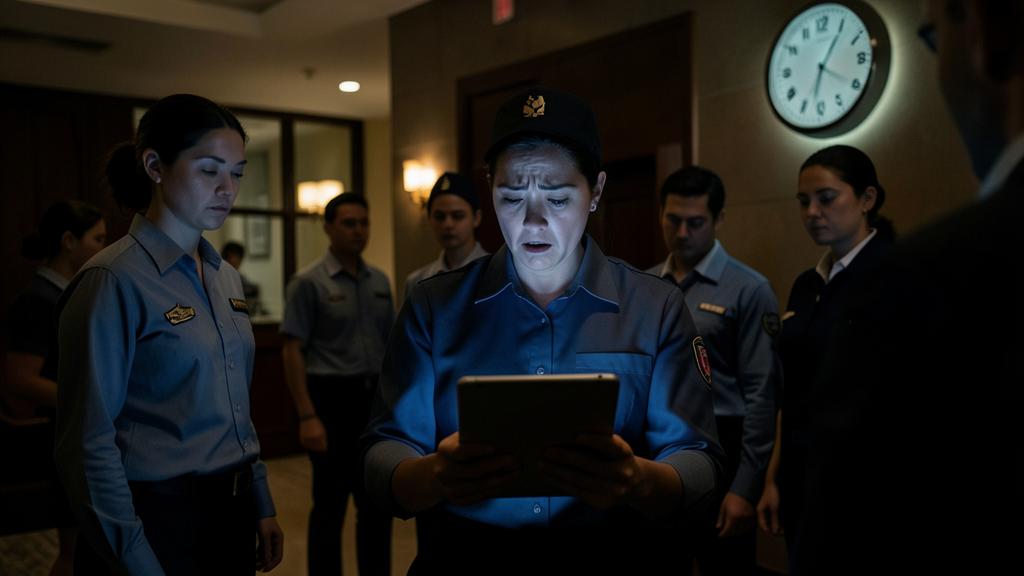
The return flight leaves at 6:10 a.m. The evening before, in the hotel lobby, the cabin crew manager runs back through her crew’s due dates and lands on one: a crew member’s periodic training expires at the end of the month — that is, tonight. No one at the outstation has the power to renew it, no one has the power to extend it, and the aircraft must depart with a complement that regulation fixes down to the seat. What is at stake in the next four hours is not a question of validity — it has lapsed, the debate is closed — but a question of margin, of function, and of who actually holds a decision.
What lapses, and at exactly what time
Three items govern a cabin crew member’s right to occupy a safety post, and none of them lapses the same way. The certificate of safety training does not expire on its own: it takes an act by the authority, or inactivity counted in years. The aeromedical assessment runs from an examination date, so it can expire on any day of the year, including a Tuesday at 4 a.m. on the other side of an ocean. Periodic training and checking, for their part, are most often expressed in calendar months: their due date falls at the end of a month.
This last convention produces a consequence that duty rosters suffer without ever naming it. If periodic validities fall at the end of the month, the exposed rotations are always the same ones: those that spend the last night of the month away from base. On a long-haul programme, that amounts to a few rotations a month, all identifiable weeks in advance — and yet the case is most often discovered on the spot, once the crew is at the hotel.
That leaves the hour. A validity that expires “on the 31st” expires at what precise instant, and in which time reference? Approved documentation may say so, or may not, and the ambiguity is then paid for at 2 a.m., at an outstation several hours off base time, during a duty period that begins before midnight and ends after it. The point is not academic: a duty period straddling the final date of validity is not treated identically by every operations manual, and that is something read cold, not settled over the phone.
The key issue is that different qualifications expire at different times, and the exact moment matters. Some expire at midnight, others at the end of the duty period, and this can cause confusion when flights are delayed across the deadline.
An Airbus A330 with 250 seats requires 5 cabin crew members (1 per 50 seats). If one crew member’s validity expires at 11:59 PM on the 31st, but the flight is delayed and lands at 12:30 AM on the 1st, the crew is now one short. Without a replacement, the flight cannot depart until a solution is found.
Why the deadline is discovered at the outstation and not on the roster
Qualification control is not continuous. It is exercised when the roster is built, then when it is published, and it bears on the rotation as planned. After that, the rotation lives its own life: a delayed departure, a diversion, a technical stop, a hotel night that runs long, a crew swap decided on the spot to save another flight. Each of these changes produces a duty that the qualification engine has never seen, or has seen on a different date.
The mechanism never varies: coverage was checked against an object that no longer exists. The roster guaranteed a qualified crew returning on the 31st; the crew returns on the 1st. Nothing was breached at the moment of publication, and no one was warned the instant the guarantee stopped being true.
A second case, more irritating, arises almost as often: the validity has not lapsed — it is its record that is missing. The check was completed, the instructor signed it off, but the entry was never made — or it was made in another group entity’s file. From the operator’s standpoint, the gap is the same, because what it must be able to prove is not the competence but the file. At the outstation, a dated document held by the crew member concerned settles the matter in ten minutes; without it, operations must treat the case as a lapsed deadline.
A little-used convention nonetheless makes most of these nights avoidable. Training or a check retaken early, within the window the documentation allows before the deadline, is generally credited from the original expiry date rather than from the date it was retaken: acting early therefore consumes no validity at all. The common objection — that retaking it too early would waste months — does not hold, and it is costly, because it pushes everyone toward the very end of the window. On rotations identified as spending the last night of the month away from base, moving the check forward by a few days removes the problem at its root, at zero cost in validity duration.
The trap. A qualification check does not replay itself when the rotation changes. A diversion, a technical stop, or an extended night decided on the spot produces a duty that has never been checked against the crew’s deadlines. Any flight pushed past midnight, at month-end, should trigger an explicit recount of validities: it is the last moment at which action is still possible without grounding the aircraft.
Minimum crew complement decides more than the date does
The right question is never “has the validity lapsed”. It has, and no one on the spot can do anything about it. The question is: can the aircraft depart without counting this person in the safety complement? Everything turns on that, and on nothing else.
Minimum cabin crew complement follows the more restrictive of two calculations. The first is arithmetic: for aircraft with a passenger configuration exceeding nineteen seats, the European rule requires one cabin crew member for every full or partial block of fifty installed passenger seats on a single deck. The second comes from type certification and the cabin layout, through the complement retained during the evacuation demonstration, which may be higher. The operator never goes below whichever of the two is higher.
Yet many flights carry crew above this minimum, for service reasons rather than safety ones. This margin is the real variable. With one unit above the minimum, losing one validity degrades the service and blocks nothing. Without margin — the ordinary situation on dense layouts, where the commercial crewing is set exactly at the rule — the same deadline grounds the aircraft.
A second lock closes where it is least expected: the function. The senior cabin crew member is not just one more unit in a headcount; the appointment requires specific experience and training, and not everyone on board can take it over. A numerically over-complemented crew can therefore still be grounded by the sole loss of whoever held that function, if no one else holds it on that flight. Both things must be checked, and in this order: the number, then the functions.
A third lock closes on the positions themselves. The minimum complement is not a floating headcount: it is distributed across assigned cabin positions, each tied to specific exits and specific evacuation duties. Removing one person is therefore not solved by shifting the remaining crew forward; the layout that remains must stay the one the operations manual specifies for that configuration. This is the detail that defeats improvised outstation arrangements: the count is right, but the position map no longer is.
Four ways back into service, and what each one costs
| Route | Opening condition | Who authorises it | What it costs |
|---|---|---|---|
| Departure with unchanged complement, the crew member concerned travelling as an extra passenger | At least one unit above the minimum complement, and all functions covered by the others | Crew scheduling, carried out by the commander | Degraded service, no delay |
| Operation with a reduced complement | Unforeseen circumstance, procedure described in approved documentation, corresponding reduction in the number of passengers, report to the authority after the flight | Operations, with the accountable manager concerned | Passengers disembarked and rerouted, delay of roughly an hour |
| Positioning a replacement | Available member, qualified on the type and for the function, whose duty period remains usable on arrival | Crew scheduling | At least one rotation’s worth of delay, base reserve consumed |
| Ferry flight without passengers | No passengers carried, so the cabin complement requirement no longer bites, subject to the operator’s own rules | Operations | Entire flight postponed, all passengers to be rerouted |
- Departure with unchanged complement: The crew member travels as an extra passenger, service is degraded, but no delay occurs.
- Operation with a reduced complement: Passengers are disembarked and rerouted, causing a delay of about an hour.
- Positioning a replacement: A qualified crew member is brought in, but this causes at least one rotation’s delay and consumes base reserves.
- Ferry flight without passengers: The flight is postponed entirely, and all passengers must be rerouted.
These four routes are not equal in delay, and the ranking is counter-intuitive: the fastest is the one that changes nothing about the aircraft, the slowest is the one that involves bringing someone in. A replacement does not teleport; they arrive with a duty period already eaten into by the flight that brought them, and that period sometimes limits what they can do on arrival. The reasoning must therefore follow the order of the diagram, not the order of instinct.
What is not a route: requalifying on the spot. Periodic training and checking require an approved programme, an instructor or examiner appointed by the operator, and equipment — a door, a slide, live fire, a training cabin — that lives at the training centre and nowhere else. This is neither a matter of goodwill nor of connectivity: the practical component cannot be transported, and a validity is not restored by the theoretical component alone. For the aeromedical assessment, an approved examiner may exist in the outstation city, but the finding must still enter a recording circuit that does not close within a transit time.
Who decides what, and who decides nothing
The cabin crew manager observes and reports. A decisive role, and a strictly bounded one: they do not arbitrate, they do not locally reorganise functions to make the headcount work, they pass on a dated fact to operations. Any attempt to settle the matter informally turns a scheduling incident into a deliberate deviation, one that a file will show.
The commander holds authority over the flight and may refuse to depart. On this specific point, however, their power is purely negative: they can veto, they cannot grant a waiver. A crew member’s qualification is not theirs to decide but the operator’s, who issues it, maintains it, and records it.
Crew scheduling is the only body capable of producing a solution: it holds the files, the availabilities, the reserves, and the power to recompose. It is the one that knows whether a replacement exists, how much duty period will be left to them, and at what time they can be at the door. Operations, for its part, arbitrates between delay and reduced load — a commercial as much as an operational trade-off, which is why it does not belong to the outstation.
The accountable manager responsible for flight operations and crew training intervenes on everything touching approved procedures: it is through them that the reduced-complement route passes, and it is never an outstation decision. As for the authority, it does not intervene in the moment; it reads the report afterwards, and that is when the quality of the traceability produced during the night becomes apparent.
The right reflex. Three questions in the first ten minutes, in this order: which counter has lapsed, and does the person concerned hold a dated document that would prove otherwise; how many members remain above the minimum complement for the flight as crewed; which functions, starting with that of senior cabin crew member, remain covered by the others. These three answers, passed together to crew scheduling, save the rotation. Delivered one at a time as reminders trickle in, they cost the night.
Who bears the grounding
The visible cost is the aircraft stopped: the delay, the accommodation, the rerouting, then the contamination of the following rotations, because an aircraft that misses its return slot also misses the flight it was due to continue into. The invisible cost lies elsewhere: a reserve consumed at base, a replacement who arrives with a duty period already eaten into and who will not depart again immediately, a roster that distorts itself over several days.
Toward passengers, the allocation is clear-cut. Crew member unavailability is classed, in the settled reading of the European courts, as part of the operator’s normal business activity, not as part of the extraordinary circumstances that exempt from liability: the European regime of compensation and assistance therefore applies in full. An operator cannot shift this cost onto the crew member concerned, whatever share of individual negligence is involved.
Internally, the reading is more nuanced. Operations documentation generally requires a crew member not to report for duty if not qualified: monitoring one’s own deadlines is therefore also their responsibility, alongside the operator’s own system, not in its place. The disciplinary line does not run between the one who let a date slip and the one who did not see it. It runs between the one who reported it and the one who, having seen it, chose to depart hoping no one would recount.
What to go and check in your own documentation
Everything above can be read cold, in eight points, and verified within an hour using documents everyone already has.
- The time reference that governs a deadline date, and the fate of a duty period straddling midnight on the last day of validity.
- Whether approved documentation includes a reduced-complement operating procedure: without it, this route does not exist, however urgent the situation.
- The alert chain from an outstation at night: who answers, on what number, and who has the authority to engage one of the four routes without waiting for offices to open.
- Whether a new qualification check is triggered when a rotation is rescheduled: automatic, on request, or not at all.
- The crediting rule for a check retaken early: does it run from the original deadline or from the date it was retaken, and within what window before the deadline.
- The recording rule for training completed outside the usual centre or within another group entity, and the actual delay before the file is updated.
- The conditions for appointing the senior cabin crew member, and how many people, in a typical crew, can hold that role.
- For a flight operated under a wet lease, which documentation governs the complement and the deadlines: that of the contracting carrier or that of the actual operator.
Two grey areas resist this exercise. The first is secondment between entities of the same group: since adaptation training is specific to the operator, its recognition from one entity to another depends on agreements and manuals that do not resemble one another, even under a single commercial brand. The second is a duty that begins before the deadline and continues after it: the literal reading and the operational reading diverge, and only documentation that settles the point explicitly protects the crew from a discussion held at 2 a.m. Outstation feedback on these two points circulates on the FL330 forum.
For anyone preparing a qualification or building an application file, there is a direct corollary. A lapsed validity leaves a mark in the training file, and that mark never says by itself whether the fault lies with scheduling or with a person. The only real defence is material: keep one’s own dated documents — certificates of completion, check reports, convocation correspondence. What one can produce oneself is worth more than what one will have to request from a former employer.
This article describes mechanisms and has no normative value. The applicable regulation, the decisions of the competent authority, and the operator’s approved documentation — operations manual, outstation procedures, training programmes — prevail in all circumstances over what has just been written.
Questions fréquentes
Does a validity that expires during the outstation stopover prohibit the return flight?
It only prohibits counting the person concerned in the safety complement. If the crewed complement includes at least one unit above the flight’s minimum complement and all functions remain covered by the others, the aircraft departs on time and the person concerned returns as an extra passenger. Without that margin, or if the function lost is that of senior cabin crew member and no one else holds it, the flight cannot depart in its planned configuration.
Can the commander authorise departure despite the deadline?
No. Their authority over the flight allows them to refuse to depart, never to grant a qualification waiver. The issuance, maintenance, and recording of crew qualifications belong to the operator, and no decision taken on board recreates a lapsed validity. On this specific point, the commander’s power is a veto, not a signature.
Can the aircraft depart with one cabin crew member fewer than the minimum?
Only if the operator’s approved documentation describes a reduced-complement operating procedure, and only under the unforeseen circumstances it addresses. This procedure requires a corresponding reduction in the number of passengers carried and a report to the authority after the flight. If no such procedure exists in the manual, this route is not open, however commercially urgent the situation.
Why not simply retake the periodic check on the spot?
Because the practical component cannot be transported. Periodic training requires an approved programme, an instructor or examiner appointed by the operator, and training equipment — a door, a slide, live fire — that remains at the training centre. The theoretical component alone does not restore a validity, and no local arrangement replaces going through this equipment.
Who bears the cost of the delay toward passengers?
The operator. Crew member unavailability falls under the normal conduct of its business, not under the extraordinary circumstances that exempt it from the European compensation and assistance regime. This cost cannot be shifted onto the crew member concerned, even when that member’s own monitoring of their deadlines has failed.
How can this situation be avoided on an end-of-month rotation?
By recounting validities at the moment the rotation is disrupted, not only when it is published. Periodic validities expressed in calendar months fall at the end of the month, so the at-risk rotations are exactly those spending the last night of the month away from base, and they are identifiable weeks in advance. Any flight pushed past midnight within that window justifies an explicit check before the crew leaves the hotel.


Leave a Reply
You must be logged in to post a comment.