
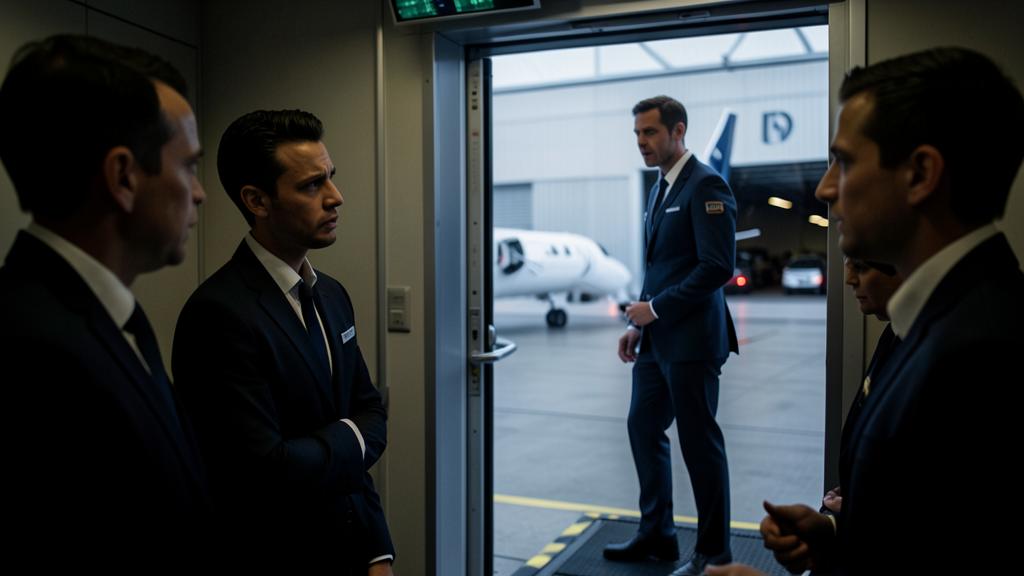
“A passenger stands up while taxiing to grab a bag from an overhead bin: what do you do?” The question comes about twenty minutes in, in a conversational tone, and half the candidates answer it as if it were a question about hospitality. The board, for its part, has just asked a safety question disguised as a service question, and what it is really listening for is the point in the story where the candidate stops improvising.
“What would you do?” Is Not a Question About Being Nice
Recruiting cabin crew does not select a customer-service profile who can also handle safety on the side. European air operations regulation builds the opposite: a cabin crew member is assigned to safety and security duties, under the authority of the commander, and the minimum cabin crew complement is calculated on the number of passenger seats installed — one crew member per block of seats, roughly fifty under the European rule — never on the level of service being sold. Service is what is done with whatever time is left over.
A selection board knows this, and its grading grid follows from it. Under in-house headings, it reuses the non-technical competencies that crew resource management training will keep working on for an entire career: situational awareness, decision-making, communication, cooperation and authority, workload management. The role-play scenario is simply the cheapest instrument for observing them. Five sentences are enough to create a real constraint, with no simulator and no training cabin.
Hence a misunderstanding that costs candidates dearly. The candidate believes there is a right answer expected of them; they cannot have it, since it is written in an operations manual they have not yet read and which differs from one operator to another. What the board is listening for is the path taken: which elements are picked up on, in what order, at what point the candidate gives up an elegant solution in favour of applying a rule, and at what point they instead own a decision that no rule covers.
The board isn’t looking for a perfect answer—they’re testing how you think. They want to see if you can spot the real problem, follow safety rules, and explain your decisions clearly. It’s not about being nice; it’s about being safe and smart under pressure.
On an Airbus A320 taxiing for takeoff, a passenger stands up to retrieve a bag. The correct response isn’t just politely asking them to sit—it’s quickly assessing the flight phase (taxiing), the crew’s availability (likely strapped in), and the deadline (seconds before takeoff). A strong answer would say: “I’d immediately instruct them to sit, explain the safety risk, and notify the cabin manager if they refuse, as we’re in a critical phase.”
Three Layers in Every Scenario
A properly written scenario stacks three layers, and candidates often deal with only one of them. The first is the triggering fact: someone stands up, a light stays on, a passenger turns pale. The second is the contextual constraint, almost always slipped into a subordinate clause: the flight phase, the crew complement present in the cabin, the position of other crew members, the turnaround time. The third is the deadline — that is, the time the candidate actually has before the situation changes in nature.
Let’s go back to the bag scenario. The fact: a person standing, cabin not secured. The constraint: the aircraft is taxiing, the crew is seated or finishing its check, no one has room to move. The deadline: a few seconds, before line-up. Answering “I kindly explain that they must sit back down” addresses the fact, ignores the constraint and says nothing about the deadline. The answer is not wrong, it is incomplete — and that is precisely what the grid is designed to measure.
Latitude for Initiative Is Not Constant
What the grid calls judgement almost always comes down to a single quantity: the latitude a crew member has at the moment in question. It is not the same from the start to the end of the flight. During critical phases — defined by the operations manual, and typically tied to an altitude threshold below which non-essential communications cease — that latitude drops to zero. The cabin is secure, the crew is strapped in, and any individual initiative degrades a state that was checked only seconds earlier.
The difficulty is that demand for service does not follow the same curve: it peaks at boarding and on arrival — exactly where latitude is lowest. A board chooses its scenarios from these two troughs, because they force the candidate to make a call rather than reconcile everything. An answer that promises both passenger satisfaction and full compliance with securing the cabin has failed to grasp that the situation is built to rule out both.
This variable latitude explains a requirement candidates mistake for rigidity. The evacuation demonstration required to certify a transport aircraft is carried out using only some of the usable exits and within a capped time of roughly ninety seconds. Anything left lying in an aisle, anything not stowed, anything that delays a crew member’s order eats into that margin. The board does not expect the candidate to know this requirement; it expects them to reason like someone who knows that securing the cabin is a state, not a formality.
What the Grid Actually Records
Grids vary from one operator to another, but they converge on one point: they score observable behaviours, not character traits. No one ticks “likeable.” What gets ticked is what the candidate mentioned, in what order they mentioned it, and what they explicitly decided not to do. The table below sets the intention the candidate displays against the trace it actually leaves.
| What the candidate believes they are demonstrating | What the grid records | Observable indicator |
|---|---|---|
| Empathy | Situational awareness | Contextual elements mentioned spontaneously: phase, crew complement, position of other crew |
| A service mindset | Prioritisation | The order of actions, in particular what is dealt with before reassuring |
| Authority | Communication | The wording addressed to the passenger, and above all the wording addressed to the crew |
| Experience | Transfer | What is carried over from a previous job and what is explicitly set aside |
| Availability | Workload management | What the candidate agrees not to do, and to whom they delegate it |
The right-hand column is the one that decides. Two candidates can reach the same conclusion — the passenger sits back down — and receive two opposite scores, because one described a cabin and the other a conversation. Saying “there are two of us in the rear cabin, my colleague is already strapped in” takes no more than three extra seconds, and fills three boxes.
The trap: answering “I’ll notify the cabin manager” to every family of scenario. Escalation without prior assessment is not a decision, it is a hand-off; the board follows up by removing that contact — “they’re busy up front” — and the candidate has nothing left. The mirror-image fault is equally disqualifying: handling on one’s own a situation that falls outside routine without telling anyone, because an initiative that is not announced deprives the rest of the crew of information they will need if things get worse.
Four Families of Scenarios, Four Isolated Competencies
Role-play scenarios fall into a small number of families, and each isolates a different competency. Recognising them does not excuse a candidate from thinking, but it does prevent treating an equipment problem as an interpersonal one.
| Family | Typical scenario | What it isolates | Usual trap |
|---|---|---|---|
| Conflict between passengers | Two neighbours trade insults after a reclined seat back | Authority without escalating tension | Taking sides, or moving someone without thinking about the rest of the flight |
| Clinical sign | A passenger turns pale and sweats during service | Early warning and factual description | Making a diagnosis instead of describing signs |
| Equipment fault | An overhead bin no longer latches | Distinguishing an inconvenience from an item to report | Improvising a repair and logging nothing |
| Time pressure | Short turnaround, a passenger demands a service | Trade-off between punctuality and safety | Caving to the commercial pressure, or refusing without explaining |
All these families come down to the same trade-off, whose four cases the matrix below sets out. Does the rule cover the case, yes or no? Is there time available, yes or no? The expected answer is not the same in the four boxes, and a good scenario shifts the candidate from one box to another mid-story by adding a constraint partway through.
The right reflex: state the five stages out loud, in order, even when the situation looks trivial. “I observe this, the procedure states that, so I do this right away, I inform so-and-so, and I log it this way.” The formula sounds like something out of a textbook; it is in fact the only way to make visible a line of reasoning that would otherwise stay inside the candidate’s head — and a grid only scores what it hears.
Technical Questions Disguised as Service Questions
Some scenarios are about equipment, and they are formidable because they invite bluffing. Candidates are asked what they do if a passenger fiddles with the oxygen mask compartment, if a piece of emergency equipment looks out of place, if a seat no longer reclines back up. A candidate not yet trained obviously does not know the procedure; the board knows that, and is looking for something else: does the candidate know what they don’t know, and through which channel they will get it?
The answer that works is built in two steps. First, what can be observed and secured without any specific knowledge — keep people away, prevent use, keep it in sight. Then the explicit admission of the limit, paired with a source: “I don’t yet know the airline’s procedure on this point, I’ll look it up in the cabin manual and ask the cabin manager to confirm before I act.” Far from disqualifying the candidate, this sentence ticks the rarest box on the grid: the ability not to make things up. An entire crew relies on this discipline, since the items to be reported before the next flight depend on someone having said exactly what they saw.
The classic mistake, by contrast, is to invent a plausible-sounding procedure. It is spotted instantly by the board member who actually works the job, and it contaminates the rest of the interview: it now becomes necessary to wonder which of the earlier answers were made up as well.
The Group Interview Does Not Measure Sociability
The group phase fuels another misunderstanding. Many candidates treat it as a visibility test and talk in order to take up space. The observers, for their part, note functional roles: who restates the instructions before the group sets off, who keeps track of the time remaining, who seeks out the opinion of someone who has said nothing, who reopens a decision already made, and who, conversely, knows how to close one.
The link to real work is direct. In the cabin, collective effectiveness rarely comes from the most expressive person; it comes from the one who restates the objective out loud and checks that everyone has heard it — exactly what crew resource management training calls shared mental model. A candidate who, at the end of the exercise, sums up what the group decided and what remains open scores higher than a candidate who produced three brilliant ideas without anyone knowing which ones were actually adopted.
The most heavily penalised behaviour, incidentally, is not shyness but interrupting. It is visible, it is counted, and it raises the one question that matters to the board: will this person cut off a crew member who is passing on information in a degraded situation?
What Is Still Worth Checking Before the Session
Three things are worth preparing, and none of them consists of learning answers by heart. The first is the vocabulary of the flight phase: knowing how to name securing the cabin, critical phases, cabin check and debrief avoids describing an incident with the words of another trade. The second is reading what the operator publishes about its cabin organisation: crew complement per aircraft type and the breakdown of responsibilities are enough to anchor an answer in its context. The third is practising, in three minutes, telling a real professional situation that went badly and what was learned from it — boards almost always come back to this, and a success is less informative there than an analysed failure.
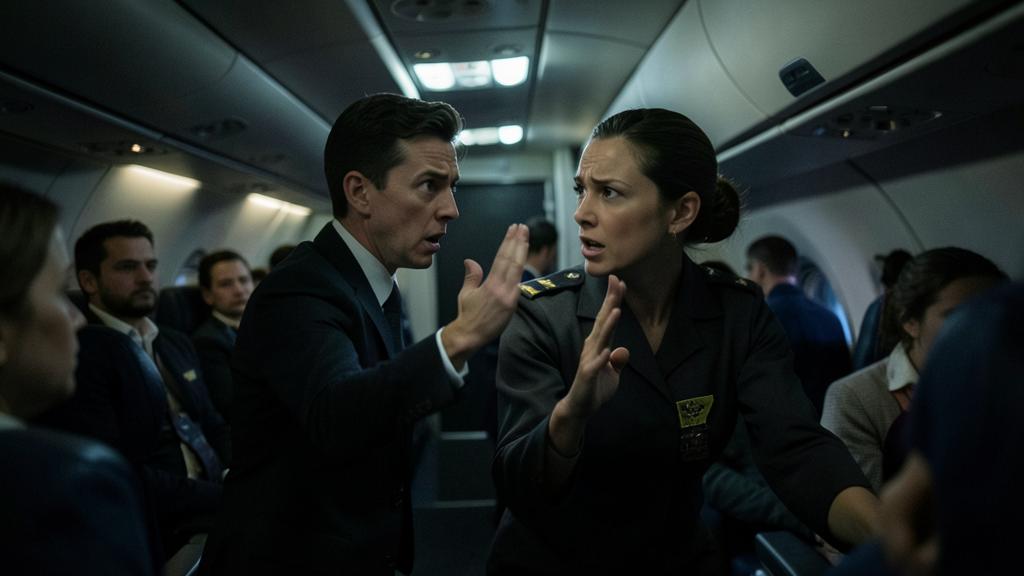
The type of operation shifts the scenarios, and it is worth knowing which one you are sitting. On a short-haul network with high rotation, scenarios concentrate on the turnaround: cabin to check quickly, passengers still standing, pressure of on-time performance — the isolated competency is trade-off under time pressure, and the board readily adds a constraint mid-story to see whether the candidate reassesses or digs in. On long-haul, they focus on duration: in-flight relief and rest, a larger crew and so coordination to maintain, a medical situation that develops over several hours and for which the cabin feeds observations into a diversion decision that belongs, itself, to the commander. On small-capacity aircraft, where the cabin may have only a single crew member, the scenario removes the other party by design: there is no one to delegate to, and the observation focuses on how the candidate sequences two competing requests while announcing which one is deferred. A one-size-fits-all answer does not survive these three contexts; a method does.
The grey area, for its part, never closes. Scoring scales are not published, weighting varies with each campaign’s needs, and the same answer can be received differently depending on whether the board is looking for seasonal reinforcement or a career base. Experience shared on the FL330 forums points to one constant above all: the score depends less on the content of the answers than on their structure. For anyone then aiming at a cabin manager position, this observation has a useful consequence — promotion boards use a very similar grid, with the same non-technical headings, with one difference: they no longer observe whether the candidate can decide, but whether they can get others to decide.
The applicable regulatory text, the operator’s approved documentation and the instructions of the recruitment campaign take precedence over the content of this article, which describes an assessment mechanism and not a binding procedure.
Questions fréquentes
Do I need to know the airline’s procedures before the interview?
No, and no one expects them from a candidate who has not yet been trained, since they are set out in an operations manual that is not public. What is expected is the vocabulary of the trade — securing the cabin, critical phases, debrief — and the ability to place an action within a flight phase. Citing a made-up procedure, on the other hand, is disqualifying, because one member of the board actually works the job and knows it.
What should you answer when the scenario does not fall under any rule you know?
That is exactly the case the board is trying to provoke, and it expects a decision that is owned, not passed on. You must first secure whatever can be secured without any specific knowledge, then decide, then immediately announce that decision to the rest of the crew. Initiative is valued on one condition: that it is said out loud and logged afterwards.
Does the board expect candidates to always call the cabin manager?
No. Calling the cabin manager is a good answer when there is time available and the situation falls outside what the procedure covers. Used as a universal answer, it reads as an absence of assessment, and the board tests this by removing that contact from the scenario. The practical rule is simple: assess, act on what cannot wait, then report.
Does experience in hospitality or catering really count?
It counts for what it proves about handling pressure and managing conflict, not as a guarantee of fitness for the role. It becomes a handicap when the candidate transposes customer-satisfaction logic onto a situation where safety alone decides. How it is presented makes the difference: saying what is kept from that trade and what has to be unlearned scores better than making it a blanket argument.
How are answers scored in the group interview?
Observers score functional roles rather than speaking time: restating the instructions, keeping track of time, drawing in those who have said nothing, explicitly closing a decision. Interrupting a participant is penalised more heavily than staying quiet, because that behaviour maps directly onto passing on information in the cabin. Summing up at the end of the exercise what has been decided and what remains open counts for more than a single brilliant idea.
Does answering “I don’t know” eliminate a candidate?
Not if it is bounded and followed by a method. Stating what you don’t know, naming the source where you will look for the information, and specifying what you do in the meantime ticks one of the most discriminating boxes on the grid. What costs points is a vague admission, with no securing action and no information channel.


Leave a Reply
You must be logged in to post a comment.