
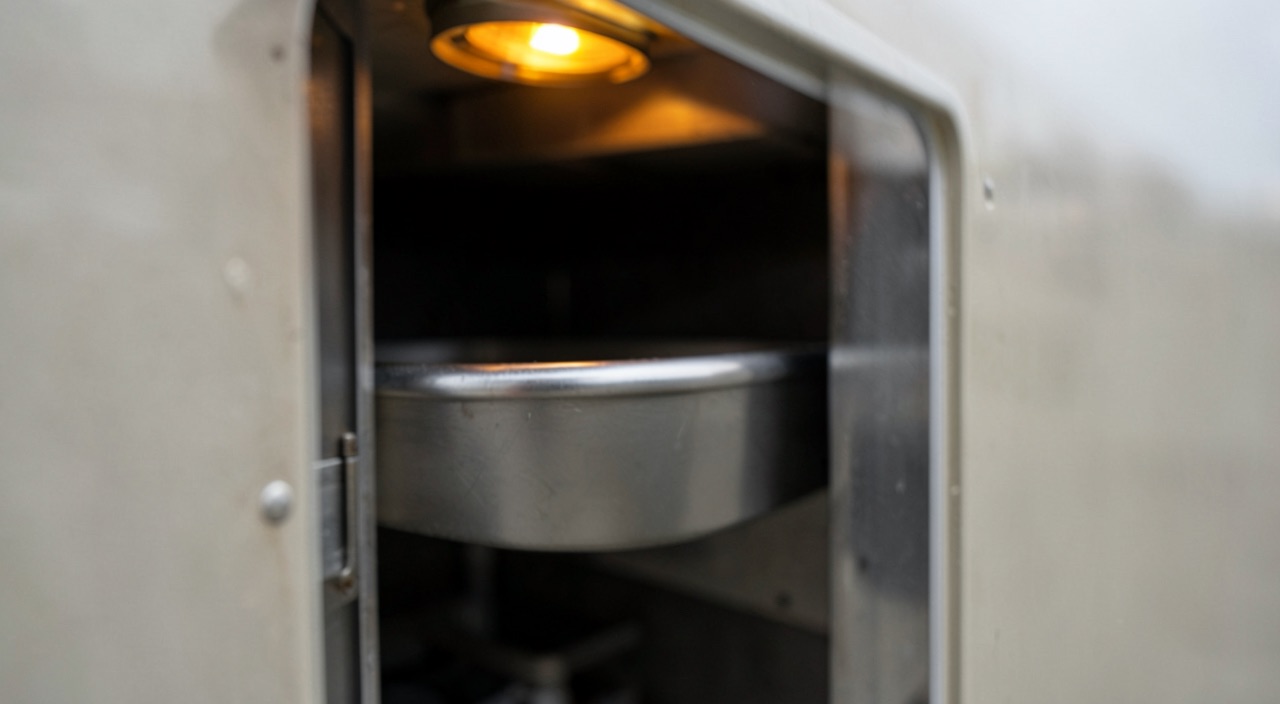
Three in the morning, cabin lights dimmed, half the passengers asleep under a blanket, and the flight deck announces a turbulence area “in about ten minutes.” The question is not what to secure — the list is in the manual — it is what order to do it in, and how far to push without turning a sleeping cabin into a standing one. Because the gesture that injures most reliably at night is not an omission — it is the check started too late, with four people still in the aisle when the first jolt hits.
Night does not change the turbulence, it changes the cabin
The physics of a turbulence encounter is the same at three in the morning as at noon. What changes comes down to three operational facts, and all three work against the crew. The cabin is dimmed, so seatbelts cannot be seen. Part of the crew is on scheduled rest, so the awake headcount is at its lowest exactly when the most hands are needed. And the passengers are asleep, which means they respond to neither the chime, nor an announcement, nor the first movement — and waking them carries an immediate cost.
This cost is the datum that written procedures integrate the worst, because it is counter-intuitive. Turning the lights fully back on in a long-haul cabin triggers a wave: passengers get up, a line forms at the lavatories, call bells start again, and two minutes later there are more people standing than before. The most visible securing action, full cabin lighting, is also the one that most quickly increases the number of unrestrained occupants.
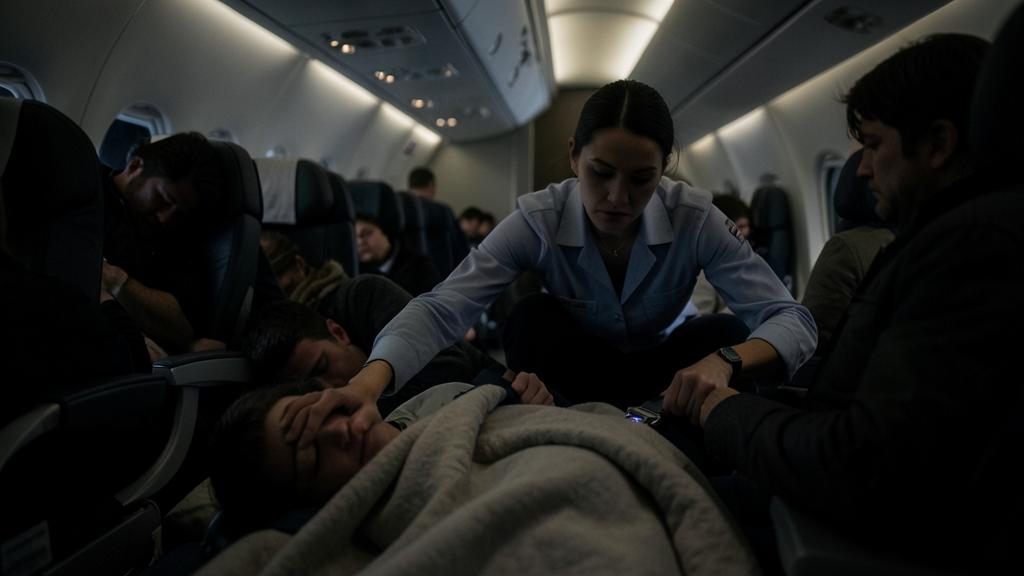
There is also a configuration difficulty. On a fully flat seat, the lap belt does not fall where the eye expects it, it runs under a duvet, and the passenger has sometimes settled diagonally. In economy class, a blanket pulled up to the chin makes it impossible, from the aisle, to tell a buckled belt from one merely resting on the lap. A night-time seatbelt check is therefore not a visual sweep of the row: it is one hands-on gesture per occupied seat, which by far makes it the most time-consuming task of the whole sequence.
At night, the main challenge isn’t the turbulence itself, but the sleeping passengers. Waking them up causes more problems than it solves, so the crew must work carefully to secure the cabin without disturbing everyone. The key is to do things in the right order and as quickly as possible.
On a Boeing 787 flying from Paris to Tokyo at 3:00 AM, the crew receives a turbulence warning with 5 minutes of lead time. They immediately secure loose mass (trolleys, ovens) in 1.5 minutes, then guide 3 standing passengers back to their seats in 2.5 minutes. With 1 minute left, they start checking seatbelts by row, using torches to avoid waking passengers. The turbulence hits just as they finish the first 10 rows, but no one is injured because the critical tasks were done first.
Where injuries actually happen
The geography of turbulence injuries is stable and is worth remembering more than any task list: you get hurt standing up, or because a heavy mass came looking for you. A seated passenger, seatbelt buckled even loosely, most often comes out of a severe encounter with a bruise and a fright. Serious injuries concentrate on two populations: cabin crew, standing by definition since it is their workstation, and unrestrained occupants — someone returning from the lavatory, an infant held in arms, a passenger who has just unbuckled to reach for a bag.
The mechanism is worth stating, because it explains why the margin is so thin. In a downward excursion, it is not the occupant who rises: it is the cabin that descends faster than they do. For as long as the acceleration gap lasts, the separation between the two grows as the square of the elapsed time. An excursion twice as long does not produce a displacement twice as large, but four times as large.
This is why calling a bump “short” means nothing until you have said what short means, and why the difference between a head lifting a few centimetres and a head striking an overhead bin is decided within tenths of a second, beyond the reach of any human reaction. You do not catch yourself during an excursion: you are restrained, or you are not.
Loose mass, the only thing that can reach a belted passenger
The second injury population is purely mechanical. A full service trolley weighs on the order of a hundred kilograms, it rolls, it is tall, and its centre of gravity is far from the floor. In an upward excursion it loads its brake; in a downward excursion it suddenly loses weight, lifts off, and comes down wherever its trajectory takes it. Standard containers, loaded ovens, full coffee pots, bottles stored upright in a poorly latched compartment pose the same problem at different scales.
The consequence for the order of priorities is direct. These objects are the only things capable of seriously injuring someone who is already properly seated and belted. An unbuckled belt exposes only its own occupant; a loose trolley exposes an entire aisle, crew included. That is the reason, and the only one, why loose mass comes before seatbelts.
Separately, and with no threshold, there is boiling water: light turbulence is enough to tip over a coffee pot held in hand in an aisle. There is no announced severity level below which a scalding liquid becomes harmless. As soon as the seatbelt sign comes on, nothing hot moves.
Lead time is the only control variable
The purser has no way to assess the threat directly: no radar, no forecast turbulence charts, no reports from preceding crews. Only one usable piece of data is available, and it is temporal — how long before it starts. Everything else, severity, extent, escape altitude, belongs to the flight deck and changes nothing about what the purser’s hands can do in the meantime.
On the flight deck side, the sources offer very different lead times. Weather radar sees precipitation, hence convective cells, but not clear-air turbulence: a return gives a few useful minutes, an empty screen gives none. Forecast turbulence charts flag broad areas hours in advance, with poor positional accuracy. Reports from preceding aircraft, including automatic eddy dissipation rate measurements exchanged between aircraft, are the most useful and the most perishable: the area drifts.
| Source of the alert | Typical lead time | Positional accuracy | What the cabin can complete |
|---|---|---|---|
| Convective cell seen on radar | A few minutes | Good in azimuth, uncertain in level | Full securing, service stopped and stowed |
| Forecast turbulence area (charts, weather messages) | Tens of minutes, or more | Broad, extent often overestimated | Everything, including gradual wake-up and resumption of crew rest |
| Report from a preceding aircraft | A few to a few dozen minutes | Good in level, perishable in position | Loose mass and standing passengers; seatbelts if the window holds |
| Unforecast clear-air turbulence | None | Not applicable | Nothing: you absorb it wherever you are |
| Wake from a crossing or preceding aircraft | None to a few seconds | Localised, very brief | Nothing, but the event is short |
The methodological consequence is simple: since the cabin cannot act on the threat, it acts on the sequencing. Lead time is not a comfort item of information, it is the parameter that carves up the task list — and every task has a price in minutes.
The durations are orders of magnitude, specific to each operator; the ratio between them, however, is robust. Securing a galley’s loose mass is quick because the number of items is finite and the gestures standardised. Checking seatbelts is long because the cost is proportional to the number of occupied seats. Between the two, reseating standing passengers is the task whose duration is least predictable.
The securing order, from heaviest to finest
The order that follows is not derived from a hierarchy of severity, but from a calculation of benefit per minute spent. At each rank, the goal is to remove the largest possible amount of energy from the danger for the time invested.
- One’s own body and that of colleagues. An injured crew member no longer secures anything, no longer leads an evacuation, and ties up two people to tend to them. If the lead time is shorter than the time to cross the galley, sit down and strap into the nearest seat available.
- Loose mass. Trolleys stowed and latched, brakes set, compartments closed, ovens cooled or at least latched, hot liquids set down and restraints in place. This is the only item that protects people other than the one carrying it out.
- Standing passengers. Lavatories, aisles, rest areas. They are not numerous at night, but they are scattered and do not respond to an announcement broadcast into a sleeping cabin: someone has to go and get them.
- Special-case occupants. Infants in a bassinet or in arms, passengers with reduced mobility. Each requires a specific action known in advance, never improvised.
- Seatbelts under blankets. Row by row, by hand or with a torch, working in the direction that leaves the shortest way out to a jump seat.
- Crew rest. Going up to it or coming down from it is exactly what should not be done late. If the delay is short, notify by interphone and let the occupants strap themselves into their bunk.
The trap: “stowed” is not “secured”. A trolley pushed into its bay, brake set, latch not engaged, behaves exactly like a loose trolley in a downward excursion: the brake locks the wheels, it does not hold the trolley once it momentarily loses its weight. The same confusion applies to an oven whose door is closed but not latched, and to a compartment whose catch is pushed in but not turned. In the rush, the eye validates the position and skips the state of the latch. This is the classic fault behind galleys found emptied after an encounter: the equipment did not fail, it was never restrained.
The reflex: announce a level, not a list. Convert the lead time into a rank in the sequence and broadcast that rank alone — “securing level two,” for instance, if your operator numbers them. Everyone then knows where to stop without having to decide on the fly. A task list broadcast under pressure produces the opposite: every crew member starts with the first line and nobody reaches the last.
Lighting without waking
Light is not a binary tool, and this is where the specificity of the night flight plays out. Between night lighting and full brightness, a modern cabin offers several steps, plus aisle and entry lighting that does not spill onto the seats. Going up one step is enough to work by; full brightness, on the other hand, is a signal that sleep is over, which passengers interpret as permission to get up.
The seatbelt check is therefore done with a torch, beam aimed down at buckle level, never at the face. The gesture is fast when standardised: hand on the strap over the blanket, you feel the buckle or you don’t. A passenger who wakes up receives one sentence, the same for everyone, short, and falls back asleep. One who does not wake up does not need to if the buckle is there.
At night, the public address serves less to instruct than to wake those who need waking. A single broadcast, in the languages set out in the manual, with a single executable instruction: stay seated, buckle over the blanket, do not stand up until further notice. Weather explanations lengthen the message and delay everything else. As for the seatbelt chime, it does not wake a deeply sleeping passenger: it signals an instruction, it does not enforce it, and it is therefore not a means of securing the cabin.
The reflex: one step of light, not two. Switch to aisle lighting or the first night-light level, keep torches for buckles, and go back up to full brightness only if the lead time comfortably exceeds what a complete check needs — which is almost never during a night cruise. Full brightness is justified after the encounter, for the post-event check, not before.
The call from the flight deck: three levels, one ambiguity to kill
The quality of the securing depends less on the cabin than on the wording of the call. A flight deck that announces “it’s going to get a bit bumpy” hands the cabin a decision it cannot make, and does so at the worst possible moment. A usable call contains three elements and nothing else: the delay in minutes, the expected action level, and who calls it in to release the cabin.
| Call from the flight deck | What it means | Cabin action | What is given up |
|---|---|---|---|
| “Cabin crew, be seated immediately” | Encounter imminent or already under way | Sit down at the nearest seat, harness or passenger belt | Everything else, loose mass included |
| “Secure the cabin, X minutes” | Lead time given, severity uncertain | Run through the securing order until the time runs out | Whatever the delay does not cover, in reverse order of priority |
| “Light turbulence expected, service with caution” | Discomfort announced, no injury risk | Seatbelt sign on, nothing hot or elevated, lighter service | Nothing, but the interruption is prepared |
| “Cabin released” | Exit from the area confirmed by the flight deck | Movement resumes, cabin check walk-through | Not applicable |
The fourth row matters as much as the other three: without an explicit release call, everyone decides alone when to stand up, and we fall back into the lull scenario. An operator that numbers its calls and requires a readback of the delay — the cabin repeats “securing, seven minutes” — closes the door on interpretation.
The trap: the unquantified lead time. “Soon,” “in a few minutes,” “as soon as we enter it” are not delays: they are invitations to start a task there will not be time to finish. Treat any lead time without a number as zero lead time — loose mass, then sit down — and ask for the number again, once. A vague lead time is more treacherous than no lead time at all: a genuinely unannounced encounter makes everyone sit down at once, whereas a “soon” launches a seatbelt check that people think they have time to finish, leaving the crew standing at the wrong moment.
The second jolt, and what happens afterwards
An encounter is rarely a single jolt. Crossing an area produces a succession of jolts separated by lulls of varying duration — often a few dozen seconds — during which the aircraft appears to be through it. These lulls are the most treacherous window of the encounter: seated crew stand up to check, passengers unbuckle, and the next jolt finds bodies standing — this time with no surprise to blame, since the area has not actually been left.
The resulting rule is flat: nobody moves before the release call, whatever impression the cabin gives. This is also the point at which the crew’s authority over passengers is most fragile, because the apparent calm contradicts the instruction. A brief announcement during the lull — we remain seated, this is not over — costs little and beats an individual reminder seat by seat.
After the release, the cabin walk-through looks for three distinct things. People first, including those who do not complain: a neck or lower-back injury often shows up late, and a seated passenger who says they are fine may have absorbed a compression. Damage next — overhead bin panels, galley door hinges, oven mounts, forced latches — which is a matter for the technical report, not for judgement calls. Traces last: what moved and should not have. A galley emptied while its latches were engaged tells a different story from one where they were not, and only the crew present can tell the difference.
The event report, finally, extends beyond the flight: turbulence reported by crews feeds information to aircraft that will follow the same route. Skipping it because “nobody was hurt” amounts to removing a marker from the chart.
What to go and check in your own documentation
None of the above replaces reading three points in your own operator’s manual, rarely gathered in the same place. Does the call phraseology between flight deck and cabin exist in numbered form, and does it include the release call? Many manuals describe the alert and forget the end of the alert. Is the securing order written as an order, or as a list with no hierarchy? A list leaves the purser to prioritise it under pressure, which is precisely the task that should have been solved in advance. Finally, night-cruise seatbelt policy: some operators leave it on all night so that the under-blanket check never has to be done under time pressure, which entirely changes the time calculation described above.
Two grey areas remain, better raised in advance than discovered in flight. The passenger who refuses to be woken or to buckle up over the duvet: the crew instruction is binding, but how the refusal gets documented varies from operator to operator. And crew rest on an intermediate lead time, where there is neither time to bring the occupants down nor reason to leave them without instruction; the interphone settles it, but the procedure needs to say so.
For anyone preparing a purser qualification or a revalidation, this topic is a good indicator at interview. What is expected is not the recitation of a list, but the demonstration of a reasoning process: what information is missing, who you ask for it, and what you give up doing when it does not arrive. The cabin training modules that work this trade-off under time pressure prepare you better than rereading a chapter.
Finally, a point that is not a formality: the applicable regulatory text and your operator’s approved documentation take precedence over everything above. The durations, orders and wordings given here are reasoning benchmarks, not procedures; in case of discrepancy, the operations manual governs.
Questions fréquentes
Should a passenger sleeping under a blanket be woken up to check their seatbelt?
You look for the buckle, not for the wake-up. A hand placed on the strap over the blanket is enough to tell whether it’s buckled, and a passenger who doesn’t wake up doesn’t need to. Waking them becomes necessary only if the seatbelt is open or cannot be found, or if the operator’s instruction requires verbal confirmation.
What should be done if the flight deck announces turbulence without giving a lead time?
Treat the lead time as zero: secure the galleys’ loose mass, then sit down and strap in. Ask the flight deck once for a number of minutes, but don’t wait for the answer before starting. An unquantified lead time is the scenario that most often catches the crew standing, because it gives the illusion of having time.
Why not turn the cabin lights fully back on to go faster?
Because full brightness is read as the end of the sleep period and triggers a wave of passengers getting up, notably heading for the lavatories. The result is more people standing than before the announcement, at the exact moment the goal is the opposite. One notch of night lighting or aisle lighting, supplemented with torches, is enough for the buckle check.
Is a trolley pushed into its bay, brake set, secured?
No. The brake locks the wheels, which is useless during a downward excursion in which the trolley momentarily loses its weight and lifts off. Only the bay’s latch holds it in place. These are two distinct gestures, and their confusion is what regularly lies behind an emptied galley.
How long does it take to secure a long-haul cabin at night?
The orders of magnitude are more stable than the total duration, which depends on the awake headcount and the load factor. Galley loose mass is dealt with in one to two minutes because the number of items is finite; standing passengers take a few minutes more, the time to go and find them; the seatbelt check is by far the longest item, since it is paid for seat by seat. That is why the order of tasks matters more than their completeness: the lead time will decide where you stop, never the reverse.
Can crew stand up during a lull in the middle of a turbulence area?
No, not until the flight deck has announced that the cabin is released. Crossing an area produces jolts separated by lulls of a few dozen seconds that look like an exit without being one. It is during these lulls that people get hurt with no surprise to blame, since bodies are standing again while nothing confirms the area has been left.


Leave a Reply
You must be logged in to post a comment.