
The refuelling truck has just pulled away and the signed delivery ticket carries only one product name: Jet A-1. Nothing on it says that the batch loaded the day before at the blending terminal contained a fraction of synthetic kerosene, and that silence is not an oversight: it is the intended outcome. What remains is to work out where the blending took place, which document was born at which moment, and why, once past the terminal’s manifold, no one can tell the molecules apart any more.
What the producer delivers is not yet kerosene
A synthetic paraffinic kerosene — whatever its pathway: hydroprocessing of esters and fatty acids, Fischer-Tropsch synthesis, alcohol conversion — leaves the production unit with an abnormally clean composition. Paraffins, branched or not, distributed within a narrow cut, almost no sulphur, almost no aromatics, almost no cyclic compounds. To a chemist, it is an excellent fuel. Against the specification, it is an off-spec product, and it is so by construction.
Two properties place it outside the admissible range from the outset. Its density sits below the floor of the range, because paraffins are light: the usual range for Jet A-1 runs from roughly 775 to roughly 840 kg/m³ at 15°C, and a pure synthetic component does not reach that floor on its own. Its aromatics content is close to nil, even though these molecules perform a mechanical function that no one bothered to write down for as long as it went without saying: they swell the elastomers of seals, bladders and fittings in a fuel system designed decades ago. A fuel without aromatics shrinks those seals and makes what never used to weep, weep.
The producer therefore does not certify a fuel: it certifies a blending component. The quality certificate it issues, batch by batch, is checked against the annex of the specification for aviation turbine fuels containing synthesized hydrocarbons that corresponds to its production pathway — that one, and no other. That annex sets limits specific to the component, including the maximum proportion it may represent in the finished product. Reading this document against the grid of conventional kerosene triggers an alarm over a value that has no business being there.
Before the first litre: how a pathway enters the specification
No authority signs off that sustainable fuels are acceptable. What is approved, every time, is a pathway: a family of feedstocks, a process within a defined window, a bounded composition, a blend-ratio cap. The route runs through the standardized practice for evaluating new aviation turbine fuels and fuel additives, which organizes the case file into successive tiers and brings in engine and airframe manufacturers at each step.
It starts with detailed composition and with the specification’s own properties. Then comes the bulk of the work: fit-for-purpose properties, the ones no specification value captures — low-temperature behaviour beyond the mere freezing point, thermal stability, lubricity, electrical conductivity, material compatibility under prolonged contact. This is where elastomers, coatings, adhesives and structural materials are tested, specimen by specimen, over periods measured in months.
The scale then climbs: isolated components on the test bench — pumps, controls, injectors — combustion chamber, complete engine, sometimes a flight demonstration. Only at the end of this path does a new annex appear, with its own limits and its own cap. That cap is not a symbolic precaution: it is the translation of the domain within which the tests were actually conducted, and it evolves pathway by pathway as case files grow.
Blending is the moment the product changes name
Blending takes place at the terminal, rarely elsewhere. Two methods coexist. In-line injection doses the synthetic component proportionally during transfer, giving a homogeneous product as soon as it reaches the tank. Tank blending loads both products into the same tank, then homogenizes by circulation before any sampling: simpler, and far more treacherous, because a stratified tank yields a sample that represents none of the products present.
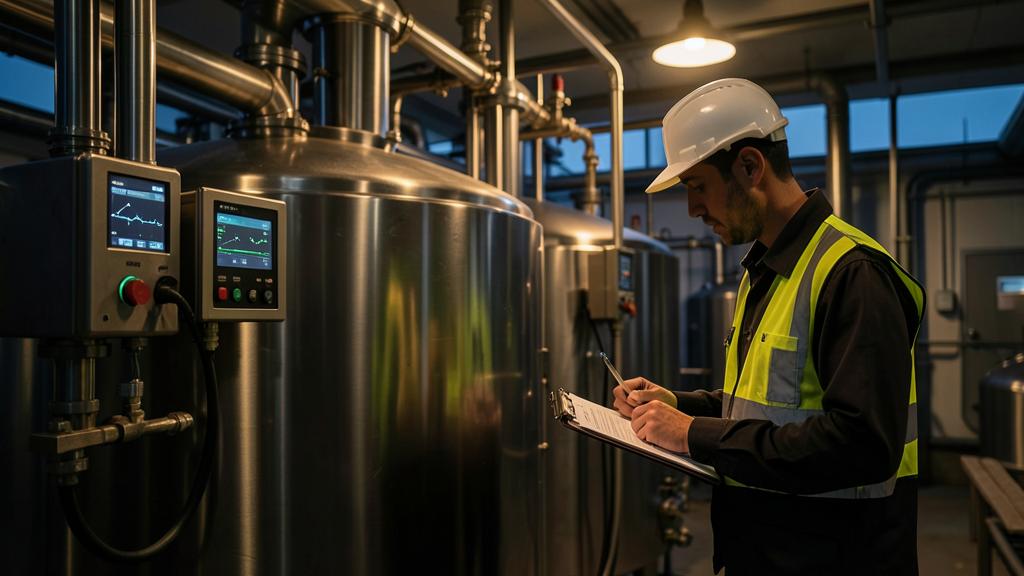
The resulting blend is then tested, no longer against the component’s annex, but against the main table of the specification for fuels containing synthesized hydrocarbons. If it meets that table, the specification states the sentence that governs everything that follows: the batch is deemed to conform to conventional aviation kerosene. It takes on its name, its handling regime and its documentary regime. Downstream, no dedicated tank, no dedicated line, no special mention: that is what “drop-in” means, and it is as much a documentary decision as a chemical fact.
This switch also shifts responsibility. The terminal that blends becomes, in the sense of quality documents, the manufacturer of the kerosene it ships — for a product neither of whose two components it refined. It is the terminal that issues the blend’s quality certificate, that answers for its conformity, and that records the incorporated production pathway and the proportion used. This entry is the last trace of the synthetic share in a quality document.
What remains is to understand why a cap persists even though the blend itself meets the specification. The answer lies in a simple geometry: a blend moves in a straight line between two points, that of the pure component and that of the kerosene receiving it. The more that is incorporated, the closer the mixture gets to the pure component, and it eventually falls out of the acceptance window from below, on aromatics or on density. The annex’s cap prudently bounds this path; since the base kerosene does not have the same composition everywhere, the exact point at which the limit bites varies from one terminal to another.
The synthetic fuel is not ready to use on its own. It must be mixed with regular kerosene to meet aviation standards. The blend is tested to ensure it meets all the rules, and then it’s treated just like regular fuel. The mix can’t be too much synthetic fuel, or it won’t work right in the plane’s systems.
An Airbus A320 at Paris Charles de Gaulle is refueled with a blend containing 30% synthetic kerosene from a Fischer-Tropsch process. The blend meets all Jet A-1 specs, including density (810 kg/m³) and aromatics (15%). The terminal’s certificate shows the blend ratio and pathway, but the fuelling ticket only lists “Jet A-1.” The aircraft’s systems handle the fuel normally, with no special procedures.
One detail says it all. The specification for fuels containing synthesized hydrocarbons imposes an aromatics floor on the blend, where the conventional kerosene specification sets only a ceiling. A product from refining always brings its own; a blend does not. This floor therefore had to be written the day it became possible to make a fuel that could lack them.
The right instinct. On a tank blend, no sample before complete homogenization plus a settling period. The synthetic component is the lighter of the two, it sits at the top of the tank, and a top sample gives a density and an aromatics content that correspond to nothing that will actually be shipped. The certificate that would result from it would attest to a fuel that does not exist.
Four documents, four objects
| Document | Issued by | Checked against | What it proves | What it does not prove |
|---|---|---|---|---|
| Synthetic component certificate | The production site | The annex for the production pathway | That the component is fit for blending, and up to what proportion | That the product is an aviation kerosene |
| Blend quality certificate | The blending terminal | The main table of the specification for synthetic fuels | That the batch is an aviation kerosene, and what synthetic share it contains | The origin of the feedstock or the emissions reduction |
| Re-check certificate | The facility that takes custody of the batch | A defined subset of kerosene tests | That the received product remains conforming after transport or retanking | Anything about the synthetic share |
| Fuelling ticket | The fuelling operator | Nothing: it is a delivery document | The product, the volume, the temperature and the applied density | The composition of the delivered fuel |
The most common confusion concerns the first two lines. The component certificate describes a product that is not a fuel; the blend certificate describes a fuel. After the latter, the downstream chain re-certifies nothing but kerosene, and nothing else.
The trap. Being shown the synthetic component certificate in place of the blend certificate, or the reverse. The first shows a density below the Jet A-1 minimum and aromatics close to zero: read against the kerosene grid, it triggers a groundless rejection. The second, read as proof of sustainability, is nothing of the sort: it attests to product conformity, not to the origin of the feedstock or its emissions balance. A batch can be perfectly conforming and give rise to no declaration whatsoever.
Downstream, no one is looking for the synthetic share any more
From the blending terminal onward, the batch follows the common regime: multi-product pipeline, barge, railcar or truck, receipt at the airport depot, settling, filtration and water separation, batch checks at each receipt, periodic checks, then refuelling. Each change of custody produces its own document. When a batch loses its identity — blending into a tank that already held something else, a pipeline interface, prolonged storage — the original certificate no longer holds good: a re-check certificate is drawn up on a defined subset of tests, and it is this document that now accompanies the product.
These re-check tests do not look for the synthetic share, and they could not. Appearance, density, flash point, electrical conductivity, water separation: these are the tests of a kerosene. Only dedicated laboratory methods, outside routine quality release, can trace a fraction of biogenic carbon — and even then, not for every production pathway. On the ground, the synthetic share is not a measurable property: it is an entry in a record.
At the end of the chain, the fuelling ticket carries the nature of the product, the volume, the temperature, the applied density and the identification of the vehicle. It does not carry the composition. The crew who sign it attest to a delivery, not to a provenance.
The right instinct. Read a certificate’s header before its values, and in this order: which specification and which table serve as the reference, which batch number, which place and date of issue, and whether it is a manufacturing certificate or a re-check certificate. Most quality disputes are settled in the header, without looking at a single test value.
Proof of sustainability travels on a different track
The physical fuel and the sustainability attribute part ways at the terminal and never meet again. This is deliberate: it is the only way to make a system work in which a small number of production sites must supply a very large number of airports without duplicating the logistics.
The mechanism is called mass balance. A sustainability certification scheme recognized by the regulator tracks the feedstock from its origin, accounts for the inflows and outflows of a site, and allows only as many attributes to leave as have entered. What then circulates is not a molecule but an entry, backed by an attestation stating the feedstock, the production pathway and the emissions reduction calculated by an approved method. Taken further, the same principle allows an operator to acquire the attribute of a batch delivered to an airport other than its own: this decoupling is exactly what both the European sustainable aviation fuel blending mandate and the eligibility criteria of the global carbon offsetting and reduction scheme are aimed at.
| Criterion | Physical chain | Sustainability chain |
|---|---|---|
| What circulates | A batch of fuel, identified by tank and by transfer | An accounting attribute, backed by an attestation |
| Who attests | Producer, blender, successive terminals, fuelling operator | Certification body of a recognized scheme, then an auditor |
| Typical proof | Quality and re-check certificates, test reports | Sustainability attestation, mass-balance entries, registry |
| Point of failure | Loss of batch identity, contamination, free water | Double counting, an attribute issued without a matching input |
| Verifiable at the airport | Yes, by batch testing | No: nothing measurable on site |
The trap. Treating an announcement of a flight “on sustainable fuel” as a statement about the contents of the tank. In almost every case, the aircraft received conventional kerosene containing a synthetic fraction within the annex’s cap, and the operator has claimed attributes acquired elsewhere. Both statements are accurate and do not describe the same thing. If you are asked to document a “fully sustainable” refuelling, ask which of the two registers is meant: the answer changes the nature of the document to be produced.
What blending actually changes on board
Within certified limits, nothing procedural: no dedicated tank, no special refuelling, no mention in the aircraft technical log, no amendment to the flight manual. What changes is a matter of order of magnitude, and it is worth knowing.
The density of a blend tends toward the low end of the admissible range, without leaving it. Direct consequence: for the same mass, more litres must be loaded. For a flight plan calculated by mass, this changes nothing — except when the tanks are full and the constraint becomes volumetric: the mass carried is then very slightly lower, and range with it. Conversely, the mass-specific energy of a paraffinic component is slightly higher than that of conventional kerosene, which partly offsets the effect on consumption. These effects are small, they do not cancel out exactly, and they do not act in the same direction depending on whether the limitation is by mass or by volume.
The freezing point of a blend containing a synthetic component is generally lower than that of the base product: an extra margin on long polar routes, never a justification for relaxing a limitation. Thermal stability is generally better and sulphur content lower, though these gains do not authorize departing from the values shown on the batch certificate. The parameter to watch remains electrical conductivity, because a very clean product dissipates charge poorly: the anti-static additive is dosed on the final blend, not on its components taken separately.
The right instinct. Convert litres to kilograms using the density shown on the day’s ticket, never a habitual value or a fleet average. On a long-haul full load, a few units of difference in density weigh in at several hundred kilograms on take-off mass — and the discrepancy shows up nowhere else.
What is left to check in your own documentation
Three checks are worth more than one more reading.
- Which reference standard applies at the terminal that supplies you. At jointly operated facilities, the reference used is the intersection of the strictest requirements of the national specifications: a document distinct from each of them, and it is this one that governs in the event of a discrepancy.
- Who, at the operator, accepts a re-check certificate, and on what evidence. The question looks administrative until the day a batch turns up with an original certificate that has lapsed and no one to say what holds.
- What the operations manual provides for when the delivered density falls outside the flight-plan assumption: recalculation, tolerance threshold, or nothing at all — all three answers exist.
One grey area remains, and is accepted as such. The blend-ratio cap is a property of the annex, not a property of sustainable fuel in general: it moves, upward, pathway by pathway, at the pace of the test case files. Fully synthetic fuels do not fall under this general regime and fly under special provisions, with the material adaptations required by the absence of aromatics. And none of the above applies to non-miscible energy sources, hydrogen or electricity, which are not replacement fuels but entire chains to be rebuilt, from production to tank.
For anyone preparing a qualification or a selection interview, the subject is not played out in numbers: it is played out in the ability to say who attests to what. Distinguishing a component certificate from a blend certificate, from a re-check certificate and from a sustainability attestation shows that one has understood an industrial chain rather than learned a slogan — a point worth discussing usefully among practitioners, notably on the forum.
None of the foregoing replaces the underlying text: the specification applicable to the delivered product, the terminal’s quality reference and the operator’s approved documentation prevail over this article, including where their requirements prove stricter than what is described here.
Questions fréquentes
Does a flight announced as “flying on sustainable fuel” mean the tank contained only that?
Almost never. The aircraft receives conventional kerosene containing a fraction of synthetic component, capped by the annex for the relevant production pathway. The announcement most often concerns sustainability attributes acquired by mass balance, which may correspond to a batch delivered elsewhere. Both statements are accurate, but they do not describe the same thing.
Does the fuelling ticket show the share of sustainable fuel?
No. As soon as the blend meets the specification’s main table, it is deemed aviation kerosene and circulates as such. The incorporated proportion appears on the quality certificate drawn up at the blending terminal, never on downstream documents. The fuelling ticket carries the product, the volume, the temperature and the applied density.
Can it be verified after the fact that a refuelling actually contained synthetic fuel?
Not with the quality release tests, which are those of a kerosene and are not concerned with the origin of the molecules. Dedicated laboratory methods can estimate a fraction of biogenic-origin carbon, but they do not cover every production pathway and are not part of the routine control chain. In practice, the proof is documentary.
Why is there a blend-ratio cap if the blend meets the specification?
Because the cap reflects the domain within which the qualification tests were conducted, and because the pure component falls outside the acceptance window from below, particularly on density and aromatics content. The higher the proportion, the closer the blend approaches these limits, and the composition of the base kerosene shifts exactly where they bite. The cap is specific to each annex and evolves pathway by pathway.
Is a special refuelling procedure required for a blend?
No, within certified limits: no dedicated tank, no dedicated line, no mention in the technical log, no amendment to the flight manual. That is precisely the point of the “drop-in” character, acquired the moment the blend is declared conforming to conventional kerosene. Fully synthetic fuels, on the other hand, fall under special provisions and are outside this general regime.
Does the blend change the calculation of the fuel mass loaded?
It changes the conversion of volume to mass, because the density of a blend tends toward the low end of the admissible range. For the same mass, more litres must be loaded; when the constraint becomes volumetric, tanks full, the mass carried is slightly lower. One should therefore use the density shown on the day’s fuelling ticket rather than a habitual value.


Leave a Reply
You must be logged in to post a comment.