
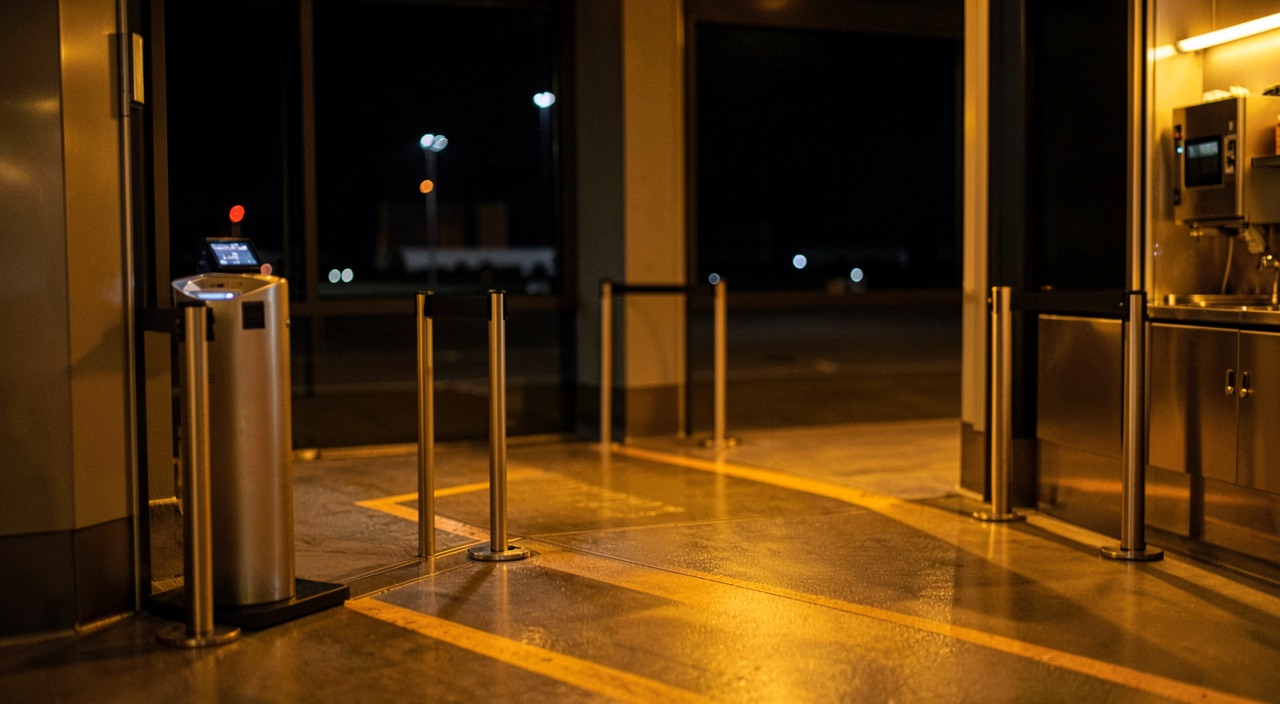
Four minutes before closing, a passenger hands over their boarding pass upside down, asks a question already asked, and the traveler behind them steps back. You have thirty seconds to decide, and it’s the last moment where the decision remains cost-effective: on the other side of the door seal, the same file is no longer resolved by a refusal but by management, sometimes by a diversion.
Two decision regimes separated by a door seal
Refusal and management are not two stages of the same problem: they are two distinct problems, with different means, different decision-makers, and different costs. Before closing, the crew has an opportunity, airport security, a medical station, and above all, time. After, they only have what is on board.
The catalog of outcomes closes in stages, each more expensive than the previous one. In the lounge, everything remains possible, including observing for ten more minutes. At the door: refusal, delay, boarding under conditions. Once seated, with the door open, deboarding is still possible at the cost of removing a suitcase from the hold and reconciling baggage—the delay is no longer counted in minutes. During taxiing, a return to the gate, a lost slot, and service time that cuts into the limit are required. In cruise, there is no longer any outcome, only management.
Before boarding, you can refuse a passenger or manage them with support. After boarding, you can only manage them, and it gets more expensive the longer you wait. The best time to decide is before the plane leaves the gate.
On an Airbus A320 with a 2,500-meter runway at 30°C, a refusal at the door causes a 15-minute delay. The same incident during taxiing requires returning to the gate, burning 500 kg of extra fuel, and losing the slot, causing a 2-hour delay for the next flight.
What you see at the door is not the maximum
The screening at the door suffers from a bias that few procedures name: an observation is made at a moment when the curve is still rising. Absorption continues after the last sip, and the peak blood alcohol concentration typically occurs between thirty minutes and an hour and a half later, longer if the stomach is full. Yet the last drink is often taken in the restricted area, just before the boarding call.
The passenger you are looking at is therefore at their best for what they will be in the following hours, even before any in-flight service. Asking « are they fit to fly? » is like reading a thermometer while the fever is rising. The useful question is prospective: in what state will they be one hour after takeoff, without consuming any more alcohol?
A word on a persistent belief: altitude does not increase blood alcohol concentration, as reduced pressure does not alter the ethanol concentration in the blood. What changes is the context in which this concentration acts: cabin altitude of around 1,800 to 2,400 meters, very dry air, immobility, sleep debt, sometimes an anxiolytic taken to combat flight anxiety. The degradations add up on vigilance, judgment, and motor autonomy, and it is this combination that determines the outcome, not a rate that no one will measure.
Observable signs and those that deceive
Useful observations fall into five categories. Balance and posture: constant leaning on the counter, wide stance, unstable half-turn when retrieving baggage. Fine motor skills: boarding pass poorly grasped, zipper missed, handle picked up three times. Speech: irregular flow, slurred articulation, poorly calibrated volume. Cognition: off-topic response, seat re-requested, confusion about connections. Social regulation: sudden familiarity, shift to irritation, unnoticed withdrawal of others.
Two reading rules are worth more than the list. No single sign decides: a convergence in at least two categories is sought—balance and speech, speech and orientation. And the trajectory weighs as much as the state: a passenger reported at check-in and then deteriorating between the counter and the door is not in the same situation as a stable passenger, even if less obvious.
| Observation | Operational reading | What it does not prove | Action that removes the doubt |
|---|---|---|---|
| Odeur d’alcool | Recent consumption | Any impairment of abilities | Start a conversation, listen to speech and content |
| Slurred speech | Motor impairment of speech | That alcohol is the cause | Ask for information not memorised: connection, arrival city |
| Unsteady gait | Impaired balance | That alcohol is the cause | Watch the passenger turn around with the bag, without offering support |
| Delayed response | Slowed information processing | Intoxication rather than deafness or a poorly mastered language | Ask a two-part question, then give an instruction to carry out |
| Abrupt familiarity, poorly judged volume | Disinhibition | Hostile intent | Resume the conversation quietly and gauge the adjustment |
| Heavy drowsiness or vomiting | Autonomie perdue | — | None: refusal and medical referral |
Smell is the most commonly used and least reliable sign: it indicates consumption, never impairment, and says nothing about the quantity—a single drink can produce it, and it fades while intoxication remains strong. A refusal based solely on it is indefensible.
The criterion is not sobriety, it’s autonomy
Refusing a passenger because they have drunk is not the crew’s mandate. The operational criterion is functional: can this person, without assistance, understand a safety instruction, fasten their seatbelt, adopt the brace position, reach their life vest, and reach an exit in a crowded aisle without becoming an obstacle for their row? Each of these actions can be observed; none depends on a rate.
This criterion is formulated without moral judgment, written without diagnosis, and can be defended to an unhappy passenger as well as to a lawyer. « You cannot stand without support » is an observation; « you are drunk » is a conclusion you are not authorized to make.
Three outcomes, not two
Binary screening pushes for boarding, as refusal seems disproportionate in borderline cases. The third outcome restores proportionality: boarding under conditions, decided and documented as such—no alcohol service, seat away from an exit row, crew informed of the row and seat letter, re-evaluation before closing, line in the flight report.
Two parameters weigh heavily, independently of intoxication. Cooperation: a passenger who hears a remark and adjusts their behavior remains manageable very far; the one who contests or immediately forgets it is no longer. The entourage: a sober companion who assumes responsibility reduces the risk; a group where only one member is unfit does the opposite—the others cover up, minimize, and, in flight, take sides.
The comparative cost of the two decisions
Refusal at the door visibly costs immediately to the decision-maker: an empty seat, an unpleasant exchange in front of the line. The in-flight incident costs later, to others, and invisibly. It is this asymmetry, not ignorance of the risk, that leads to poor decisions.
| Dimension | Refusal at the gate | Incident after door closure |
|---|---|---|
| Decision-maker and time available | Captain informed, a few minutes to confer | A single crew member, a few seconds |
| Moyens mobilisables | Station, airport security, medical post | What is on board, plus volunteer passengers |
| Reversibility | Total: once the doubt is removed, the passenger reboards | None once the sequence is under way |
| Effect on the flight | Empty seat, off-block delay, bag to offload | Diversion, fuel, slot, duty time exceeded |
| Effect in the cabin | A conversation on the jet bridge | Entire cabin as witnesses, secondary incidents, complaints |
| Suite administrative | Denied boarding, commercial dispute | Criminal proceedings, jurisdiction to establish, statements |
| Burden on the crew | A decision owned and written down | Injuries, sick leave, legal follow-up |
The trap: everything that resembles intoxication
Slurred speech, unsteady gait, delayed responses, sweet breath: the picture is also that of hypoglycemia, a developing stroke, a post-ictal phase of epilepsy, a medication effect, a vestibular disorder, or a panic attack. The two symmetrical errors are costly: boarding a passenger in medical distress believing them to be drunk, or publicly humiliating a sick passenger.
The trap. Writing « intoxicated passenger » in a report is making a diagnosis you cannot establish or defend, and offering a challenge its only line of attack. Write what you saw and heard, timestamped, word for word if possible: « could not stand without leaning on the wall, » « asked for their seat number three times. » The qualification belongs to the competent authority; the observation is yours and is irrefutable.
The conversation that decides
Thirty seconds of well-conducted exchange are worth more than a minute of distant observation: they simultaneously test speech, orientation, working memory, and social regulation. You speak away from the line, sideways and not face-to-face, using the baggage as a pretext: the passenger does not lose face and no longer has an audience. You ask an open-ended two-tier question— »are you collecting your baggage or continuing to a connection? »—whose answer requires a constructed sentence and real information. Finally, you give a simple and verifiable instruction, the execution of which provides more information than anything else.
The right reflex. Announce the doubt before it becomes a refusal: « stay here, we’ll be back in two minutes. » This sentence creates the only asset you will later lack, time, allows you to consult the captain, and transforms a public face-to-face into a team decision. It gives the passenger the opportunity to show cooperation, half of the assessment. The FL330 training places this delay before de-escalation, which it conditions.
What you still need to verify with your operator
Three points vary from one operator to another and deserve a review before the next borderline case. Who pronounces the refusal, and according to what chain: the captain decides, but the manual specifies who records it, within what deadline, and whether the station can interrupt boarding on its own. The formal existence of boarding under conditions: many manuals only know the two extreme outcomes, and the no-alcohol service instruction is lost due to lack of support. The general conditions of transport, which decide whether the refused passenger is rebooked, compensated, or left to their own devices—a piece of information to be given at the door, best not to improvise.
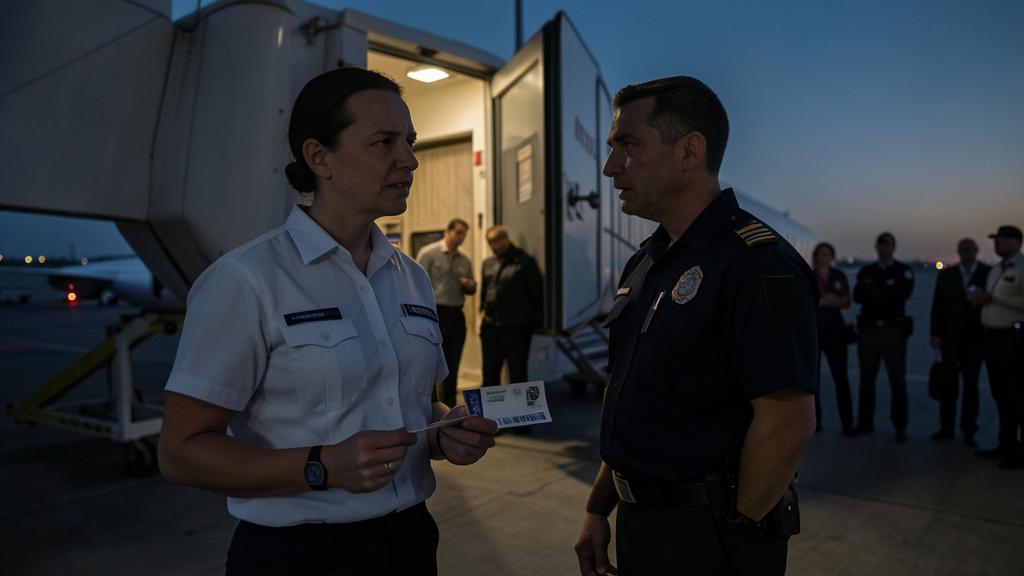
There remains a gray area that no one has resolved: the moderately intoxicated passenger, cooperative, on a long-haul night flight, who will sleep most of the journey. The immediate risk is low; that of waking up, on a dehydrated and sleep-deprived body, is not, and no text addresses it. This is the case where the no-alcohol service instruction and seat identification are worth more than a refusal difficult to justify. For those preparing a periodic assessment, it is also the scenario that separates the learned response from reasoning: the examiner expects the autonomy criterion, the three outcomes, and the written record, not a refusal bluntly stated. The FL330 forum feedback revolves around this case, never around obvious refusals.
The applicable text and the approved documentation of your operator take precedence over this article, which is only a method of reading: in case of discrepancy, it is the manual that prevails.


Leave a Reply
You must be logged in to post a comment.