

Three days after the event, the crew is recalled. The co-pilot has read the captain’s report, both have re-enacted the sequence with a colleague at the layover, and one of them saw a snapshot of the parameters. The two accounts match almost word for word, and that’s exactly what should concern the investigator: such a clean convergence means there are no longer two testimonies, but one, copied twice. A memory is not a recording to be replayed; it’s a reconstruction to be redone—and the interview is part of that reconstruction.
A memory is not a file; it’s a reconstruction
Memory is reconstructed. Episodic memory does not preserve a scene; it preserves fragments: a few sensory cues, prominent landmarks, an approximate order, an associated emotion. At the time of recall, these fragments are recombined with general knowledge to produce a continuous narrative. For a professional, this general knowledge is particularly powerful: it’s the scripts of the trade. An approach normally unfolds in a certain way, so the call must have been made here, so the configuration must have been requested there. The resulting narrative is coherent, fluid, and in line with procedures—and that’s its weakness, not its strength.
The witness does not lie; they fill in the gaps. The holes are patched with what should have happened, without the speaker noticing the difference between the retrieved fragment and the fill. That’s why the confidence expressed by a witness is a poor indicator of its accuracy: it follows the fluidity of the reconstruction, which increases with repetition.
A second, even more troubling mechanism for the investigation: recall modifies the trace. What is retrieved is re-recorded in the state in which it was just formulated. A version pronounced once becomes easier to repeat and harder to correct; it serves as a template for subsequent recalls, which conform to it rather than returning to the episode. Two operational consequences follow. The first interview contains the least edited version, and none of the subsequent ones replace it. And every unmanaged recall that precedes it—a casual debrief with colleagues, a call to the duty officer, a story told to a loved one—consumes testimony before anyone has even asked the first question.
When you remember something, your brain fills in gaps with what makes sense, not what actually happened. The more you repeat a story, the more it changes, and the first version is usually the most accurate.
After an incident involving an Airbus A320, the crew described a sudden loss of altitude. The first interview mentioned a “sharp dive,” but later interviews added details like “the aircraft pitched down 15 degrees” and “the autopilot disengaged.” The later details were likely influenced by post-event discussions and data reviews, not the original memory.
Four ways in which the interview writes the memory it collects
Post-event information. Everything the witness learns between the event and the interview is integrated into the trace without any source tag. A few weeks later, they no longer distinguish between what they saw and what they read, or between what they heard in the cockpit and what a colleague told them. This mixing is irreversible: you can document the sources, but you can’t remove them.
Formulation. The vocabulary of the question becomes the vocabulary of the memory. A stronger verb than another shifts the intensity of the scene recalled; a question that names an object installs that object. This is not a matter of the investigator’s bad faith, but of the normal functioning of language: the question provides a framework, and memory adjusts to it.
Order and repetition. Asking a question already addressed signals to the witness that their first answer was not satisfactory; they propose another. For professionals who are controlled and evaluated throughout their careers, this recalibration reflex is very strong, and it is even stronger if the person conducting the interview holds a hierarchical position in the same organization.
The hindsight bias. Knowing the outcome reorganizes the narrative into a chain leading to it. Ambiguous cues become signs; reasonable decisions become failures; considered and discarded options disappear from the narrative, even though they explain the decision made. This bias affects the witness as much as the listener, and it cannot be corrected by goodwill alone.
The timeline: early for contamination, later for retrieval
Two opposing curves dictate the choice of timing. Immediately after the event, external contamination is zero, but retrieval is poor: emotional load, possible end of a long period of wakefulness, attention still focused on ongoing management. Speech is also defensive as long as the status of what is about to be said has not been stated. After a sleep cycle, consolidation has done its work, and the witness sorts, prioritizes, and recounts much better—but exposure to other sources has begun.
The compromise adopted by organizations that take this collection seriously is to separate two actions. A brief, immediate, non-directed collection: the witness writes or dictates freely what they experienced, without any questions being asked, without cross-checking between crew members, and without access to recordings. Then, a thorough interview after rest, conducted before any data is presented. The first action protects a version; the second exploits it.
| What we look at | Immediate account | Entretien approfondi |
|---|---|---|
| Moment | Before the crew goes off duty, without waiting for a file to be opened | After a full sleep cycle, before any exposure to the recordings |
| Forme | Written or dictated by the witness themselves, no questions asked | Individual interview, conducted, recorded or taken verbatim |
| Objet | Capture an unprompted version, in the witness’s own words | Reopen access to details and establish the origin of each element |
| Typical duration | Quelques minutes | One to two hours, breaks included |
| What is not done | Questioning, having other crew members review it, showing a trace | Confronting with the parameters, correcting the witness, sorting for them |
| Accepted weakness | Fatigue and emotional load limit recall | External exposure has already begun |
The structure of an interview that writes nothing
The interview technique derived from memory research—the so-called cognitive interview, adopted in both safety investigations and professional hearings—consists of a sequence where the order matters as much as the content.
- The contract. Stating who you are, what will become of the report, who will have access to it, what is protected and what is not. A witness who does not know the status of their words calibrates them, and this calibration is invisible in the report.
- Transfer of control. Explicitly stating that the witness is the only one who knows, that the listener does not know, that nothing should be omitted—even if apparently insignificant—and above all, nothing should be guessed. “I don’t know” must be presented as a complete answer.
- Restoring the context. Before asking for the facts, have the witness mentally reconstruct the situation: their position, the noise, the lighting, what they were holding, what they were looking at, their state of fatigue, what was on their mind at that moment. Contextual cues reopen access to fragments better than any question.
- Free narrative. Without a single interruption, including silences. Questions that come to mind are noted, not asked.
- Guided probing. Revisiting the segments the witness themselves opened, in their own words, one idea per question, in open-ended questions. The probing follows the structure of the narrative, never the technical chronology.
- The closing. Have them rephrase, allow corrections, explicitly ask what they learned afterward and from whom.
The right reflex. Write down your questions instead of asking them, and hold the silence a few seconds longer than is comfortable after each end of the witness’s sentence. It’s in these silences, never in the prompt, that elements they didn’t think mattered resurface. The interviewer is almost always the first to fill the void.
The vocabulary of the question
A question always carries more than its request: it carries presuppositions, an order between facts, sometimes an evaluation. The witness responds to the whole, without being able to separate what is asked of them from what is provided. The table below lists five formulations that recur in internal reports, and what they introduce along the way.
| Formulation courante | What it plants | Wording that adds nothing |
|---|---|---|
| « L’alarme a-t-elle retenti avant la remise de gaz ? » | The existence of the warning, and an order between the two facts | “What did you hear, and at what point in what you have just described?” |
| “How fast did the parameter drop?” | A drop, its speed, and the obligation to give a figure | “What did you see on this indicator, and what made you look at it?” |
| “You were tired, weren’t you?” | A state, a judgement, and the expected answer | “What state were you in at that point in the rotation?” |
| “Why didn’t you discontinue the approach?” | That it should have been discontinued, and so that there was a fault | “What, at that moment, seemed to you the right course of action?” |
| “The captain says that… do you confirm?” | Someone else’s account, which the witness will now carry | “What were you told, and in what words, as far as you remember?” |
Two rules suffice to cover most cases. One idea per question, because a double question receives a simple answer that you no longer know what it refers to. And never a technical term that the witness has not themselves used: if they say “it moved,” you ask them what they felt, you don’t offer them a name for an oscillation.
Recording: perceived, inferred, learned afterward
A useful report does not contain only what the witness said, but where they got it from. Three statuses suffice: perceived directly, inferred at the time from something else, learned after the event. The witness often makes this distinction themselves, and without difficulty, if asked without aggression—“how do you know?” is an open question, not a challenge—and the distinction becomes impossible if you wait several months to ask.
The transcription follows the same requirement. The verbatim in quotation marks, the reformulation clearly identified as such, never a synthesis that would replace the witness’s words with those of the procedure. The audio recording serves precisely for this, but it changes the regime of speech: it is announced, its storage duration and recipients are explained, and refusal remains possible without consequence. The witness’s review concerns the accuracy of the transcription, not the revision of their narrative: it’s an additional opportunity for reconstruction, and it must be limited.
The gap between the narrative and the data is a data point
Subjective chronology dilates under high workload: a few intense seconds are experienced and recounted as a long duration, and the order of very close events is unreliable, whereas the content of what was done is much more reliable. A sequence discrepancy between the narrative and the recording is therefore not, in itself, a contradiction to be resolved.
Better yet: when a witness describes a parameter they could not have seen, or a different indication from the one recorded, they say nothing about their honesty and a lot about their mental model. The gap points exactly to where the crew’s representation and the actual state of the aircraft diverged—that is, the heart of the analysis. We are not looking to see who is right; we are looking to understand why each of the two versions was coherent for the person who held it.
The trap. Presenting the recorded trace before the end of the narrative destroys two things at once, and without any possibility of return. The witness stops recounting to comment on the graph, and the gap between the two sources—the only information that designates the crew’s mental model—becomes unusable, since we will no longer know if it disappeared on its own or because it was shown. The parameters will always be there tomorrow; the spontaneous narrative, not.
What must be settled before the next interview
Three points are verified in your own documentation, not at the time of the event. Who is authorized to receive testimony, and under what regime: mandatory report, voluntary collection, internal analysis under the management system, safety investigation conducted by the authority, disciplinary procedure. These regimes do not offer the same protections and should not be mixed in the same interview. Who retains the recording and the verbatim, where, for how long, and who can access it. Finally, what happens to this material if a judicial procedure is opened: the protection of the notifier has limits, and the witness often knows them better than the person questioning them.
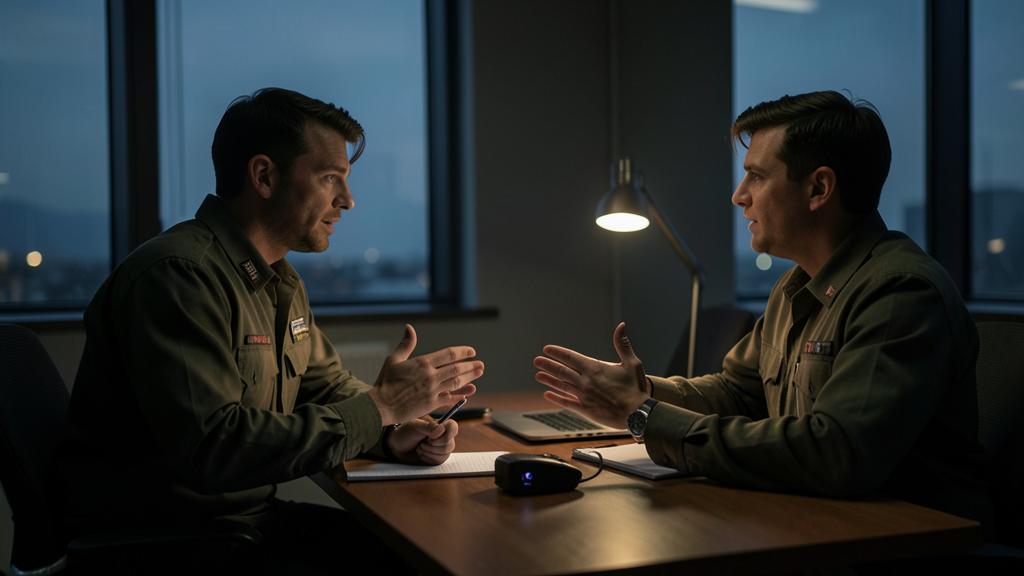
The persistent gray area is here. A just culture policy written in the manual is not enough to guarantee that a verbatim will not resurface elsewhere; the witness arbitrates accordingly, and this arbitration is visible in the precision of what they provide. The only truly available lever is consistency: what was announced at the beginning of the interview must be verified afterward, file after file.
There remains the competence of the person conducting the interview. A sector manager, an instructor, or a safety correspondent often improvises an interview technique that cannot be learned on the job, and the value of the collected material depends more on this than on any other part of the file. For those taking on an analysis function or preparing for an investigator qualification, training is done on low-stakes events, recording themselves and counting their own closed questions. The method is honed in training, and cases are usefully compared on the forum.
The applicable texts on the collection and protection of testimonies, as well as the operator’s operations manual and safety management system manual, take precedence in all circumstances over this article, whose purpose is to explain a mechanism and not to serve as a procedure.


Leave a Reply
You must be logged in to post a comment.