
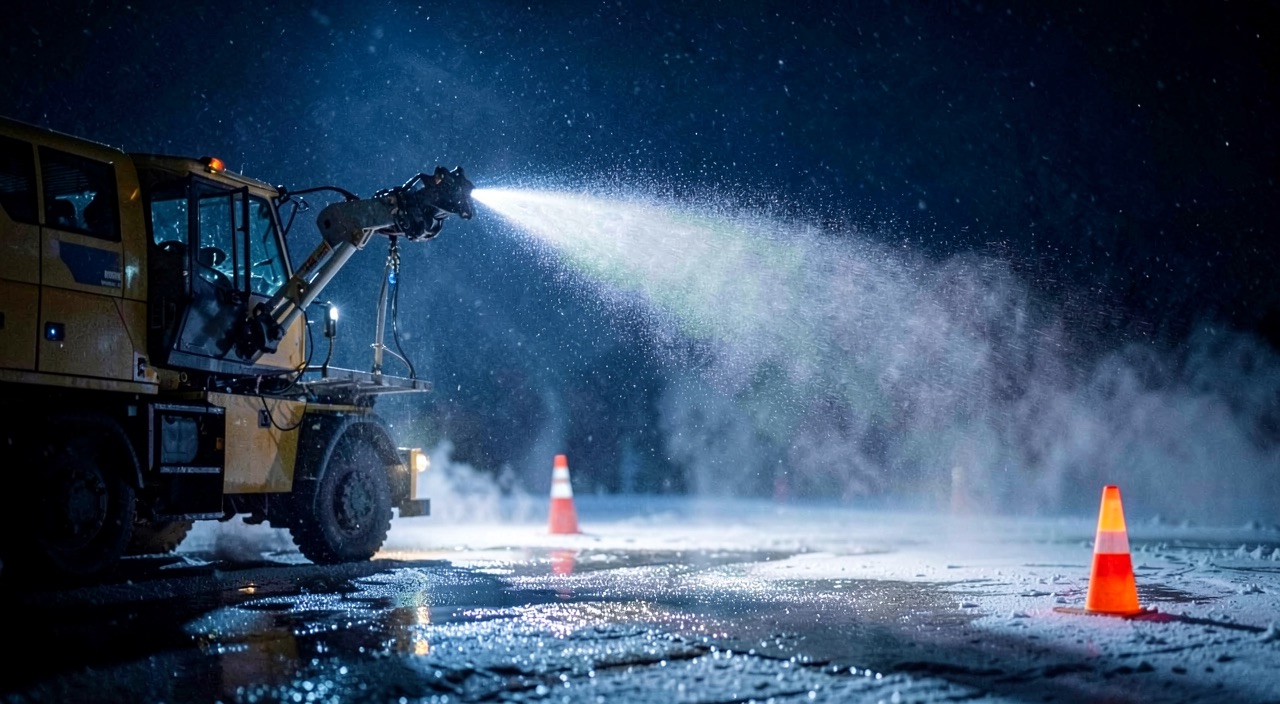
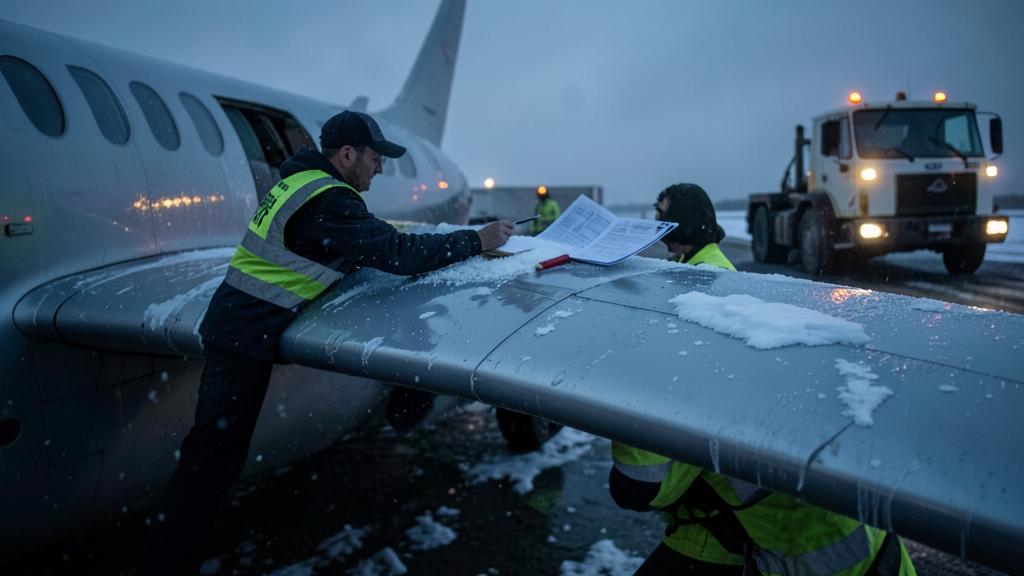
Holdover time assumptions matter. Moderate snow, a few degrees below zero, thickened fluid: the box in the table indicates a range where the upper bound exceeds half an hour. About twenty minutes after the last application, the shine has disappeared at the left root, and the snow is starting to stick. Nothing was done wrong: the correct product was delivered, the timer was armed at the right moment, and the box was read correctly. What was not read are the assumptions on which this box is based — a flat plate, a constant flow rate, calm air, and a surface at air temperature — three of which were false that night.
What a protection duration actually measures
The published durations do not come from an aircraft. They come from a climatic chamber, where a metal plate inclined at a standardized slope receives a layer of fluid of controlled thickness, followed by artificial precipitation with a regulated and constant mass flow rate. An operator observes the surface and declares failure when a fixed criterion is reached: a agreed-upon fraction of the plate is no longer protected. The test is repeated, the dispersion is processed, and a time range is published for each combination of product, temperature, and type of precipitation.
The quantity thus obtained is perfectly defined — and perfectly narrow. It is the duration during which this film, on this plate, under this flow rate, retains this contaminant. None of the words in this definition mention wing, dihedral, leading edge, cold fuel, or jet blast. The transition from the plate to the aircraft is not a measurement: it is a usage convention, accompanied by notes stating in so many words that the duration is not a guarantee. These notes are the part of the document that is never reread, even though they contain the essence of the reasoning.
The geometric difference alone is already sufficient to shift the problem. On the plate, the slope is uniform, and the drainage is regular: the film remains homogeneous until failure, and the failure is visible at a glance. On a wing, the local slope changes from the leading edge to the trailing edge, the dihedral drains outward or toward the root depending on the type, and the fluid migrates throughout the time it is supposed to work. It thins where the curvature is strongest — that is, exactly where a roughness of a few tenths of a millimeter costs the most in maximum lift — and it accumulates toward the rear, where it no longer protects anything useful.
The test measures how long fluid lasts on a flat plate in perfect conditions. Real wings are curved and have different drainage, so the fluid doesn’t behave the same way. The test results don’t directly apply to aircraft.
On an Airbus A320 at -5°C with moderate snow, the chart might show 30-45 minutes of protection. But if the wing skin is -10°C (cold from fuel), the actual protection drops to 15 minutes. The chart doesn’t account for this real-world condition.
The assumptions that the box does not show
A box in a table is a compact object: two entries, a range. This compactness masks a stack of assumptions that, taken one by one, are reasonable on the bench and rarely true on a ramp. Listing them is not academic: it is the only way to know, on a given evening, which side of the range you are on.
| Test assumption | What operations make of it | Direction of the deviation | What reveals it |
|---|---|---|---|
| Constant precipitation, at the nominal rate for the category | Showers, changes of type, rate varying from one minute to the next | Shortens, without warning | Accumulation on the reference surface, never the stopwatch |
| Calm air around the plate | Steady wind, jet blast from the preceding aircraft, relative wind while taxiing | Shortens, first at the leading edge | Gloss disappearing on one side before the other |
| Plate at ambient air temperature | Upper surface cold-soaked by fuel, short turnaround, cold refuelling | Shortens sharply, sometimes from application | Immediate matt appearance, refreezing under the film |
| Even film on a flat, clean surface | Camber, dihedral, wing roots, sheltered areas, old residues | Shortens locally, where you look least | Dull or dry patches ahead of the line of greatest thickness |
| Fluid at the dilution ratio used for the test | Mixture prepared for the day’s temperature, then diluted by precipitation | Shortens as the film takes on water | Truck readout and concentration check |
| Failure judged against a fixed criterion, in a lit chamber | Human judgement, at night, through a window, on a thickened fluid | Reading uncertainty adds to the shortening | Nothing: what you cannot see proves nothing |
The notable fact is not that there are deviations — a standardized test is designed for that — but that none of them work in favor of the crew. The bench is not an average case; it is a favorable case: the only configuration where the fluid works under ideal conditions. A box read without correction is therefore optimistically constructed, and the extent of the optimism depends on the number of assumptions that have fallen, not on the box itself.
Intensity is not a number; it is a class
The table entry has a class name: light snow, moderate snow, freezing drizzle. This name designates a range of accumulation rates, not a value. Depending on the observation method used — human judgment, relationship with visibility, measurement of water equivalent — the same precipitation can be reported in one class or the next, and within a single class, the actual rate varies considerably. Reasoning is therefore based on a quantity whose value and precision are unknown.
Where does the range come from? Not from a safety margin, contrary to what the layout suggests. It precisely reflects this extent: the upper bound corresponds to the low end of the class, and the lower bound to its high end. Retaining the upper bound is therefore neither prudent nor bold; it is a bet on the intensity, formulated without measurement. And if the precipitation is denser than the announced class — a sudden burst, a band more active than the sector average — the protection fails before the lower bound, without anything in the table having signaled it.
Non-stationarity is added. The bench operates at a constant flow rate because a variable flow rate would make the test unusable; real weather, on the other hand, proceeds in transitions. Freezing drizzle turning to snow, snow becoming slushy when the temperature rises above zero, a shower doubling in intensity in three minutes: each of these transitions changes the box while the timer is running. The reasonable approach is to switch to the more restrictive of the two boxes and to consider an unknown portion of the protection as consumed. This is a course of action, not a calculation, and no arithmetic can make up for a change in regime.
The wind, the blast, and the time that cannot be controlled
The climatic chamber is in still air, because an air current would make the test irreproducible. The ramp never is. An established wind, the blast from the preceding aircraft at the holding point, the relative wind during taxiing: all of this shears a film that is held in place only by its viscosity. Thickened products are formulated to resist gravity, not sustained flow. Thinning begins with the most exposed surfaces and the leading edge, that is, once again, where it matters most.
The second factor is time itself, and it is the most poorly estimated of all. Between the end of treatment and brake release are the pushback, engine start, taxiing (whose duration depends on the day’s configuration), a queue, sometimes a change of runway or a slot to be held. In snowy weather, all these durations lengthen at the same time and for the same reasons: it is the most unfavorable coincidence, and it is structural. Protection is entirely consumed on the ground, in the phase where the crew has the least control over the schedule.
There remains a convention that regularly costs minutes: the timer starts at the beginning of the last application, not at the end of spraying. In a two-step treatment, it therefore starts at the beginning of the second step, while the truck is still working. The choice is deliberately pessimistic, since the product deposited first already receives precipitation. Taking the end of treatment as a reference offers several minutes for free that you do not have — and the error goes unnoticed as long as the weather remains favorable.
The wing skin is not at air temperature
The table is indexed to the outside air temperature, because it is the only quantity available everywhere and at all times. The fluid, on the other hand, does not encounter the air: it encounters a skin. After a long stage at altitude, the remaining fuel in the wing is very cold, and its thermal mass is such that the upper surface over the tanks remains below the ambient temperature well beyond the duration of a short stopover. Refueling with cold fuel itself maintains the gap instead of reducing it.
Two consequences combine. The first: if the skin is colder than the freezing point of the applied mixture, the fluid freezes on contact, and its protection is compromised from the start — the announced duration has never begun to run. The second: liquid water that reaches this skin freezes before the fluid has to hold it. This is the mechanism of the deposit that appears in clear skies, without precipitation, on an aircraft whose entire exterior appears dry, and it is the reason why the temperature difference between the freezing point of the mixture and the day’s temperature must be a safety margin, not a tight adjustment.
The trap: reading the range from the top. The upper bound of a box is only valid if you are at the low end of the announced class, in still air, on a wing at air temperature, and with short taxiing. As soon as one of these conditions fails — and they almost always do — the actual duration slides toward the lower bound, sometimes below it. Retaining the upper bound because “the snow is not strong” is like adding four favorable bets without verifying any of them.
What the table does not say about takeoff
The protection duration stops at brake release. What happens next falls under a separate demonstration, conducted elsewhere and for other reasons: aerodynamic acceptance of the product. A thickened fluid must remain in place on the ground and then be evacuated under the effect of shear during acceleration, and this evacuation is verified in a wind tunnel on a reference wing, for a reference acceleration profile. The result is a demonstrated capability within a framework, not a universal property of the product.
Anything that deviates the actual takeoff from this profile falls outside the framework: reduced thrust, low mass with late rotation, departure from an intersection, an aircraft whose rotation speed is inherently low — hence the existence of products intended for slow aircraft, which are not a degraded version of the others but a response to this constraint. A runway covered with slush adds its own effect: the rollout lengthens, the accumulation drag increases, and part of the contaminant is thrown onto the flaps and the tail, outside of everything the box had anticipated.
You must also account for the fluid that did not leave. Residues of thickened products deposit in sheltered areas — control surface gutters, joints, cavities — dry out, then rehydrate and freeze upon subsequent exposure, sometimes several flights later. The phenomenon does not play out on the scale of a departure but on the scale of a season, and it is addressed by dedicated inspections included in the maintenance program, never by a station timer.
The timer does not authorize anything: it warns
The regulation requires: no takeoff with adhering deposits on critical surfaces. The protection duration does not appear in this sentence. It answers a different, more modest, and more useful question: from when should you stop assuming and go check? An elapsed duration does not prohibit departure; it prohibits departure without having seen.
The act that authorizes is the pre-takeoff inspection. It only has value if it actually allows you to assess the condition of the surfaces: a position from which you can see the reference surface designated by the flight manual for the type — and not the one you can see best — sufficient lighting, a light at night, and a short delay before brake release. From the front seats, you can see almost nothing of what matters. On many types, the observation is done from a cabin window, which requires having organized it before lining up, not discovering it while lining up.
What you are looking for is not snow: it is the end of the fluid. A film that is still protecting is shiny and smooth; a film at the end of its life loses its sheen, takes on a matte appearance, and then holds the flakes instead of absorbing them. On a thickened product, this transition is difficult to read from a distance and very difficult at night — which is precisely when you are looking for it. Hence the interest in having looked at the reference surface a first time right after treatment: you can only compare well with a reference that you have seen.
The right reflex: noting to the minute the start time of the last application, never the end, and setting the timer to the lower bound of the box. The upper bound is only achieved by verifying one by one the assumptions that support it; otherwise, it is not read. And the question of whether the pre-takeoff inspection will be feasible from where you are is decided at the holding point: realizing it while lined up on the runway leaves only one option, and it costs a slot.
What remains to be established in your own documentation
None of the above replaces five checks that each operator decides for itself, and whose answers are not obvious.
- The set of tables retained by the operator and its version: these documents are reissued for each season, and an outdated version easily circulates in a kit or on a personal device.
- The product actually loaded on the truck that day: the box is only valid for that fluid, and the minimum usage temperature of the mixture depends on its dilution, and therefore on what was prepared in the morning.
- The reference surface designated for your type, and the exact location from which it is visible with night lighting.
- Who is authorized to conduct the pre-takeoff inspection, and what the procedure provides when it is not feasible from the position reached.
- The limitations related to thickened products in the flight manual: they exist on certain types, relate to configuration or rotation, and cannot be deduced from any duration table.
What the tables do not cover, and this may be the most instructive: the blank boxes. The absence of a value is not an oversight; it is a statement of the absence of usable data, or the judgment that no product holds in this condition. Ice pellets, freezing rain beyond a certain intensity, mixed conditions: the blank box says that there is no timer to arm, therefore nothing to consume and nothing to monitor. It does not authorize treatment followed by a cautious departure; it refers to treatment immediately followed by a check, or to waiting. This is the area where operational pressure is most felt, and where the table offers no support.
For those preparing a qualification, a line check, or an operator interview, the subject is recognized by two questions that almost always come up: when does the timer start, and what authorizes departure once the duration has elapsed. Answering “the table” to both is the typical mistake, and it is immediately visible. The exchanges of the technical forum FL330 and the training courses FL330 take up the subject from that angle.
The tables retained by the operator, the flight manual for the type, the operations manual, and the approved deicing and anti-icing procedures take precedence over this article, whose purpose is to explain a mechanism and not to replace it.


Leave a Reply
You must be logged in to post a comment.