
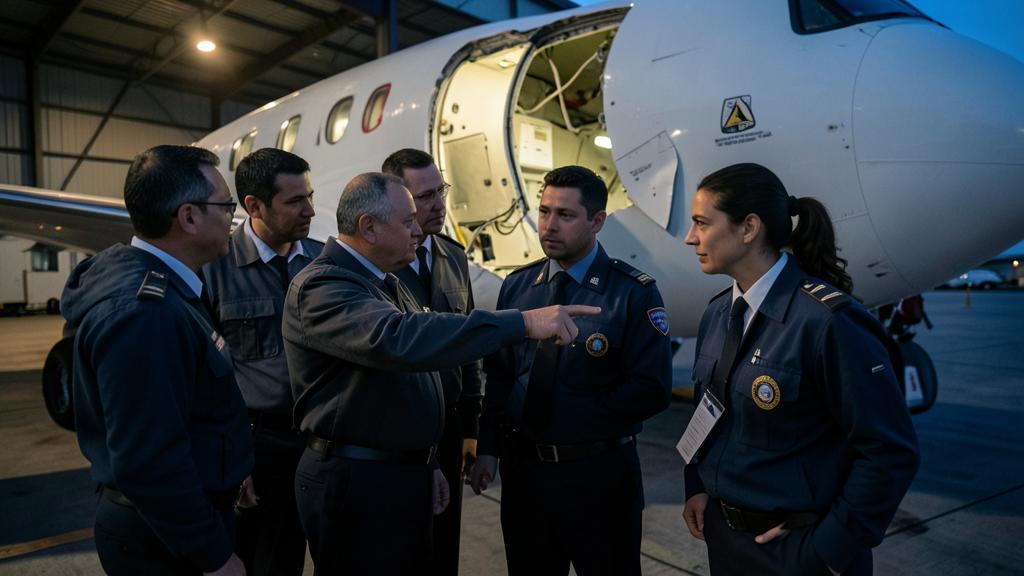
Safety management training is one of the few subjects an airline teaches where nobody, at the end of the session, can say what the crew is now able to do that they could not do that morning. The slides are correct, the attendance sheet is signed, the record satisfies the audit. And the reporting rate does not move. The gap is not in the content — it is in the fact that the objective was recall rather than capability, and that the material described a system the room had never met.
What the requirement actually asks for
ICAO Annex 19 organises safety management into four components: safety policy and objectives, safety risk management, safety assurance, and safety promotion. Training sits in the fourth, alongside safety communication — and the placement is deliberate. Safety promotion is not a knowledge-transfer component; it is the component whose job is to make the other three work by ensuring that the people generating and consuming safety information understand what they are part of.
In the European framework, the management-system requirements now run through the operator, the approved maintenance organisation and the continuing-airworthiness organisation alike, so the same architecture reaches flight crew, cabin crew, mechanics, planners and ground staff. The FAA carries the same structure in its own safety management rule, and alongside it the voluntary reporting programmes are typically established jointly by the operator, the employee group and the regulator. The vocabulary differs at the edges; the four components do not.
What none of those texts specify — and this is where operators are on their own — is what a line employee is supposed to be able to do at the end of the training. The regulation sets the obligation to train. The definition of competence is the operator’s problem, and most operators solve it by defaulting to a syllabus of definitions.
Why the definitions-based session fails predictably
A session built around the components, the risk matrix and the reporting policy produces a room that can answer questions about the system and cannot operate inside it. That is not a training failure in the usual sense — the material was delivered and understood. It is an objectives failure. Knowing that safety assurance exists does not tell a first officer whether the thing that happened on the last sector is worth writing up. Knowing the definition of a hazard does not help a mechanic decide whether a recurring awkward access on a panel is a report or just a bad day.
Three specific weaknesses show up on the line, and they are the ones worth designing against.
- The threshold problem. Nobody has told people where the line is. Left to themselves, most people set it far too high — they report what was frightening, not what was informative. The system then receives a diet of serious events and almost none of the precursors it was built to catch.
- The empty-loop problem. A report goes in and nothing visible comes back. After two or three of those, a rational person stops. Reporting rate is not a measure of safety culture in the abstract; it is a measure of whether the last report was worth the effort.
- The protection problem. People do not report when they are unsure what happens to them afterwards. Vague reassurance makes this worse, not better, because it signals that nobody wants to state the boundary precisely.
The problem with traditional safety training is that it teaches people to memorise facts about the system, not to use it. Workers need to know when to report issues, what happens to their reports, and how they’re protected. Without clear answers, they won’t report problems that could prevent accidents.
On a hot day at an airport with a 7,000-foot runway, a Boeing 737 pilot notices the aircraft is using more runway than usual during takeoff. Instead of reporting this as a potential hazard (which could help identify a trend), the pilot only reports it after a near-miss, when it’s already too late to prevent the issue from recurring.
The competences a line team should actually leave with
The productive move is to write the objectives as things a person can be observed doing, then build the session backwards from them. The list is short, and it is close to identical across flight crew, cabin crew and maintenance — only the examples change.
| The person can… | Why it matters | How you verify it |
|---|---|---|
| Tell a hazard from an occurrence, and report both | Hazards are the cheap information; occurrences are the expensive kind | Give five short scenarios, ask which is which and what they would file |
| Write a report someone can act on | An unusable report costs analyst time and returns nothing | Have them write one from a scenario; score it on whether an analyst could act without calling them back |
| State what happens to their report after they file it | Belief in the loop is what sustains reporting | Ask them to describe the path, by name of function, not by org chart |
| State their own protections and the limits of those protections | Uncertainty suppresses reporting more effectively than any policy | Ask where the line sits and who decides — an accurate answer includes the exceptions |
| Name two changes in their own operation that came from reports | Evidence that the system is real in this company | Straight recall — and if the room cannot do it, the problem is communication, not training |
| Raise a concern upward and have a script for being overruled | Most safety information dies in the moment it is not said | Role-play or line observation; the escalation is either practised or it is theoretical |
Note what is not on that list: the ability to recite the four components, to reproduce the risk matrix, or to name the accountable manager. Those are all reasonable things to mention in passing. None of them is a capability, and none of them should consume the middle third of a session.
The single change that alters the room: use your own events
A session built on the operator’s own de-identified occurrences behaves differently from a session built on generic case studies, and the difference is visible within ten minutes. The room recognises the aircraft, the airport, the stand, the procedure. Nobody is deciding whether the material applies to them, because it obviously does. And the discussion shifts from whether the system is worth using to what should have been done about a specific thing that actually happened here.
There is a second, less obvious gain. Presenting the operator’s own events forces the safety department to have an answer for each of them — what was analysed, what was decided, what changed, and what did not change and why. That is exactly the feedback loop the reporting population is missing. A training session built this way is simultaneously a safety promotion action, and it closes loops that a newsletter would not close.
| Built on the framework | Built on the operator’s events | |
|---|---|---|
| Material | Components, definitions, matrix, policy extracts | Ten to fifteen de-identified occurrences from the last twelve months |
| Room’s question | Will this be examined? | What happened next? |
| What the trainer needs | The slide deck | Access to the safety data and the analysis outcomes |
| Preparation cost | Low; reusable indefinitely | Real; the material has to be rebuilt each cycle |
| Output on the line | Recall, decaying over months | A calibrated reporting threshold and a visible loop |
| Side effect | None | Forces the safety department to close its own feedback loops |
The preparation cost line is the honest objection, and it should be stated rather than hidden. A framework deck is written once and shown for five years. An event-based session has to be rebuilt every cycle, requires the trainer to have real access to safety data, and requires the safety department to release outcomes it may not have documented cleanly. That is a genuine organisational cost. It is also, more or less exactly, the cost of having a safety management system that functions rather than one that is described.
Just culture: state the boundary, including the exceptions
In the European Union, occurrence reporting and the protection of reporters are governed by Regulation (EU) No 376/2014, which establishes both mandatory and voluntary reporting schemes and requires that information from those schemes not be used against the reporter — with defined exceptions for wilful misconduct and for a manifest, severe and serious disregard of an obvious risk. Other States implement equivalent arrangements through their own law and their national safety programme.
The training implication is unpopular and important: teach the exceptions. A session that says “you are protected” and stops produces a room that does not believe it, because everyone present knows there must be a limit somewhere and is now quietly guessing where. A session that states the boundary explicitly — here is what is protected, here is what is not, here is who makes that call and by what process — produces a room that can act on the information. Precision reassures. Vagueness does not.
The trap. A just-culture policy that has never been tested in public is treated as decoration. The first time an event sits near the boundary and the outcome is not visibly explained, the reporting population draws its own conclusion and the rate drops. What restores trust is not another poster campaign — it is a documented decision process, applied consistently, and communicated when the case allows it.
The maintenance side is not a variation on the crew session
Maintenance personnel already receive human factors training under the maintenance organisation rules, with continuation training on a recurrence set by the approved training programme — a two-year cycle in common practice. That training covers error types, shift handover, fatigue, norms and the environmental factors of the hangar and the line station. It overlaps with safety management training but does not replace it, and combining the two badly produces a session that satisfies neither requirement.
The specific content that has to exist on the maintenance side is different in kind from the flight-crew equivalent. It concerns what happens to a report about a procedure that cannot be followed as written, about a tool or an access that generates errors by design, about a task card whose duration assumption is wrong, and about the pressure of a departure time on a decision that should have been technical. Those reports go to a different analysis chain and produce a different class of corrective action — a maintenance instruction change, a tooling change, a manning change. Teaching them with cabin examples wastes the session.
The right reflex. Build the session backwards from a single question: what will someone in this room do differently on Tuesday? If the honest answer is “know more about the system”, the objectives need rewriting. If it is “file the near-miss they would previously have discussed in the crew room and then forgotten”, the session is designed correctly, and everything else in it is supporting material.
Measuring the training without pretending to measure safety
Safety performance indicators and targets are part of the Annex 19 architecture, and they are also where a lot of well-intentioned measurement becomes theatre. A training programme cannot be evaluated by the accident rate, and it should not be evaluated by an end-of-session quiz either. What it can be evaluated by are indicators that respond to it within a plausible time frame.
| Indicator | What it tells you | What to be careful about |
|---|---|---|
| Voluntary report rate per department | Whether the reporting threshold has moved | A rise is usually good news; treating it as a deterioration is the fastest way to kill it |
| Proportion of reports that are hazards rather than events | Whether people are reporting before something happens | Needs a stable definition, applied by the analysts and not by the reporter |
| Report quality, sampled and scored | Whether the writing competence was actually taught | Score the report, never the reporter; publish the criteria in advance |
| Median time from report to acknowledgement, and to feedback | Whether the loop is closing at a speed people can perceive | Acknowledgement and feedback are different measurements; only the second one sustains reporting |
| Share of the workforce able to name a change from a report | Whether the loop is visible, not merely closed | Sampled by conversation, not by survey form |
None of those numbers proves the operation is safer. All of them tell you whether the machinery for finding out is running. That is the correct level of claim for a training programme, and stating it that way protects the programme from being judged against something it cannot deliver.
What a line team is entitled to expect
Turned around, from the point of view of the crew room or the hangar, the reasonable expectations are short and testable. That the session uses events from this company. That the threshold for reporting is stated in concrete examples rather than in adjectives. That the path a report takes is described by function and by timescale. That the protections are stated with their exceptions. That at least a few of the reports discussed have visible outcomes attached. And that someone in the room can be asked what happened to the report they filed last spring, and get an answer.
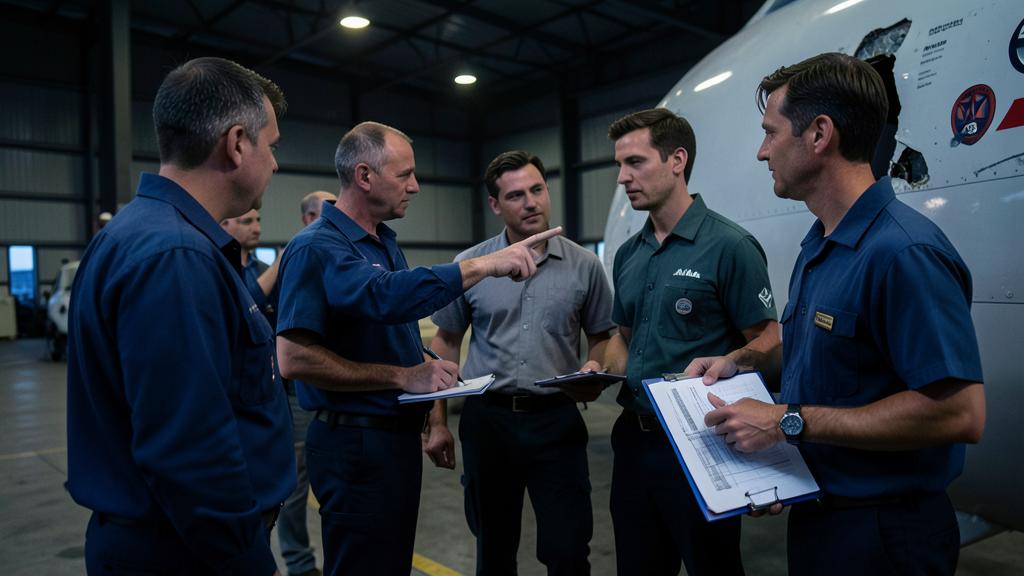
An operator that can do those six things is running safety promotion as the regulation intends it. One that cannot is running an attendance record. The distinction is not detectable in an audit of training files, which is precisely why it survives so comfortably in so many organisations — and why the useful measure of a safety management training programme is not what was delivered, but what the line does the following week. Structured material on building this kind of session is available through formations.fl330.com, and the practical arguments about reporting thresholds and just-culture boundaries run continuously on forums.fl330.com.


Leave a Reply
You must be logged in to post a comment.