
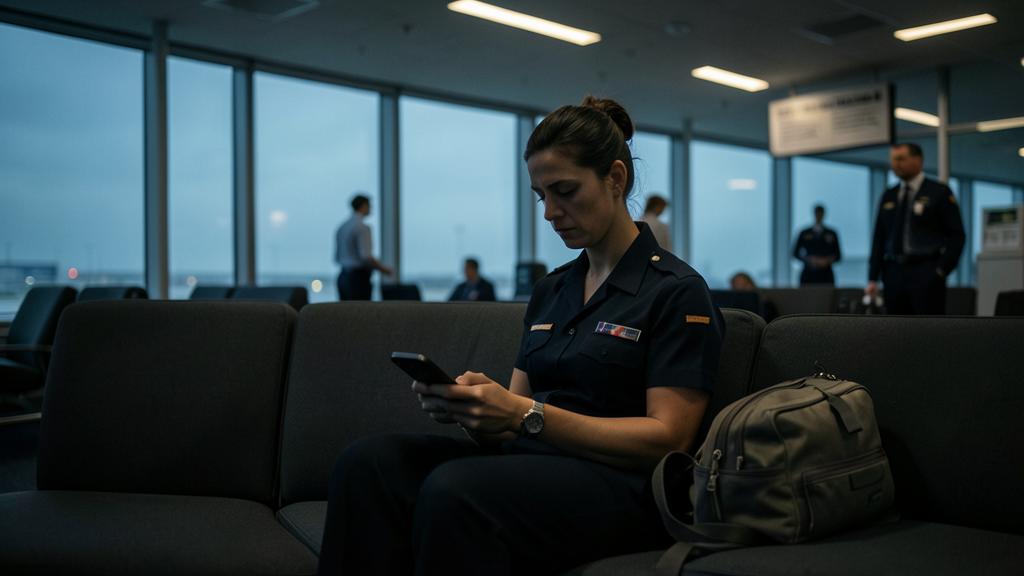
A standby day that ends without a call looks, on paper, like a day off with an inconvenience attached. The flight time limitation scheme disagrees, and it disagrees for a reason worth understanding rather than merely complying with: waiting is not resting. A crew member who spends eleven hours dressed, packed and within reach of a telephone has not slept as they would have slept, and arrives at the eventual report time already carrying part of a duty they never flew. That is what the partial counting of standby is measuring, and it is why the maximum duty available to you shrinks before you have gone anywhere.
Three things called standby, and why the label decides everything
The word covers arrangements that differ enormously in what they cost the crew member and in how they are counted. Getting the label right is the first step, because every subsequent rule hangs off it, and rostering systems and crew occasionally use the terms loosely in a way the scheme does not.
| Form | What it asks of the crew member | How it is generally counted |
|---|---|---|
| Airport standby | Presence at the aerodrome, in uniform or ready to operate, for a defined period | In full as duty, and in the European scheme it counts toward the flight duty period that follows |
| Standby at a place other than the aerodrome — home standby, or standby at accommodation | Availability at a nominated place with a defined response time; no requirement to be at the aerodrome | Partially as duty, at a proportion set by the scheme, with a reduction applied to the maximum flight duty period once the standby has run long enough |
| Reserve, or long-call availability | Availability for assignment, typically with notice long enough for a full rest period before report | Frequently not counted as duty at all, provided the notice and the protected rest before report are genuine |
| Split duty | A flight duty period broken by a defined rest on the ground, under conditions set by the scheme | Under specific provisions that are neither standby nor ordinary duty; a separate topic with its own conditions |
The critical boundary is between the second and third rows. A duty called reserve but carrying a short response time and no protected sleep opportunity is home standby by any operational measure, whatever the roster code says. Crew members who suspect their operator has drawn that line in the wrong place are describing a scheme question, and it belongs in a fatigue report, not in a corridor conversation.
Why airport standby counts in full and home standby does not
The asymmetry looks arbitrary until you ask what each arrangement does to sleep. At the aerodrome, in a crew room, in uniform, subject to interruption and to ambient noise and light, meaningful restorative sleep is essentially unavailable. The scheme therefore treats airport standby as what it is: duty, indistinguishable in its fatigue cost from any other time spent at work.
Home standby is genuinely different. The crew member is in their own environment, with the possibility of lying down, eating properly, and in some cases obtaining real sleep. It would be dishonest to call that duty in full. It would be equally dishonest to call it rest. Studies of on-call sleep consistently point the same way: the possibility of being woken degrades sleep even when no call comes. Anticipation tends to delay sleep onset, fragment the night, and reduce the restorative depth of whatever sleep is obtained.
Partial counting is the scheme’s answer to a genuinely intermediate state. It is a compromise, and it is deliberately a floor rather than a measurement — no regulator can know how much sleep any individual actually obtained on a given Tuesday.
Standby at home isn’t full duty, but it’s not real rest either. The rules count part of it as work because being on call messes up your sleep, even if you don’t get called.
A crew member on home standby from 08:00 with a 2-hour response time might nap for 30 minutes but wake up groggy. If called at 16:00, after 8 hours of standby, their maximum flight duty period is reduced by the 2 hours beyond the first 6, even if the flight itself is only 3 hours long.
The proportion that counts, and what it counts toward
In the European scheme, a defined proportion of time spent on standby other than airport standby counts as duty — the regulatory floor sits at a quarter, and an operator’s approved scheme or a collective agreement may count more. The essential point for a crew member is not the number but the destination: that time flows into the cumulative duty limits, the running totals over consecutive days, weeks and months that cap how much work can be assigned in a period.
This has a consequence people notice late in a roster month. A crew member who has been on standby repeatedly without being called can find themselves approaching a cumulative limit having flown comparatively little. The hours are real hours in the counting even though no aeroplane moved. Rostering departments know this; individual crew members frequently do not, and are surprised when a request for an additional sector is refused, or when a standby block is removed from a published roster to protect a later trip.
The reduction: waiting shortens a duty you have not started
The second mechanism is the more consequential one on the day itself. When a call finally comes, the flight duty period begins at report — not at the moment the telephone rang, and not at the start of the standby. But the maximum flight duty period available is not the full table value. Beyond a threshold defined in the applicable scheme, each further hour of standby is subtracted from the maximum duty the crew member may then perform.
The reasoning is direct. The table of maximum flight duty periods is built around a crew member who arrives having rested. Someone who has spent most of a day in a state of maintained readiness does not arrive in that condition, and applying an unreduced maximum to them would be applying a limit derived from a person who does not exist. The reduction restores the intent of the table.
The trap. The reduction is applied to the maximum, not to the roster. A crew member called out late in a long standby can be assigned a duty that is perfectly legal and still ends materially later than the roster suggested, because the reduction bit into headroom that was never going to be used. The dangerous version is the reverse: a duty planned close to the unreduced maximum, then assigned from a standby that has already consumed several hours. That combination has to be caught at assignment, and the crew member is often the only person looking at both figures at once.
The practical habit is short: before accepting an assignment from standby, know the time the standby started, the applicable threshold and reduction in your own scheme, and the planned finish of the duty being offered. Two of those three are on your roster. The third is in the operations manual, and it takes one reading to learn permanently.
What actually happens to sleep on a standby day
The regulatory language speaks of a sleep opportunity. Fatigue management is concerned with sleep obtained, and the gap between the two is where standby does its damage.
| Mechanism | Effect on the eventual duty |
|---|---|
| Anticipatory arousal — the expectation of being woken | Longer sleep onset, more fragmentation, less deep sleep, even on nights when no call arrives |
| Timing uncertainty | Napping is either skipped or attempted at the wrong circadian phase, producing little recovery |
| Sleep inertia after an unplanned wake-up | Reduced performance in the first stretch after waking, overlapping the pre-flight preparation and the departure phase |
| Circadian misalignment | A call that lands a duty across the window of circadian low, defined in the European scheme as the period from 02:00 to 05:59 in the time zone the crew member is acclimatised to, places it where alertness and performance are most reliably degraded |
| Cumulative debt across a standby block | Several consecutive standby days without calls can leave a crew member less rested than several days of flying |
| Domestic load | Standby at home is rarely spent lying down; the day fills with everything that cannot be done while flying |
The last line is not a joke. Home standby is frequently the most active day of a roster week, because it is the only day at home that is not a duty. That behaviour is entirely rational and it is invisible to every limitation scheme ever written, which is precisely why the individual’s judgement remains the last line.
The response time is a fatigue parameter, not a logistics one
The scheme requires a response time to be defined — the interval between call and report. It is usually discussed as a commuting question: can the crew member reach the aerodrome in time? That framing is incomplete and it produces bad schemes.
A response time also determines what the crew member can do during standby. A short response time forbids sleep in any useful sense, forbids leaving the immediate area, and in practice converts home standby into a sedentary vigil. A longer one permits a genuine nap, a meal, and a controlled preparation. Two schemes with identical counting rules and different response times impose entirely different fatigue loads.
Whether travelling time from the standby location to the reporting point counts as duty is set by the scheme and by any agreement above it, and it is a recurring source of disagreement — particularly for crew who live at a distance from base, or who are on standby at an accommodation whose transfer time is longer than anyone assumed. It is worth knowing your own answer before the day you need it. Crew discussing how different operators construct these schemes will find the comparison running on the FL330 forums.
Where the European and United States approaches diverge
This is one of the areas where a crew member moving between regulatory systems can carry an assumption that no longer holds. The underlying physiology is identical; the regulatory constructions are not, and neither is the vocabulary. The scope differs too: the European scheme covers flight crew and cabin crew together, while the United States rule below applies to flight crew only, cabin crew duty limits sitting elsewhere in Part 121.
| European scheme (Part-ORO Subpart FTL) | United States — 14 CFR Part 117 (Part 121 flight crew) | |
|---|---|---|
| Vocabulary | Airport standby, standby other than airport standby, reserve | Short-call reserve and long-call reserve, each with a defined reserve availability period |
| Core mechanism | Partial counting toward cumulative duty, plus a reduction of the maximum flight duty period once standby exceeds a threshold | A bounded availability period, with the time spent available interacting with the flight duty period limit that follows |
| Protected sleep | Rest requirements before and after standby, with the scheme defining maximum standby duration | Long-call reserve requires notice sufficient for a protected rest period before report |
| Where the detail lives | The regulation, the certification specifications, and the operator’s approved scheme | The regulation itself, which is more prescriptive, with less left to operator schemes |
Two general cautions follow. First, do not transfer a remembered figure across systems; the constructions differ enough that a number correct in one is meaningless in the other. Second, many operators are bound by collective agreements more restrictive than the regulation, so the applicable limit is frequently not the regulatory one. The binding figure is the most restrictive of the three: regulation, approved scheme, and agreement.
What the crew member controls, and what to report
Very little of the above is negotiable on the day. What remains within the individual’s control is narrow but genuinely useful, and it is mostly a matter of treating standby as a duty to be prepared for rather than a day to be filled.
- Protect a sleep window inside the standby, at a time consistent with the most likely call-out, and treat it as an appointment rather than an aspiration.
- Pack, prepare and check documents at the start of the standby, so that a call requires no decision-making at all.
- Know the standby start time, the threshold and reduction in your scheme, and the planned finish of any duty offered — the three figures that determine whether an assignment is sound.
- Treat a call arriving near or inside the window of circadian low as a distinct case, and expect the first hours after waking to be the weakest of the duty.
- Use the fatigue reporting channel when a standby produced a duty you would not choose to repeat. A commander’s discretion entry describes one flight; a fatigue report is the only mechanism that reaches the scheme itself.
The right reflex. Judge a standby by what it did to your sleep, not by whether you flew. A standby day with no call and no sleep is a fatiguing day and should be reported as one. Fatigue reporting systems are consistently starved of exactly this data, because crews report the duties that felt bad and not the waiting that made them so — which is why standby schemes are so often revised only after an event rather than before one.
Why the partial count is the honest answer
It is tempting to read the counting of standby as a bureaucratic device, a way of pricing inconvenience. It is better understood as an admission. The scheme is conceding that a crew member held in readiness is being spent, slowly, in a way that produces no flying and no rest — and that when the assignment finally arrives, they arrive at it with less of themselves available than the tables assume.

Everything else follows from that. The proportion counted toward cumulative limits acknowledges that standby days accumulate. The reduction of the maximum duty acknowledges that a long wait has already consumed part of the day’s capacity. The response time acknowledges that readiness has a cost proportional to how tightly it is drawn. None of it is generous, and none of it is arbitrary. It is an attempt to put a number on something crew members have always known from the inside: the flight after a long standby is harder than the same flight would have been from rest, and the difference was spent before the telephone rang.


Leave a Reply
You must be logged in to post a comment.