
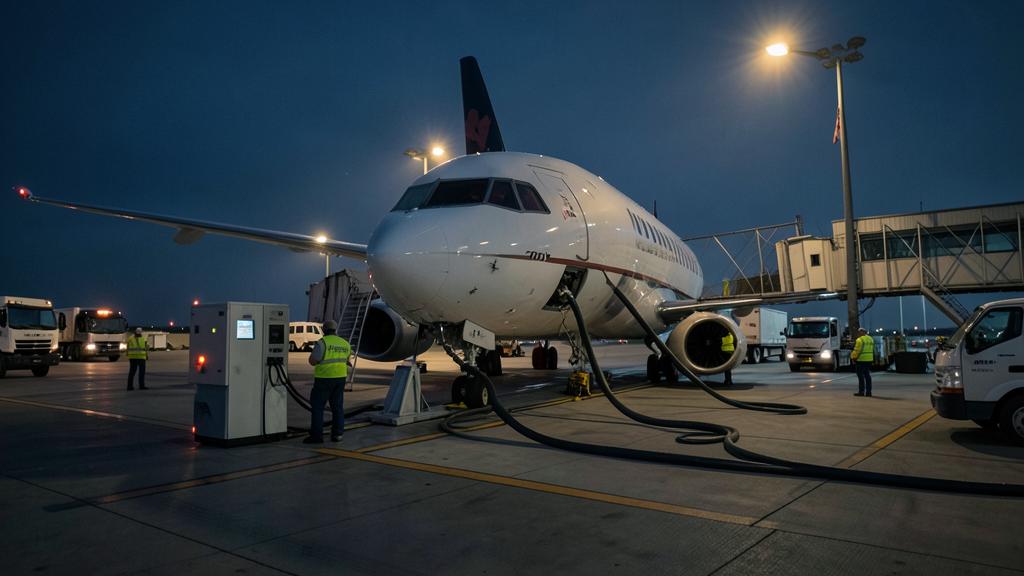
Every discussion of electric aircraft eventually arrives at the pack: its energy density, its chemistry, its mass fraction. Yet for anyone planning an actual schedule, the pack is rarely the thing that decides how many rotations a day the aeroplane flies. The stand does. The power available at the parking position, the ability to reject the heat that power creates, and the electrical connection feeding that corner of the apron all bite well before the cells reach any limit of their own. This is where the ceiling really sits, and why moving it is a civil engineering programme rather than a purchase.
The arithmetic that frames the problem
Before any engineering, there is division. Recharging a given quantity of energy within a given ground time requires a power that follows directly from the two numbers, and the result is uncomfortable at every plausible combination.
| Energy to replace | 45-minute window | 25-minute window |
|---|---|---|
| 400 kWh | about 530 kW | about 960 kW |
| 1 200 kWh | about 1.6 MW | about 2.9 MW |
| 3 000 kWh | 4 MW | about 7.2 MW |
Two corrections make the real requirement worse rather than better. Charging is not lossless: conversion, cabling and the pack’s own internal resistance all take a share, and every watt lost also becomes heat somebody has to remove. More significantly, charging power is not constant. Cells accept high current comfortably in the middle of their state-of-charge range and much less so near the top, so the current tapers as the pack fills. To achieve the average powers in the table, the peak power in the constant-current phase has to be appreciably higher — which means the installation is sized on the peak, not on the average.
The practical conclusion is that a turnaround charge for anything above the very light end of the market is a megawatt-class event. That single word changes which department of the airport you are talking to.
To charge an electric plane fast enough for multiple flights per day, you need power measured in megawatts. But airports weren’t built for this—most stands only handle a fraction of that power. The real bottleneck isn’t the battery, it’s the ground infrastructure.
A 1,200 kWh battery needs about 2.9 MW of power to recharge in 25 minutes. That’s like powering 2,900 typical homes at once. Most airport stands today can’t handle even a fraction of that, let alone multiple planes charging simultaneously.
The stand was electrified for a different job
Apron electrification is not new. Aircraft parking positions have been fed with electrical power for decades, but for a job whose scale bears no relation to charging. Fixed ground power delivers 115/200 V at 400 Hz to run the aircraft’s systems with the engines and auxiliary power unit shut down; a narrowbody stand converter is typically rated on the order of 90 kVA, with widebody positions served by a larger unit or a pair of them. Pre-conditioned air adds a further load of the same broad order.
So a conventional stand is provisioned in the low hundreds of kilovolt-amperes. A megawatt-class charge is roughly an order of magnitude beyond that at a single position, and considerably further once a row of stands is expected to charge within the same hour. Nothing in the existing installation — the feeder, the transformer, the ducting under the apron, the switchgear in the substation, in many cases the airport’s own connection agreement with the network operator — was sized with that in mind.
The aircraft side has an equivalent discontinuity. The existing ground power receptacle is an AC connector sized for tens of kilovolt-amperes; it cannot be repurposed. A charging inlet is a new, separate, high-current DC interface, and its position on the airframe is an aircraft-level design decision with apron consequences: it has to be reachable by a cable that does not cross the fuel hydrant, the catering route, the belt loader path or the passenger boarding bridge envelope, and it has to remain reachable at every stand geometry the aircraft will use.
Follow the power from the substation to the cell
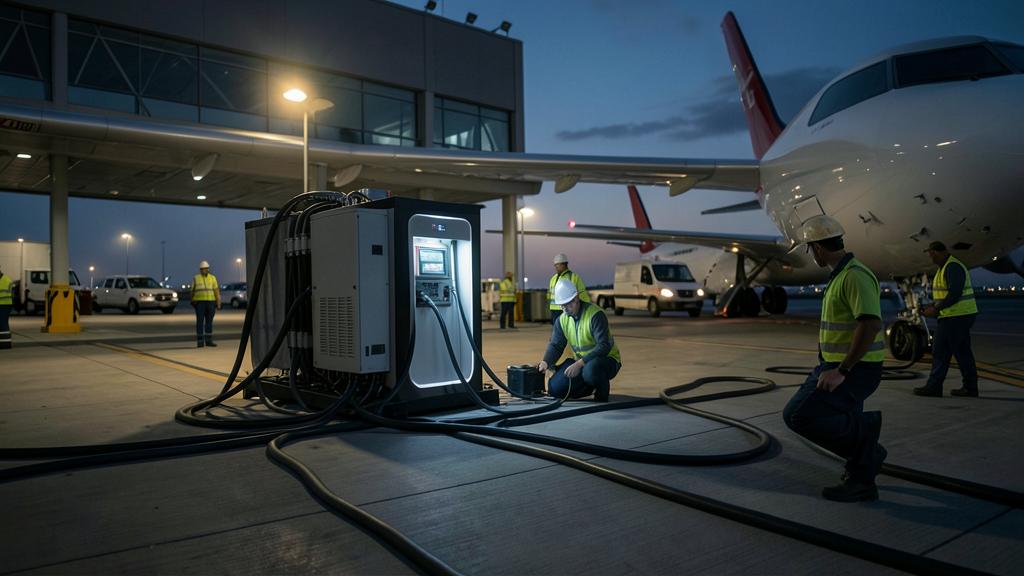
The useful discipline is to walk the whole chain and identify what limits each link, because the answer is different at every step and the binding constraint is rarely where the discussion starts.
| Link | What limits it | What relieving it involves |
|---|---|---|
| Network connection to the airport | Contracted capacity, and the local network’s spare headroom | A new or upgraded connection agreement; lead times commonly measured in years, not months |
| Distribution around the airfield | Existing duct routes, feeder cross-section, voltage drop over apron distances | Trenching across live movement areas, achievable only in staged possessions and normally only in the low season |
| Transformer and rectifier serving the stand | Physical footprint, heat rejection, acoustic limits | Apron or basement real estate that is already committed, and clearance rules that govern what may stand where |
| Cable and connector | Current, and therefore conductor cross-section, mass and cooling | Liquid cooling, and mechanical handling assistance once the assembly exceeds what a person can position by hand |
| Aircraft inlet and internal distribution | Contactor and busbar ratings, protection coordination, insulation | Airframe design, not a retrofit decision |
| The pack itself | Acceptable charge rate as a function of temperature and state of charge | Cell chemistry and thermal management; both traded against energy density and life |
One lever cuts across the whole middle of that chain: voltage. For a given power, current falls as voltage rises, and it is current that drives conductor mass, cable cooling and connector heating. This is exactly the reasoning that produced megawatt-class charging standards for heavy road vehicles, developed by the same standardisation bodies that produced the earlier car connectors, and it is the obvious starting point for aviation. The ceiling is set by insulation coordination, creepage and clearance, arc management in direct current, and — for the airborne portion of the same architecture — the fact that air’s dielectric strength falls with altitude, which constrains how far the aircraft’s internal distribution can follow the ground equipment upward.
Heat is the second constraint, and it arrives first
An aircraft that has just landed brings a hot pack to the stand. Discharging at flight power heats the cells; so does the descent and taxi. Charge acceptance is temperature-dependent in both directions — cells will not take high current when cold, and must not take it when hot — so the first minutes of a turnaround may be spent conditioning the pack rather than filling it. That time comes out of the same window as everything else.
Then the charge itself adds heat, at the worst possible moment. In flight there is ram air and a great deal of it. On stand there is none: the aeroplane is stationary, the surrounding air is often warm, the apron surface is radiating, and any heat exchanger has to be driven by fans that themselves consume power and make noise. The thermal system that has to be sized for the charge is therefore frequently larger than the one the flight would require — mass carried for the whole sector to serve forty minutes on the ground.
The trap. Fast charging is not thermally or chemically free. Charge rate, cell temperature and time spent at high state of charge all accelerate degradation, and pack replacement is a capital item, not a consumable. An operator that solves its rotation problem by charging as hard as the equipment allows has moved the cost from the schedule to the balance sheet — and will discover the transfer only at the second or third pack.
A turnaround is a process, not a duration
The ground time is not a block of free minutes waiting to be used. It is a sequence with a critical path: on-blocks, doors open, disembarkation, cleaning and catering, boarding, doors closed, pushback. Charging is only free if it runs in parallel with that sequence. If it cannot, it becomes serial, and the entire duration is added to the turnaround rather than absorbed by it.
That is why the regulatory question — may charging proceed with passengers on board, boarding or disembarking? — is worth more to a business plan than a great deal of pack chemistry. The nearest established analogue is refuelling with passengers on board, boarding or disembarking, which the operational rules permit under specified conditions: qualified personnel posted and able to initiate an evacuation, two-way communication maintained between them and the ground crew supervising the operation, exits and escape routes kept usable, and the whole procedure set out in the operations manual. The framework exists because the hazard was characterised and the mitigations were agreed.
High-power charging is not that framework, and its hazards are not the same ones. Thermal runaway propagates differently from a fuel fire and is fought differently. Direct current at these levels does not self-extinguish an arc the way alternating current does. Isolation faults on a wet apron have to be detected and cleared automatically, in the presence of ground crew who are handling staff rather than qualified electrical workers. None of that is insurmountable, but all of it has to be written down, approved, trained and equipped before a single minute of parallel charging appears in a schedule.
What the airport actually has to build
The temptation is to size the airfield installation by multiplying stands by power and applying a comfortable diversity factor, on the reasoning that not everything peaks at once. At an airport this reasoning is unusually weak, because airline schedules are deliberately synchronised. Hub banks are built so that aircraft arrive together, sit together and leave together; low-cost operations concentrate departures in the same morning and evening peaks. The coincidence factor is highest exactly when the demand matters.
Two commercial features then compound it. Network tariffs for large consumers are typically billed in part on peak demand measured over a short interval, so a single simultaneous bank can set a charge that persists long after the peak has passed. And the capital has to be committed years before the fleet that justifies it exists, on the basis of aircraft that are, in most segments, still certification programmes rather than deliveries.
There is a governance layer too. In Europe, ground handling services are opened to competition under the access rules for the ground-handling market, so the question of who owns, operates and charges for the equipment — airport, handling agent, airline, or a third-party energy provider — is not merely commercial. It determines who can finance the installation and who is entitled to sell the electricity through it, and it has to be settled before anything is built.
The ways out, and what each one really costs
| Approach | What it buys | Where the cost reappears |
|---|---|---|
| Stationary buffer storage at the stand | Decouples charging power from grid power; shaves the peak and the demand charge | Apron footprint, its own thermal management and degradation, and a second pack to finance and eventually replace |
| Oversize the aircraft pack, charge less often | Fewer charging events, some at base overnight at low power | Mass carried on every sector, traded directly against payload or range |
| Charge on a remote stand or dedicated pad | Concentrates the electrical investment in one place | Towing time and a tug for each movement — which consumes the turnaround saving the electric aircraft was supposed to deliver |
| Battery exchange | Removes the power problem from the turnaround entirely | Structural and certification consequences, a fleet of spare packs, and a handling operation that does not currently exist |
| Hybrid or range-extended architecture | Makes the ground charge optional rather than critical | A second energy path to certify, maintain and fuel |
| Schedule around it | Costs nothing to install | Fewer rotations per aircraft per day, which is the metric the whole business case rests on |
The right reflex. When someone quotes a charging time, ask three questions before anything else. Over what state-of-charge range — because the last fifth costs disproportionately more time than the first. At what pack starting temperature, and is conditioning inside or outside that figure. And what is the peak power drawn, not the average, since that is the number the stand, the cable and the connection agreement are sized on. A charging time quoted without those three is not an operational figure.
The one-line version
Doubling the charging power at a stand is not a procurement decision about a charger. It is a decision about a transformer, a duct route under a live apron, a connection agreement with a network operator, a thermal installation that must work on a still, hot afternoon, and a set of procedures allowing the operation to run alongside passengers. The pack will very rarely be the thing that stops you. The stand almost always will. Readers following how this reshapes ground operations more broadly will find the wider context on FL330.


Leave a Reply
You must be logged in to post a comment.