
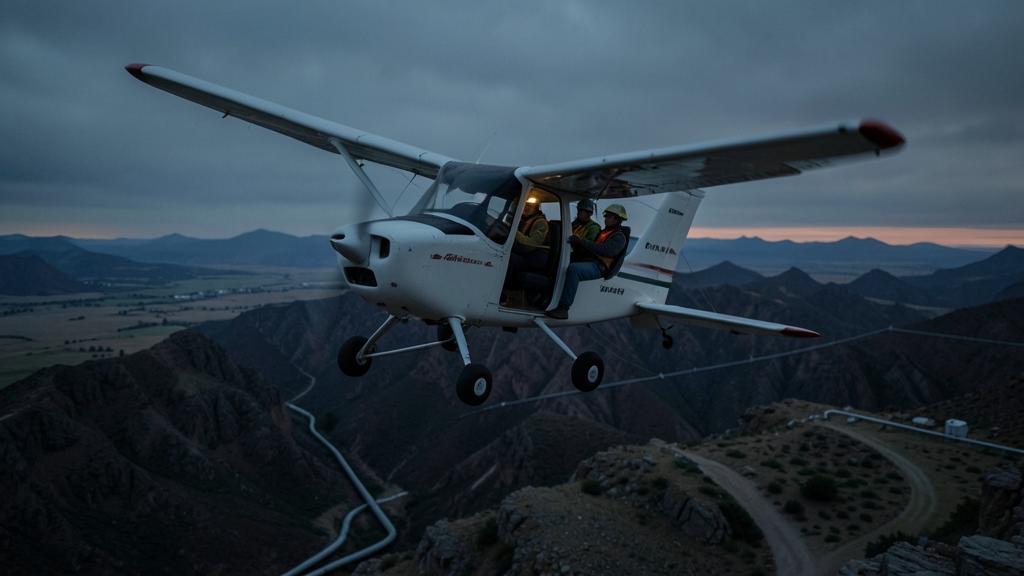
A pilot who has spent a thousand hours on pipeline patrol, survey grids or jump runs has learned to decide alone, fast, and without explaining. That is not a bad habit; it is the job, and it is what kept the aircraft safe. Under an air operator certificate the same reflex reads as a defect. Understanding why has almost nothing to do with skill and almost everything to do with who else is supposed to see the decision.
Two legitimate jobs, two definitions of a good pilot
Specialised operations and commercial air transport are not two levels of the same activity. They are two different problems, and each has produced the pilot it needs.
Aerial work puts a single pilot in an aircraft with a task specialist, or with nobody at all, close to terrain, in a mission whose shape changes with the weather, the client and the light. The pilot writes the plan, flies it, judges when the product is good enough, and decides when to stop. There is no second opinion in the cockpit because there is no second seat that matters. The measure of competence is the quality of solitary judgement: seeing the wire, calling the grid short, refusing the last run.
Commercial air transport puts two licensed pilots in front of a machine that neither of them designed, on a route neither of them chose, with a fuel figure computed elsewhere and a schedule that belongs to the network. The aircraft is flown thousands of times a year by dozens of crews who have never met. The measure of competence is different: it is the ability to produce a standard flight.
Neither definition is superior. But moving from the first to the second is a genuine change of trade, and pretending otherwise is the single most common reason a good aerial-work pilot has a hard line-training report.
What the certificate actually adds
The instinctive reading of the transition is that the airline adds rules. That is not quite it. The certificate adds accountability for someone else’s flight, and the procedures are what makes that accountability possible.

An operator holding a certificate publishes an operations manual. That manual is not a suggestion: it is the document against which the authority approved the operation, and the document against which the operator’s own management is answerable when something goes wrong. Everything the crew does on a normal day is written down somewhere in it, because the operator has to be able to say, in advance, what its crews will do. ICAO Annex 6 sets the international expectation for that manual; in Europe it is Part-CAT and the operator rules of Part-ORO that give it its shape, and the FAA reaches a comparable result through the operations specifications issued with a Part 121 or Part 135 certificate.
Around that manual sits an apparatus that does not exist in most aerial-work outfits: a nominated post holder answerable for flight operations, a safety management system that collects reports and analyses them, recurrent training and checking at fixed intervals, and — on larger aeroplanes — a flight data analysis programme that reads what the aircraft actually did. Annex 6 makes such a programme mandatory above a mass threshold, and plenty of operators run one well below it.
The consequence for the newcomer is concrete. In aerial work, a good decision that nobody saw is still a good decision. Under a certificate, a good decision that nobody saw is an unverifiable one, and the system is built on the assumption that unverifiable decisions eventually go wrong.
Under a certificate, every decision must be documented and shared. The system works because everyone follows the same rules, not because each pilot is perfect.
On a Boeing 737 with a 2,500-meter runway in hot weather, the manual might require a go-around below 500 feet if the approach is unstable. Even if the pilot feels confident, they must follow the rule to ensure safety across all flights.
| Stage | Aerial work, single pilot | Operation under a certificate |
|---|---|---|
| Framing the problem | In the pilot’s head, continuously | Announced aloud, so the other pilot can build the same picture |
| Options | Weighed silently, often in seconds | Stated, with the one being chosen and the reason |
| Decision | Taken and executed in the same movement | Taken, then briefed, then executed |
| Verification | The result on the ground: the product, the fuel, the landing | Cross-check by the monitoring pilot, before the result exists |
| Trace | The pilot’s memory and the client’s file | Recorded data, reports, checks, the manual it was drawn from |
| Recovery from error | The pilot notices, or nobody does | Designed to be caught by the other seat |
The multi-crew problem: an unannounced decision does not exist
This is the hinge of the whole transition, and it is worth stating flatly. In a two-pilot cockpit, a decision that has not been spoken has not been taken. Not because of etiquette, but because the second pilot’s entire function is to hold an independent picture of the flight and to notice when the aircraft stops matching it. If the picture is not shared, the monitoring pilot is monitoring a different flight, and the redundancy the operator paid for is gone.
The aerial-work pilot arrives with a reflex trained by years of results: see it, fix it. On the line, that reflex produces the recognisable pattern — the pilot flying who silently corrects a bad energy state, quietly changes a bug, dials a new heading before the request has left the controller’s mouth. Each individual act is competent. Taken together, they leave the other pilot behind, and the report writes itself: flies the aeroplane well, does not operate as part of a crew.
The mirror-image failure is just as common and rarely discussed: the same pilot, moved to the right seat, monitors badly. Monitoring is not a passive state and it is not a rank. It is an active task with its own workload — following the flight path against what was briefed, watching the automation do what was selected, calling deviations early and out loud. Someone whose whole career has been about doing rather than watching has to learn that watching is doing.
The trap. Believing that the transition is about learning a new aeroplane. The type rating is the easy half: it is finite, examinable, and it rewards exactly the qualities aerial work built. The hard half is line training, where nothing is examined item by item and what is being assessed is whether the flight you produce looks like everyone else’s.
Standard calls are a protocol, not a ritual
Standard calls look, from outside, like corporate liturgy. They are closer to a network protocol: a small set of fixed messages whose meaning does not depend on tone, seniority or mood, and which allow two people who met that morning to synchronise without negotiation.
Three properties make them work, and all three are counter-intuitive for someone arriving from a single-pilot background. They are fixed in wording, so no interpretation is needed under stress. They are mandatory even when obvious, because their absence is itself information — a missing call is the first sign that the other pilot has gone somewhere else. And they are symmetrical: the junior pilot calls a deviation to the captain in the same words the captain uses, because the protocol has no rank.
The related discipline is the briefing. In aerial work, the brief is often internal and adaptive: the plan changes with the light. Under a certificate, a departure or approach briefing is the moment the two pilots agree on what the next twenty minutes will look like, including what will make them stop. A briefing that lists frequencies and altitudes but never says what we will do if it does not work has skipped the only part that matters.
Gates: the deliberate removal of judgement
Nothing offends a good aerial-work pilot more than a stabilised-approach gate. It says that below a fixed height, on a defined set of parameters, the crew goes around — no matter how confident anyone is that it can be salvaged. To a pilot whose trade was salvaging things, this is an insult to competence.
It is not. A gate is a deliberate decision to remove judgement from a place where judgement has been shown, statistically, to fail. The individual pilot who continues an unstable approach usually gets away with it; the population of pilots who continue unstable approaches does not, and the operator is managing the population. The heights themselves — commonly one figure in instrument conditions and a lower one in visual conditions — belong to the operator’s manual, not to folklore, and they vary between operators and fleets. What does not vary is the logic: the gate exists precisely because it overrules the pilot who feels able to make it.
The same reasoning underpins the minimum equipment list, duty limitations, fuel policy and the sterile flight deck in the critical phases of flight. Each is a place where the system has decided that a rule beats a judgement, and each is a place where the transitioning pilot has to give something up on purpose.
The right reflex. When a procedure looks stupid, ask what population of events it was written for, not whether it fits today’s flight. Almost every procedure that irritates an experienced pilot exists because it fits a case that pilot has not yet had.
The habits that transfer, and the ones that cost you
The transition is not a purge. Aerial work builds capacities an airline cannot buy, and they carry directly: real weather judgement, a working relationship with terrain, comfort with degraded equipment, and the ability to keep flying the aircraft while something else is going badly. Nobody who has flown low-level survey in poor visibility is fragile about a raw-data approach.
What has to change is narrower than it feels, and it is almost entirely about visibility of intent.
| Habit built by aerial work | How it reads under a certificate | What to do instead |
|---|---|---|
| Fixing a deviation the instant you see it | The other pilot loses the picture; the deviation was never shared | Call it, then fix it — the two-second delay is the point |
| Re-planning continuously in your head | Reads as an unpredictable crew member | Say the new plan out loud before acting on it |
| Adapting the profile to the conditions of the day | Reads as non-standard operation, whatever the outcome | Keep the profile, use the flexibility the manual actually grants |
| Solving it rather than reporting it | The event never reaches the safety system, so nobody else is protected | File it, even when you handled it perfectly |
| Trusting your own assessment of an approach | Collides with the gate, and the gate wins | Treat the gate as a limit, not as an opinion to be argued |
| Running your own weight and balance in your head | Bypasses a cross-checked figure the operator is accountable for | Use the computed figure, then apply your instinct as a sanity check |
What line training is really assessing
A type rating is examined against a published test form: sections, items, a defined standard. Line training has no such form, and this is what disorients experienced pilots. The line trainer is not scoring manoeuvres. Over a number of sectors, the trainer is answering a small number of questions.
- Does this pilot’s flight look like the operator’s flight, or like a well-flown personal version of it?
- When something changes, does the plan get spoken before it gets flown?
- In the monitoring seat, is this pilot actually monitoring — or waiting for their turn?
- When the captain is wrong, does anything happen? And when this pilot is wrong, does the correction land without a fight?
- Does the pace hold when the day goes long, the aircraft goes technical and the slot slips?
The last one deserves emphasis, because it is where aerial-work backgrounds sometimes fail unexpectedly. Aerial work is intense and short; the sortie ends, the pilot resets. Line flying is a four-sector day with a delay in the middle, and the skill being tested is whether the standard survives fatigue and irritation. The procedure exists mainly for that day, not for the good one.
Preparing the change properly
Three things are worth doing before the first line sector, and none of them is about the aeroplane.
First, read the operations manual as a document with a logic, not as a reference to be searched. The parts that matter to a newcomer are the ones describing the operator’s own philosophy: how the crew is expected to work together, what is delegated to the commander and what is not, how a decision to deviate is meant to be taken and recorded. That section is short and almost nobody reads it in advance.
Second, take multi-crew training seriously rather than as a box to tick. In Europe, Part-FCL requires multi-crew cooperation training before a first multi-pilot type rating, and crew resource management training is a recurring obligation on the operator’s side. For a pilot arriving from single-pilot work, these courses are not administrative: they are the only place where the new trade is explicitly taught.
Third, decide in advance what to do with the instinct to solve things quietly. It will not disappear, and it should not — it is a genuine asset in an abnormal situation. The workable rule is simple: keep the instinct, add a sentence in front of it. Naming what you are about to do costs a second and converts a solitary act into a crew one. Almost the whole transition is contained in that sentence, and pilots comparing notes on the FL330 forums tend to arrive at the same conclusion from different fleets.
The uncomfortable part: it is also a loss
Transition guides usually stop at the gain — bigger aircraft, better contract, structured career. It is honest to say the rest. A pilot moving from aerial work to an operation under a certificate gives up the thing that made the previous job worth doing: being the person who decides. In exchange they receive redundancy, a system that catches their errors, and the possibility of flying tired without it being dangerous.
Pilots who make the change well are usually the ones who have understood the trade rather than merely accepted it. Those who struggle are rarely short of skill. They are pilots still running a single-pilot decision loop in a cockpit built for two — and on the line, that is not a style, it is a hazard.


Leave a Reply
You must be logged in to post a comment.