

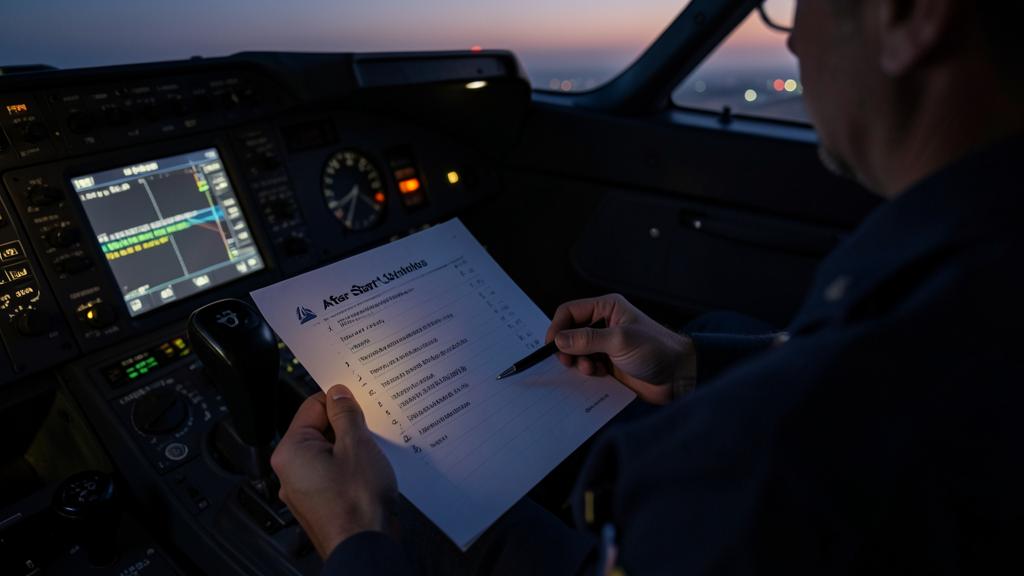
The After Start checklist is under way when the marshaller calls on the interphone to report an obstacle behind the aircraft. The crew answers, settles the matter, returns to the card — and picks up one item further down. The slats stay retracted. The configuration warning will catch them when the thrust levers are advanced, or no one will. Between those two outcomes there is no gap in competence, but the way the place was held during the few tens of seconds the exchange lasted. The mechanism that produces this omission is regular and predictable; it is countered by actions that hold up on the line, not only in the classroom.
What an interruption destroys is not attention, it is the index
Common intuition holds that we forget because we were not paying attention. The actual sequence is the reverse. At the moment the interruption occurs, attention is intact — it is simply directed, and correctly directed, at whoever is interrupting. What the interruption carries away is not vigilance: it is the marker that indicated where we had got to.
A procedural task is not held in memory like a learned list. It is held by an external index: the finger resting on the line, the last callout heard, the position of the cursor, the rhythm of a two-voice exchange. This index is almost never explicit. It is carried by the context, and the interruption replaces that context with another one, entirely.
What remains is then a deferred intention: to come back to item four. A deferred intention has no deadline, no alarm and no recipient. It relies on a reminder triggered by the environment, yet the environment that was supposed to trigger it — the task itself, at the exact point where it stopped — has just been pushed out of the field.
Resumption therefore consists in rebuilding the index, not in retrieving it. It costs a measurable amount of time, on the order of a few seconds, during which neither the interrupting task nor the primary task is being performed. Above all, it proceeds by inference: asked what point was reached, the answer produced is what one believes one has done — that is, precisely the content the interruption has just blurred.
When you’re interrupted, your brain doesn’t forget the task—it just loses the “bookmark” of where you were. You have to rebuild that marker from scratch, which takes time and often leads to mistakes. The more automatic the task, the harder it is to remember where you left off.
An A320 crew is completing the Before Takeoff checklist. At “Slats,” the tower calls with a runway change. The crew handles the change, then resumes the checklist—but skips “Slats” entirely. The aircraft takes off with slats retracted, triggering a configuration warning. The error wasn’t due to inattention, but to losing the “index” of where they were in the checklist.
Two error signatures, and they are not handled the same way
Reconstruction fails in two symmetrical ways, which have neither the same frequency nor the same cost.
The first is omission: one picks up beyond the interrupted item, that item is never performed and nothing flags it. It is the quieter of the two, and the harder to intercept, because the sequence goes on unfolding normally: the rhythm is right, the callouts follow one another, only one link is missing. It is detected only downstream, by an independent barrier where one exists, or through its effects.
The second is repetition: one picks up short of the point reached and redoes an action already done. It is noisy, often benign, and sometimes serious when the action is not idempotent — an entry that adds instead of replacing, a control with a cumulative effect, a torquing repeated on a fastener already tightened to value. The defect is no longer the absence of an action but its excess, and it escapes any review that merely checks that every line has been done.
The point of interruption largely decides which regime is obtained. An interruption that falls at the boundary between two blocks leaves a solid marker: the last complete callout, heard by both crew members. An interruption that falls inside a compound item — select, check, call out — leaves nothing: the action is begun but not closed, and neither of the two can say which of the three gestures was completed.
| Criterion | Interruption at the boundary between two blocks | Interruption inside an item |
|---|---|---|
| Marker that survives | The last completed callout, heard by both | None: the action is begun but not closed |
| Dominant signature | Resumption at the next block, without harm | Omission of the item, or repetition of an action already done |
| Detection | The missing block shows up at the next reading | The missing item shows up only through its effects |
| Cost of the countermeasure | Almost nil: the block heading is read again | Resumption at least one item earlier, often of the whole block |
| What makes it worse | A long block with no intermediate callout | An item made of several gestures not called out separately |
The most interruptible moments are the ones where the margin is thinnest
The density of interruptions is not uniform across a flight, and it is highest where the sequences are longest and the consequences closest. Approach preparation is the canonical example: it is conducted while the frequency is busy, while the cabin is calling, while a runway change voids half the work already done, and it bears on parameters that will produce their effects a few minutes later.
Taxi has the same structure with an aggravating factor: the aircraft is moving, most of the visual attention is outside, and the sequences carried out there — configuration, departure briefing, charts — are precisely the ones whose omission cannot be seen through the window.
This is what sterile flight deck discipline protects during critical phases. The principle is often reduced to a rule of silence, which makes it unappealing and negotiable. Yet it does not protect quiet: it protects the integrity of sequences, by forbidding an unnecessary conversation from cutting into a task whose resumption costs more than the conversation is worth. The threshold adopted — ten thousand feet in most definitions, sometimes a lower altitude set by the operator — matters only through what it triggers.
There remains the category hardest to deal with: self-interruption. No one has spoken; one has left the sequence oneself to go and check a point that had just looked doubtful. The intention is good, the check is often useful, and the forgetting mechanism is rigorously identical. It escapes any sterile flight deck rule, since there is no one to ask for silence.
Holding the place: four actions that work on the line
Effective countermeasures have one thing in common: none of them asks for better memorisation. All of them move the memory out of the head, into an object, a posture or a phrase.
Defer when it can be deferred. “Stand by” is a complete answer, and it is available more often than one thinks: towards the cabin, the ground staff, the colleague. Towards ATC, the readback is due immediately, but carrying out a non-urgent instruction can wait until the item under way is closed, provided one is aware of it and says so.
Leave a physical mark before switching. The finger stays on the line, the card stays open at the point reached, the hand stays on the control not yet operated, the pen is laid across the page. One second of action buys back the entire reconstruction.
Call out the resumption point aloud. “Stopped at item four” turns the other crew member into an external index. It is the only countermeasure that survives a long interruption, and the only one that works when the person resuming is not the person who stopped.
Resume upstream, never at the presumed point. Resumption is made at least one item before the one you believe you reached, and over the whole block when the interruption has lasted. Deliberate overlap costs a few seconds; its absence costs an item, and which one will only be known afterwards.
The trap: resuming where you believe you are, without asking yourself how you know. The feeling of knowing where you had got to is produced by the smooth unfolding of the sequence, and that unfolding is exactly what the interruption has just removed. The feeling, for its part, stays intact — and it is all the stronger the better the procedure is known: the more automatic the chain of actions, the fewer conscious traces it has left to consult.
The right reflex: call out the stopping point before dealing with the interruption, never after. A callout made at the instant you disengage — “stopped at item four” — is worth more than a two-person reconstruction a few tens of seconds later, based on memories that have already begun to rewrite themselves.
Making the unfinished visible
One rule subsumes all the others: a suspended task must never look like a finished task. It holds on the flight deck, it holds in the cabin, and it holds on the ramp, where it is the oldest.
In maintenance, interruption is structural: it comes from the shift handover, from waiting for a part, from a call about another aircraft. The countermeasures there have long been made physical — the panel deliberately left open, the warning tag placed on the control, the tooling left across the walkway, the work card left unsigned at the line reached. All rest on the same idea: the mark must outlive the person who left it, because whoever resumes may not be that person.
In the cabin, the door arming and disarming sequence is the textbook case: it is short, it is interruptible by nature — a passenger addressing you, a call from the flight deck — and its intermediate state can be told from a correct one only by looking at the right indicator. That is the reason cross-checking exists: not to duplicate the action but to give it an independent reader.
On the flight deck, the same principle shows in the unspoken conventions: a pulled circuit breaker carries a collar, a selector left in an unusual position is flagged, a checklist card stowed away means the list is finished and nothing else. Stowing the card while two items remain is manufacturing, all by yourself, the state that looks like a finished state.
| Mode of suspension | What the person resuming sees | What detects the omission | Survives a change of person |
|---|---|---|---|
| Bare suspension: nothing is left in place, the intention stays in the head | A state that looks like a finished state | Nothing, until the effects | No |
| Physical mark: flag, tag, finger on the line, tool left across | A visibly abnormal state, which invites a question | The next glance, with no effort and no procedure | Yes, as long as the mark stays in place |
| Written trace: unsigned line, named stopping point, handover note | A dated and identified stopping point | The mandatory re-reading at resumption or at handover | Yes, including remotely and several days later |
What the competency framework calls by its name
Holding your place is neither a moral quality nor a character trait: it is an observable behaviour, and it is on that basis that it appears in the competency frameworks used in training and checking — workload management, situation awareness, application of procedures, communication. An examiner does not count omissions. He looks at whether a method exists, whether it is applied without being asked for, and whether the other crew member is used as an external memory rather than as a spectator.
This reading changes what has to be worked on. You do not train not to be interrupted: you train to be interrupted cleanly. In a training session that means asking for interruptions rather than enduring them, placing them in the middle of an item and not between two blocks, and checking that resumption is made with overlap — on sequences you know by heart, because those are the exposed ones.
The paradox deserves to be spelled out to a first officer starting line flying: the riskiest period is not the first one. As long as the procedure demands effort, it leaves conscious traces that can be consulted on resumption. When it becomes automatic, the effort disappears, performance improves — and the trace disappears with the effort. That is the moment when the physical mark and the callout stop being beginner’s crutches and become the only thing left. Crew resource management programmes and evidence-based training address the subject from this angle, and the FL330 training paths treat it as a competency to be maintained, not as a chapter to be signed off once.
What to go and check in your own documentation
Three points deserve a careful reading, because they vary from one operator to another and are rarely discussed on the line.
First, what the manual says about the interruption of a checklist. Some require the whole block to be repeated whatever the duration; others leave it to the crew to judge; others again say nothing, which is an answer in itself and lets the rule settle by station habit. Then, the local definition of critical phases and the threshold that delimits them, to be read together with the list of communications that remain authorised inside those phases. Finally, the existence of a written interrupted-task procedure on the maintenance side, and the formality of the shift handover: a box ticked “work in progress” with no named stopping point conveys nothing.
Two grey areas remain. The first is the interruption that cannot be refused — an ATC instruction, a warning, an event that forces you out of the sequence right away. No discipline rule applies to it, and the mark together with the callout remains the only countermeasure available. The second is the interrupter that presents itself as a helping tool: datalink messages, the electronic flight bag, notifications from a performance application. They arrive at the best moment for themselves and the worst for the sequence under way, and nothing in their ergonomics signals that they have just cut into a task. The subject is usefully discussed between operators on the FL330 forum, for want of being settled anywhere else.
This article describes a mechanism and practices, with no normative force whatsoever. The applicable regulation, the operating procedures and the operator’s approved documentation prevail in all circumstances over what is written here, including where they adopt a resumption rule different from the one described above.
Questions fréquentes
After an interruption, should the checklist be resumed from the beginning?
Not from the beginning, but never at the presumed point either. The rule that works is overlap: you pick up at least one item before the one you believe you reached, and you repeat the whole block when the interruption has lasted or fell in the middle of a compound item. Some operators require the block to be repeated in every case: it is the operations manual that settles the matter, and you need to have read what it says before you need it.
Can an ATC communication be deferred in order to finish an item under way?
The readback is due immediately and is not deferred. On the other hand, carrying out an instruction that is not urgent can wait until the item in progress is closed, provided that this postponement is deliberate and announced on the flight deck. The useful distinction is not between answering and not answering, but between acknowledging and executing.
How do you hold your place on an electronic checklist that you are not holding in your hand?
The cursor or the highlighted line plays the part of the finger, provided you do not move it before dealing with the interruption: the faulty reflex is to scroll the page while talking. When the display is liable to change, the verbal callout of the item number becomes the only reliable mark, because it is carried by the other crew member and not by the screen.
In maintenance, what must a handover contain when a task is left unfinished at the end of a shift?
A named stopping point, and not a mere mention of work in progress: the last operation completed, the first operation still to be done, the physical state in which everything has been left and the tooling still fitted. The written trace must be doubled by a physical mark on the aircraft, because whoever takes over will look at the aircraft before reading the file.
Can a first officer do anything when it is the captain who interrupts during a critical phase?
Yes, and it implies no conflict. Calling out your own stopping point aloud — “stopped at item four” — serves two purposes: the place is marked, and the information passes that a sequence was in progress. It is a factual form of words, accepted in every crew resource management framework, and it usually obtains the postponement without having to ask for it.
Does automation reduce the problem or make it worse?
It moves it. Systems remove manual tasks, and with them opportunities for omission, but they themselves produce interruptions — messages, alerts, notifications — that arrive according to their own logic and not that of the sequence under way. They also make unfinished states less visible, since a parameter that has not been entered looks like one that has, as long as the value is not read back.


Leave a Reply
You must be logged in to post a comment.