
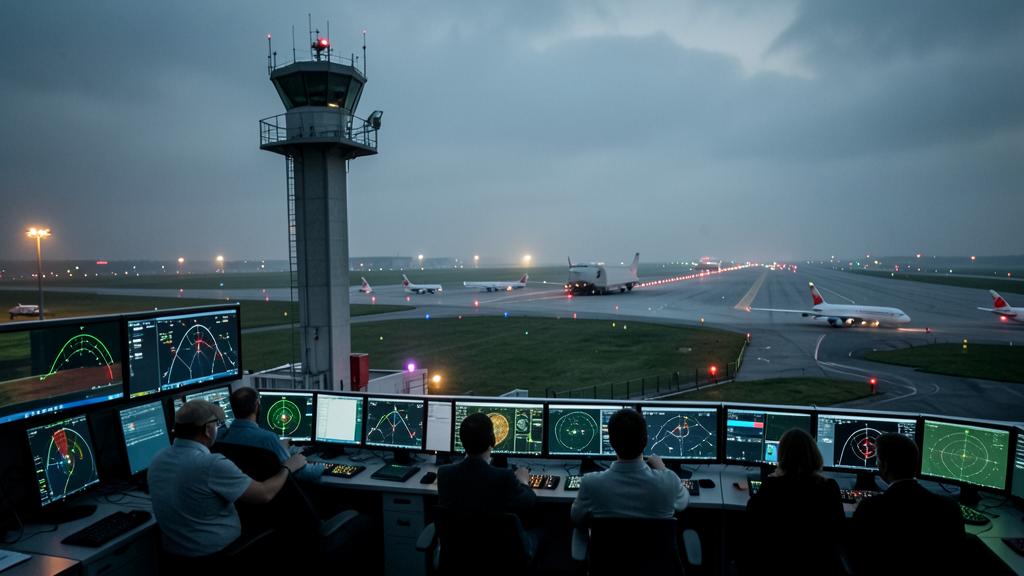
Every coordinated airport publishes a number: so many movements an hour. Airlines build a season against it, a coordinator refuses schedules that exceed it, and journalists quote it as though it were a measurement of the concrete. It is nothing of the kind. A declared capacity is an administrative decision that sits on top of at least three independent physical limits, and the published figure is the lowest of them, minus a margin chosen on purpose. Knowing which of the three is doing the work tells you far more about an airport than the number itself.
A number that is declared, not measured
The vocabulary matters, because it is where most misreadings start. Throughput is what an airport actually delivered in a given hour. Peak throughput is the best hour it ever delivered, in ideal wind and visibility, with a favourable mix and no unserviceabilities. Declared capacity is what the airport says it will accept when schedules are built, months before anyone knows the weather. The first two are routinely quoted as if they proved something about the third.
Declared capacity exists because of schedule coordination. Under the framework used worldwide, an airport is classified by the level of congestion it faces: airports with capacity comfortably ahead of demand need no intervention, airports where demand is approaching capacity operate a voluntary schedules-facilitation regime, and airports where demand structurally exceeds capacity are fully coordinated, with an independent coordinator allocating slots. Only the last category is genuinely constrained by the published number, and it is the only category where the number has legal teeth. In the European Union the mechanism is set out in the slot regulation, Regulation 95/93 as amended; elsewhere the same architecture is applied through national rules that follow the same industry guidelines.
The declaration is made by the airport managing body, in consultation with the air navigation service provider, the coordinator and the airlines, usually through a coordination committee, and it is published ahead of each scheduling season. It is not a single figure. A serious declaration is a small table: movements per hour, often broken down into rolling sub-periods of ten or fifteen minutes to stop everyone scheduling on the hour, with separate ceilings for arrivals and departures, and frequently additional constraints on passengers per hour, on stands, or on night movements.
Constraint one: the runway system
The runway limit is the one everybody assumes is binding, and it is the one most often misunderstood, because the arithmetic is about time, not distance.

Arrival throughput is the reciprocal of the average time gap between successive landings on the same runway. That gap is built from three things. The first is the separation minimum applied on final, which for consecutive arrivals is the greater of the radar minimum and the wake turbulence minimum for the two categories concerned, and which therefore depends entirely on the traffic mix: a stream of similar medium aircraft packs far tighter than one alternating heavy and light. The second is runway occupancy time, the interval from crossing the threshold to being clear of the runway, which depends on the aircraft, the exit geometry, the surface condition and the crew’s willingness to make a specific rapid exit taxiway. The third, and the least visible, is the buffer the approach controller adds on top of the minimum so that natural delivery scatter does not turn into a separation infringement or a go-around.
That buffer is the interesting part. It is not slack; it is a deliberate choice about risk. Deliver every pair exactly at the minimum and the statistical spread guarantees a stream of infringements and missed approaches, each of which costs far more capacity than the buffer saved. The size of the buffer is a function of how accurately the system can deliver aircraft to the threshold, which is precisely why arrival management tools and time-based separation exist: they do not change the safety minimum, they reduce the scatter around it, so the buffer can shrink.
Time-based separation also fixes a counter-intuitive loss. A distance-based minimum flown in a strong headwind produces a longer time gap, because groundspeed on final is lower, so a windy day mechanically costs landings even though nothing about the aeroplanes has changed. Expressing the minimum in seconds rather than miles recovers most of that loss. Airports that have adopted it did so to defend a declared capacity they were otherwise failing to meet on windy days.
On top of that sits the configuration question. A single runway worked in mixed mode, with departures inserted between arrivals, delivers a different total from the same runway worked in segregated mode with a parallel. Parallel runways may be independent or dependent depending on their spacing and the surveillance available. Crossing runways introduce an interaction that no amount of good will removes. And low visibility procedures cut the figure hard: protecting the instrument landing system sensitive areas stretches the spacing, and runway occupancy rises because everybody vacates more cautiously.
The runway limit is not just about how fast planes can land. It’s also about how much space controllers need to keep flights safe, and how weather or runway layout can change that. The declared capacity is the lowest number after all these factors are considered.
At London Heathrow, a Boeing 747 followed by an Airbus A320 requires around 5 nautical miles of separation due to wake turbulence. In a strong headwind, the time needed to fly that distance increases, reducing the number of landings per hour. On a calm day, Heathrow handles around 44 arrivals per hour; with distance-based separation in strong headwinds, that would drop below 40, which is why the airport moved to time-based separation.
| Family | What sets the limit | Typical unit | How fast it can change |
|---|---|---|---|
| Runway system | Wake separation minima, runway occupancy time, delivery buffer, configuration, visibility | Arrivals and departures per hour | Within minutes, with wind or visibility |
| Airspace and controller | Sector workload, arrival and departure route structure, interaction with neighbouring airports, holding availability | Movements per hour per sector | Hours to days, with staffing and airspace configuration |
| Ground infrastructure | Stand hours by aircraft code letter, taxiway routing and bottlenecks, de-icing positions, terminal and baggage processing | Aircraft on stand, passengers per hour | Seasons to years, other than de-icing |
| Administrative or environmental | Night curfews, annual or hourly movement caps, noise quota systems | Movements per period | Only by political decision |
Constraint two: the airspace and the controller
An airport does not exist in isolation, and its runway can be capable of a figure the surrounding airspace cannot feed. The approach sector has a workload ceiling that has nothing to do with concrete: the number of aircraft one controller can safely sequence depends on the route structure, the vertical profile, the number of transitions between sectors, and how much of the sequencing is done by the arrival manager rather than by voice.
Departure capacity is frequently the sector-limited half. Departures on the same standard instrument departure route need separation in the climb, and where routes diverge quickly the throughput is high, while where they share a common initial segment the departure rate collapses to whatever the en route interface will accept. This is why two airports with identical runway layouts can declare very different departure figures.
Then there is the neighbour problem. In dense terminal areas, arrival and departure flows from adjacent airports are interleaved, and one airport’s declared capacity is effectively negotiated against another’s. Raising one may simply move the constraint next door. That is a systems question, not an airport question, and it is one reason declared capacities in busy regions move slowly.
Constraint three: the ground
The least glamorous constraint is often the real one. An aircraft that lands must go somewhere, and stands are not interchangeable. Aerodrome reference code letters describe what a stand can physically take; a stand sized for a narrowbody does not become a widebody stand because demand says so, and multiple-aircraft ramp arrangements only work if the scheduled mix cooperates. What limits an airport is not the count of stands but the stand-hours available at the moment of peak demand, and those hours are consumed by based aircraft resting overnight, by long turnarounds, by maintenance and by aircraft parked out of service.
Taxiway geometry does the rest. A single entry to a remote apron, a runway crossing that has to be worked into the arrival stream, a de-icing pad with a fixed number of positions in December: each of these can cap the movement rate well below what the runway would take. The terminal adds its own ceiling through security lanes, border control and baggage handling, which is why some declarations carry a passengers-per-hour figure alongside the movement figure.
The minimum rules, and it is often not the runway
The declared capacity is the minimum of the family limits, reduced by whatever robustness margin the airport and its partners agree to hold. That last reduction is not timidity. Queueing behaviour near saturation is violently non-linear: as scheduled demand approaches the physical service rate, average delay does not rise gently, it accelerates, and the first disturbance of the day propagates through every subsequent rotation because there is no recovery gap anywhere in the schedule. An airport declared at its physical maximum is an airport that will be late every day by construction.
The practical consequence is that you cannot read an airport from its runway count. A two-runway airport whose stands saturate at the morning wave has a stand-limited declared capacity, and building a third runway would change nothing. A single-runway airport with abundant apron and a fast-diverging departure route structure can declare a figure that embarrasses larger neighbours. The only way to know is to ask which family binds, and the answer is usually visible in how the number behaves: a runway-limited airport loses capacity whenever the weather turns, while a stand-limited or terminal-limited airport keeps the same number in fog and simply moves the queue elsewhere.
The trap. A record hour is not a capacity. Peak throughput is achieved with a favourable mix, an ideal configuration, no unserviceability and a controller team pushing hard; it says what the system can do once, not what it can sustain for a whole season while absorbing a thunderstorm and a technical delay. Quoting a record hour as evidence that the declared capacity is too conservative confuses a sprint with a timetable.
Declared capacity is not the rate you meet on the day
There is a second number, and it lives on a different clock. Declared capacity governs the schedule, months ahead. On the day, air traffic flow management applies a rate to the actual conditions, and when the airport cannot deliver its declared figure, because of visibility, wind, a runway closure or staffing, a regulation is applied with a lower rate and departures elsewhere receive slot times to meter the flow.
The two numbers answer different questions. The declared figure asks: how many aircraft may be planned into this hour? The tactical rate asks: how many can we accept in the next hour, given what is actually happening? A well-set declared capacity means the tactical rate matches it most of the time; a badly set one means the airport is regulated on ordinary days, which is the clearest possible evidence that the declaration was optimistic.
| Declared capacity | Tactical or flow rate | Achieved throughput | |
|---|---|---|---|
| Horizon | Scheduling season, decided months ahead | The next few hours | The hour that has just passed |
| Decided by | Airport managing body, after consultation | Air traffic services and the flow management function | Nobody, it is an outcome |
| Weather assumption | A representative mix, not the best case | The observed and forecast conditions | What actually happened |
| Effect of exceeding it | The coordinator refuses the schedule | Departure slot times applied upstream | Not applicable |
| What it tells you | The structural limit and the margin held | Today’s degradation | Mix, luck and effort on one occasion |
Who declares it, and who is bound by it
The chain of responsibility is worth stating plainly, because the coordinator is regularly blamed for a figure they did not choose. The airport managing body declares the capacity after a capacity analysis and consultation. The State decides whether the airport is coordinated at all, on the basis of that analysis. The coordinator then allocates slots strictly within the declared parameters, applying the historic precedence rules and the usage requirement that obliges a carrier to operate a series of slots to retain it for the following equivalent season. The coordinator has no power to invent capacity, and no power to withhold it.
The airline’s constraint is therefore indirect: it does not negotiate with the runway, it competes for slots inside a ceiling set by someone else. And the aircraft that turns up without a slot at a fully coordinated airport is not merely inconvenient, it is outside the allocation on which the whole hour was planned.
The right reflex. Before comparing two published capacities, normalise them. Check the averaging period, since a figure quoted per hour but enforced per fifteen minutes is a much tighter constraint than the same figure enforced hourly. Check whether it is a total or a pair of arrival and departure ceilings that cannot both be reached at once. Check the runway configuration and weather assumption behind it. Two numbers that look identical can describe entirely different regimes.
Reading a published figure without being fooled
Three questions extract almost everything useful from a declaration. First: which family binds? If the airport publishes separate arrival and departure limits whose sum exceeds the total movement limit, the total is being set by something other than the runway, and that something is usually apron or airspace. Second: how large is the margin? Compare the declared figure with the best hours actually flown in good weather; a small gap signals an airport with no resilience, a large one signals a constraint that is not the runway. Third: what else is capped? A passenger ceiling, a night quota or an annual movement cap tells you that the binding constraint is not physical at all but political, and no engineering project will move it.
The last point deserves emphasis, because it is where public debate goes wrong most often. Where an airport is capped by an annual movement limit or a noise quota, the discussion about runway throughput is beside the point: the concrete could take more, the permission cannot. Conversely, an airport whose stands saturate before its runway will gain nothing from a separation improvement, however elegant. The engineering only pays where the engineering binds, and identifying which family is doing the work is the whole of the analysis, an exercise regularly carried out line by line on forums.fl330.com.
What emerges, once the arithmetic is laid out, is that a declared capacity says less about an airport’s concrete than about the confidence its operators have in a whole system: the accuracy with which aircraft reach a threshold, the willingness of an airspace design to absorb divergent departures, the stand-hours available at the exact minute of the wave, and the tolerance for noise at night. Change one of those and the number moves. Change the wrong one and it does not move at all.


Leave a Reply
You must be logged in to post a comment.