
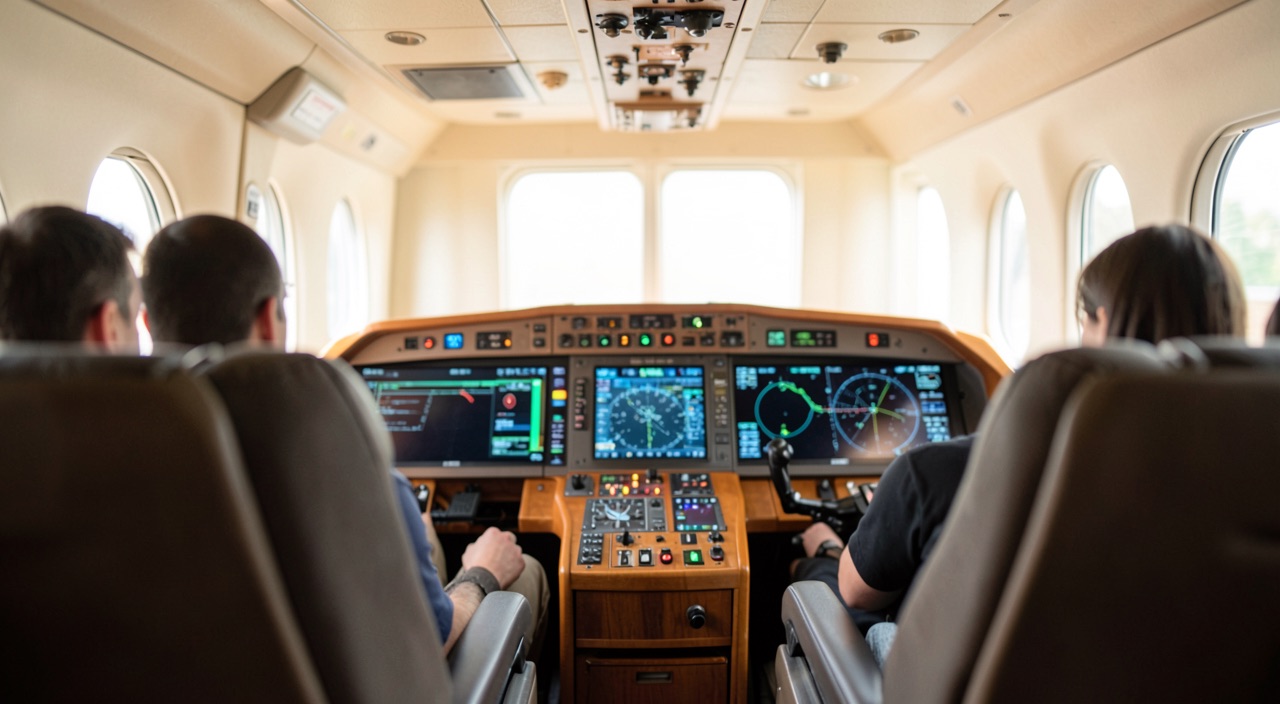
High-altitude cruise, autopilot in altitude hold, not a single warning light. The trimmable horizontal stabiliser, meanwhile, has been running nose-up for several minutes without anything having asked for it, and nobody has read it. When turbulence makes the automation let go, the aircraft is handed back to the crew with an out-of-trim condition the elevator alone can no longer catch, and the attitude departs. Upset prevention and recovery training teaches a recovery manoeuvre; it rarely teaches how to read the tens of seconds that precede it. Yet those are the seconds that decide whether anything will have to be recovered at all.
The unusual-attitude threshold is a finding, not a warning
The sets of values that industry reference material commonly retains to define an unusual attitude — a nose-up pitch attitude greater than twenty-five degrees, a nose-down pitch attitude greater than ten degrees, a bank angle greater than forty-five degrees, or a speed manifestly inappropriate to the configuration — are not detection thresholds. They are conventional boundaries, chosen to delimit a domain in which normal handling ceases to be the right answer. They describe a state that is already established. Nothing monitors them in order to prevent: they serve to qualify, after the fact, what has just happened, and to frame the content of training.
Between the stabilised state and that threshold there is a continuous state trajectory, and two very different ways of travelling along it. An imposed crossing — wake turbulence, a gust, a control failure, an inappropriate action by an already startled crew — is counted in seconds and offers no usable warning. A crossing by drift, on the other hand, takes tens of seconds to several minutes, because an automatic system or a pilot compensates for the imbalance as it grows. It is this second family that leaves the crew something to work with, and the only one in which the word prevention has any operational content.
The cost-benefit calculation leans heavily the same way. A successful unusual-attitude recovery costs altitude, a load factor that has to be justified, sometimes a speed exceedance, a disordered cabin, a ground inspection and a report. Early detection costs a few seconds of reading. No quality of manoeuvring makes up the difference between the two.
The unusual attitude threshold is just a line we draw to say “this is bad.” But the problem starts long before that line. The key is watching small changes in trim, angle of attack, and control forces before they become a big problem. These are like early warning signs that something is wrong, even if everything looks normal on the instruments.
On an Airbus A320 in cruise at FL350, the trim starts moving nose-up slowly due to fuel transfer. Over 5 minutes, it moves 3 units without any alarm. The flight path stays stable, but the angle of attack increases by 2 degrees. When the autopilot disconnects, the pilots feel a strong nose-up force. If they had noticed the trim moving earlier, they could have adjusted before the situation became critical.
Three quantities that speak before the attitude does
Attitude is a state; it says nothing about the trend. Three quantities, by contrast, are by construction ahead of it: the trim position, which is the integral of the balancing force since the last stable state; the gap between pitch attitude and flight path, which is the angle of attack; and the sign of the force to be held on the control column, which situates the trim speed relative to the speed being flown. None of the three has a dedicated instrument, none triggers an alarm, and that is precisely why they remain available when everything else looks normal.
The common feature is worth stating, because it is what makes the method: these are second-order quantities. They do not measure where the aircraft is, they measure what has to be spent to keep it there. A perfectly held flight path therefore proves nothing; it only proves that someone — or something — is still paying.
| Quantity observed | What it actually measures | What masks it | The reading that should trigger attention |
|---|---|---|---|
| Pitch trim position | The integral of the balancing force since the last stable state | The automation, which moves it slowly, with no noise and no alarm | A continuous run in a single direction, with no commanded cause |
| Gap between pitch attitude and flight path | The angle of attack, the only variable that sets the stall margin | A normal-looking pitch attitude and a still-nominal speed | The gap grows while the displayed pitch attitude does not move |
| Sign and gradient of the control force | The position of the trim speed relative to the speed being flown | The autopilot, the auto-trim, an artificial force feel | The force changes sign, falls to zero, or stops increasing as the deviation grows |
| Authority already consumed by the automation | The reserve remaining before the control loop drops out | A flight path still being held, therefore no surface symptom | Persistent deviation from the target, unusually large control inputs |
The trim is the autopilot’s effort gauge
To trim is to cancel the force needed to hold a state of equilibrium. In manual flight, the operation is conscious. Under automation, it is permanent and silent: the auto-trim continuously offloads the elevator servo so that it works around zero and retains its authority. The trimmable horizontal stabiliser therefore records, position after position, everything that alters the longitudinal balance — fuel burn and fuel transfer, a change of configuration, a de-icing sequence, contamination of a leading edge, thrust asymmetry, a weight or centre of gravity entered wrongly at departure, an angle-of-attack measurement that starts lying to a control law.
None of this produces any surface symptom as long as the loop holds. The flight path is followed, the speed is the one that was asked for, no alarm goes off: the divergence is absorbed, it is not absent. It is stored in its entirety in a peripheral quantity, displayed without emphasis, whose movement is too slow to catch the eye. That is the very definition of a free cue that goes unread.
The asymmetry of authority makes this reading mandatory. On most transport aircraft, the trimmable stabiliser acts on a far larger surface than the elevator and therefore has markedly greater pitch authority: a large offset cannot be caught with the elevator alone, especially if the speed has increased in the meantime, since the moment produced grows roughly as the square of the speed. The value read on the trim at the moment the automation hands back control is therefore not a comfort item: it is the measure of the force that is about to appear in the hands, and of the time it will take to remove it.
The trap. Disconnecting the automation because “something is not right”, without having read the trim position. The force that appears in the hands is exactly the one the servo was holding, and it grows with the square of the speed; the first reaction — releasing in order to understand — lets the aircraft follow its imbalance. On a badly out-of-trim aircraft, the elevator alone does not catch the trimmable stabiliser: trimming has to be done at the same time as holding, and that simultaneity cannot be improvised at the moment the attitude begins to depart.
Pitch attitude is not flight path, and the margin lies between the two
The artificial horizon displays a pitch attitude: an angle between the longitudinal axis and the horizontal. The wing, for its part, knows only the angle of attack, the angle between the chord and the relative wind. In the vertical plane and without sideslip, one is deduced from the others: the angle of attack is what remains once the flight path angle is subtracted from the pitch attitude. In other words, a normal-looking pitch attitude says nothing about the margin as long as one does not know where the aircraft is actually going.
Slow drift exploits exactly this flaw. The automation holds the altitude, the speed erodes for some reason, the flight path angle stays at zero and the pitch attitude rises only slightly: on the screen, almost nothing changes. The angle of attack, however, has travelled the whole distance. When a flight path vector is displayed, the information becomes directly readable — the vertical gap between the aircraft symbol and the vector is an image of the angle of attack. When it is not, it has to be reconstructed from the pitch attitude, the vertical speed and the speed trend, which takes time and assumes one has got into the habit of doing it before needing to.
The turn adds a second input. Holding the flight path in a bank requires a load factor greater than one; at forty-five degrees the order of magnitude is one point four, which raises the stall speed by about a fifth — the stalling angle of attack, for its part, does not move. A bank angle that establishes itself while attention is elsewhere therefore consumes angle-of-attack margin without displaying anything abnormal. Close to the ceiling, where the gap between the speed being flown and the initial buffet is already reduced, the same bank angle is enough to close what was left.
The force that changes sign
With the trim frozen and the configuration constant, a statically stable aeroplane has a trim speed: the force to be applied at that speed is zero, one has to pull below it and push above it, and the gradient of that force is what the pilot calls feel. This relationship carries positional information — which side of equilibrium one is on — but its evolution carries trend information, and it is the latter that counts. If the force to be held changes sign while neither the trim, nor the configuration, nor the thrust has moved, it is not the hand that has shifted: it is the trim speed.
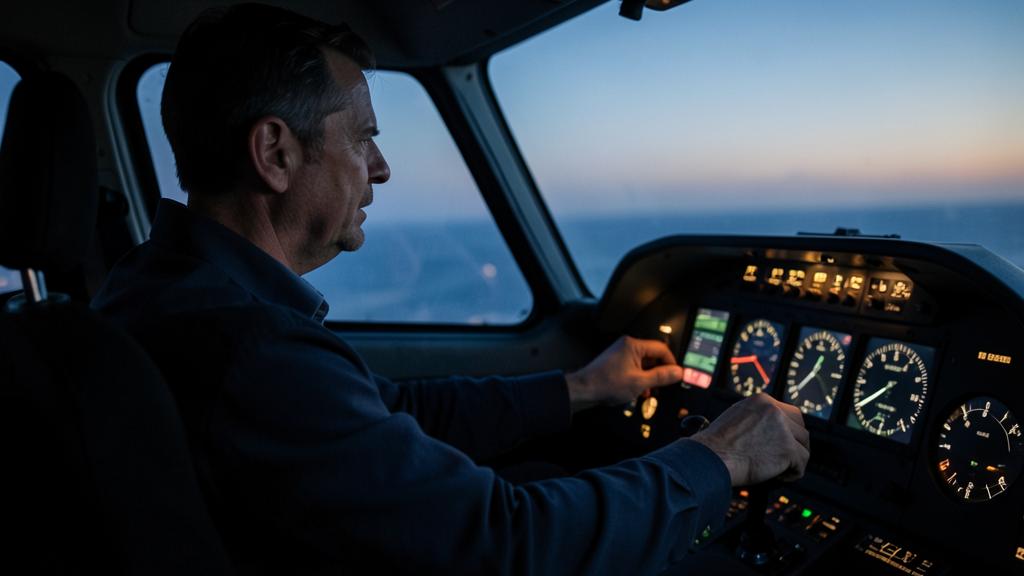
Two degradations are worth knowing in their own right. The first flattens the gradient: the aircraft barely returns towards its speed, and a deviation sustains itself instead of closing. The second reverses it at low speed — a particular configuration, leading-edge contamination, a local separation — and the aircraft then starts moving away on its own from the state one thought was being held. Reversal is the strongest signal a flight control can send, and one of the least taught: it shows itself first as a lightening, then as a force on the wrong side, well before the attitude tells anything at all.
That leaves the modern case. On fly-by-wire aircraft in normal law, the force feedback is artificial and often independent of speed: the stick no longer says anything about equilibrium, and the auto-trim erases the cue as fast as it appears. What remains is still the position of the trimmable stabiliser, and knowledge of the active law — because the tactile cues reappear precisely when the law degrades, that is, at the worst possible moment to discover them. A pilot who has only ever flown in normal law has no sensory reference against which to compare what will be felt on that day; that is a serious argument in favour of maintaining manual flying skills, and not only in calm cruise.
The right habit. Treat the trim as an instrument in the scan and not as an accessory. Call out its position at every lasting change of state — entering cruise, level change, fuel transfer, de-icing sequence — then, before any deliberate disconnection, state the value read and the direction of the expected force. It is not the absolute value that informs, it is the difference from the previous one: the reading is only worth something if it is repeated, and a few seconds are enough.
Two speeds of divergence, two usable windows
Distinguishing the two regimes avoids looking for the right counter in the wrong place. In slow divergence, the window is wide and the failure is a monitoring failure: the information existed, nobody sampled it. The remedy is an instrument scan that includes the equilibrium quantities and not only the flight path quantities, and a division of tasks that leaves somebody the time to look. That is structurally the role of the pilot monitoring, and it is also the first thing lost when workload rises.
In rapid divergence, there is no reading window. What decides then is the state one entered it in: remaining angle-of-attack margin, energy available, trim authority still free, configuration consistent with the speed. Prevention there does not consist in detecting an event, but in maintaining a reserve. The two regimes therefore meet in a single requirement, and it is the most useful result to take away: never arrive half spent.
What training rewards, and what it does not measure
An upset prevention and recovery session almost always starts with the aircraft already in position, or puts it there within seconds. The grade is given on the recovery: order of actions, dosage, absence of excessive load factor, return to a stabilised state. That is legitimate, and it is incomplete. We train intensively for what we hope never to do, and almost never for what we may well do several times in a career, namely reading a drift and stopping it before it becomes a manoeuvre.
That part has to be asked for. An instructor can set up a slow drift and let it run, freeze the simulation just before the threshold, and then have the crew state not the manoeuvre but the cue: which one appeared, at what moment, what should have interrupted it. The simulator excels at this exercise, precisely because a trim drift lasting several minutes is difficult to produce in flight and trivial to programme on the ground.
It is much less at ease with the rest. The aerodynamic model of a simulator is validated only over the domain bounded by the tests that fed it; beyond that — past the stall, at strong combinations of angle of attack and bank — the reproduction is extrapolated, which has led to extending the models and to providing an indication to the instructor when the session leaves the validated domain. That is the reason for the on-aeroplane part of advanced training, which the European aircrew regulation places ahead of the first multi-pilot type rating: it does not bring better model fidelity, it brings real load factor, disorientation and the management of one’s own reactions. The two media teach different things and do not replace one another.
What remains to be checked in your own documentation
Four points are worth checking before the next session, because the answers vary from one type and one operator to another:
- where the manual places the boundary between a trim anomaly and a runaway, and what action it prescribes on either side — the two situations do not resemble each other, and the second has immediate consequences for the speed to be held;
- what becomes of the auto-trim when the control law degrades: does it stay active, does it freeze, does it re-centre;
- in which modes and under which failures the flight path vector disappears from the display, since it is what makes the angle of attack readable without calculation;
- what the angle-of-attack protections inhibit, and from which state they cease to be available.
The grey area, for its part, is not closed by documentation. On most fleets, none of the three quantities described here is the subject of a standardised trend alert: there is no warning announcing that a trim has been running in the same direction for several minutes. As long as that is the case, the cue exists only if somebody looks at it — which makes it a question of procedure and task allocation, not of equipment. For anyone preparing a type rating, being able to state what precedes the threshold is worth more than reciting the manoeuvre that follows it: the preparation modules that deal with prevention before recovery produce candidates who are more solid both in the oral and in the session, and scan formats that include the equilibrium quantities are exchanged between operators on the forum.
The applicable text, the aircraft flight manual for the type and the operator’s approved documentation take precedence over this article, which sets out a mechanism and does not stand in for a procedure.
Questions fréquentes
At what moment should the trim position be called out?
Two moments make the reading useful: at every lasting change of state — entering cruise, level change, fuel transfer, de-icing sequence — and before any deliberate disconnection of the automation. The call-out serves as a reference point, because it is the difference from the previous value that informs, not the absolute value. The operation takes a few seconds and it turns a disconnection suffered into a disconnection prepared.
How is the angle of attack read when the aircraft does not display a flight path vector?
It is reconstructed: the angle of attack is what remains once the flight path angle is subtracted from the pitch attitude, and the flight path angle is derived from the vertical speed related to the airspeed. In practice, the habit to acquire is to compare the displayed pitch attitude systematically with the altitude change and the speed trend, rather than reading the pitch attitude alone. It is slower than a direct reading, which is why it is worth practising outside degraded situations.
Does an autopilot that holds the flight path perfectly guarantee that nothing is drifting?
No, quite the opposite. A control loop holds the flight path as long as it has authority left, so it absorbs the divergence instead of showing it. The information does not disappear for all that: it migrates towards the effort spent, that is, towards the trim position and the amplitude of the commands. A held flight path is a result, never a diagnosis.
Does training on an aeroplane duplicate what the simulator does?
No, the two media do not cover the same need. The simulator reproduces procedures, long scenarios and the slow drifts that are impossible to provoke in flight, but its aerodynamic model is validated only over a bounded domain and becomes extrapolated beyond it. The aeroplane brings real load factor, spatial disorientation and the management of one’s own reactions, which no ground-based reproduction replaces.
What should be done when the force to be held changes sign although nothing has been touched?
Treat it as an event and not as a sensation. This change signals that the trim speed has shifted, and therefore that a parameter of the balance has changed: weight, centre of gravity, configuration, thrust, condition of the aerofoil. The handling consists in freezing whatever can be frozen, checking configuration and trim, calling out, and not increasing the speed deviation as long as the cause has not been identified.
Do these cues still mean anything on a fly-by-wire aircraft?
Two of them remain fully valid: the position of the trimmable horizontal stabiliser and the gap between pitch attitude and flight path. The third changes in nature, since the force feedback there is artificial and often independent of speed. The practical consequence is that one must know which law is active, because the tactile cues only reappear in degraded law, at the very moment when they are most needed and least familiar.


Leave a Reply
You must be logged in to post a comment.