
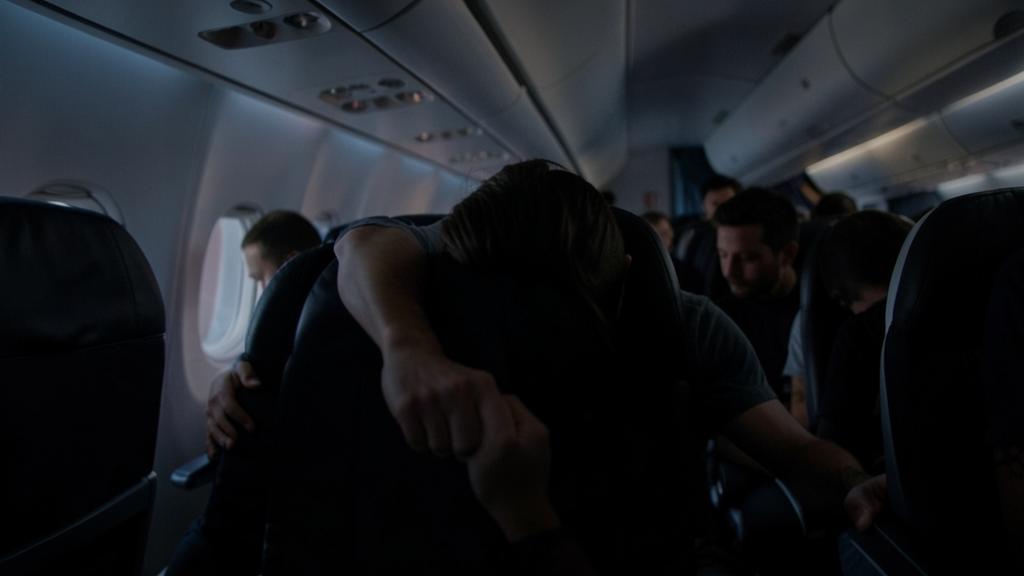
There is no single brace position. There is one objective — hold the occupant inside a survivable load path and leave them able to walk out afterwards — and a family of postures that reach it from different starting geometries. A passenger facing forward at short seat pitch, a passenger facing aft in a suite, a child in an approved restraint and an infant on a lap are four distinct mechanical problems, and one shouted command has to solve all of them at once. The differences between the drills are not stylistic. They come from where the deceleration puts the load.
Three jobs, and a fourth nobody states
Strip the drawings away and the position does three things. It removes the closing velocity between the head and whatever the head is going to reach — a seat back, a bulkhead, a table stowed a few seconds too late. It pre-loads the body against the structure that will restrain it, so the body does not spend the first part of the pulse accelerating into that structure and arriving with energy to shed. And it stops the limbs travelling: an arm that flails takes an elbow into the aisle furniture and comes back injured, and a lower leg driven under the seat ahead fractures.
A fourth job sits underneath the other three and is almost never said out loud: keep the lap belt on the pelvis. A belt that has ridden up onto the soft abdomen does not restrain anything — it loads viscera and lets the occupant slide out underneath it. Every element of every brace variant is traceable to one of those four purposes, and an element that cannot be traced to one of them is folklore.
The brace position is designed to protect passengers by keeping their bodies in a safe position during a crash. It stops the head from hitting things, keeps the body pressed against the seat, and prevents limbs from getting hurt. The most important part is making sure the seatbelt stays on the hips, not the stomach.
On an Airbus A320 with a seat pitch of 30 inches, a forward-facing passenger in economy class would brace by placing their head against the seat back ahead. If the seat pitch were 40 inches, they would instead bend forward, placing their head down and shielding it with their arms. The difference in seat pitch changes the brace position needed.
The pulse the seat was certified against
Transport-category seats are now qualified by firing a sled, not by hanging static weights. Two dynamic pulses are run under the large-aeroplane certification standards: one predominantly vertical, representing the ground impact, and one predominantly longitudinal. An instrumented dummy occupies the seat, and the installation passes if the head injury criterion stays below its limit — a value of 1000 in the rule on both sides of the Atlantic — if the femur and lumbar compressive loads stay under theirs, if the belt stays on the pelvis rather than migrating onto the abdomen, and if the seat remains attached and the occupant can still get out. Seats certified before the dynamic standards took effect were qualified against static load factors only, and aeroplanes of that vintage remain in service.
Two features of that test decide everything that follows. The dummy represents an adult of average male build. And the injury criteria were written around an occupant facing forward: the head arc and the belt path both assume it. That is the envelope the base rule describes. Everything outside it — a small adult, a child, a side-facing divan — is either covered by additional conditions written case by case for that installation, or not represented in the test at all. The brace position is the occupant’s own contribution to a system that was optimised without them in it.
Facing forward: every element earns its place
The forward-facing passenger on a lap belt is restrained at the pelvis and nowhere else. The belt holds the hips; the torso rotates about that hinge, and the head describes an arc. Whether the head reaches the seat back ahead depends on seat pitch, and that single geometric fact splits the drill in two.
At economy pitch the head reaches. The instruction is therefore to put it there first and keep it there: head against the seat back ahead, hands on top of the head or on the seat back, with one hand placed over the other rather than with the fingers interlaced. Interlacing is not a detail. A falling overhead bin injures both hands at once, and injured hands cannot release a belt buckle, push a jammed door or pull a slide handle.
Where the head does not reach — a bulkhead row, an exit row, a premium seat with generous pitch — the arc has nowhere useful to end, so the answer is to shorten it: bend as far forward as the belt and the body allow, head down, forearms shielding the head and the back of the neck, hands still not interlaced. Feet flat on the floor and further aft than the knees in both variants; feet placed ahead of the knees invite the lower leg to be driven backwards against the seat structure at the moment the body loads it.
| Element | What it prevents | Why it is written that way |
|---|---|---|
| Lap belt low and tight across the hips | Belt migration onto the abdomen, submarining under the belt | The pelvis is the only bony structure that can take the load; the abdomen cannot |
| Head placed against the seat back ahead | Head strike with the full closing velocity of the torso arc | Contact already made means no relative velocity to dissipate |
| Or torso folded, head as low as it will go | The same strike where the seat back is out of reach | Shortening the arc is the only alternative to removing it |
| Hands over the head, one on the other, not interlaced | Debris injury to the head; injury to both hands at once | Egress depends on hands that still work |
| Feet flat, further aft than the knees | Lower-leg fracture, foot trapped under the seat structure | The leg must not be loaded in the direction the seat pan can drive it |
Facing aft: the instruction reverses
Turn the seat around and the mechanics invert. In a longitudinal deceleration the aft-facing occupant is pressed into the seat back, and it is the seat back — not a strap — that takes the load, spread across the whole of the torso instead of concentrated on a belt path. That is why aft-facing seating has been described as inherently better protected for decades, and why many cabin crew seats face aft.
The protection is conditional on two things. It exists only if the occupant is already in contact with the structure when the pulse arrives, and only up to the height at which that structure stops. Anything above the top of the seat back and head rest is unsupported: the torso is arrested and the head is not, and the neck loads in extension. Hence a drill that reads as the mirror image of the forward-facing one — sit upright, back and head firmly against the seat back and head rest, arms in the lap or along the sides, feet flat on the floor.
The trap. Telling an aft-facing passenger to bend forward is the most consequential error in this subject, and the easiest to make, because the forward-facing drill is the one everyone learned first. Bending opens a gap between the torso and the structure that is meant to hold it, converts a distributed contact into an impact, and presents an unsupported neck to the pulse.
Facing sideways: the case the base rule never described
Side-facing seats put the pulse across the body. The belt runs over a pelvis that is not aligned with the load, the torso bends laterally, and the neck is loaded in a direction the standard test dummy was never built to measure. No posture turns a side-facing occupant into a forward-facing one. That is why such installations are approved through additional conditions carrying injury criteria the base rule does not contain, and why they normally arrive with hardware — a fixed shoulder harness, an end closure, a rigid divider — doing the work a posture cannot do.
The consequence for the cabin is narrow and specific. The brace instruction for a side-facing seat comes from that installation’s approval and from the operations manual, not from a general drill and not from analogy. If the cabin has them, there is a fourth position to know and a fourth depiction the card owes the passenger.
| Facing forward | Facing aft | Facing sideways | |
|---|---|---|---|
| What restrains the occupant | The lap belt, at the pelvis only | The seat back, across the whole torso | The belt plus whatever structure the approval added |
| Where the load concentrates | Pelvis and lumbar spine; head at the end of the arc | Distributed on the back; neck above the head rest | Lateral bending of the torso and neck |
| What the posture must achieve | Remove or shorten the head’s travel | Remove the gap; support the head | Stay inside the structure that was certified |
| Effect of bending forward | Correct — it is the whole drill | Harmful — it creates the gap | Not a substitute for the installation’s own instruction |
Children: where the anatomy stops matching the belt
A young child is not a scaled adult. The head is a far larger fraction of body mass, the neck musculature that would resist its excursion is undeveloped, and — decisively for restraint — the iliac crests that hold a lap belt down on an adult pelvis are not yet formed. Put a lap belt on a small child and it sits on the abdomen, because there is nothing above it for the belt to catch on. That anatomical fact, not caution, is why child restraint systems exist and why they remain the right answer well past the age at which a child can sit up unaided.
A child correctly installed in an approved restraint does not brace at all. The restraint already performs what a posture would attempt, and folding the child forward defeats it. The instruction for the accompanying adult is therefore to leave the child in the restraint and brace themselves — counter-intuitive enough that it has to be said explicitly in the individual briefing, never assumed.
Above the restraint’s range and below adult build, the child braces as an adult does, with the same feet-back and hands-not-interlaced detail, plus one addition: check that the lap belt is low and tight across the hips before the cabin is secured. It is the belt most likely to have crept upwards during the flight.
Infants: where the states have not agreed
Everything about a lap-held infant is a compromise, and the authorities have not settled on the same one. An approved child restraint device in a seat of its own is what the evidence supports and what both EASA and the FAA recommend; neither requires it for an infant. What differs is the fallback. The supplementary loop belt, attached to the adult’s own belt, remains in service in parts of Europe and is not accepted by the FAA, on the grounds that it loads the infant against the adult’s body during the pulse. European guidance has been moving in the same direction for years without the practice having disappeared.
A crew member’s job is not to arbitrate that. It is to know that the drill in the operations manual is one of several defensible positions, that it may differ from the one learned at a previous operator, and that the brace for an adult holding an infant is prescribed rather than improvised. Two principles survive every version: the infant is not positioned where the adult’s own torso will arrive during the pulse, and the infant is never restrained by an adult’s arms alone as the primary means.
| Occupant | Primary restraint | Brace | The point that is missed |
|---|---|---|---|
| Adult, forward-facing | Lap belt | One of the two forward variants, by seat pitch | Pitch, not class, decides which variant applies |
| Adult, aft-facing | Seat back and belt | Upright, head against the head rest | Bending forward is actively harmful |
| Child in an approved restraint | The restraint | None — the child stays as installed | The adult braces; the child does not |
| Older child in a seat | Lap belt | Adult drill for that seat | The belt has usually ridden up and needs resetting |
| Lap-held infant | Operator-specific, and state-dependent | Operator-specific, briefed individually | The drill is not transferable between operators |
Crew seats: your position is not the passengers’
Where the crew seat faces aft, as many do, the crew brace follows the aft-facing logic — upright, back and head against the structure, feet flat on the floor. The addition is the hands: in the lap or under the thighs, palms upward, so the arms cannot flail and the hands stay usable. A crew member with two working hands after the impact is the difference between a door that opens and a door that does not.
The crew position also has to be compatible with continuing to shout. The command is not given once. It is repeated until the aircraft stops, because passengers relax out of the position within seconds and because more than one impact is possible. A posture that allows a full breath is therefore part of the specification, which is one more reason it is not a curled one. Crews who have compared drills across operators — the kind of exchange that fills the cabin safety threads on the FL330 forums — find the variation is almost always in the arms and the hands, rarely in the spine.
The card, the demonstration, and the seconds you may not get
A cabin that mixes orientations needs a depiction for each brace it expects, and a recurring finding after a reconfiguration is a card that still shows the forward-facing drill alone. Cards are configuration documents. They age with the cabin, not with the fleet, and a retrofit that adds aft-facing or side-facing suites obsoletes them on the day it is installed.
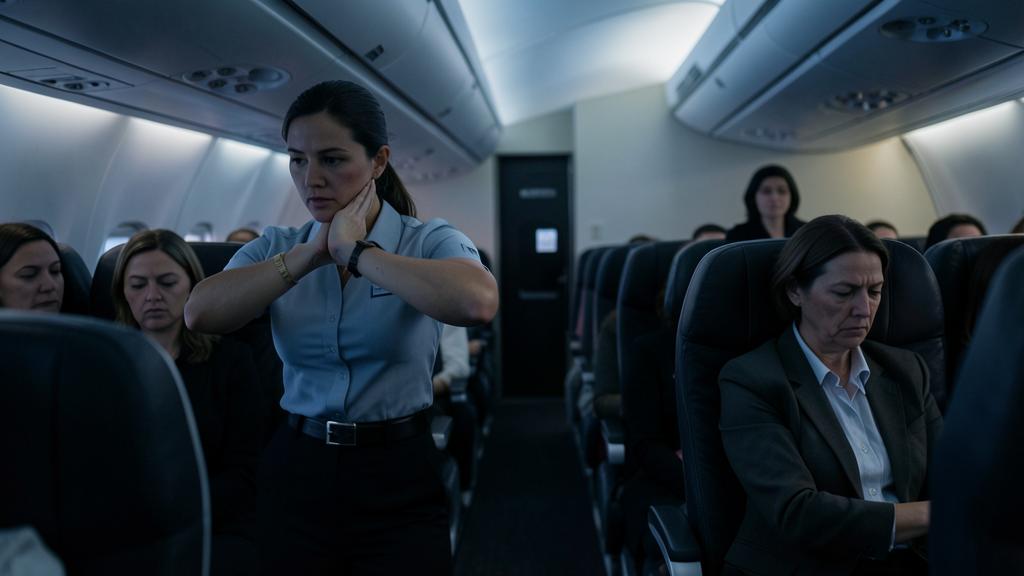
The other half is time. A prepared emergency landing buys a briefing, a demonstration, a redistribution of passengers who cannot adopt the position, and a check that able-bodied passengers sit where they will be useful. An unprepared one buys a shouted command and whatever the passenger absorbed while boarding. The evidence from survivable accidents is consistent on one point: the position works when it is adopted, and adoption is imperfect. Cabin design does not change that. The briefing, the card, and the crew’s own visible posture are the only levers anybody holds.
The right reflex. Before each departure, run the cabin in your head one zone at a time and name the brace that applies to each block of seats — including the crew seats you will be occupying. If a zone produces hesitation, that is the zone whose passengers get the individual briefing, and the card is the thing to check on the ground rather than at eighty knots.


Leave a Reply
You must be logged in to post a comment.