
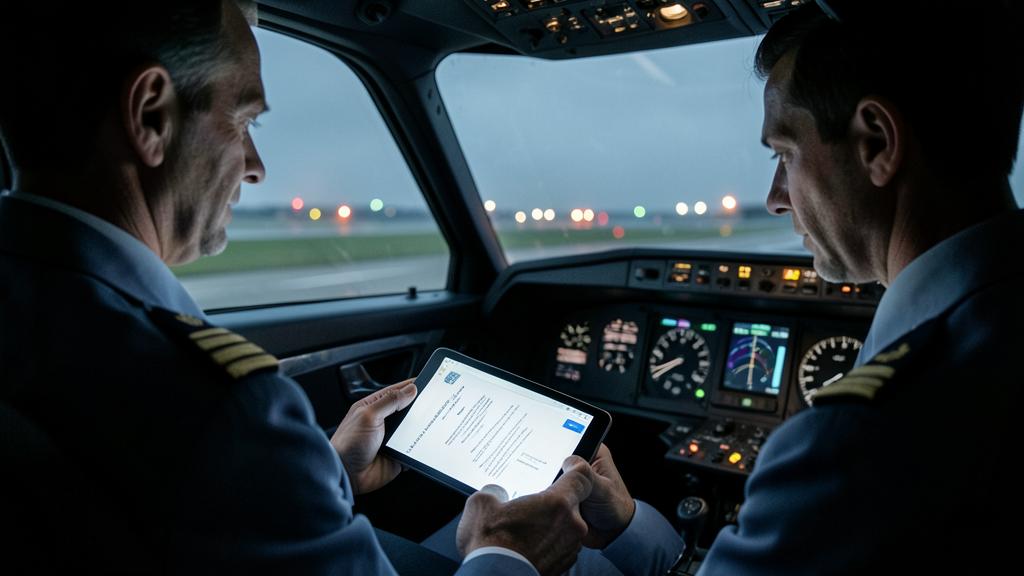
An operator offers three rotations at the end of the week and asks the question that decides everything else: “do you invoice, or are you on an umbrella contract?” The answer looks like an accounting matter. It is not. It determines who absorbs a mission cancelled the day before, who pays for the recurrent simulator session, what a family receives if you are off work for six months, and above all what will happen the day a social security fund, a labour inspector or an insurer looks the relationship squarely in the face. Three arrangements coexist in contract flying — employment, umbrella employment, company or sole trader — and what separates them is not primarily a tax matter.
The contract moves the money, not the responsibility
The European air operations regulation recognises only one responsible party: the operator. It is the operator that holds operational control of the flight, that must demonstrate that every crew member has completed the operator conversion course, passed the recurrent checks, and received dangerous goods and crew resource management training; that keeps the flight, duty and rest time records; whose management system must cover the activity of everyone operating under its certificate. None of these obligations can be transferred by contract. An operator that buys a piloting service buys an invoice, not a discharge of liability.
On the maintenance side the mechanics are more rigid still. The authorisation to certify does not belong to the licence holder: it is issued by the approved organisation, on the basis of its own competence file and against recent-experience criteria that it monitors, and it lapses with the relationship. “Independent” certifying staff do not exist outside an organisation; what such a person sells is working time to a structure which alone commits its signature — and which must be able to prove to the authority that it controls the competence of its contracted staff exactly as it does that of its employees.
The operator always remains responsible for everything related to the flight, no matter who invoices. The status you choose only changes who gets paid and how, not who is legally responsible if something goes wrong.
A pilot flying an A320 for an airline under an umbrella contract still has all their training and checks managed by that airline. If the pilot is involved in an incident, the airline's insurance and management system will handle it – not the umbrella company. The pilot's status only affects their paycheck, not their operational responsibilities.
Everything else follows from this asymmetry. The status changes the money circuit, the basis of social contributions, social protection and the legal risk borne by each party. It changes neither the applicable training programme, nor the operations manual, nor the commander’s authority, nor the identity of the party the authority will hold to account at the next audit. The “employee or independent” debate is therefore never an operational debate: it is a debate about apportioning a risk that the regulation has already assigned.
The trap of shared flight times. A crew member who operates for two operators is the only one who knows the total. Each operator builds its rosters and its compliance on what the crew member declares, and the regulation requires that crew member to declare all activities, including those carried out elsewhere. A day left unmentioned out of commercial caution — so as not to lose the next mission — is not an approximation: it is an exceedance attributable to the person who kept quiet, and a finding against the certificate of the operator that planned in good faith.
The contradiction each arrangement handles in its own way
Employment law presumes that a person registered with a professional register is not an employee. The presumption is thin: it falls as soon as a judge establishes a relationship of subordination, that is, the power to give orders, to check that they are carried out and to sanction failures. That is word for word the description of what an operator must exercise over its crew. The roster is imposed, the procedures are those of the operations manual, the checks are the operator’s and take place before its instructors, the uniform is the operator’s, and the “service provider” most often has only one client.
On top of that comes a heavier and less often quoted prohibition: supplying labour for profit is a criminal offence outside the frameworks the law expressly authorises — temporary work, umbrella employment, employer groupings, shared-time employment. A single-shareholder company that invoices flight hours with no purpose other than to place its director at another’s disposal is the textbook case. This is not an inspector’s subtlety: both parties are exposed, and on the operator’s side the matter does not end with a simple reassessment, it goes back to its organisation and its oversight.
Umbrella employment is not a disguise: it is the framework built to make this triangle lawful. It does, however, assume that the umbrella employee has genuine autonomy, has sought out the client and negotiated the price of the service, and it caps the duration of a single assignment with the same client — in the order of a few years. Contract flying fits this mould very unevenly. A commander who chooses assignments, turns some down, works for several operators and invoices a lump sum fits without strain. A “service provider” present every week on the same aircraft, on the roster on the same footing as the employees and called to the same briefings, does not: the arrangement remains lawful, the relationship no longer is.
Three arrangements, four criteria
The table below does not compare rates — those depend on income level and on remuneration trade-offs — but mechanisms: who bears what, and at what point.
| Criterion | Employment | Umbrella employment | Company or sole trader |
|---|---|---|---|
| Who answers to the authority | The operator | The operator | The operator |
| Personal liability in the event of fault | Protected by employee status, except for fault separable from duties | Employee of the umbrella company; the client’s recourse is framed by the commercial contract | Third-party contractor: recourse possible, aviation-risk insurance to be taken out |
| Mission cancelled the day before | Paid: salary does not follow the schedule | Paid if the commercial contract provides for it | Lost, unless a cancellation fee clause applies |
| Social protection | General scheme, collective agreements, aircrew pension | General scheme and unemployment insurance; aircrew pension to be checked | Self-employed or treated as an employee; no aircrew entitlement, no unemployment cover |
| Cash flow | Monthly payroll | Monthly payroll, management fees, financial guarantee of the umbrella company | Payment received after invoice and payment period; contributions and tax to be set aside |
| Maintaining competence | Borne by the operator | Negotiated, re-invoiced or built into the price of the mission | Borne by you unless otherwise stipulated |
| Acceptability to the operator | Not applicable | Identified legal framework, single invoice, solvent counterparty | Frequent reluctance as soon as the mission becomes recurrent |
| Exposure to reclassification | None | Low as long as autonomy is genuine | High as soon as there is only one client |
- The cancelled mission row shows that only employees are guaranteed payment if a flight is cancelled last minute
- The acceptability row reveals that operators often refuse invoices for recurring work from sole traders
- The social protection row highlights that only employees get full aircrew pension benefits
Two rows deserve to be read together. The one on the cancelled mission, because it describes the economic reality of contract flying: demand is irregular, the operator adjusts at the last moment, and the only arrangement in which this uncertainty stays with the client is the one where the crew member is paid monthly. And the one on acceptability, because an operator that refuses your invoice is not judging your competence: it is assessing what a judge, a social security fund or its own insurer will say about the relationship three years later.
The operator’s insurance does not cover you by magic. The European regulation requires the carrier and the operator to hold cover for damage to passengers, baggage, cargo and third parties; it protects the operator first. Whether the contracted crew member is a beneficiary, and whether the insurer waives its right of recourse against that person after a claim, is a matter for the policy, not for the regulation. The employee also benefits from the immunity granted to an employee acting within the limits of the assignment; the independent service provider does not — that person is a third party, and an ordinary professional liability contract almost always excludes aviation risk.
What becomes of the revenue, and when
The most immediate difference is not the net figure, it is the date. The employee and the umbrella employee receive a monthly payroll; the umbrella company must, moreover, provide a financial guarantee intended to cover salaries and contributions should it default, and in return charges management fees on the revenue brought in. The person who invoices is paid afterwards. Between businesses, payment periods are capped by law — in the order of two months from the issue of the invoice, with a variant calculated at the end of the month where the parties stipulate it — and nothing obliges a client not to use them in full.
The tax regime is then chosen on actual costs, never on declaratory convenience. The micro-enterprise scheme applies a flat-rate expense allowance and prohibits any deduction of actual costs, under an annual revenue ceiling that the legislature revises regularly: that is a trap for a crew member who self-funds a type rating, simulator sessions, travel and insurance. On value added tax, a service supplied to a French operator is taxable, whereas a service supplied to a customer established in another Member State falls under the reverse charge; as for the exemption enjoyed by certain operations carried out for airlines operating chiefly on international routes, it cannot be presumed and must be settled before the first invoice, not after an audit.
The right reflex: invoice availability, not just the flight. A mission cancelled the day before costs the day to whoever had blocked it out. Write into the service contract a cancellation deadline beyond which the day remains payable, a deposit for long trips, and remember that payment periods between businesses are capped and that a late payment automatically triggers a fixed recovery fee. Over a year, those three lines weigh more than the choice between income tax and corporation tax.
Social protection: what is missing is not what you think
Received wisdom has it that the self-employed pay less and are less covered. The reality is more discriminating: protection is not missing everywhere, it is missing at precise points, and two of them are specific to the profession. Four risks deserve to be examined separately — involuntary loss of work, sick leave, the specific pension and permanent unfitness to fly — because they do not behave the same way from one arrangement to another.
Unemployment insurance exists neither for the self-employed worker nor for the director of a simplified joint-stock company treated as an employee: the allowance scheme open to the self-employed is subject to conditions so narrow that it does not amount to cover. Daily sickness benefits do exist for a self-employed worker, but on a basis calculated on declared income and after a waiting period that is not the employee’s. The director who has taken remuneration as dividends to lighten contributions discovers, when off work, that the same move lightened the benefit — and, in a limited liability company, that the fraction of dividends exceeding a share of the share capital, the share premiums and the sums left in the current account is in any case reintegrated into the contribution base of the majority managing partner.
That leaves the two genuinely aircrew-specific points. The supplementary pension scheme specific to professional aircrew presumes an employer belonging to the air transport sector: an invoice issued by one’s own company opens no entitlement to it, and the case of the umbrella employee — whose employer is an umbrella company — deserves a written answer from the fund before being taken for granted. As for loss-of-licence cover, often attached to collective agreements on the employee side, it becomes an individual policy to be taken out, in which the definition of the insured event matters far more than the headline capital sum.
What the operator looks at before accepting your invoice
An operator hesitating over a crew member’s invoice is not thinking about your cash flow: it is thinking about three people. Its auditor, who will check that the training, checking and flight time records of contracted crew members are kept in the same way as those of employees and that the use of subcontracting appears in the management system. Its insurer, who will want to know who is covered and against whom it could claim. And its accountable manager, who knows that a collective reclassification is paid for in retroactive contributions and in credibility lost before the authority.
Two configurations almost always pass: the one-off, bounded mission, for a need no employee covers — ferry flights, seasonal cover, instruction, expert assessment, audit — and the service bought from a structure that employs its own staff. A third deserves attention: the foreign operator. For crew members, the applicable social security scheme is determined by the home base, that is, the place where they habitually start and end their duties, and not by the client’s address or by the currency of the invoice. A crew member based in France for an operator established elsewhere falls under the French scheme, however elegant the proposed arrangement may be.
What to open up before signing
Four documents are worth requesting in writing, and none of them requires any particular research on the operator’s side: the insurance certificate naming the contracted crew members or recording the insurer’s waiver of recourse, the procedure by which the operator collects the activities you carry out for others, the list of what it funds in the way of maintaining competence and what it leaves to you, and finally the treatment of a cancelled mission. A serious operator answers in two emails; an operator who finds the request out of place has just told you what will happen at the first incident.

The reflex that settles the debate before signing. Lay the relationship out flat: who sets the dates, who sets the procedures, who checks, who sanctions, how many clients. If all five answers point to the same operator, no arrangement will make the relationship independent — it then remains to choose between employment and umbrella employment, the two lawful ways of being subordinate while being paid monthly. If the answers are spread out, the independent service is defensible, and it must then be written into the contract, not merely thought.
Two grey areas remain, and it is more honest to name them than to settle them. The affiliation of an umbrella employee to the aircrew pension scheme is in no way automatic and must be checked with the fund, with a file in support, before the first mission. And the value added tax treatment of a crew service supplied to an international airline should be discussed with an adviser, in advance. For anyone preparing a self-funded type rating, the order of operations in fact weighs more heavily than the choice of status: training paid for by a structure on an actual-cost basis does not have the same final cost as the same training paid for by a micro-entrepreneur who deducts nothing, and a repayment undertaking given to an operator should be read line by line before signing. The FL330 training pathways and the feedback shared on the professional forum give more solid benchmarks on these orders of magnitude than online status simulators.
The applicable texts, any collective agreement invoked and the operator’s approved documentation prevail over this article, which describes mechanisms and not your situation; on this subject, an employment law adviser and an accountant familiar with the sector cost considerably less than a reclassification.
Questions fréquentes
Can an operator refuse an invoice from my company and require umbrella employment?
Yes, and the refusal is anything but arbitrary. By accepting an invoice for flight hours issued by a company whose only purpose is to place its director at another’s disposal, the operator exposes itself to the relationship being reclassified as an employment contract and to the charge of supplying labour for profit outside an authorised framework. Umbrella employment is precisely one of the frameworks the law authorises for this triangle, which is why it is often set as a condition.
Does umbrella employment give entitlement to the supplementary aircrew pension?
It is not automatic and cannot be inferred from employee status. The pension scheme specific to professional aircrew presumes an employer belonging to the air transport sector, whereas the umbrella employee’s employer is the umbrella company. The only reliable course is to ask the fund in writing, describing the arrangement and the nature of the missions, before committing to a long period under this status. A verbal answer from a salesperson at the umbrella company is worth nothing on the day the pension is drawn.
Who has to pay for maintaining competence when I invoice my missions?
The regulation requires the operator to ensure that training and checks are carried out, kept up to date and documented in its records; it does not say who bears the cost. This is therefore a strictly contractual point, and one of the most decisive for actual income: recurrent simulator, recurrent training, dangerous goods, first aid. Have the operator list in writing what it funds and what it leaves to you, and build the balance into your day rate.
Am I covered by the operator’s insurance when I fly a mission as a service provider?
Not as a matter of principle. The insurance obligation borne by the operator protects the operator first, in relation to passengers and third parties. Whether the contracted crew member is among the insured, or whether the insurer waives its right of recourse against that person, depends on how the policy is drafted. Ask for a certificate naming the contracted crew members, and check that your own professional liability contract does not exclude aviation risk, which it almost always does by default.
Micro-enterprise or company to start out in contract flying?
The micro-enterprise scheme allows no deduction of actual costs: it suits an activity with no investment, not a crew member who self-funds a type rating, simulator sessions, travel and insurance. As soon as those costs become significant, an actual-cost regime — as a sole trader or through a company — becomes more favourable again, and the choice between a simplified joint-stock company and a limited liability company is then made on the trade-off between remuneration and dividends, which also governs your daily sickness benefits.
What must I declare to an operator when I fly for several clients?
All your activities, including those carried out for other operators and ground activities such as instruction or simulator work. Each operator builds its flight and duty time compliance on your declarations, and you are the only one holding the total. An omission cannot be repaired after the event: it produces an exceedance attributable to you and a finding against the certificate of the operator that planned in good faith.


Leave a Reply
You must be logged in to post a comment.